
Losing your credit card while traveling internationally can be stressful, but acting fast can save you from financial trouble. Here’s what you need to do:
- Contact Your Card Issuer Immediately: Freeze or cancel your card to stop any misuse. Use international hotlines provided by your bank.
- File a Police Report: Essential for fraud claims and travel insurance. Include details like the last place you used the card and suspicious transactions.
- Secure Emergency Cash: Request emergency funds through your bank or rely on backup payment methods like a second card or prepaid travel card.
- Get a Replacement Card: Many issuers can deliver a new card within 24–48 hours or provide a virtual card for immediate use.
- Monitor Your Account: Check transactions daily and set up fraud alerts to catch any suspicious activity.
Pro Tip: Before traveling, save your bank’s international contact numbers, carry multiple payment options, and keep copies of important documents securely stored.
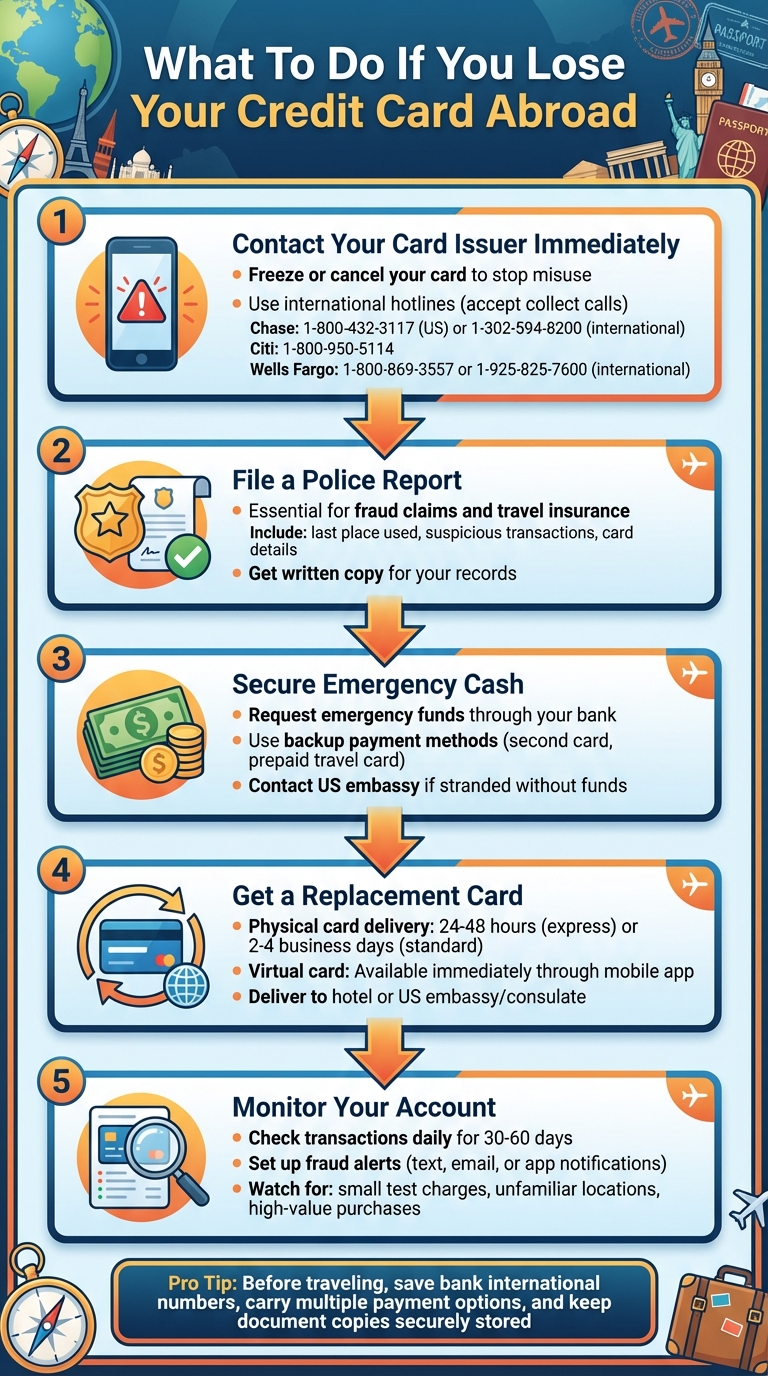
5 Steps to Take When You Lose Your Credit Card Abroad
What To Do If My Credit Card Is Lost Abroad?
Step 1: Call Your Card Issuer Right Away
The moment you realize your card is missing, contact your card issuer. Fraudsters can rack up unauthorized charges in no time, whether through contactless payments or online purchases. Major U.S. issuers like Chase, Citi, American Express, Capital One, and Wells Fargo accept collect calls from almost anywhere in the world, so don’t delay.
Find Your Card Issuer’s Contact Number
If you don’t have the card’s contact number memorized, check another card from the same issuer in your wallet or hotel safe. Alternatively, log into the issuer’s mobile app or website for their international contact number. For example:
- Chase: 1-800-432-3117 (U.S.) or 1-302-594-8200 (collect, international)
- Citi: 1-800-950-5114
- Wells Fargo: 1-800-869-3557 (1-800-TO-WELLS) or 1-925-825-7600 (collect, international)
Always use official sources or pre-saved contacts to find these numbers. If your phone doesn’t support international calls, try using Skype or Wi‑Fi calling through your hotel.
What to Provide When You Call
When you get through to customer service, be ready with key details. Share your full name, account number (if you know it or can access it via your app), and any card details you remember, like the expiration date. Explain where and when you think the card went missing – whether at a restaurant, in a taxi, or due to theft – and mention any recent transactions you recall making. This helps the representative verify your identity and identify any fraudulent charges.
Some issuers, like American Express or Discover, may also ask security questions or request confirmation of recent purchases to confirm you’re the account holder. The more specific you can be about your last legitimate transaction, the quicker they can freeze your card and investigate any suspicious activity.
Freeze or Cancel Your Card
Once your identity is confirmed, decide whether to freeze or cancel your card. A temporary freeze suspends your card without closing your account, which can be helpful if you think the card might turn up later – say, in your luggage or at the hotel’s lost and found. Many issuers, including Chase and Capital One, allow you to freeze your card instantly through their mobile apps.
If you’re certain the card is stolen or lost for good, request a permanent cancellation. This fully deactivates the card, starts the replacement process, and ensures no further unauthorized use. With your card secured, your next step should be filing a police report.
Step 2: File a Police Report
Once you’ve frozen or canceled your card, the next step is to file a police report if your card was stolen. This creates an official record that your card issuer or travel insurance provider can use to validate fraud claims and refund any unauthorized charges. Many banks and payment networks require this documentation to process fraud claims or chargebacks, especially for unusual or large transactions. It also demonstrates that you acted quickly, which can be crucial for liability protections or disputes.
Filing a police report becomes even more critical if your entire wallet or bag is missing, if you spot suspicious charges on your account, or if multiple forms of identification were lost. Having a formal record can help you down the line if fraud occurs later. Once you’ve decided to file, locate the nearest police station to begin the process.
Find the Local Police Station
If you’re staying at a hotel or hostel, ask the staff for help finding the nearest police station that handles tourist reports. They are often familiar with local procedures and can assist with language barriers. If hotel staff isn’t an option, reach out to the nearest U.S. embassy or consulate. They can guide you to the appropriate police authority and explain the reporting process. Alternatively, staff at major transport hubs like airports or train stations may be able to direct you to an official police location. However, always verify addresses through reliable sources and avoid following unsolicited advice.
What to Include in Your Report
When filing your report, make sure to include the following details:
- The last date and time you had the card in your possession.
- The location where you believe the card was lost or stolen (e.g., hotel, café, public transit, or ATM).
- A description of the incident, such as pickpocketing, bag theft, or another cause.
- Card details, including the type, issuer, and the last four digits of the card number.
- Information about other items that may have been taken, like a passport or phone, and when you reported the loss to your bank.
- Any suspicious transactions, witnesses, or specific locations that could help with the investigation or support a fraud claim.
Before leaving, make sure to get a written copy of the report for your records. This document will be essential when working with your card issuer or travel insurance company to handle disputes or request reimbursements.
Step 3: Get Access to Emergency Cash
Once you’ve filed your report, the next step is securing funds for immediate needs like meals, transportation, and lodging. If your primary payment method is unavailable, consider using your bank’s emergency cash service or alternative payment methods. Many major U.S. card issuers and networks offer ways to access cash quickly, but it’s essential to understand the fees and limitations before making a request. These services can help you manage until your replacement card arrives.
Use Your Bank’s Emergency Cash Service
Several U.S. banks and card networks offer emergency cash services, which allow you to withdraw money even after your card has been canceled. For instance, Visa works with financial institutions to arrange emergency cash pickups at partner banks or money-transfer locations, often within hours of approval. When reporting your lost card, inquire about these options and specify how much you need.
To access emergency cash, you’ll typically need to provide your name, your card issuer, the last four digits of your card, answers to security questions, and an alternate contact method. When picking up the cash, you’ll also need to present a valid government ID. The amount you withdraw will either be debited directly from your bank account or charged as a cash advance against your credit limit, not as a separate loan. Be sure to ask about pickup locations, their operating hours, withdrawal limits, and any required documentation.
Keep in mind that emergency cash services come with fees. For example, American Express charges either 3% of the amount or a $5 minimum fee, and cash advances often have higher APRs that accrue interest immediately. Additionally, foreign transaction fees (around 3%) and local ATM or partner bank charges may apply. To keep costs manageable, withdraw only what you need, opt to be charged in the local currency rather than U.S. dollars when possible, and aim to pay off the balance as soon as you can.
Use Your Backup Payment Methods
If emergency cash services are delayed, turn to your backup payment options. Travel experts suggest carrying at least one backup credit card from a different issuer, a debit card linked to a checking account, and a small reserve of local currency along with U.S. dollars. Keep these backups in a separate location from your primary wallet.
A prepaid travel card (Visa or Mastercard branded) is another helpful backup. These cards can be minimally funded until needed, reducing risk if they are lost or stolen. Some issuers may also update your canceled card’s details in mobile wallets like Apple Pay or Google Wallet, allowing you to continue making payments at contactless terminals. However, mobile wallets may not work everywhere, especially in regions where contactless payments aren’t widely accepted, so it’s a good idea to test this option early in your trip.
If all else fails and you have no working cards or access to bank services, you can ask friends or family in the U.S. to send money through a global transfer service, which usually delivers funds to local partner locations within minutes or hours. In more severe situations – such as being stranded without any money after theft – you can contact the nearest U.S. embassy or consulate. They may assist in facilitating funds from your relatives through official channels or, in rare cases, provide temporary repatriation loans to cover urgent expenses like transportation and lodging.
sbb-itb-e205081
Step 4: Get a Replacement Card
To get back on track with your travel plans, securing a new card is essential. Most major U.S. issuers, including Visa, Mastercard, American Express, Citi, Chase, Capital One, and Bank of America, offer emergency card replacement services. In many international locations, they can deliver a physical card within 24–48 hours, though standard shipping might take anywhere from 2–4 business days to as long as 2–3 weeks depending on where you are. If waiting isn’t an option, many issuers now provide virtual or digital card numbers that you can add to your mobile wallet, allowing you to start using the card immediately.
Check Your Issuer’s Replacement Options
Before deciding how to proceed, reach out to your card issuer’s international support line to confirm the replacement options available in your area. Some important questions to ask include: How quickly can express delivery reach my location? Can you provide a virtual card number right away? Will the new card have the same number, or will I need to update recurring payments? Are there fees for expedited shipping or emergency replacement?
Many issuers now offer digital cards through their apps. For instance, Capital One’s Eno service generates virtual numbers, while Bank of America and Citi have similar tools. Once you receive a virtual card, you can add it to Apple Pay, Google Wallet, or Samsung Pay and immediately use it for online bookings or at contactless payment terminals. After choosing the best option for your situation, make sure the delivery process is secure.
Arrange Delivery to a Safe Address
If you’re opting for a physical card, select a secure delivery address where you’ll be available to receive it. Hotels with reliable mail-handling services are often a good choice. Provide your issuer with the hotel’s complete address, main phone number, your full name as listed on your reservation, and your check-in and check-out dates. Be sure to label the shipment “Hold for Guest”. Notify the hotel in advance and confirm their package-handling process.
Another option is to have the card delivered to the nearest U.S. embassy or consulate. Before proceeding, confirm with both your card issuer and the embassy that they can accept and hold the package. When picking it up, bring your U.S. passport and a copy of the police report. Always track your shipment and open the envelope privately. If the delivery timing conflicts with your travel plans, consider adjusting your flight schedule. Services like Flight Booking 247 can assist with rebooking domestic or international flights by phone, ensuring your plans stay on track.
Step 5: Watch Your Account for Fraud
Once you’ve secured a replacement card, staying alert is your next line of defense. Fraudsters often act swiftly, making unauthorized purchases within hours of obtaining stolen card details. Fortunately, U.S. law limits your liability if you report fraud quickly. To stay ahead, set up fraud alerts and keep a close eye on your transactions.
Set Up Fraud Alerts
Reach out to your card issuer right away to activate fraud alerts. Many banks, like Chase (1‑800‑432‑3117) and Citi (1‑800‑950‑5114), have 24/7 international hotlines that let you request notifications via text, email, or app for every transaction. If you have Wi‑Fi access, you can also enable these alerts directly through your bank’s mobile app. Apps like Chase Mobile, Capital One Eno, and Citi Mobile send instant push notifications to flag suspicious activity.
When setting up alerts, it’s a good idea to share your travel details – like your current country and hotel address – with your card issuer. This helps them tailor alerts for foreign transactions and reduces the chance of unnecessary alarms. For an added layer of protection, enable two-factor authentication on your banking apps and consider using SMS alerts as a backup.
Check Your Transactions Daily
Alerts are helpful, but nothing beats manually reviewing your transactions every day. Log into your bank’s mobile app or online portal to examine recent activity, including pending charges. Keep an eye out for warning signs like small test charges (often $1 or less), purchases made in your home country after you reported the loss, high-value transactions at luxury stores, or ATM withdrawals in unfamiliar locations. Fraudsters often start with tiny charges to test stolen details before attempting larger purchases.
Continue monitoring your account for 30–60 days after receiving your replacement card since fraudulent charges can sometimes appear later. If you spot anything suspicious, report it immediately through your app or by calling your bank. Most issuers act quickly to investigate flagged transactions and may issue provisional credits during the review process. For added security while traveling, use secure Wi‑Fi or a VPN to access your accounts, and steer clear of public computers.
How to Prevent This in the Future
Planning ahead can save you a lot of stress if you lose your credit card while traveling abroad. A few simple preparations can ensure you always have access to funds, complementing the immediate steps we’ve already covered.
Bring Multiple Payment Options
Relying on just one credit card while traveling internationally is risky. Instead, bring at least two credit cards – preferably one Visa and one Mastercard – a debit card, and $100–$300 in small U.S. dollar bills. Keep the cash in small denominations and store it in a secure place, such as a money belt or hotel safe. It’s also smart to keep backup cards separate from your primary card. For example, carry your main credit card with you while leaving a spare securely locked in your hotel room or suitcase. Prepaid travel cards can also be a good option, as they limit your exposure if the card is lost or compromised.
Save Emergency Contact Numbers
Having quick access to emergency contact information is just as important as having multiple payment options. Before your trip, save the international and collect-call numbers for each of your cards. Store this information, along with photos of your cards, passport, and itinerary, both digitally (in a secure app or your phone’s contacts) and on paper. Keep the paper copy in a safe place away from your wallet. Additionally, make a note of U.S. embassy and consulate contact details for the countries you’re visiting – they can assist with coordinating with your bank or even help arrange emergency loans if needed.
Use Travel Support Services
Access to 24/7 travel assistance can be a game-changer during unexpected emergencies. Services like Flight Booking 247 offer round-the-clock help with rebooking, canceling, or changing domestic and international flights in real time. This can be invaluable if you lose your card and need to quickly adjust your travel plans or purchase a new ticket without delay. Many credit card issuers also provide global assistance programs, including emergency cash advances and ticket replacement services. Check what your card offers before your trip so you’re prepared if the unexpected happens.
Conclusion
Losing your credit card while traveling abroad doesn’t have to ruin your trip – quick action can make all the difference. Start by reporting the loss, filing a police report, arranging emergency cash, requesting a replacement card, and keeping a close eye on your account activity. These five steps – reporting, documenting, accessing funds, replacing your card, and monitoring – are essential for protecting your finances while away from home.
Most major credit card companies offer zero-liability protection and emergency support, which helps minimize the impact of unauthorized charges as long as you report the loss promptly. If you’re in a particularly tough spot, U.S. embassies can step in to verify your account with hotels or airlines. They can even provide temporary repatriation loans to cover essentials like transportation, meals, and lodging. These resources can help you recover quickly and even prepare better for future trips.
To avoid similar issues down the road, consider carrying multiple payment options, saving international customer service numbers, and keeping secure copies of important documents. And if your travel plans shift after such an incident, services like Flight Booking 247 offer 24/7 assistance to help you rebook flights and keep your journey on track.
FAQs
What should I do if I can’t reach my credit card company while traveling abroad?
If you can’t reach your credit card issuer while traveling abroad, you can contact the emergency helpline at +1-866-787-0513 for help. This line is available 24/7 to assist with urgent issues like reporting a lost or stolen card or setting up a replacement.
It’s important to act promptly to safeguard your account and reduce the risk of any unauthorized charges.
How can I find a reliable and affordable emergency cash service while traveling?
When planning for emergency cash services, prioritize a provider with a solid reputation and a commitment to transparency. Focus on those that clearly disclose their fees and offer competitive rates. Find out if they are partnered with major ATM networks or banks in your destination country to help you sidestep hefty withdrawal fees. Look for options that provide fee-free or low-cost foreign transactions whenever possible. Lastly, double-check that the service is accessible at your destination before you travel to avoid any last-minute surprises.
What are the advantages of using a virtual card while waiting for your replacement credit card?
Using a virtual card while waiting for your replacement credit card can be a game-changer. First, it provides an extra layer of security by keeping your main account details safe from potential misuse. Virtual cards also make managing your spending easier – you can set limits or designate them for specific purchases. On top of that, they let you shop online or use apps without delay, so your travel plans or daily routines don’t get interrupted while waiting for your physical card to arrive.