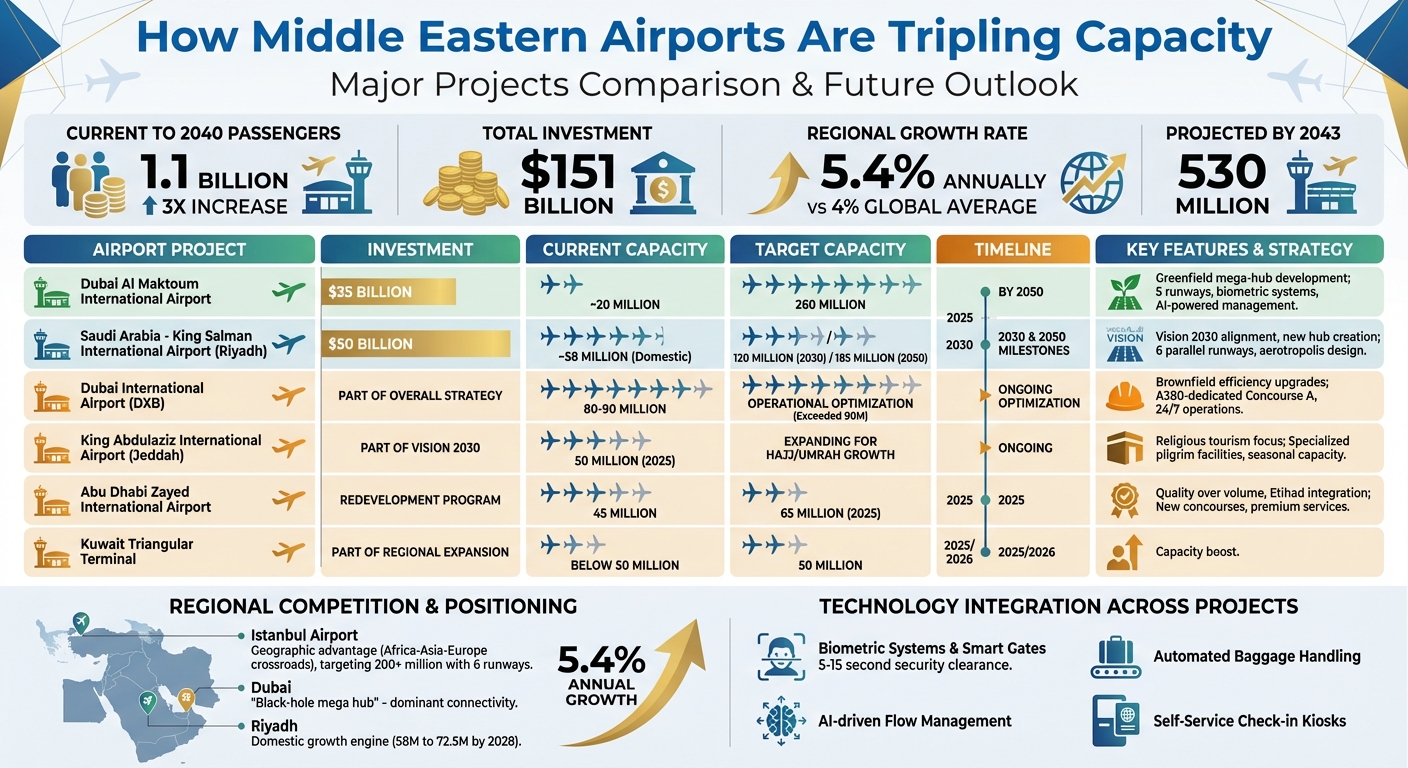
Middle Eastern airports are scaling up operations to handle a projected 1.1 billion passengers annually by 2040 – a threefold increase. This growth is driven by investments totaling $151 billion in airport infrastructure. Key projects include:
- Saudi Arabia’s King Salman International Airport: $50 billion investment to serve up to 185 million passengers annually by 2050.
- Dubai’s Al Maktoum International Airport: $35 billion expansion targeting 260 million passengers annually by 2050.
- Kuwait’s Triangular Terminal: Boosting capacity to 50 million passengers by 2025/2026.
- Jeddah’s King Abdulaziz International Airport: Enhancing facilities for Hajj and Umrah pilgrims, with capacity already hitting 50 million in 2025.
These airports combine large-scale construction with cutting-edge technologies like AI, biometrics, and automated systems to improve efficiency. The competition between hubs like Dubai, Riyadh, Abu Dhabi, and Istanbul is reshaping global aviation, with each pursuing unique strategies to meet rising demand. The region’s aviation growth is outpacing the global average, with passenger traffic expected to grow 5.4% annually through 2028.
Middle Eastern Airport Expansion Projects: Capacity, Investment & Timeline Comparison 2025-2050
Dubai’s $35BN New Airport Will Change Air Travel Forever
1. Dubai International Airport Expansion
Dubai International Airport (DXB) experienced a staggering transformation, growing its annual passenger capacity from 10–15 million to over 80–90 million in just two decades before the pandemic. This remarkable growth was achieved through a phased approach that combined infrastructure upgrades with cutting-edge technology.
The centerpiece of this expansion was Terminal 3 and its associated concourses (A, B, C, and D), designed primarily for Emirates. A standout feature is Concourse A, which opened in 2013 as the world’s first A380-dedicated facility, equipped with 19 contact stands. This innovation enabled DXB to accommodate more passengers per flight, effectively increasing capacity without needing to expand its runways proportionally.
Runway improvements also played a crucial role. In 2014, the airport underwent an 80-day resurfacing project for its two parallel runways, which included upgraded lighting systems and taxiways. This allowed for more flight movements per hour and helped minimize delays. Operating 24/7 without a night curfew, DXB maximizes its facilities with wave-bank scheduling, ensuring gates and aircraft stay active throughout the day.
Technology has further streamlined operations. The introduction of smart gates and biometric systems now allows passengers to clear security in as little as 5–15 seconds. These advancements, along with AI-driven flow management and automated baggage handling systems, have significantly increased terminal efficiency. As a result, DXB can handle more passengers per square foot, reducing the need for extensive new construction.
Although the airport’s design capacity is approximately 90 million passengers annually, operational optimizations have allowed it to exceed this during peak periods. DXB’s success in boosting efficiency without massive expansions has become a model for other airports in the region, many of which are now implementing similar strategies to enhance their own operations.
2. Al Maktoum International Airport Expansion
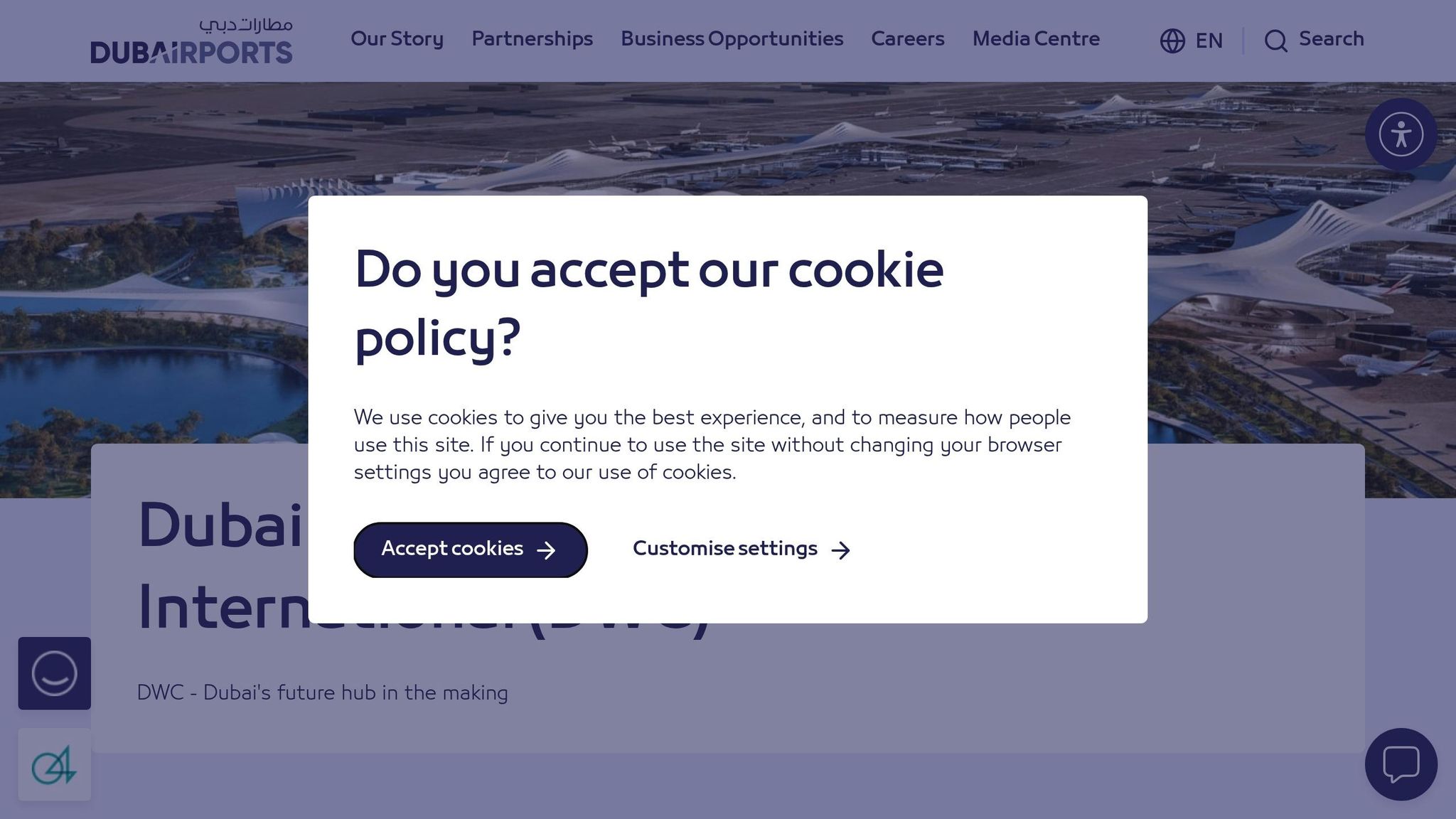
While Dubai International Airport manages the current influx of travelers, Al Maktoum International Airport (also known as Dubai World Central or DWC) is gearing up to become the region’s next mega-hub. Unlike Dubai International’s step-by-step upgrades, Al Maktoum is being developed with a long-term, phased plan that integrates cutting-edge technology. The ultimate goal? To handle around 260 million passengers annually with five runways, putting it among the largest airports in the world.
The centerpiece of this ambitious project is a $35 billion terminal development, funded by the Dubai government as part of a decades-long master plan. The phased approach is demand-driven, meaning early stages aim to ease the load on Dubai International, while later stages – stretching out to 2050 – will expand capacity as passenger numbers and airline commitments grow. This method not only avoids unnecessary spending but also ensures that each phase benefits from the latest advancements in technology and design.
The airport’s infrastructure is built with flexibility in mind. The terminal complexes will include numerous widebody-compatible gates, centralized processor halls tailored for hub-and-spoke operations, and high-capacity transfer areas. On the airside, multiple parallel runways and an extensive taxiway network will ensure high aircraft movement efficiency. Landside, the airport will feature highway links, cargo corridors, and planned rail and metro connections, making it a truly multimodal transportation hub. With these physical foundations in place, the next focus is on integrating advanced technology to manage operations seamlessly.
To handle the massive passenger volumes expected in the future, the airport will incorporate advanced technological solutions. Biometric systems will streamline check-in, security, and boarding processes. Self-service bag drops and AI-powered queue management will help maintain smooth operations even during peak times. The flexible terminal layouts are designed to adapt quickly to changes in airline networks and aircraft models – an essential feature for an airport targeting over 200 million passengers annually. For U.S.-based travelers, platforms like Flight Booking 247 offer 24/7 concierge support, simplifying flight bookings and travel adjustments through this growing hub.
Dubai’s focus on connectivity is key to its vision. As the CEO of Dubai Airports explains:
the more connected you are, the more attractive you are [to airlines], and the more airlines come to you, the more connectivity you have.
3. Riyadh King Salman International Airport Developments
Saudi Arabia is embarking on an ambitious project with the $50 billion King Salman International Airport, set to be built on the site of King Khalid International Airport. Backed by the Saudi Public Investment Fund (PIF), this development is a cornerstone of the Kingdom’s Vision 2030 aviation strategy, aiming to establish Riyadh as a key global hub connecting three continents. The airport is expected to handle 120 million passengers annually by 2030, with plans to increase that capacity to 185 million by 2050, making it one of the busiest airports in the world.
The scale of this project is immense, featuring six parallel runways, multiple state-of-the-art terminals, and integrated facilities for cargo, logistics, and real estate. This “aerotropolis” is designed to accommodate Riyadh’s growing population, projected to reach 15–20 million residents. Alongside Dubai’s Al Maktoum International Airport, King Salman International represents nearly 80% of all airport development investment in the MENA region.
Passenger demand in Saudi Arabia is on a rapid upward trajectory. Domestic passenger volumes are forecast to grow from 58 million in 2024 to 72.5 million by 2028, reflecting an annual growth rate of 5.5%. The Kingdom has set a bold target of 300 million annual air passengers across its network by 2030, with King Salman International playing a pivotal role in this expansion. Supporting this growth is Riyadh Air, the Kingdom’s new carrier, which recently launched its first London–Riyadh flight for PIF staff. Public bookings are expected to open by late 2025.
A key focus of the airport’s development is improving connectivity and operational efficiency. Riyadh Air CEO Tony Douglas has emphasized the need to expand direct connections to major destinations like Tokyo, Shanghai, and the United States, reducing reliance on transit hubs such as Doha and Dubai. To achieve this, the airport plans to streamline visa processes and optimize slot allocation, making it more competitive with established Gulf hubs. For U.S. travelers, services like Flight Booking 247 offer round-the-clock concierge support to navigate Riyadh’s growing flight network.
This phased development aligns seamlessly with Vision 2030’s broader goals of economic diversification, reducing reliance on oil by boosting sectors like tourism, logistics, and aviation. Industry experts highlight the importance of government-backed initiatives, such as liberalized air transport policies and visa reforms, in driving this transformation. With its six-runway design and mixed-use real estate strategy, King Salman International is set to become both a global aviation hub and a key economic driver for Riyadh.
sbb-itb-e205081
4. Jeddah King Abdulaziz International Airport Upgrades
Jeddah’s King Abdulaziz International Airport (KAIA) is undergoing major improvements to handle the growing number of travelers, especially those visiting for Hajj and Umrah. As the main entry point for millions of pilgrims heading to Makkah and Madinah, KAIA faces unique challenges that demand specialized infrastructure. These upgrades, part of Saudi Arabia’s Vision 2030 initiative, aim to accommodate more religious visitors and strengthen the country’s role in global aviation.
A significant focus of the upgrades is on terminal facilities designed to handle the seasonal influx of pilgrims. Features like expanded immigration and health-screening areas, dedicated zones for Hajj and Umrah travelers, and wide circulation spaces help streamline the arrival process during peak periods. The terminal also includes multilingual signage, prayer and ablution areas, and separate passenger flows for arrivals and departures. Specialized baggage systems for group charters further improve efficiency, addressing the complexities of managing large crowds during the short Hajj season.
Beyond terminal enhancements, operational efficiency is a key priority. Self-check-in kiosks, biometric controls, and e-gates are being introduced to speed up passenger processing. Improved coordination and integrated operations help manage the high volume of arrivals during peak times. On the ground, expanded bus terminals and upgraded road networks connecting to Makkah help reduce congestion and ensure smoother travel for pilgrim groups.
For U.S. travelers heading to Saudi Arabia during religious seasons, navigating KAIA’s upgraded facilities can still be challenging. Services like Flight Booking 247 offer 24/7 concierge support to assist with coordinating flights into Jeddah, handling last-minute itinerary changes, and ensuring group travel plans align with the airport’s new infrastructure – making the journey as seamless as possible.
5. Abu Dhabi Zayed International vs. Istanbul Airport Competition
Abu Dhabi’s Zayed International Airport and Istanbul Airport are pursuing very different strategies to expand their operations. Zayed International, which currently accommodates 45 million passengers annually, is undergoing redevelopment to boost its capacity to 65 million by 2025, with new concourses in the works. On the other hand, Istanbul Airport is aiming much higher, targeting over 200 million passengers per year. This ambitious goal includes plans for up to six runways, developed across multiple phases.
Geography plays a pivotal role in this competition. Istanbul Airport’s CEO, Selahattin Bilgen, emphasized the airport’s strategic location at the intersection of Africa, Asia, and Europe, calling it a “huge advantage” over Gulf-based hubs. This positioning allows Istanbul to attract a significant share of transit traffic, giving it a natural edge.
However, the competition isn’t just about infrastructure. Dubai Airports CEO Paul Griffiths described Dubai as a “black-hole mega hub” that draws in immense demand from the region. This competitive environment forces Abu Dhabi to carve out its own niche by focusing on integrating tourism and offering premium services, rather than simply chasing passenger volume. The rivalry between these airports extends to their workforce as well. Recently, Istanbul Airport lost key executives to Dubai Airports, showcasing the fierce battle for talent.
Both hubs benefit from the region’s strong aviation performance. In October 2025, Middle Eastern carriers saw a 10.7% increase in demand, with an 82.5% load factor that outpaced an 8.1% growth in capacity. Abu Dhabi is leveraging Etihad Airways‘ hub strategy and investing in quality upgrades, while Istanbul is capitalizing on its central location to handle a high volume of transit passengers. With Middle Eastern passenger traffic projected to grow by 5.4% annually through 2028, each airport is positioning itself to capture distinct segments of this expanding market.
For U.S. travelers connecting through these hubs, understanding their unique strengths can make a big difference. Services like Flight Booking 247 offer 24/7 concierge support to simplify complex international travel plans.
Advantages and Disadvantages of Each Approach
Here’s a closer look at the benefits and challenges of the different airport expansion strategies discussed earlier.
Each strategy comes with its own set of trade-offs, particularly in terms of cost, timeline, and the overall passenger experience. Greenfield projects, like Al Maktoum International and King Salman International, allow for building massive capacity from scratch. For instance, Al Maktoum aims to handle 260 million passengers by 2050, while King Salman sets its sights on 185 million within the same timeframe. These projects are not tied down by outdated systems, offering flexibility in design and operations. However, they come with steep price tags – Al Maktoum’s development is estimated at $35 billion – and face risks related to relocating major hubs.
On the other hand, brownfield upgrades, such as those at King Abdulaziz International in Jeddah and Zayed International in Abu Dhabi, focus on enhancing existing infrastructure. These expansions typically cause less disruption to ongoing operations. For example, King Abdulaziz International hit a milestone of 50 million passengers in 2025, proving its ability to handle growing traffic. Similarly, Zayed International is upgrading its facilities, currently supporting 45 million passengers. The downside? These upgrades tend to scale more gradually, making it harder to match the ambitious capacity goals of greenfield projects.
| Airport | Current Capacity | Target Capacity | Timeline | Key Advantage | Main Challenge |
|---|---|---|---|---|---|
| Dubai International / Al Maktoum | ~90–100 million | 260 million | By 2050 | Established hub dominance | $35B cost; relocation risks |
| King Salman Intl (Riyadh) | ~58 million (domestic) | 120/185 million | 2030/2050 | Alignment with Vision 2030; domestic growth | Unproven scale; reliance on new airlines |
| Zayed Intl (Abu Dhabi) | 45 million | Expanding | Ongoing | Minimal disruption; Etihad backing | Geographic limitations vs. Istanbul |
| King Abdulaziz Intl (Jeddah) | 50 million | Expanding | Ongoing | Strong Hajj/Umrah traffic | Seasonal demand; slower capacity growth |
Table summarizes capacity and timeline details.
Beyond just capacity, the geographical positioning and revenue models of airports play a huge role in their ability to handle the expected surge in passenger numbers. For instance, Istanbul Airport’s CEO, Selahattin Bilgen, highlighted its prime location at the crossroads of Africa, Asia, and Europe as a “huge advantage” over Gulf-based hubs. In contrast, Paul Griffiths, CEO of Dubai Airports, referred to Dubai as a “black-hole mega hub”, drawing in regional demand through its unmatched connectivity. Meanwhile, Saudi Arabia’s airports are banking on robust domestic market growth, projected to rise 5.5% annually – from 58 million in 2024 to 72.5 million by 2028. However, these airports still lack the international clout of Dubai’s well-established operations.
Financial stability for these airports will also depend on diversifying revenue streams. Relying solely on connecting passengers leaves them exposed in a competitive market. Airports integrated into broader economic plans, like Riyadh’s alignment with Saudi Vision 2030, may benefit from strong government support. That said, these initiatives come with risks, especially if new airlines like Riyadh Air struggle to scale effectively.
Conclusion
Middle Eastern airports are addressing rapid growth in two primary ways: expanding existing hubs and building large-scale greenfield mega-airports. According to ACI, the region’s passenger traffic is expected to triple to approximately 530 million by 2043, aligning with earlier estimates of a 5.4% annual growth rate through 2028 – well above the global average of 4% since 2010. This growth highlights the need for a combination of increased capacity and operational improvements.
Projects like Dubai’s $35 billion Al Maktoum International Airport, designed to handle 260 million passengers, and Riyadh’s King Salman International Airport, targeting 185 million passengers by 2050, represent bold investments tied to broader economic strategies. Saudi Arabia’s Vision 2030 exemplifies how airport development can support tourism and economic diversification, with goals of attracting 150 million visitors by 2030 and increasing domestic passenger numbers from 58 million in 2024 to 72.5 million by 2028.
Paul Griffiths, CEO of Dubai Airports, has emphasized the importance of moving beyond transit traffic. He pointed out that the rise in tourism across destinations like Saudi Arabia, Jordan, and Oman will “exponentially expand markets” and drive long-term growth in connectivity. Meanwhile, Istanbul’s geographic location at the crossroads of three continents gives it a competitive edge over Gulf hubs, as noted by CEO Selahattin Bilgen.
Despite the opportunities, challenges remain. The region will need to invest an estimated $240 billion in infrastructure by 2035. However, the fundamentals are strong. Middle Eastern carriers recently reported 10.7% year-over-year demand growth, with load factors reaching 82.5%.
Success will come to airports that combine physical expansion with policy innovation. Liberalized air transport agreements, modernized slot management, and simplified visa procedures are key to increasing capacity and making travel easier. Services like Flight Booking 247 play a role in helping travelers navigate this evolving landscape of mega-airports and intense competition. With these strategies in place, the Middle East is on track to become a global aviation powerhouse, and the race to accommodate this growth is already in full swing.
FAQs
How are Middle Eastern airports preparing to accommodate more passengers by 2040?
To keep up with the growing demand for air travel, airports across the Middle East are pouring resources into expanding terminals and upgrading infrastructure. These ambitious projects are designed to dramatically increase capacity, with some airports gearing up to accommodate as much as three times their current passenger traffic by 2040.
By improving facilities and optimizing operations, these airports are setting themselves up as key players in global travel. Their goal? To support future growth while ensuring passengers enjoy a smooth and efficient experience.
How is technology helping Middle Eastern airports handle more passengers efficiently?
Technology is reshaping how airports in the Middle East handle the surge in passenger numbers. With systems like automated check-ins, streamlined baggage handling, and smart security measures, airports are speeding up operations, cutting down wait times, and improving the overall travel experience.
In addition, many airports are now using real-time passenger flow monitoring and data-driven tools to fine-tune terminal operations. These advancements help them keep up with increasing demand while ensuring top-notch service for travelers.
How are Middle Eastern airports expanding to handle more passengers?
Middle Eastern airports are stepping up their game to handle the surge in air travel demand. Some are channeling resources into massive terminal expansions and cutting-edge infrastructure, aiming to dramatically boost their capacity and cement their status as global transit leaders. Meanwhile, others are prioritizing upgrades to existing facilities, improving passenger experiences, and forging new airline partnerships to streamline operations.
These initiatives are designed to handle increasing traveler numbers, promote tourism, and enhance regional connectivity, all while staying competitive on the global aviation stage.