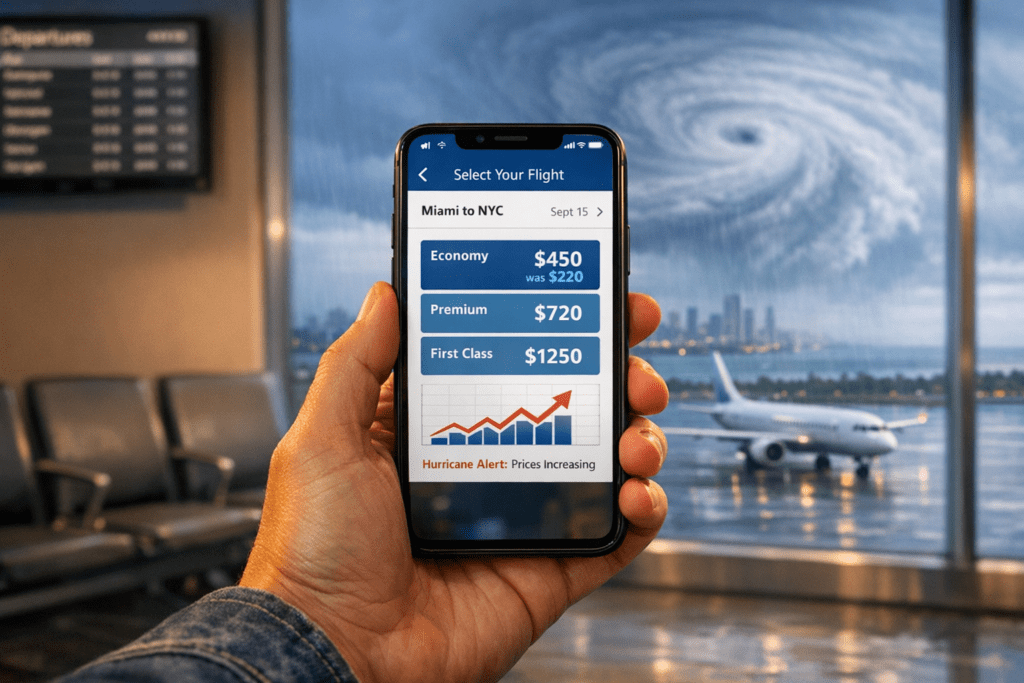
When hurricanes hit, flight prices often skyrocket, leaving many wondering: Are airlines exploiting travelers, or is it just automated systems responding to high demand? Here’s the short answer: Airlines use demand-driven pricing algorithms, not deliberate price gouging, but the results can still feel unfair.
Key takeaways:
- During emergencies like Hurricane Milton (2024), ticket prices surged up to $2,351 due to demand spikes.
- Airlines rely on algorithms that raise prices when demand increases, but extreme cases (e.g., $6,300 tickets) are often glitches or outliers.
- Federal oversight exists, but no strict price caps are enforced. Airlines voluntarily cap fares ($99–$399) during crises after public pressure.
- To avoid high costs, book early, monitor fare caps, use points/miles, and document any extreme prices for potential complaints.
While airlines aren’t intentionally exploiting travelers, their pricing systems aren’t designed for disasters. Planning ahead is your best defense against steep costs.
What Is Price Gouging for Airline Tickets?
Price gouging happens when prices for goods or services are raised far beyond normal levels, especially during emergencies, without any significant increase in costs. In the airline industry, this often translates to steep fare hikes when people urgently need to travel, such as during natural disasters like hurricanes.
Airlines rely on automated systems to adjust ticket prices based on factors like demand, seat availability, and timing. While this is standard practice, it can blur the line between normal pricing and gouging. For example, during Hurricane Irma, last-minute flights out of South Florida saw prices jump by over 25%. Bob Mann, an airline industry consultant, explained:
Situations such as these drive pricing anomalies due to sudden demand surges.
Such pricing patterns have drawn attention at both state and federal levels.
State laws aimed at preventing price gouging generally cover essential items like food, water, and lodging but often exclude airline tickets. When complaints arise, state authorities typically approach airlines directly instead of imposing regulations. For instance, during past hurricanes, Florida’s Attorney General’s office fielded more than 450 complaints during Hurricane Helene and over 200 during Hurricane Milton.
On the federal side, the U.S. Department of Transportation (DOT) oversees airline pricing during emergencies. The DOT works to prevent excessive fare hikes by monitoring airlines closely. During Hurricanes Helene and Milton in 2024, the DOT stayed in direct communication with carriers to evaluate flight availability and ensure fares remained reasonable. This role is critical since airlines operate under a unified federal aviation framework, crossing state boundaries.
For travelers, state protections often fall short when it comes to booking emergency flights. Without federal price caps, passengers must rely on airline goodwill and DOT oversight to keep fares manageable during crises.
sbb-itb-e205081
Do Flight Prices Go Up During Hurricanes?
Yes, flight prices do increase during hurricanes, but this is largely due to how pricing algorithms react to sudden spikes in demand. For example, during Hurricane Irma, flight searches skyrocketed by 388% compared to the previous week. This surge caused automated systems to remove lower-priced fares, leaving only higher-priced options. As a result, the average flight price jumped 25% from the usual $350 baseline.
Some extreme cases highlight how these systems can struggle in such situations. For instance, Delta charged $3,258.50 for a Miami-to-Phoenix flight, while United listed a Miami-to-Denver ticket at $6,785. Seth Kaplan, Managing Partner at Airline Weekly, explained:
This is what happens when thousands of people want to leave a place all at once.
However, not every hurricane follows this pattern. During Hurricane Harvey in 2017, flight searches only rose by 15%, and ticket prices stayed relatively steady. In Houston, the availability of alternative travel options helped keep airfare stable. Samuel Engel, Head of the Aviation Group at ICF, shed light on how the system typically works:
The system is designed to hold some seats open for people who are willing to pay more at the last minute… typically a business traveler, not someone fleeing from a hurricane.
Airlines have occasionally stepped in to manually adjust pricing during emergencies. In September 2017, JetBlue capped one-way fares at $99 (including taxes and fees) for all remaining direct flights out of Florida. Similarly, Delta imposed a $399 cap and added 24 extra flights, providing 5,000 additional seats to help with evacuations. These actions demonstrate that airlines can intervene to manage price surges and address public concerns when necessary. This leads to a broader discussion about how airlines handle accusations of price gouging and refine their pricing strategies during crises.
How Airlines Respond to Price Gouging Claims
When airlines face accusations of price gouging, they often take steps like capping fares, adding more flights, and offering flexible travel options. These actions aim to address public concerns while ensuring safe evacuations. Here’s how major carriers like United, American, and Delta handled such claims during Hurricane Milton in October 2024.
United Airlines introduced fare caps starting October 6, 2024. Leslie Scott, a spokesperson for United, stated:
We implemented fare caps on Sunday. Since then, the average price paid for a one-way, economy-class ticket to our hubs from the impacted Florida markets was below $500.
However, despite these efforts, social media posts highlighted fares as high as $2,351 for refundable economy tickets with multiple connections. United clarified that these prices reflected complex itineraries that were eventually canceled due to airport closures.
American Airlines focused on increasing capacity. On October 7, 2024, they added 2,000 seats from Tampa and Sarasota, followed by another 2,000 seats from Orlando on October 8. Altogether, they provided 4,000 additional seats across Florida during the storm.
Delta Air Lines also implemented fare caps for flights leaving areas affected by Hurricane Milton, though they did not disclose specific price limits.
Hannah Walden from Airlines for America highlighted the industry’s broader efforts:
Large U.S. airlines are working diligently to accommodate customers impacted by Hurricane Milton… allowing passengers to adjust their travel plans if needed.
Beyond pricing adjustments, airlines also made operational changes. By the afternoon of October 8, 2024, over 700 U.S. flights had been canceled as airports in the hurricane’s path shut down. These actions raise important questions about whether such measures adequately address price gouging concerns.
Federal Oversight and DOT Involvement
The Department of Transportation (DOT) keeps a close watch on airline pricing during hurricanes through direct communication with airlines and real-time monitoring. DOT officials actively engage with airline leadership during crises, requesting updates on flight availability and fare levels in affected areas. They also track flights in real time to detect any “excessively increasing fares”, which could indicate price gouging. This oversight works in tandem with the self-regulation efforts airlines implement, as mentioned earlier.
Federal oversight becomes especially crucial in such situations. During Hurricane Milton in October 2024, U.S. Transportation Secretary Pete Buttigieg emphasized the DOT’s commitment:
The Department takes all allegations of airline price-gouging seriously. We are keeping a close eye on flights in and out of areas affected by Hurricane Milton to make sure airlines are not charging excessively increasing fares.
Despite such strong statements, no formal legal actions or fines have been issued specifically for hurricane-related price gouging. The DOT’s role is complicated by the difficulty of distinguishing between illegal price gouging and standard dynamic pricing, where ticket prices naturally rise as seat availability decreases. Instead of pursuing legal action, the DOT focuses on monitoring fares, reviewing consumer complaints, and encouraging airlines to voluntarily cap fares. This strategy has prompted major airlines to announce price caps during emergencies, addressing public concerns while steering clear of regulatory penalties. These practices help clarify the line between normal dynamic pricing and potential price gouging.
Price Caps vs. Normal Ticket Costs
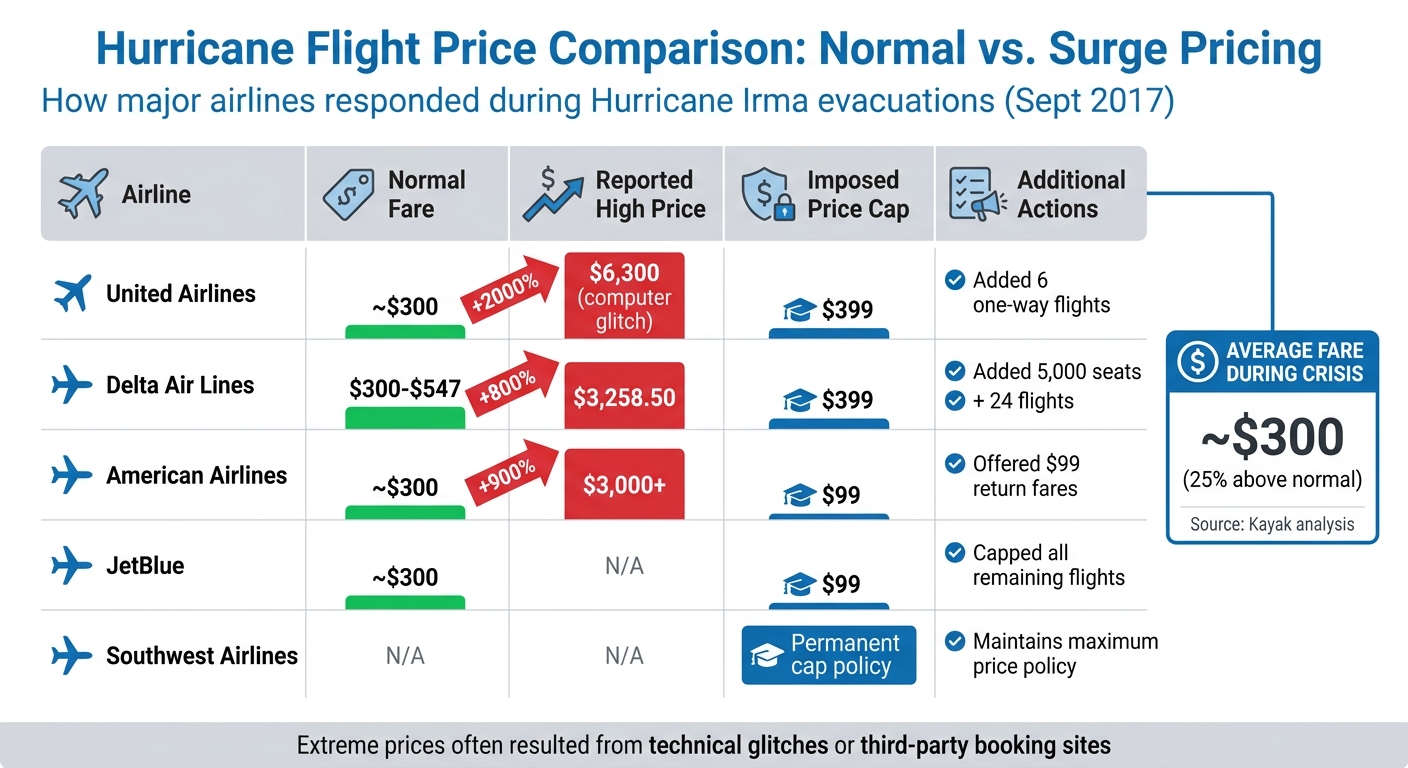
Hurricane Flight Price Comparison: Normal vs. Surge Pricing Across Major Airlines
During emergencies, automated pricing systems can push ticket costs to staggering levels, often requiring immediate human intervention. For example, before Hurricane Irma hit in September 2017, flights out of South Florida typically ranged from $300 to $550. But as evacuation demand surged, automated algorithms drove prices sky-high. Screenshots shared on social media revealed fares exceeding $3,000, with one United Airlines ticket hitting an astonishing $6,300 – a price later blamed on a computer glitch. These extreme price hikes led to swift action from airlines.
In response, airlines stepped in to manually override their systems and enforce price caps. United Airlines and Delta placed a $399 cap on one-way tickets, while American Airlines and JetBlue set even lower caps at $99 for remaining evacuation flights. Beyond capping prices, Delta added 5,000 seats and 24 extra flights, and United introduced six additional one-way flights from Miami and Fort Lauderdale. These actions came after mounting public outrage and pressure from U.S. senators and Florida’s Attorney General.
However, this type of revenue management raises ethical questions during crises. Samuel Engel, who heads the aviation group at ICF, explained:
The system is designed to hold some seats open for people who are willing to pay more at the last minute… typically a business traveler, not someone fleeing from a hurricane.
While this pricing strategy makes sense in normal circumstances, it becomes problematic when large-scale evacuations are necessary. Industry experts now recommend that airlines adjust their pricing parameters as soon as a storm’s trajectory becomes clear, rather than waiting for public backlash to force changes.
Table: Hurricane Flight Price Comparison
| Airline | Hurricane Event | Normal Fare (Approx.) | Reported High Price | Imposed Price Cap | Other Measures |
|---|---|---|---|---|---|
| United Airlines | Irma (Sept. 2017) | ~$300 | $6,300 | $399 | Added 6 one-way flights |
| Delta Air Lines | Irma (Sept. 2017) | $300–$547 | $3,258.50 | $399 | Added 5,000 seats and 24 flights |
| American Airlines | Irma (Sept. 2017) | ~$300 | $3,000+ | $99 | Offered $99 return fares |
| JetBlue | Irma (Sept. 2017) | ~$300 | N/A | $99 | Capped remaining flights |
| Southwest Airlines | All Events | N/A | N/A | Permanent Cap | Maintains maximum price policy |
Examining the Evidence: Is Price Gouging Real?
When crises hit, claims of price gouging often go viral. But a closer look at the data suggests these accusations frequently highlight rare, extreme cases rather than the norm. Take Hurricane Irma in September 2017, for example. Social media posts drew attention to airline tickets priced over $1,000. However, an analysis by Kayak showed that the average fare out of South Florida was actually around $300 – about 25% higher than usual. This increase reflected standard last-minute pricing rather than intentional exploitation.
Many high-profile allegations of price gouging can be traced back to technical errors or third-party pricing issues. For instance, a viral United Airlines ticket priced at over $6,300 was later explained as a “glitch in the computer”, according to a United spokesperson. Similarly, a Delta ticket that appeared to skyrocket from $547.50 to $3,258.50 on social media was linked to Expedia, not Delta’s own system. Delta spokesman Anthony Black even worked directly with the customer to resolve the issue.
Another example occurred during Hurricane Lane in 2018, when a Twitter post accused Delta of charging $10,000 for a one-way flight from Honolulu to Los Angeles. Delta’s Anthony Black quickly clarified:
I can assure you we did not sell any tickets at all close to those prices.
Screenshots of standard $249 fares for the same route backed up his statement.
Bob Mann, an airline industry consultant, explained these pricing spikes:
Situations such as these drive pricing anomalies due to an instantaneous imbalance between demand and supply.
In other words, the sudden surge in demand – like thousands of evacuees booking flights simultaneously – overwhelms automated pricing systems, which are typically designed for business travelers. As Samuel Engel from ICF noted:
All of that is perfectly logical, and there’s nothing really nefarious about it. The problem comes when you marry it with the public-relations and human aspect.
While price increases during emergencies may feel unfair, the evidence points to demand-driven algorithms rather than deliberate exploitation. The real challenge for airlines is adjusting their pricing systems more quickly in response to disasters, rather than waiting for public backlash to prompt manual fixes. For travelers, understanding this dynamic can help in planning strategies to avoid high costs during emergencies.
How to Avoid High Flight Costs During Hurricanes
When hurricanes are on the horizon, airfare prices can skyrocket due to demand-driven pricing. To sidestep these steep costs, consider these strategies to secure more affordable tickets.
1. Book Early
Timing is everything. Airlines tend to raise prices as soon as a storm’s path becomes clear. By booking your flight early, you can lock in lower fares before algorithms adjust to the surge in demand. For example, during Hurricane Milton in October 2024, United Airlines kept average one-way economy fares for Florida markets under $500. Similarly, during Hurricane Irma in September 2017, JetBlue and American Airlines capped one-way fares at $99.
2. Monitor Fare Caps and Regional Airlines
Keep an eye on fare caps, as airlines often implement them during emergencies. Regional carriers like Allegiant may also provide additional availability and maintain fixed pricing policies. Since these airlines don’t always appear on major search platforms, checking their websites directly can uncover options you might otherwise miss. Additionally, airlines like Southwest Airlines have permanent maximum price caps, which can safeguard against extreme fare hikes. Booking directly through airline websites is generally more reliable during emergencies, as third-party sites may show inflated or temporary “ghost” fares.
3. Use Points and Miles
Flexibility can be your best friend. Many airlines waive change fees and allow free cancellations within 24 hours for bookings made at least seven days in advance. If cash fares spike, redeeming points or miles becomes a great alternative, as their value often remains steady during emergencies. This can help you save significantly when demand is high.
4. Consider Travel Assistance Services
Navigating high demand and potential website crashes can be overwhelming. Services like Flight Booking 247 offer round-the-clock access to travel concierges who can assist with rebooking or adjusting your plans, providing an extra layer of support when you need it most.
5. Document and Stay Flexible
Take screenshots of fare trends to document any extreme price spikes. If you encounter unreasonable costs, you can file a complaint with the Department of Transportation (DOT). Additionally, consider flying on less popular days like midweek or Saturdays, which can save you 10–20% compared to peak travel days.
Conclusion: The Verdict on Hurricane Price Gouging
When hurricanes hit, airline price spikes are often the result of demand-driven algorithms rather than intentional price gouging. While some fare increases may seem extreme, they’re usually tied to dynamic pricing systems designed to prioritize last-minute, high-paying travelers. As Samuel Engel from ICF explains, these systems are not about exploitation but rather about responding to demand.
To address public concern, many major airlines now implement fare caps ranging from $99 to $399 during severe weather events. These caps, alongside federal oversight from agencies like the DOT and FTC, show that airlines are taking steps to manage fare increases responsibly. These changes highlight the importance of planning ahead. Booking early, keeping an eye on fare caps, using reward points, and staying flexible with travel routes can help you avoid the steepest price jumps. Services like Flight Booking 247 can also assist by offering real-time support to secure capped fares, rebook flights, or adjust plans as needed.
Even though there’s no deliberate policy of price gouging, algorithm-driven pricing can still feel overwhelming, especially during emergencies. By staying prepared, vigilant, and seeking reliable travel assistance, you can navigate these challenges and minimize last-minute costs.
FAQs
Why do hurricane fares sometimes appear much higher on certain sites?
When hurricanes hit, airfare prices can sometimes skyrocket, leaving travelers frustrated. This happens because airlines rely on dynamic pricing – an automated system that changes ticket costs based on demand and seat availability. During storms, when demand surges and seats fill up quickly, these algorithms push prices higher.
While it might feel like price gouging, airlines often explain that these spikes are not intentional but rather the result of automated systems responding to market conditions. To avoid getting caught in these price hikes, it’s a good idea to book your travel plans as early as possible, especially during storm seasons when demand is likely to surge.
When do airlines usually start fare caps during a hurricane threat?
Airlines often set fare caps just days before a hurricane is expected to hit. These caps are typically introduced in the final stretch before the storm, aiming to assist travelers during emergency situations.
What proof should I save if I want to report extreme hurricane fares to the DOT?
When dealing with extreme hurricane fares, it’s crucial to gather evidence. Save documents like screenshots of fare prices, booking confirmations, and any communications or advertisements that display inflated pricing. These records will be essential when reporting the issue to the DOT.