
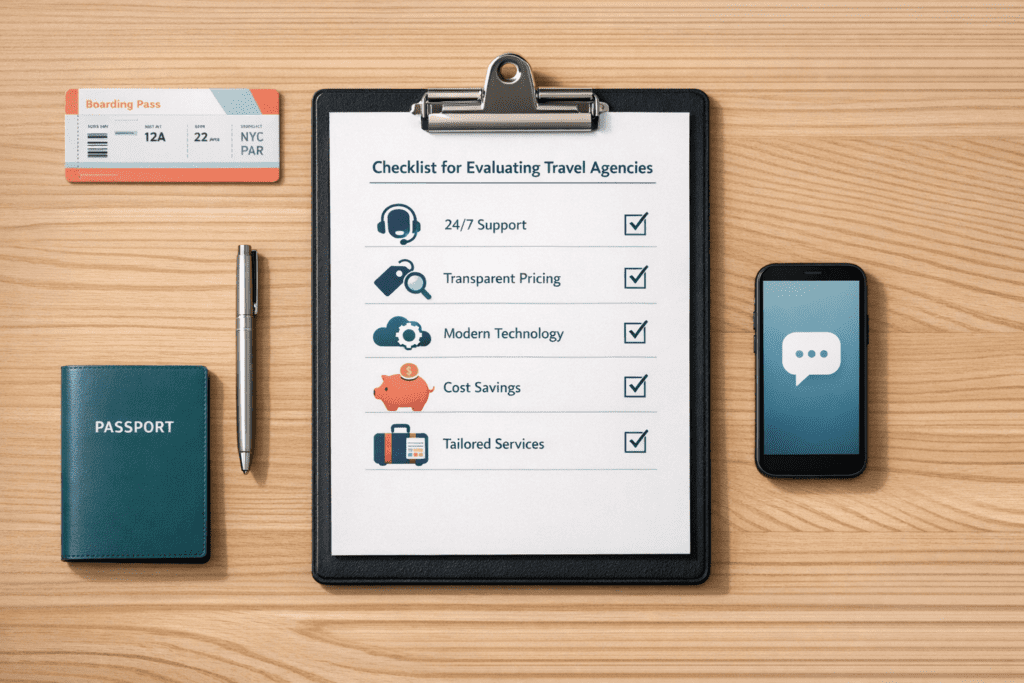
When choosing a travel agency, the goal is to find a reliable partner who aligns with your organization’s needs and saves time and money. A poor choice can lead to hidden fees, wasted time, and mishandled emergencies. Here’s a quick guide to help you evaluate travel agencies effectively:
Key Factors to Consider:
- Services Offered: Ensure the agency handles your primary needs (flights, hotels, car rentals) and offers extras like visa assistance, travel insurance, and real-time itinerary updates.
- Corporate Travel Expertise: Look for 24/7 support, disruption management, and tools for enforcing travel policies.
- Pricing Transparency: Avoid hidden fees by requesting itemized breakdowns and comparing pricing models (transaction-based, subscription, flat-fee, etc.).
- Cost-Saving Measures: Agencies should secure discounts, track unused tickets, and provide reporting tools for clear savings insights.
- Support Availability: Prioritize agencies with 24/7 access to real experts, not automated systems, and a dedicated account manager for personalized assistance.
- Technology: Choose a user-friendly platform with real-time updates, mobile compatibility, and integration with tools like QuickBooks.
Why This Matters:
Efficient travel management reduces costs, saves time, and ensures smooth operations, especially as travel volumes grow. By following a structured approach, you can compare agencies fairly and avoid costly mistakes.
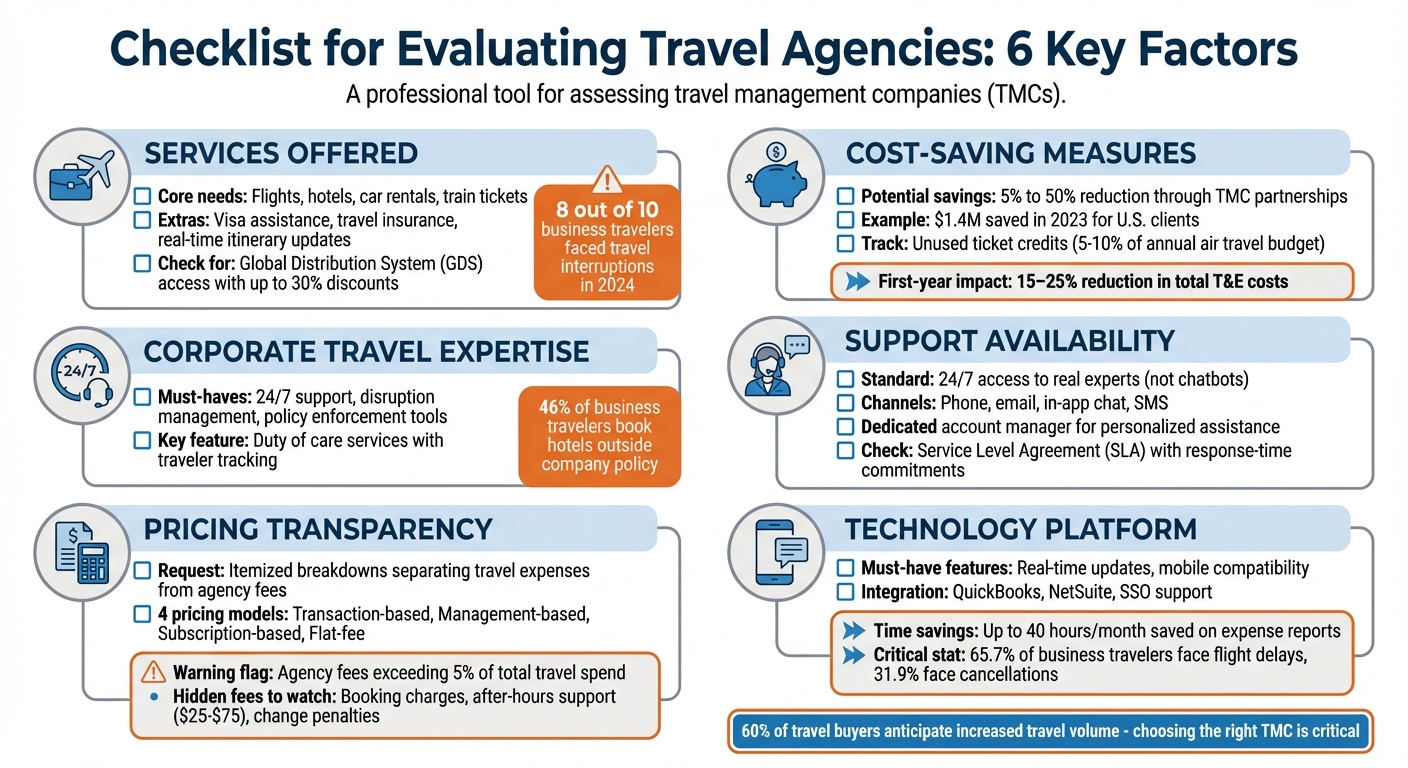
Travel Agency Evaluation Checklist: 6 Key Factors to Compare
Services and Areas of Focus
Available Services
Make sure the agency can cover your primary travel needs, including arranging domestic and international flights, hotel bookings, car rentals, and train tickets. For more complex requirements, check if they handle group bookings for events like conferences or department-wide travel. This includes multi-city itineraries and VIP services.
Some agencies go beyond the basics by offering concierge-level support. This might include help with visas and passports, business travel insurance, airport lounge access, or meet-and-greet services. These extras can be a lifesaver, especially when you’re juggling tight schedules. Also, confirm whether the agency uses a Global Distribution System (GDS), which provides access to a wide range of flights and hotels, often with discounts of up to 30%.
A key feature to look for is real-time itinerary management. This technology syncs your travel plans across devices, provides instant updates for delays or gate changes, and centralizes all trip details. Unlike traditional support, these tools deliver immediate updates, which can be critical during disruptions. In fact, in 2024, 8 out of 10 business travelers faced travel interruptions. Having these tools at your disposal can save you a lot of time and stress when things go wrong.
Specialized corporate travel agencies build on these core services by offering expert solutions for handling disruptions effectively.
Corporate Travel Experience
Corporate travel agencies bring added value by managing disruptions with efficiency. They excel at rebooking without needing to rebuild entire itineraries. This can make all the difference when a flight is canceled late at night or a same-day change is required at the crack of dawn. Be sure to confirm their approach to handling such situations and ensure they offer 24/7 support via phone, chat, or email. A great example is Flight Booking 247 (https://flightbooking247.com), which provides round-the-clock assistance to address unexpected changes.
Another hallmark of experienced agencies is their duty of care services. These include proactive traveler tracking, risk alerts, and emergency support. Additionally, they should manage unused ticket recovery, ensuring the value of canceled tickets isn’t lost in the accounting shuffle. Lastly, check if the agency integrates your company’s travel policies into their booking platform. This ensures automatic enforcement of spending limits and cabin-class restrictions. With around 46% of business travelers booking hotels outside their company’s policy, automated compliance tools are critical to keeping costs under control.
sbb-itb-e205081
Pricing and Cost Control
Clear Pricing Structure
Many travel agencies present a single “total cost”, which can make it hard to figure out how much you’re actually paying for individual services. This approach often hides rate markups, where the agency buys a service at one price and resells it to you at a higher rate. To avoid surprises, always ask for an itemized breakdown that separates travel expenses from agency fees, booking charges, and other service-related costs.
Travel management companies typically use four pricing models: transaction-based, management-based, subscription-based, and flat-fee. Each has its own pros and cons. For example, transaction-based fees are straightforward but can add up fast for complex trips, while management-based fees provide consistent costs but often require minimum spending commitments, usually between $50,000 and $75,000 annually.
Be on the lookout for hidden fees like booking charges, after-hours support (ranging from $25 to $75), and penalties for changes or cancellations. Some agencies also impose fees if you don’t meet a minimum booking volume. Pay attention to agency fees – if they exceed 5% of your company’s total travel spend, it’s a warning sign.
To compare agencies effectively, use a standardized pricing template that ensures consistency across proposals. Also, check if upfront planning fees (which can range from $100–$500 for domestic trips and $250–$1,500 for international travel) are credited toward the final cost. This approach helps you understand the actual cost of services and assess whether the agency’s pricing aligns with your budget. A transparent pricing structure is key to evaluating an agency’s potential for cutting costs.
Once you have clarity on pricing, the next step is to examine how these models translate into real savings.
Cost-Saving Capabilities
Beyond transparent pricing, a good travel agency should actively secure discounts that deliver real savings. One major advantage of working with an agency is access to exclusive rates through pre-negotiated corporate deals and supplier partnerships. Partnering with a travel management company can cut travel expenses by anywhere from 5% to 50%. For example, in 2023, one agency saved its U.S. clients over $1.4 million, including $496,648 through creative ticketing strategies and $251,321 by recommending alternative airlines or routes.
Agencies often offer two types of corporate rates: fixed rates, which stay consistent over time, and negotiated rates, which are tailored to your company’s travel volume and specific needs. Ask whether the agency uses New Distribution Capability (NDC) technology to provide personalized airline packages with perks like priority boarding or better seating options. Additionally, modern agencies can automatically track unused ticket credits, which often account for 5% to 10% of a company’s annual air travel budget.
“A lower fee might sound appealing, but if the service quality drops or you’re not getting the savings you expected, is it really worth it?” – Corporate Traveler
Make sure the agency offers integrated reporting tools and real-time dashboards so you can clearly see where savings are coming from. Consolidating all your travel with one agency can also boost your booking volume, giving you more leverage to negotiate deeper discounts with preferred airlines. Companies moving from unmanaged travel to a structured program often see a 15% to 25% reduction in total travel and entertainment costs within the first year.
Support and Availability
24/7 Support Access
Imagine your flight gets canceled in the middle of the night, or you’re stranded during a severe storm – this is where 24/7 support becomes a lifeline. Today, most modern travel management companies include round-the-clock assistance as a standard service, not an extra-cost perk. Before committing to any agency, it’s smart to review their Service Level Agreement (SLA). This document should guarantee real 24/7 availability with clear response-time commitments.
Leading agencies provide access to support through multiple channels – phone, email, in-app chat, and SMS – connecting you directly to seasoned travel experts rather than automated systems. For example, ATPI demonstrated the importance of reliable 24/7 support by quickly ensuring passenger safety during a critical incident. Similarly, during Hurricane Milton in October 2024, AmTrav agents worked tirelessly to help travelers reschedule their plans, avoiding the storm’s chaos. Another example is Flight Booking 247, which offers access to a travel concierge at any hour to book, change, or cancel flights, whether domestic or international.
“No chatbots, no endless hold music – just real travel experts ready 24/7 to rebook, reroute, and resolve any travel issue. Call, text, chat, or email – we’re always here for you.”
– AmTrav
While many larger agencies include 24/7 support at no extra charge, smaller firms might tack on fees for after-hours assistance. It’s crucial to clarify any potential costs upfront. Testing communication channels before signing a contract can also provide insight into their responsiveness.
Another key consideration is having a dedicated contact who understands your specific travel needs and can provide personalized assistance.
Assigned Account Manager
While 24/7 support is essential for handling urgent travel issues, a dedicated account manager plays a crucial role in ensuring your travel program runs smoothly day-to-day. This person manages routine bookings, clarifies travel policies, and identifies ways to save money – all while delivering consistent, tailored service.
A dedicated manager doesn’t just handle the basics; they also proactively address gaps in your travel policy and suggest cost-saving opportunities. For instance, when the Blast! Film crew was stranded in Siberia in 2024 due to travel disruptions, their dedicated team at Corporate Traveler coordinated logistics to bring them home safely. Similarly, the Houston Rockets, who navigate complex travel schedules across multiple cities each month, depend on their travel partner to handle all the intricate planning.
“Corporate Traveler provides a level of service that’s both thorough and anticipatory. We’re an incredibly fast-moving business and to have a partner as nimble as us managing our travel needs is invaluable.”
– Caroline Roche, Chief of Staff, Bumble
When evaluating travel agencies, ask whether you’ll have a single, dedicated point of contact or if your requests will be routed through a general call center. It’s also worth checking if the agency has documented SLAs for non-transactional requests like reporting or resolving issues. Many account managers bring years of industry experience, which can mean faster, more effective problem-solving. Lastly, confirm that your dedicated manager has a clear plan for working with the 24/7 emergency team during global disruptions, ensuring seamless support no matter the time or situation.
Technology and Platforms
Platform Usability
The backbone of any successful travel program lies in the technology behind its booking platform. A poorly designed system can frustrate users, leading them to avoid the platform entirely. This not only disrupts spending oversight but also undermines policy compliance.
Modern systems leverage AI to streamline the booking experience by analyzing traveler preferences, past bookings, and company policies. This ensures that users see the most relevant flight and hotel options. Additionally, features like auto-generated expense reports can save employees up to 40 hours of manual work each month. To maximize efficiency, platforms should support smooth booking, modifications, and expense reporting across both mobile and desktop devices.
Before committing to any platform, test its compatibility with your existing tools. For example, make sure it integrates with accounting software like QuickBooks or NetSuite and supports single sign-on (SSO) for added security and convenience. Also, inquire about implementation timelines; many cloud-based platforms can be fully operational within weeks.
A well-functioning platform is essential for providing real-time updates and data, which are crucial in the fast-changing landscape of business travel.
Live Updates and Data
Real-time updates are a must-have, especially since 65.7% of business travelers encounter flight delays, and 31.9% face cancellations. A reliable platform should send push notifications for critical updates like flight delays, gate changes, and booking confirmations. Advanced tools go a step further by incorporating risk management features, such as live traveler maps that show employee locations during emergencies.
Reporting capabilities are equally vital. Finance teams benefit from live dashboards that provide immediate insights into spending, eliminating the need to rely on delayed monthly statements. For companies with project-specific budgets, the ability to tag expenses by department or project at the time of booking is invaluable.
The mobile app should offer more than just itinerary viewing. Travelers need the ability to make trip modifications on the go, ensuring flexibility when plans change. Offline access to itineraries is another helpful feature, especially for employees traveling in areas with limited connectivity.
“Technology should allow travellers to access and manage their travel reservations via their mobile devices, enabling them to make changes when necessary and to receive relevant notifications such as flight delays.”
– FCM Travel
Business Travel and Corporate Travel Management, Explained
Conclusion
Taking a structured approach to evaluating travel management companies (TMCs) through weighted criteria – covering support, technology, and policy controls – can help align your travel program with your company’s goals and long-term vision.
This method not only helps identify hidden fees but also ensures fair, apples-to-apples comparisons between vendors while verifying critical features like 24/7 support. With around 60% of travel buyers anticipating an increase in travel volume, these steps become even more important. Companies like Flight Booking 247 demonstrate the kind of robust support travelers need, especially in the face of unexpected disruptions.
“Working with a TMC that takes a consultative, customized approach to managing your travel program is one of the greatest investments you can make.” – George Kalka, Vice President of Global Client Solutions, Fox World Travel
To stay ahead, ensure your chosen technology integrates seamlessly with tools like QuickBooks or NetSuite. Plan for an 8–16 week selection process, followed by 4–12 weeks for implementation. While this timeline requires effort, the payoff is clear: improved operational efficiency, reduced costs, and the foundation for a strategic partnership that benefits your travel program in the long run.
FAQs
What should I ask to uncover hidden travel agency fees?
When discussing costs, always ask: “Are there any additional fees or charges beyond the initial quote?” This question can help uncover hidden expenses like booking fees, cancellation penalties, or service surcharges. Getting clarity upfront ensures you’re fully informed and avoids any unexpected surprises down the line.
How can I verify an agency really offers 24/7 human support?
To ensure an agency truly offers 24/7 human support, check if you can reach real travel experts anytime – whether by call, text, chat, or email. Pay attention to whether these are seasoned professionals who provide personalized help, rather than scripted responses from call center staff. Clear communication about their availability and expertise is key to confirming their dedication to being there for you around the clock.
What integrations should a corporate travel platform support?
A corporate travel platform needs to work smoothly with essential systems like expense management tools, ERP software, and travel booking platforms. These integrations ensure data flows effortlessly, reducing manual work and boosting automation.
Equally important are security integrations, which safeguard sensitive information such as itineraries and payment details. By supporting open APIs, companies gain the flexibility to tailor connections with other enterprise tools. This not only simplifies operations but also enhances the traveler’s overall experience – all while keeping data accurate and secure.