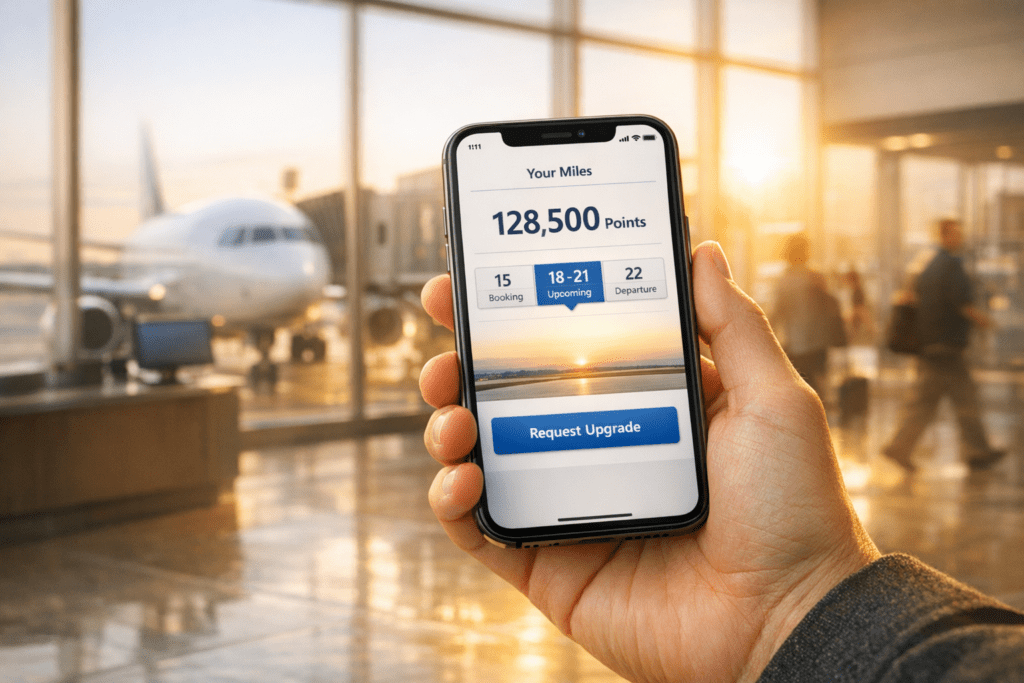
Want to turn your points into a premium seat? Timing is everything. Airlines release unsold business or first-class seats at key intervals, and knowing when to act can boost your chances of securing an upgrade. Here’s the breakdown:
- Immediately after booking: Some upgrade inventory is available right away. Request early for a chance to clear instantly.
- 1–4 days before departure: Airlines often release more premium seats as the flight approaches. Elite members may see upgrades cleared during this period.
- Day of departure: A last-minute opportunity arises if cancellations free up seats. Check with gate agents early for the best shot.
Your chances depend on elite status, ticket type, and timing. Higher-tier loyalty members and full-fare tickets are prioritized. Business-heavy routes (like NYC to SF) are tougher, while leisure destinations (like Hawaii) offer better odds.
Each airline has its own rules, so understanding their upgrade systems is key. For example, United prioritizes Premier 1K members and uses specific fare buckets for upgrades. Delta and American also rank requests by status, fare class, and timing.
Pro tip: Monitor seat maps and act quickly when premium seats open up. Services like Flight Booking 247 can help track availability in real time and assist with requests.
Timing your request strategically and knowing your airline’s system can make the difference between economy and a premium seat.
How to get Upgraded on Your Next Flight
sbb-itb-e205081
When to Request Flight Upgrades
Mastering the timing of your upgrade request can make all the difference. Airlines release premium cabin seats in phases, and each phase benefits different types of travelers. Knowing when to act is just as crucial as having the points or cash to secure the upgrade.
Right After You Book Your Ticket
Your first chance to upgrade often comes immediately after booking. Airlines sometimes have specific upgrade inventory available (like United’s “PZ” or “PN” fare buckets), allowing upgrades to clear instantly. If that inventory is open, there’s no reason to delay your request.
It’s also worth checking the airline’s mobile app for exclusive upgrade offers. Travel advisor Sara Wilcox highlights how these app-only deals can save you big:
“Chances are, the fare you paid plus the upgrade fee will be much less than if you had just bought the first-class ticket originally”.
If your upgrade doesn’t clear right away, don’t worry – there are additional opportunities closer to your departure date.
1 to 4 Days Before Your Flight
If you’re still waiting on an upgrade, the next window opens one to four days before takeoff. Airlines often release extra premium seats or slash upgrade fees during this period. This phase also aligns with elite status clearance schedules, meaning higher-tier loyalty members may see their upgrades confirmed earlier.
Joe Cronin, President of International Citizens Insurance, explains why this timing works:
“Airlines often slash prices a day or two before a flight to fill the remaining spots”.
Keep an eye on the seat map during this window. If premium seats are still widely available, patience might pay off with a lower fee. But if the cabin is filling up quickly, it’s smarter to secure your upgrade before prices climb or inventory disappears.
On the Day of Departure
The day of your flight offers a last-ditch chance to snag an upgrade, but it’s a gamble. Success depends on last-minute cancellations opening up premium seats. Start at the check-in counter – some travelers have scored international business class upgrades for as little as $200 by arriving early.
Timing is everything when dealing with gate agents. Julian Kheel, Founder and CEO of Points Path, offers this advice:
“The boarding process is the busiest part of their day. Attempting to talk to an agent about an upgrade in the middle of boarding… isn’t likely to succeed”.
To improve your odds, approach the gate agent as soon as they’re available and check the gate monitors for upgrade availability. Once boarding begins, your chances drop significantly. Flight attendants are generally unable to reassign seats once passengers are on the plane.
What Affects Your Chances of Getting Upgraded
Your loyalty status and ticket type play a huge role in whether you snag an upgrade. Airlines follow a strict hierarchy to decide who gets bumped up to a better seat.
Your Loyalty Status and Ticket Type
If you want a free upgrade, elite status is your best bet. Airlines rank passengers by tier, and the gap between levels can be massive. For example, on United Airlines, Premier 1K members can see their upgrades clear as early as 96 hours before departure, while Premier Silver members have to wait until the day of the flight.
Travel + Leisure‘s Stefanie Waldek sums it up perfectly:
“Most upgrades happen for those who pay early or are frequent fliers with elite status”.
Your ticket type is just as important. Full-fare economy tickets are prioritized over discounted ones. And if you’ve booked Basic Economy, you’re out of luck – it’s excluded from all upgrade eligibility. For a better shot at an upgrade, consider booking a higher-priced economy class. Top-tier elites might even score instant upgrades with these fare types.
If you’re traveling with others, elite status takes precedence over both fare class and how early you request an upgrade. With upgrade lists often exceeding 20 people for a single seat, only those with the highest status typically stand a chance.
But it’s not just about who you are and what you paid – your flight route and timing also play a big role.
Flight Route and Travel Demand
Where and when you’re flying can make or break your upgrade chances. Routes frequented by business travelers are tougher to crack. These passengers often hold high elite status or buy premium seats outright. Flights like San Francisco to Newark or Chicago to LaGuardia are highly competitive. On the other hand, leisure routes to destinations like Hawaii or the Caribbean have a much higher upgrade success rate – estimated at 60-80%.
Timing matters, too. Monday mornings (6:00 AM – 9:30 AM), Thursday afternoons, and all day Friday are notoriously difficult times to secure an upgrade. According to Gary Leff from View from the Wing:
“Your chances are almost never better than noon on a Wednesday”.
Airlines also prioritize last-minute cash sales over upgrades. They might hold premium seats until the very last minute, hoping a business traveler will pay full price rather than giving the seat away for points. Keep an eye on the seat map as your flight nears – if there are still plenty of open premium seats, the airline may reduce the points or cash cost for an upgrade.
How Major Airlines Handle Upgrade Requests
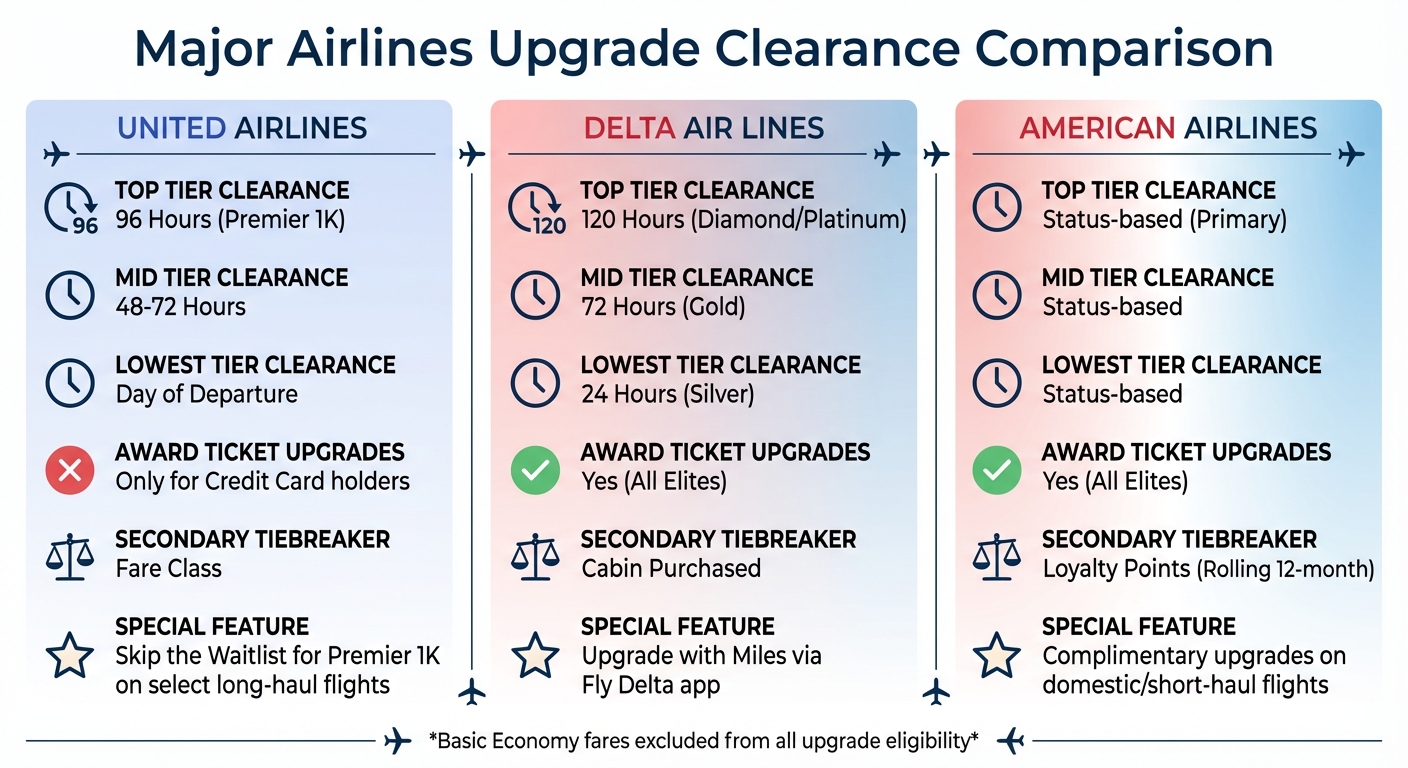
United vs Delta vs American Airlines Upgrade Clearance Timeline Comparison
United, American, and Delta each have their own methods for processing upgrade requests. Understanding these differences can help you optimize the timing of your request.
United Airlines vs. American Airlines vs. Delta Airlines
United Airlines allows you to request an upgrade either during ticket purchase or later through the “My Trips” menu by selecting “Upgrade cabin”. The airline prioritizes upgrades based on elite status first, followed by fare class. For example, tickets in Y, B, and M fare classes get higher priority. Premier 1K members have an added advantage with the “Skip the Waitlist” feature, which lets them confirm Polaris upgrades immediately using PlusPoints on select long-haul flights.
Delta Air Lines offers an “Upgrade with Miles” option, which is accessible during booking on delta.com or later via the “My Trips” section in the Fly Delta app. After elite status, Delta ranks upgrade requests by the purchased cabin class. This means a Silver Medallion member who books a higher-class cabin could potentially outrank a higher-tier member traveling in a lower fare class.
American Airlines also uses a status-based system but includes complimentary upgrades for all elite members on domestic and short-haul flights, even for award tickets. The tiebreaker among members is determined by loyalty points earned over the previous 12 months. However, Basic Economy fares are excluded from complimentary upgrades.
| Feature | United Airlines | Delta Air Lines | American Airlines |
|---|---|---|---|
| Top Tier Clearance | 96 Hours (1K) | 120 Hours (Diamond/Platinum) | Status-based (Primary) |
| Mid Tier Clearance | 48–72 Hours | 72 Hours (Gold) | Status-based |
| Lowest Tier Clearance | Day of Departure | 24 Hours (Silver) | Status-based |
| Award Ticket Upgrades | Only for Credit Card holders | Yes (All Elites) | Yes (All Elites) |
| Secondary Tiebreaker | Fare Class | Cabin Purchased | Loyalty Points (Rolling 12-mo) |
One notable difference is that Delta and American Airlines allow all elite members to join the waitlist for upgrades on award tickets. In contrast, United reserves this perk primarily for those with a co-branded United credit card.
Next, discover how Flight Booking 247 can assist with real-time support for your upgrade needs, anytime you need it.
How Flight Booking 247 Helps with Upgrades

Timing is everything when it comes to securing an upgrade, and Flight Booking 247 gives you an edge with 24/7 support and real-time tracking. Since airlines handle upgrades differently, figuring out the right moment to act can be tricky. That’s where Flight Booking 247’s travel concierge service steps in, helping you pinpoint which upgrade fare classes are actually available.
Get Help with Upgrades Anytime, Day or Night
Flight Booking 247 offers round-the-clock phone access to experienced travel concierges who know the ins and outs of airline upgrade systems. Airlines manage upgrade fare classes – like “C” for business or “A” for first class on American Airlines – separately from regular seating. This means that even if seats appear open, they might not be eligible for upgrades unless released by the airline’s revenue management team.
A concierge can check if your ticket’s fare class qualifies for an upgrade. For instance, United Airlines only waives cash copays for mileage upgrades if your ticket is booked in O, Y, or B fare classes. Plus, the service keeps an eye on upgrade inventory so you’re always in the loop and ready to act.
Track Upgrade Availability in Real Time
Beyond concierge support, Flight Booking 247 offers real-time tracking to catch fleeting upgrade opportunities. Since availability often changes during the crucial 24–48 hours before departure, constant monitoring is essential. Flight Booking 247’s team watches inventory closely during this window, ensuring you don’t miss out. As Joe Cronin, President of International Citizens Insurance, advises:
“Watch the seat map instead of the clock. The moment you spot premium rows tightening, snag the upgrade before prices jump again.”
This service is especially helpful for United Airlines travelers. After November 24, 2025, the airline switched to dynamic pricing for mileage upgrades, making costs more unpredictable. Flight Booking 247’s concierges also excel at spotting last-minute opportunities, like when premium seats become available at the gate.
Conclusion
Securing a flight upgrade often comes down to timing, loyalty status, and a well-thought-out approach. You can request upgrades right after booking, during online check-in, or even at the gate. However, each airline has its own system. For instance, United Airlines processes complimentary Premier upgrades for 1K members starting four days before departure, while American Airlines typically requires a $350 copay plus 25,000 miles for business class upgrades on long-haul flights booked in discount economy.
Your loyalty status and the type of ticket you hold play a big role in determining your upgrade chances. Airlines give priority to their top-tier elites like Global Services members, followed by sorting requests based on ticket class. Traveling on off-peak days, such as Tuesdays, Wednesdays, or Saturdays, can also improve your odds, as business-heavy routes are often busiest on Monday mornings and Friday evenings.
It’s important to note that even an empty premium cabin doesn’t guarantee an upgrade. Airlines often hold those seats for last-minute full-fare buyers. Keeping an eye on unsold premium seats during the final 24–48 hours before departure can make all the difference. This is where having expert assistance can be a game-changer.
Flight Booking 247’s 24/7 concierge service takes the stress out of the process by tracking specific upgrade fare classes and notifying you the moment an opportunity arises. Whether you need guidance on which fare buckets qualify for upgrades or someone to monitor availability during those critical final hours, having expert support can be the deciding factor between flying in economy or enjoying the comfort of business class.
FAQs
How do I know if my ticket can be upgraded with points?
To find out if you can upgrade your ticket using points, start by checking if the airline has upgrade space available for your flight. Your eligibility will often depend on factors like your fare class, loyalty program status, or whether you have specific upgrade certificates. Keep in mind, not all tickets are eligible for upgrades – even if premium seats are open. It’s a good idea to confirm upgrade options through the airline’s website or by contacting customer service, either before booking or closer to your departure date, as availability can fluctuate.
Do upgrades with points clear instantly or go on a waitlist?
Upgrading with points often places you on a waitlist instead of granting an immediate upgrade. Whether your upgrade clears or not depends on seat availability and the specific policies of the airline. To understand the process better, it’s worth reaching out to your airline for detailed information on how their upgrade system operates.
What should I do if my upgrade hasn’t cleared by departure day?
If your upgrade hasn’t gone through by the day of departure, it’s worth checking in with the gate agent or the check-in desk. Airlines occasionally release last-minute upgrades for premium seats that haven’t been sold. When asking, make sure to be polite and approachable – it can make a difference.
If upgrades aren’t an option, it might be a good idea to save your points for a future trip. Alternatively, if you have elite status, reaching out to your airline’s loyalty program could provide additional guidance or options.