Business travel can be expensive, but with the right strategies, you can save 15–25% on travel expenses without sacrificing productivity. Here’s how to manage costs effectively:
- Book Early: Booking flights and hotels 2–4 weeks in advance can reduce costs by up to 40–50%.
- Leverage Loyalty Programs: Use airline and hotel rewards to save up to 30% on travel perks like free Wi-Fi and meals.
- Negotiate Corporate Rates: Secure discounts of 10–20% on hotels and 3–10% on flights by partnering with preferred vendors.
- Centralize Payments: Use a single platform to track expenses, enforce policies, and recover unused credits, saving up to 78% on administrative costs.
- Set Spending Limits: Establish daily caps for hotels and meals, cutting 15–25% from total travel budgets.
- Replace Some Trips with Virtual Meetings: Save on travel by identifying which meetings can be done online.
- Bundle Meetings: Combine multiple meetings into one trip to save on airfare and lodging.
- Use Public Transit or Ridesharing: Cut ground transportation costs by 10% or more with these alternatives.
- Track Unused Tickets: Recover up to 11% of travel expenses by automating the use of unused airline credits.
- Choose Extended-Stay Options: For longer trips, stay at hotels with kitchens to save on meals and lodging.
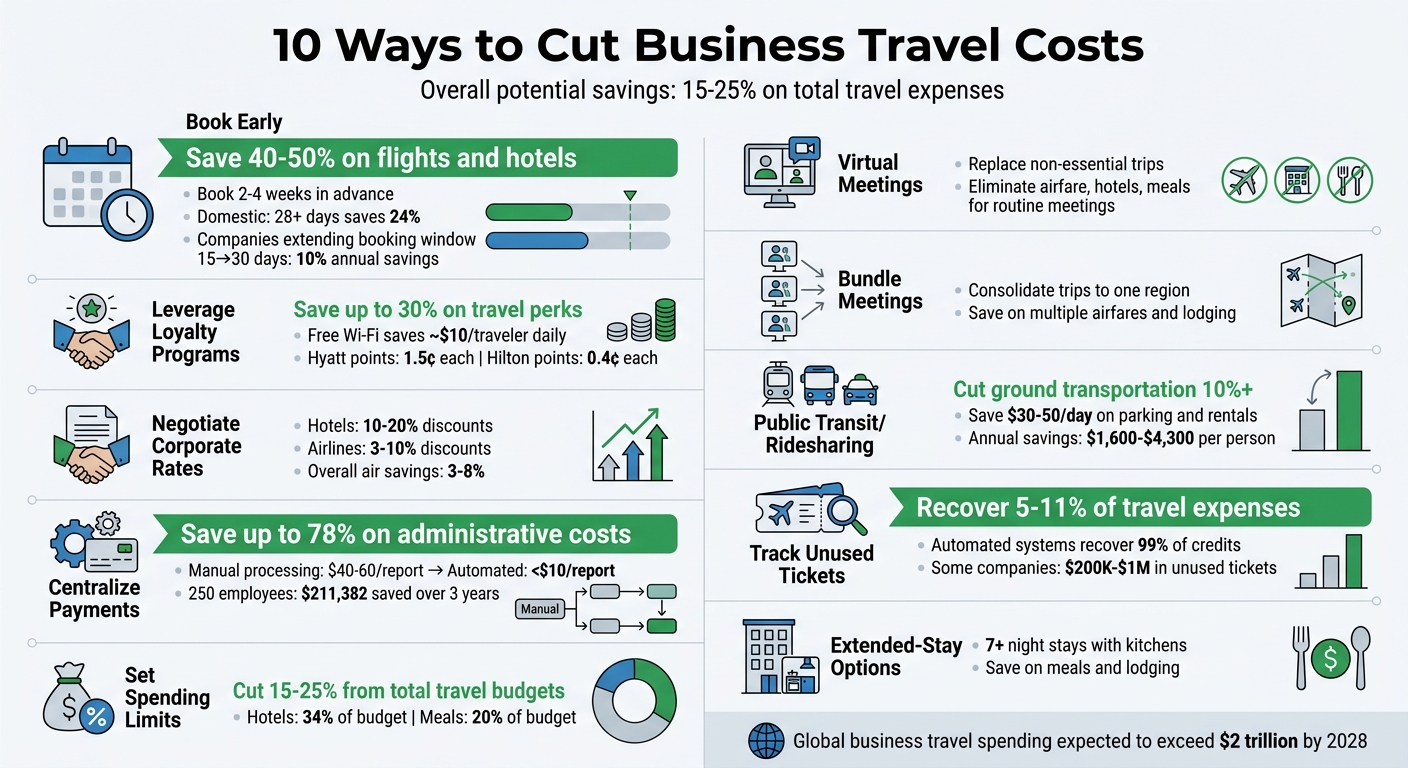
10 Business Travel Cost-Cutting Strategies with Potential Savings
How to cut business travel costs? | Tumodo Webinar
sbb-itb-e205081
1. Book Flights and Hotels in Advance
One of the best ways to keep travel expenses down is to plan ahead. Airlines and hotels use pricing models that increase costs as travel dates get closer. Booking a flight two weeks in advance can save you 40% to 50% compared to waiting until just two days before departure.
The numbers back this up. Around 22% of business travelers overspend because they delay their bookings. Companies that extend their booking window from 15 days to 30 days often report annual savings of 10%. For domestic flights, booking at least 28 days in advance can save up to 24% compared to last-minute fares.
Cost Savings Potential
The refrigerant company A-Gas demonstrated how effective this strategy can be. By extending their booking window from 15 to 30 days between 2017 and 2019, they cut their annual travel expenses by 10%.
| Booking Window | Domestic Flights | International Flights |
|---|---|---|
| Minimum Policy Requirement | 14–21 days | 21–35 days |
| Optimal “Goldilocks” Zone | 1–3 months | 2–6 months |
Booking early not only reduces costs but also secures cheaper rate types. Restricted airfares and hotel rooms are significantly less expensive than flexible options. Plus, booking early ensures access to hotels closer to meeting locations, which can lower ground transportation costs.
These examples highlight why enforcing strict booking windows is a smart move for managing travel budgets effectively.
Ease of Implementation for Businesses
The simplest way to put this into practice is by incorporating strict booking windows into your travel policy. For domestic trips, require bookings 14–21 days in advance, and for international travel, set the window at 21–35 days. Travel management software can help by flagging or requiring special approval for bookings outside these timeframes. As the Routespring Team emphasizes:
“This is the single most impactful strategy for cutting travel costs”.
2. Use Airline and Hotel Loyalty Programs
Loyalty programs can help businesses save on travel expenses while giving employees the added benefit of earning frequent flyer miles. Programs like British Airways On Business and Air France/KLM BlueBiz are great examples of how companies can participate in corporate loyalty programs.
Cost Savings Potential
These programs offer perks that can significantly reduce travel costs. For example, free checked bags, in-flight Wi-Fi (saving about $10 per traveler daily), airport lounge access, and complimentary hotel breakfasts are just a few of the benefits. When used strategically, loyalty programs can cut travel expenses by as much as 30%.
Some programs, such as BlueBiz, allow companies to use earned credits not only for base fares but also for taxes and surcharges, ensuring maximum value from accumulated points. Similarly, hotel loyalty programs offer varying redemption values – World of Hyatt points, for instance, are worth about 1.5 cents per point, while Hilton points are valued at around 0.4 cents per point.
To fully capitalize on these savings, it’s essential to streamline enrollment and track points effectively.
Ease of Implementation for Businesses
Getting started with these programs is straightforward. British Airways On Business, for instance, has no joining fee, while BlueBiz requires a minimum annual spend of €5,000. A practical approach is to consolidate travel spending with two or three key providers that best align with your office locations and most frequent destinations. Additionally, centralizing loyalty numbers ensures points are automatically captured during bookings.
Nick Kropelin, VP of Corporate Land Partnerships & Strategy – Americas at Flight Centre Travel Group, highlights the importance of this approach:
“Corporate Traveler ensures that everything booked through us is recognized from a loyalty standpoint… There’s no concern about missing out on member rates, promos, or status recognition.”
Scalability for Businesses of Different Sizes
One of the great benefits of loyalty programs is their adaptability to businesses of all sizes. Many programs, such as Hertz Gold Plus Rewards and Marriott Bonvoy, are free to join. Booking.com‘s Genius program, for example, offers instant discounts of 10%–20% without requiring any membership fees.
Even smaller companies with just a handful of travelers each month can see real savings. By using business credit cards that earn triple points on travel purchases, businesses can stack those rewards with loyalty program benefits for even greater value.
3. Negotiate Corporate Rates with Travel Providers
Securing corporate rates with airlines and hotels can lead to direct discounts and added perks like waived fees, priority boarding, and complimentary breakfasts. By consolidating your travel spend with two or three preferred vendors, you can strengthen your bargaining position and achieve better deals.
Cost Savings Potential
Negotiated rates can make a noticeable difference in your travel budget. For hotels, discounts typically range from 10% to 20% off public rates, while airlines often provide 3% to 10% discounts on select fares. This translates to an overall air travel savings of 3% to 8%, which is especially valuable given that flight costs have risen by 29% since 2021. In many cases, companies have seen annual travel expenses drop by approximately 10% through these agreements.
Ease of Implementation for Businesses
Getting started with corporate rate negotiations doesn’t have to be complicated. Begin by analyzing 12 to 24 months of travel data to identify patterns, such as key routes, travel volume, and cabin class preferences. Then, issue a Request for Proposal (RFP) to potential vendors detailing this information.
Focus your efforts on the top three to five cities where your employees travel most often. You can choose between static rates, which provide predictable pricing, or dynamic rates, which adjust based on market trends. Additionally, negotiate for “soft dollar” perks – like waived change fees, name change flexibility, and complimentary Wi-Fi – that can add significant value alongside direct discounts.
This approach builds on early booking practices, helping you maximize your travel budget and maintain better cost control.
Scalability for Businesses of Different Sizes
The beauty of negotiated corporate rates is that they can work for companies of all sizes. Larger businesses can secure formal contracts with major carriers like Delta or United by committing to an annual spend between $250,000 and $500,000. Meanwhile, smaller companies can still benefit through programs like Delta SkyBonus or United PerksPlus, which offer rewards without requiring such high spending thresholds.
For smaller organizations, partnering with Travel Management Companies (TMCs) can also provide access to pre-negotiated corporate rates that might otherwise be unattainable. Sue Schroeder, Client Consulting Services Manager at Christopherson Business Travel, highlights the importance of focusing your efforts:
“I suggest establishing relationships with two to three top vendors. I also encourage clients to not have discount contracts with too many travel suppliers… having too many discount contracts dilutes an organization’s volume.”
4. Centralize Travel Payments Through One Platform
Centralizing travel bookings under one system can help cut direct costs and reduce hidden administrative expenses. By using a single platform, your finance team gains real-time insights into spending patterns, making it easier to enforce travel policies and uncover savings opportunities.
Cost Savings Potential
Manually processing expense reports can cost between $40 and $60 per report. Switching to an automated, centralized platform can reduce that cost to under $10 – a savings of up to 78%. A 2024 Forrester Consulting study found that an organization with 250 employees traveling quarterly saved $211,382 over three years by adopting a centralized travel platform.
Centralized systems also improve policy adherence, often saving organizations about 10% per trip. They help recover unused flight credits, which can represent 5% to 10% of total air spend. This added efficiency strengthens your position when negotiating corporate rates with vendors.
As one healthcare organization’s Director of ERP Solutions shared:
“Travel for us was a free-for-all situation. People booked at a premium and chose carriers based on their personal preference or personal rewards, not on price. We knew there was extra spending we were not catching.”
Consolidating travel payments not only reduces costs but also simplifies travel management across the board.
Ease of Implementation for Businesses
Setting up a centralized travel payment platform is often simpler than expected. These platforms integrate seamlessly with accounting systems like QuickBooks, NetSuite, Sage, and Xero, syncing travel expenses directly with your general ledger – no manual data entry required. Many solutions allow businesses to set project-level spending limits in just minutes, and most teams can be fully operational within a few weeks.
For example, a company with 100 employees and an annual travel budget of $1,000,000 might invest $25,000 per year in subscription and transaction fees, plus a one-time implementation cost of $15,000. With estimated annual savings of $32,600, the investment could break even in just 5.5 months. In 2025, SafeRide Health saved $191,000 using Engine’s Flex coverage and reduced reconciliation time by 92%, cutting it from 12 hours to just 1 hour.
This streamlined setup ensures that as your travel needs grow, managing expenses remains hassle-free.
Impact on Employee Productivity and Convenience
Centralized payment processes not only control costs but also make life easier for employees. By eliminating the need for personal credit card use and reimbursements, employees can stay focused on their work. Bookings automatically generate detailed expense entries, while AI-powered tools handle receipt scanning and coding – no manual effort required.
Brandon Stites, Head of Travel at Expensify, highlights the transformation:
“The biggest shift is that travel becomes predictable and scalable instead of reactive and chaotic. What used to take hours becomes automated, and companies can finally focus on strategy instead of administration.”
A Director of Procurement in the education sector added:
“When people have visibility and agency over their budgets they’re a little more diligent about what they’re doing. They care more because they can see their budgets and see the savings.”
Scalability for Businesses of Different Sizes
Modern centralized platforms are built to scale with businesses of any size, from small companies to large enterprises. These systems provide access to negotiated rates and automated workflows without requiring upgrades as travel volume grows. As Brandon Stites explains:
“The most common misconception is that corporate travel tools are only for large enterprises or are ‘too complex’ for smaller organizations. In reality, modern platforms are built for teams of any size, even those with part-time ops support.”
Fragmented workflows can create administrative headaches as travel increases. By automating processes, businesses can handle more trips without adding to their finance teams. For example, Sims Crane saved over $40,000 in hotel modification fees and achieved five times faster booking by implementing Engine’s centralized booking and Direct Bill system in 2025. Whether managing 10 trips a month or 1,000, a centralized platform ensures consistent policy enforcement and cost control while adapting to your needs.
5. Use Flight Booking 247 for Real-Time Deals and 24/7 Support
Cost Savings Potential
With Flight Booking 247, you can tap into real-time flight deals that often go unnoticed through standard booking methods. The platform provides access to exclusive discounts, potentially slashing fares by up to 60%. These negotiated rates, typically unavailable on consumer booking sites, offer businesses a smart way to manage travel expenses.
But it’s not just about upfront savings. 24/7 expert support ensures that unexpected travel disruptions – like canceled flights or schedule changes – don’t derail your plans. Having round-the-clock access to consultants who can quickly rebook or adjust reservations helps save both time and money. Plus, automated systems keep track of unused ticket credits, ensuring nothing goes to waste. This approach works hand-in-hand with advanced booking strategies to maximize efficiency.
Impact on Employee Productivity and Convenience
Flight Booking 247 also simplifies the booking process with its phone-based travel concierge service. Instead of employees spending hours comparing flight options on multiple websites, they can make a quick call and let an expert handle the search in real time. This is especially helpful during travel hiccups like missed connections or last-minute changes.
By centralizing bookings, the service reduces the stress of managing business travel. Employees can focus on their work while the system takes care of policy compliance and applies unused ticket credits automatically. Real-time alerts also guide travelers toward in-policy options, making the entire process seamless.
Scalability for Businesses of Different Sizes
Flight Booking 247’s centralized model is built to grow with your business. Whether you’re a small team or a large corporation, the platform offers the same access to discounted rates and expert support. A centralized admin panel simplifies managing employees and expenses, while the concierge service ensures consistent assistance no matter your company’s size.
For businesses with increasing travel needs, the automated “set and forget” system keeps everything running smoothly. It guides travelers toward in-policy options without requiring constant manual intervention, helping maintain cost control as your team expands.
6. Set Spending Limits for Hotels and Meals
Cost Savings Potential
Hotels and meals often take up a big chunk of any travel budget – lodging typically accounts for 34%, while food can make up 20% or more of business travel expenses. By setting clear spending limits and combining them with effective policy enforcement, businesses can cut overall Travel and Entertainment (T&E) expenses by 15% to 25%.
To set these limits effectively, dive into your expense data. Look at 6–12 months of expense reports and establish hotel rate caps at the 75th percentile of what your team has historically spent in each city. This ensures employees have access to quality and safe lodging without overspending. For meals, a daily per diem is often more practical than itemized limits – it gives employees flexibility to manage their budget while also improving compliance. The next step is making these limits actionable through proper enforcement.
Ease of Implementation for Businesses
Modern booking platforms can simplify compliance by blocking non-compliant options during the purchase process [35, 36]. This means employees only see approved options when booking. As Engine Marketing explains:
“The system handles policy for you now. If the rate shows up, you’re good to go”.
For handling exceptions, a three-tier approval system works well. For example:
- Tier 1: Bookings within the 75th percentile are automatically approved.
- Tier 2: Bookings slightly above the standard (e.g., with a $25 or 10% cushion) require manager approval.
- Tier 3: High-cost markets or emergencies need finance department approval [35, 36].
Review these spending caps every 90 days to account for seasonal price shifts or market changes.
Scalability for Businesses of Different Sizes
Spending limits don’t have to follow a one-size-fits-all approach. Tailor them based on roles and regions. For instance, a project manager traveling to Manhattan might need a $215 nightly cap, while someone visiting Dallas could have a $110 cap. The same tools used to manage policies for a small team can scale to handle larger, multi-department organizations.
For longer trips, consider hotels with kitchens to save on both lodging and meal expenses. Properties designed for stays of seven nights or more often offer discounted rates and reduce the need for costly restaurant meals. Additionally, negotiating perks like included breakfast, parking, and Wi-Fi can improve employee convenience without adding to nightly costs.
7. Replace Some Trips with Virtual Meetings
In addition to strategies like booking early and centralizing payments, swapping some trips for virtual meetings can help businesses manage travel expenses more effectively.
Cost Savings Potential
Virtual meetings can replace many in-person gatherings, cutting out costs like airfare, hotels, and meals. By identifying which meetings can happen online, companies can save their travel budgets for the moments that truly require face-to-face interaction, such as major client pitches or critical negotiations.
The benefits go beyond the obvious. Virtual meetings also reduce “hidden” costs, like the productivity lost during travel time and the average 23 minutes it takes employees to refocus after switching tasks. Together, these savings align perfectly with other travel management strategies to stretch budgets further.
How Businesses Can Implement This
Start by reviewing your company’s meeting types and categorizing them as either “must be in-person” or “suitable for virtual.” Routine updates, team check-ins, and internal discussions are often ideal for video calls – there’s no need to fly someone across the country for a quick meeting.
Uber for Business highlights the simplicity of this approach:
“Substituting nonessential travel with virtual meetings is a simple way to cut (or eliminate) costs while maintaining business efficiency”.
Focus on reserving in-person meetings for high-impact situations, like industry events, client negotiations, or strategic discussions. This approach works well for businesses of all sizes.
Works for Companies Big and Small
Virtual meeting strategies are flexible enough to benefit both small startups and large corporations. Shruthi Dakshanamurthy from Zoho Expense sums it up well:
“The difference between chaotic travel and managed travel isn’t scale. It’s intention”.
Whether you’re a 10-person team or a massive organization, making thoughtful decisions about when to meet virtually can lead to meaningful savings and efficiency.
8. Schedule Multiple Meetings in One Trip
Combining smarter booking practices with centralized payments, grouping meetings into a single trip can add another layer of savings to your travel budget.
Cost Savings Potential
By scheduling all meetings in one region during a single trip – like grouping all Dallas-based meetings into one week – you can cut down on airfare and secure better lodging deals. This method, known as trip consolidation, is a straightforward way to reduce travel expenses.
Longer stays often come with perks like discounted weekly lodging rates and reduced meal costs. For trips lasting seven nights or longer, accommodations with kitchens can further lower food expenses. GBQ highlights this strategy’s value:
“When travel is non-negotiable, maximize value by bundling multiple objectives into one trip. This isn’t just booking – it’s strategic orchestration that turns travel into a competitive edge”.
But how do you put this into action? Let’s break it down.
Ease of Implementation for Businesses
Start by identifying clients or partners within a 60–90-minute radius and schedule back-to-back meetings to make the most of your time. Select a centrally located hotel to cut down on ground transportation costs, including rideshare surcharges, tolls, and airport transfers.
For trips lasting three to five nights, consider flexible hotel rates to avoid change fees if plans shift. For week-long stays, extended-stay properties with kitchens and laundry facilities can keep employees comfortable while reducing daily expenses.
Impact on Employee Productivity and Convenience
Consolidating meetings into one trip means less time spent navigating airports and more time focusing on work. Staying in one area for several days allows employees to dive deeper into a specific market or client base without the constant interruptions of packing, traveling, and returning home.
Accommodations with kitchens and laundry facilities also make longer trips more manageable, helping employees stick to routines, reduce stress, and stay productive.
Scalability for Businesses of Different Sizes
This approach works for businesses of all sizes. Small businesses can focus travel on specific regions and negotiate corporate rates with local hotels. Larger companies can take advantage of group booking options for field teams, requesting extras like free parking, early breakfasts, or truck parking to stretch their budget further.
9. Use Public Transit and Ride Sharing
Managing ground transportation effectively can be a game-changer for controlling travel expenses. Costs like rental fees, parking, and fuel can quickly add up, draining your travel budget. Switching to public transit and ride-sharing not only helps cut these costs but also creates opportunities for broader savings.
Cost Savings Potential
Public transit removes the need for car rentals, fuel, and parking fees, which can range from $30 to $50 per day in major cities. For shorter commutes (up to 12 miles), ride-sharing can save individuals around $1,600 annually, while longer trips can lead to savings of up to $4,300 per year. When companies adopt shared transportation for multiple employees, the combined savings can reach as high as $81,000.
For regional travel, rail options between close cities – like New York and Washington, D.C. – are often cheaper than flying. Meanwhile, in urban centers, public transit frequently outpaces ride-sharing in both cost and speed, particularly during peak hours.
Ease of Implementation for Businesses
Streamlining ground transportation is easier than you might think. Companies can designate preferred ride-sharing services in their travel policies and use centralized platforms to manage expenses. These platforms allow businesses to set spending limits based on location, time, and budget, making it simple to keep costs under control.
Uber for Business highlights the effectiveness of this approach:
“73% of administrators said our platform helped lower their company’s ground-transportation costs, and more than half of the travel managers surveyed agreed that by enforcing better compliance, they’ve reduced costs by up to 10%”.
Another practical strategy? Book hotels within walking distance of meeting venues or near public transit hubs. This eliminates the need for additional transportation altogether.
Impact on Employee Productivity and Convenience
Public transit takes the hassle out of navigating unfamiliar roads, finding parking, or returning rental cars. In cities with robust rail systems, employees can use their commute time to catch up on work instead of sitting in traffic. For situations where public transit isn’t feasible, ride-sharing provides a reliable, door-to-door option.
Scalability for Businesses of Different Sizes
The beauty of these transit strategies is their scalability. Small businesses can start by integrating a single ride-sharing platform into their travel policies and monitor usage through monthly reports. Larger companies can take advantage of administrative dashboards – available in over 70 countries – to track spending, enforce compliance, and adjust limits by region as needed. This flexibility ensures that businesses of any size can implement and benefit from these cost-saving measures.
10. Track and Reuse Unused Ticket Credits
Unused airline tickets can account for 5% to 11% of a company’s total travel expenses. In 2021, some businesses had over $200,000 tied up in unused tickets, while larger organizations faced over $1 million in locked credits. The real issue isn’t just the financial loss – it’s that these credits often expire unnoticed.
Cost Savings Potential
Tracking unused credits offers a clear opportunity to cut costs. Paul Foster, Strategic Consultant at Christopherson Business Travel, highlights the scale of the problem:
“It’s estimated that 11 percent of a company’s travel spend is locked into unused tickets, which means it’s money left on the table. That money is often forfeited because tickets haven’t been repurposed and end up expiring.”
Automated systems can recover up to 99% of unused ticket credits, translating into savings of 6% or more on total travel expenses[48,50]. Even applying just one credit before it expires can save a company $2,000 or more. These numbers make a strong case for integrating automated credit tracking into travel management systems.
Ease of Implementation for Businesses
As travel volume grows, manually tracking unused tickets becomes unmanageable. Automation simplifies the process. A centralized travel management platform can maintain a “credit bank”, consolidating vouchers from various airlines. These systems automatically flag available credits during bookings and send reminders at intervals like 120, 60, and 30 days before expiration.
To maximize efficiency, update your travel policy to specify that unused flight credits belong to the company, not individual employees. For staff departures, many domestic airlines allow name changes for about $300, enabling the transfer of credits to current employees. Handle credits in smaller batches based on their expiration dates to avoid logistical challenges.
Impact on Employee Productivity and Convenience
Automating credit tracking reduces the workload for both employees and finance teams. No more tedious support calls or manually updating spreadsheets – employees get timely alerts when credits are available.
Chloe Stinis, Team Leader – Customer Success at Corporate Traveler, shares their approach:
“Our booking systems are configured to trigger alerts during the booking process when a traveler has available credits with a specific airline… This process ensures no value is lost.”
This streamlined method not only saves hours of manual effort but also ensures credits are applied before they expire. If a credit can’t be recovered, it can be documented as an unrecoverable loss for tax purposes.
Conclusion
The strategies we’ve explored – like advance booking, automated payment systems, and centralized platforms – show that smarter travel planning leads to considerable cost savings. Cutting costs doesn’t have to mean cutting trips; it’s all about making smarter decisions. With global business travel spending expected to surpass $2 trillion by 2028, companies that act now to implement strategic measures will reap long-term financial benefits.
Centralization, automation, and data-driven decision-making are at the core of effective travel management. Using a centralized booking platform not only provides full visibility into spending but also enforces cost-saving policies automatically. Smart policies and automation can reduce travel expenses by 15–25%, but these policies need to evolve continuously to remain effective.
The numbers speak for themselves. Automating the recovery of unused ticket credits alone can recapture 5–10% of total air travel costs. When these strategies are combined, the savings add up significantly over time.
Creating a culture of cost-consciousness among employees is equally important. Andy Jack, Head of Customer Experience at Corporate Traveller, highlights this point:
“People engage when they’re making a difference and can see they’re helping the business perform better and achieve its goals. Hero those champions of the policy and others will follow”.
Recognizing and incentivizing employees who consistently book within budget, while clearly communicating the positive impact of their choices, can drive lasting behavioral change.
To see immediate savings, focus on advance booking, centralized payments, and automated credit recovery. Regularly review travel analytics to pinpoint departments with high last-minute bookings or overspending. Use this insight to renegotiate vendor contracts and refine your policies. Companies that treat travel management as a continuous improvement process, rather than a one-time effort, will stay ahead as travel costs rise. By uniting all these tactics into an adaptable strategy, businesses can transform travel management into a powerful tool for sustained success.
FAQs
What travel data should I review first to find the biggest savings?
Booking flights at the right time can make a big difference in travel costs. For domestic flights, aim to book 14 to 21 days in advance, while international trips often yield better deals when booked 21 to 35 days ahead. Waiting too long typically means higher prices as the travel date approaches.
It’s also helpful to review past spending on things like hotels and transportation. Look for trends in your expenses and use that information to fine-tune your policies. Encouraging early reservations and maintaining flexibility are smart ways to keep overall travel costs in check.
How do I set hotel and meal caps without frustrating employees?
Set clear and reasonable limits for hotel and meal expenses, and make sure employees understand them upfront. Pay particular attention to areas with the biggest impact, like pre-negotiated hotel rates or meal allowances. By automating these limits in your travel policy, you can help curb unnecessary spending. Be transparent about why these caps exist, involve your team in the decision-making process, and allow some flexibility within the set boundaries. This approach balances cost control with keeping employees happy.
How can we stop unused airline credits from expiring?
To make sure airline credits don’t go to waste, create a system to track and manage them across all airlines. Set reminders for upcoming expiration dates so you can use the credits in time. Having clear policies in place for monitoring these credits is also important. Leveraging technology to keep everything organized and visible can help transform what might have been lost into real savings.