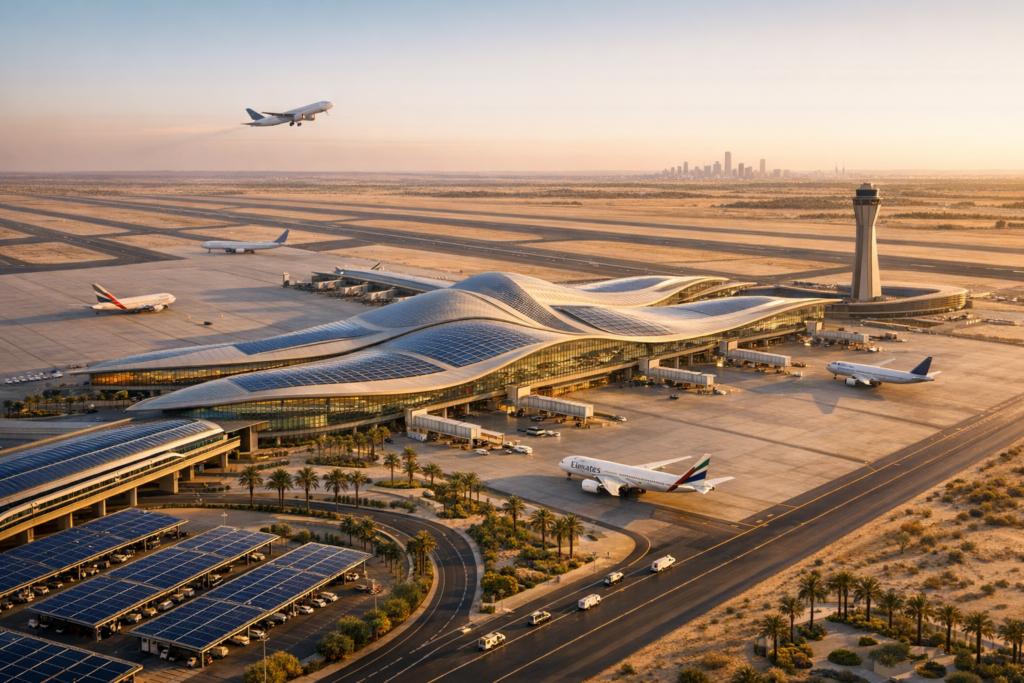
The $30 billion expansion of King Salman International Airport in Riyadh is a transformative project under Saudi Vision 2030. By 2030, the airport aims to handle up to 120 million passengers annually, with a goal of 185 million by 2050. This development spans 57 square kilometers and includes an “aerotropolis” featuring retail, hotels, and residential areas connected by the Wadi Loop. Here’s what you need to know:
- Passenger Capacity: Six runways and advanced terminals will manage high passenger volumes and reduce congestion. By 2029, the airport will handle 40 million passengers annually.
- Economic Impact: Contributing $7.2 billion yearly to non-oil GDP, it will create 103,000 jobs in sectors like aviation, logistics, and technology.
- Modern Technology: AI-driven systems, biometric corridors, and automated services will streamline passenger experiences.
- Global Connectivity: The airport will support Riyadh Air, expanding international routes and positioning Riyadh as a global aviation hub.
- Eco-Friendly Design: Powered by renewable energy, the airport aims for LEED Platinum certification with sustainable materials and zero-landfill initiatives.
This expansion will reshape air travel in the Middle East, boosting tourism, trade, and job creation while setting new standards in efficiency and sustainability.
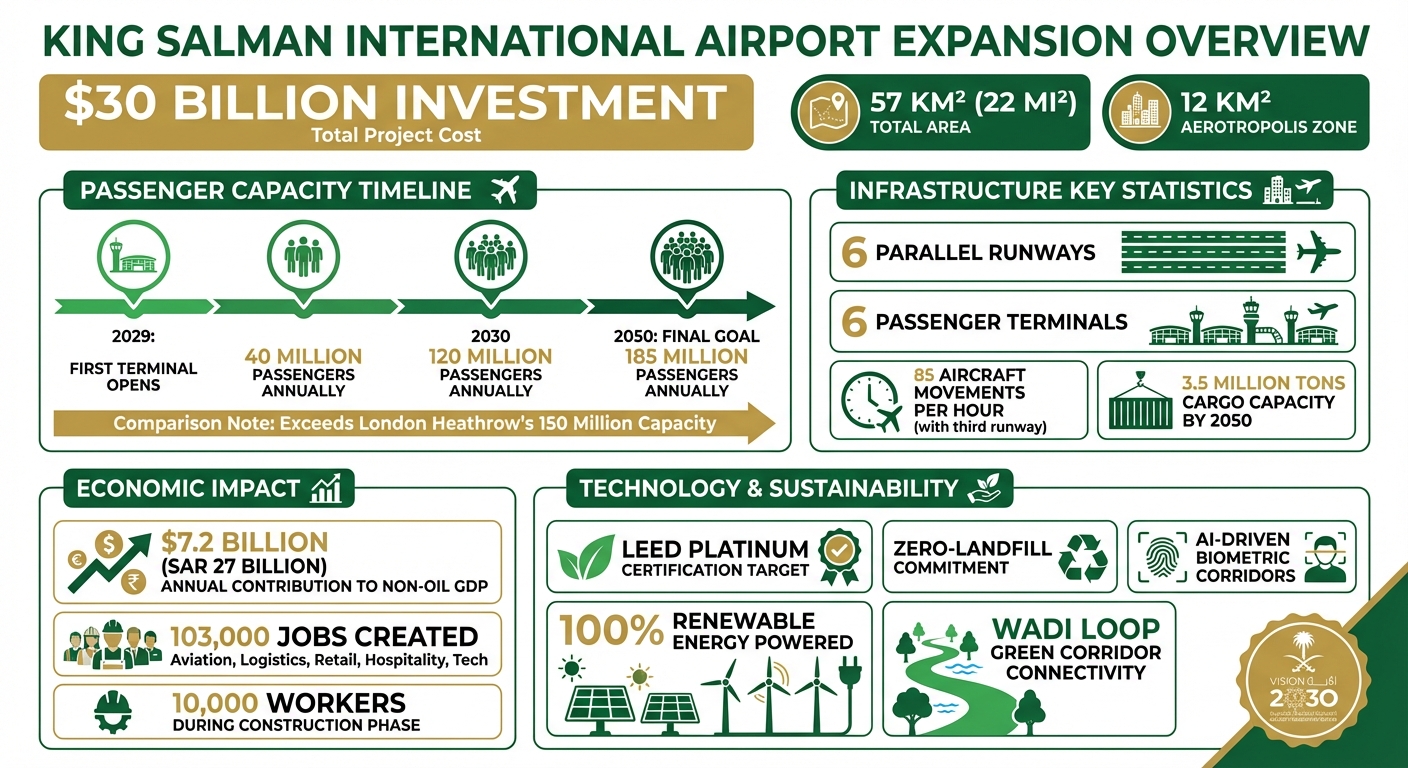
King Salman Airport Expansion: Key Statistics and Timeline 2026-2050
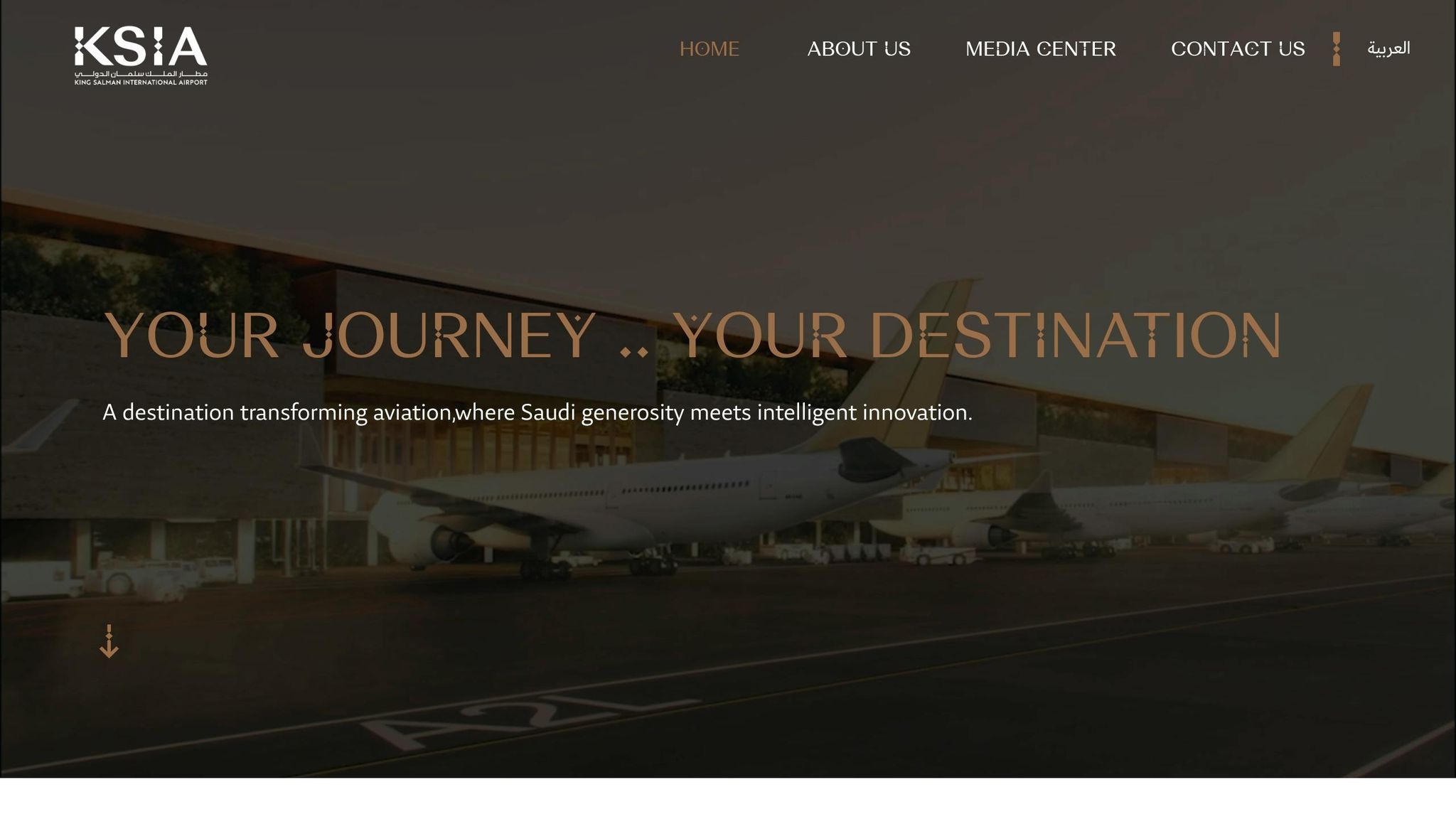
Inside Riyadh’s mega-airport project: King Salman International Airport
sbb-itb-e205081
1. Increased Passenger Capacity
The expansion of King Salman International Airport directly addresses the growing challenges of managing high passenger volumes in modern aviation. Spanning a massive 57-km² (22-mi²) area, this development represents a major leap in infrastructure upgrades.
A new passenger terminal, scheduled to begin construction in 2026, is designed to handle 40 million travelers annually upon its opening in 2029. By 2030, the airport is projected to accommodate between 100 and 120 million passengers each year, with an ambitious goal of reaching 185 million by 2050. This growth positions Riyadh as a global leader, potentially surpassing the expanded capacity of London Heathrow, which is set at 150 million. The state-of-the-art terminal will redefine what’s possible in passenger capacity.
The airport’s six parallel runways allow for simultaneous take-offs and landings across various flight classes, significantly increasing operational efficiency. Additionally, a third runway, measuring 4,200 meters (about 2.6 miles), will boost the airport’s capacity from 65 to 85 aircraft movements per hour. Marco Mejia, Acting CEO, emphasized the importance of this milestone:
Launching construction of the third runway marks a pivotal step in delivering the KSIA Master Plan and reflects our commitment to developing world-class infrastructure capable of supporting future growth, enhancing operational efficiency, and expanding long-haul connectivity without constraints.
To further enhance the travel experience, the airport incorporates innovative design features to manage passenger flow. Six passenger terminals are strategically distributed to reduce congestion, a frequent issue in major travel hubs. The “Wadi Loop”, an advanced linking system, ensures seamless movement between terminals while supporting both foot and vehicle traffic. Smart mobility corridors equipped with autonomous transport systems add another layer of efficiency to the complex.
This expansion also strengthens Riyadh Air’s ability to scale its operations, offering travelers reduced wait times, fewer bottlenecks, and a wider range of flight options. These advancements align with Saudi Arabia’s Vision 2030 goals, which aim to attract millions of international tourists annually.
2. Economic Growth and Job Creation
The expansion of King Salman International Airport is set to play a major role in driving Saudi Arabia’s economic transformation, aligning closely with the Vision 2030 initiative to reduce reliance on oil revenues. This ambitious project is expected to inject around $7.2 billion (SAR 27 billion) annually into the country’s non-oil GDP, opening up new revenue streams across various industries. These economic benefits also pave the way for widespread job creation across multiple sectors.
The project’s job creation efforts cover both immediate construction needs and long-term operational roles. An estimated 103,000 jobs will be generated across industries like aviation, logistics, retail, hospitality, data science, cybersecurity, and green-building engineering. During the construction phase alone, housing and infrastructure are being developed to accommodate approximately 10,000 workers on-site.
As the project advances, targeted hiring initiatives are addressing the demand for specialized skills. In early 2026, Parsons Corporation began recruiting for advanced roles in contract administration, environmental coordination, and engineering, supporting the expansion while promoting the Saudization of high-level positions.
The airport’s planned 12-square-kilometer “aerotropolis” – featuring residential, recreational, and retail spaces – is set to create sustained employment opportunities far beyond aviation services. In May 2025, Bechtel was appointed as the delivery partner for three new terminals at the airport. During the signing, Darren Mort, President of Bechtel‘s Infrastructure Business, highlighted the project’s significance:
The King Salman International Airport is a landmark project that will reshape Riyadh and enhance the lives and communities it serves.
Beyond traditional roles, the expansion is expected to fuel demand for specialized digital and logistics expertise. The airport’s dedicated e-commerce zone and logistics hub, designed to handle 3.5 million tons of cargo by 2050, will create positions in supply chain management and automated warehousing. Partnerships with the Saudi Data and Artificial Intelligence Authority (SDAIA) and Elm aim to integrate AI-driven services, fostering high-tech jobs in digital infrastructure and predictive maintenance. This aligns with Vision 2030’s mission to diversify the economy. Marco Mejia, Acting CEO of the airport, emphasized:
the airport is also expected to… serve as a major catalyst for economic diversification through enhanced connectivity, expanded cargo capacity and increased tourism flows.
3. Improved Passenger Experience with Modern Technology
King Salman International Airport is embracing advanced technology to simplify and enhance air travel. Through partnerships with the Saudi Data and Artificial Intelligence Authority (SDAIA), Elm, and Cluster2, the airport is introducing AI-powered passenger services designed to improve the flow of travelers across the terminal.
One standout feature is the introduction of biometric corridors. These corridors enable passengers to move from check-in to boarding without repeatedly presenting physical documents. Using facial and iris recognition, travelers can clear immigration and proceed to their gate with a contactless process. This technology is already making waves globally. For example, Singapore’s Changi Airport rolled out a fully passport-free clearance system in September 2024, and by mid-October 2024, around 1.5 million travelers had used it. The results? Clearance times dropped by 60%, from 25 seconds to just 10 seconds per passenger.
Shorter wait times are a top priority for many travelers – 64% of them, according to research, cite reduced queues as their most desired improvement in airport experiences. King Salman Airport is addressing this with smart systems like automated baggage handling, self-service check-in counters, and predictive maintenance tools. These innovations are part of a broader strategy to efficiently manage the projected 120 million passengers the airport aims to accommodate annually by 2030.
Other global examples highlight the effectiveness of such advancements. India’s DigiYatra program, for instance, has implemented biometric processing at 24 airports using SITA’s Smart Path and Face Pods technology. This has cut average entry times from 15 seconds to just 5 seconds, benefiting over 30 million passengers so far.
Foster + Partners, the architectural firm behind the airport’s design, encapsulates the vision behind King Salman International:
The airport will become a dynamic aerotropolis centred around a seamless customer journey, world-class efficient operations, and innovation.
The terminal’s layout reflects this vision, offering intuitive navigation, minimal level changes, and clear sightlines across the sprawling 57 km² (22 mi²) site. Omar Hakim of the United Arab Times adds:
The accords lock in expertise across design, sustainability, logistics, and data science, positioning the project as the Middle East’s most technologically advanced airport city.
4. Better Regional and International Connections
The expansion of Riyadh’s airport is set to establish it as a global aviation hub, linking the Middle East to destinations worldwide. This development will make the airport the central base for Riyadh Air, Saudi Arabia’s new national airline, which aims to expand international flight options and boost tourism traffic. By doing so, the airport will directly compete with other major hubs in the region, offering travelers more variety and improved access to global destinations.
With increased capacity, the project will also strengthen direct international and regional route networks. The airport’s design includes six parallel runways, engineered to handle high flight volumes and simultaneous operations, ensuring smoother connectivity across numerous routes. Additionally, the facility is set to process an impressive 2 million tons of cargo annually. According to the Saudi Public Investment Fund, Riyadh is envisioned as a “bridge” connecting east and west, fostering growth in transport, trade, and tourism.
The airport’s “aerotropolis” concept integrates multiple transportation systems, creating efficient links between passenger terminals, cargo facilities, and the city’s infrastructure. Mammen Tharakan, Vice President of Investment & Partnership at King Salman International Airport, highlights the focus on logistics:
“The connectivity from passenger terminals to cargo areas is also being prioritized to reflect the importance of belly cargo in our operations and to improve the kingdom’s logistic performance index to be among the top 10 globally.”
These upgrades will ensure smooth transitions for passengers and cargo, solidifying Riyadh’s role as a strategic aviation hub.
Travelers will likely see reduced airfares as competition increases and high-capacity carriers commit to the region, driving down ticket prices on both Saudi and regional routes. Moreover, the expansion is expected to encourage multi-city tourism packages, combining Riyadh with nearby hubs like Dubai and Abu Dhabi, making it simpler for tourists to explore multiple destinations in a single trip.
Economically, the project is anticipated to add approximately $7.19 billion (SAR 27 billion) annually to Saudi Arabia’s non-oil GDP and generate around 103,000 direct and indirect jobs. Marco Mejia, Acting CEO of King Salman International Airport, underscores the transformative nature of the endeavor:
“The new terminal forms part of Riyadh’s ambitious strategy to transform the King Salman Airport into one of the world’s largest aviation hubs.”
5. Eco-Friendly Design and Green Infrastructure
The King Salman Airport expansion isn’t just about increasing capacity and connectivity – it’s also setting a new standard for sustainability in aviation. Designed with a focus on eco-conscious innovation, the project aims to meet the highest environmental benchmarks in the industry. A key goal is achieving LEED Platinum certification, addressing both the carbon footprint of construction materials and the operational emissions over the airport’s lifespan. Foster + Partners, the project’s design architect, emphasized this in 2026:
With sustainability at its core, the new airport will achieve LEED Platinum certification by incorporating advanced green initiatives addressing both embodied and operational carbon, and will be powered by renewable energy. – Foster + Partners
This dedication to sustainable design aligns seamlessly with the airport’s broader goals of enhanced capacity, connectivity, and economic growth.
One of the project’s standout commitments is its reliance on renewable energy to power the entire facility, eliminating the need for fossil fuels in daily operations. In February 2026, the King Salman International Airport Development Company partnered with firms like Jacobs, Mace, and Nera to ensure the use of low-carbon construction materials and on-site renewable energy systems. Additionally, a green procurement pipeline was established, requiring suppliers to meet LEED-Platinum standards for all materials and components.
A key feature of the expansion is the “Wadi Loop”, a 4.6-square-mile (12 km²) green corridor that blends natural landscapes with sustainable urban design. The main terminal itself incorporates passive strategies such as natural ventilation and optimized lighting, reducing energy consumption while maintaining a comfortable environment.
The airport’s environmental initiatives go even further with a zero-landfill pledge. Backed by advanced waste management systems, this commitment is supported by a 2026 agreement with the National Centre for Waste Management. The partnership ensures the integration of circular-economy principles throughout construction and daily operations. Smart waste technologies, including sensor-enabled compactors, anaerobic digesters, and waste-to-energy systems, will play a central role. Additionally, specialized carbon-accounting software will monitor emissions across the supply chain.
These efforts solidify the airport’s position as a global leader in sustainable infrastructure, proving that environmental responsibility can work hand in hand with technological and economic progress.
What This Means for Travelers
The King Salman Airport expansion is set to make a noticeable difference for anyone flying through Riyadh. With plans for six parallel runways, airspace congestion will ease, cutting down wait times for takeoffs and landings significantly. On top of that, AI-powered passenger services and biometric corridors will simplify the entire process, offering automated check-ins and predictive systems to make your journey smoother and faster. These updates promise a more seamless travel experience.
But it’s not just about efficiency. The airport’s aerotropolis design adds a whole new dimension to the experience. Spanning 12 km², the area will feature retail, leisure, and hospitality spaces, all connected by the scenic Wadi Loop. Whether you’re passing through or have a layover, this setup makes the airport a destination in itself. With a goal of accommodating 120 million passengers by 2030 and new nonstop routes through its partnership with Riyadh Air, the airport is gearing up to attract more global travelers.
Travelers can also expect lower airfares as competition among carriers heats up, which is great news for U.S. and international passengers. Omar Hakim of the United Arab Times highlights how this development positions Riyadh as a key hub for regional connectivity.
Adding to the convenience, platforms like Flight Booking 247 provide 24/7 support to help you compare flight options, find deals, and manage bookings. Whether you’re planning a trip or making last-minute changes, their live operators make navigating the growing network of connections at King Salman Airport easier than ever.
With the first two runways and a terminal designed for 40 million passengers set to open by 2029, travelers won’t have to wait long to start enjoying these upgrades. And as the project continues toward its full capacity of 185 million passengers by 2050, the improvements will keep coming. It’s a phased approach that ensures steady progress in enhancing passenger convenience over time.
Conclusion
King Salman Airport’s expansion is more than just a construction project – it’s a bold step toward reshaping air travel in the Middle East while aligning with Saudi Arabia’s Vision 2030. With a staggering $30 billion investment, the airport is set to grow its capacity and capabilities to keep pace with increasing demand.
This development will do more than accommodate travelers. It’s projected to add over 103,000 high-skill jobs and significantly contribute to the non-oil GDP, underscoring its economic importance. Passengers can also look forward to a seamless travel experience, thanks to the integration of mixed-use districts via the Wadi Loop and cutting-edge AI services. On top of that, the airport’s commitment to LEED-Platinum standards places sustainability at the forefront of its design.
“The new terminal forms part of Riyadh’s ambitious strategy to transform the King Salman Airport into one of the world’s largest aviation hubs.” – Marco Mejia, Acting CEO, King Salman International Airport
With its first phase set to open in 2029, this expansion is poised to enhance regional connectivity and competition. It’s a project designed to leave a lasting impact on both the aviation industry and travelers across the Middle East for generations to come.
FAQs
When will the first phase open?
The first phase of the King Salman Airport expansion is scheduled to open in 2026. This marks an important step toward increasing the airport’s capacity and improving the overall passenger experience.
How will biometric corridors affect privacy?
Biometric corridors come with potential privacy concerns due to the collection and use of personal biometric data. These concerns often revolve around data security, informed consent, and the risk of misuse. To address these issues, implementing strong safeguards is crucial. Measures like robust encryption, clear consent protocols, and strict regulations can help protect individuals’ information and ensure their privacy is respected.
Will the expansion lower ticket prices?
The planned expansion is designed to boost capacity and upgrade infrastructure. This could potentially result in lower ticket prices, as increased efficiency and competition often drive costs down. However, this outcome isn’t guaranteed and will likely depend on various market conditions.