
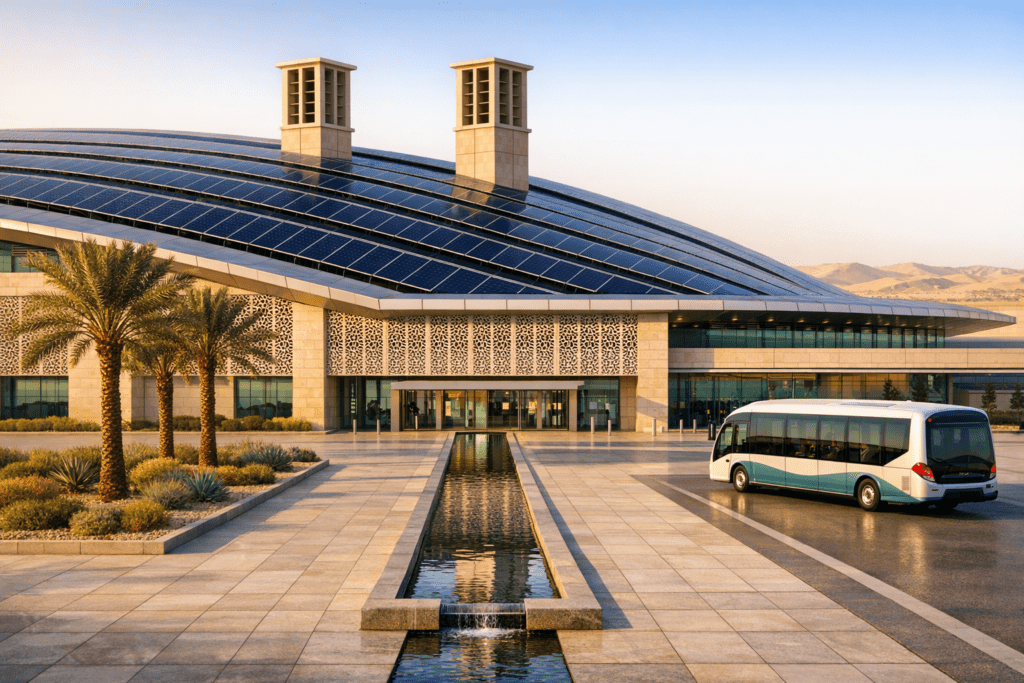
In the Middle East, building airports that work efficiently in extreme climates is no small task. With temperatures often exceeding 104°F and scarce rainfall, energy and water conservation are critical. Here’s how airports in the region are tackling these challenges:
- Energy Efficiency: Airports like Zayed International and Hamad International are adopting solar panels, LED lighting, and advanced cooling systems to cut energy use and reduce carbon emissions.
- Water Conservation: Projects like Zayed International’s landscaping with native plants and volcanic soil have reduced water use by 50%. Other airports recycle wastewater for irrigation and cooling.
- Smart Technologies: AI-driven systems optimize cooling and lighting based on real-time occupancy, saving energy and improving comfort.
- Green Certifications: Many airports are earning LEED certifications and participating in the Airport Carbon Accreditation program to track and improve their carbon footprint.
These measures not only reduce resource use but also prepare airports for future growth while meeting global sustainability goals.
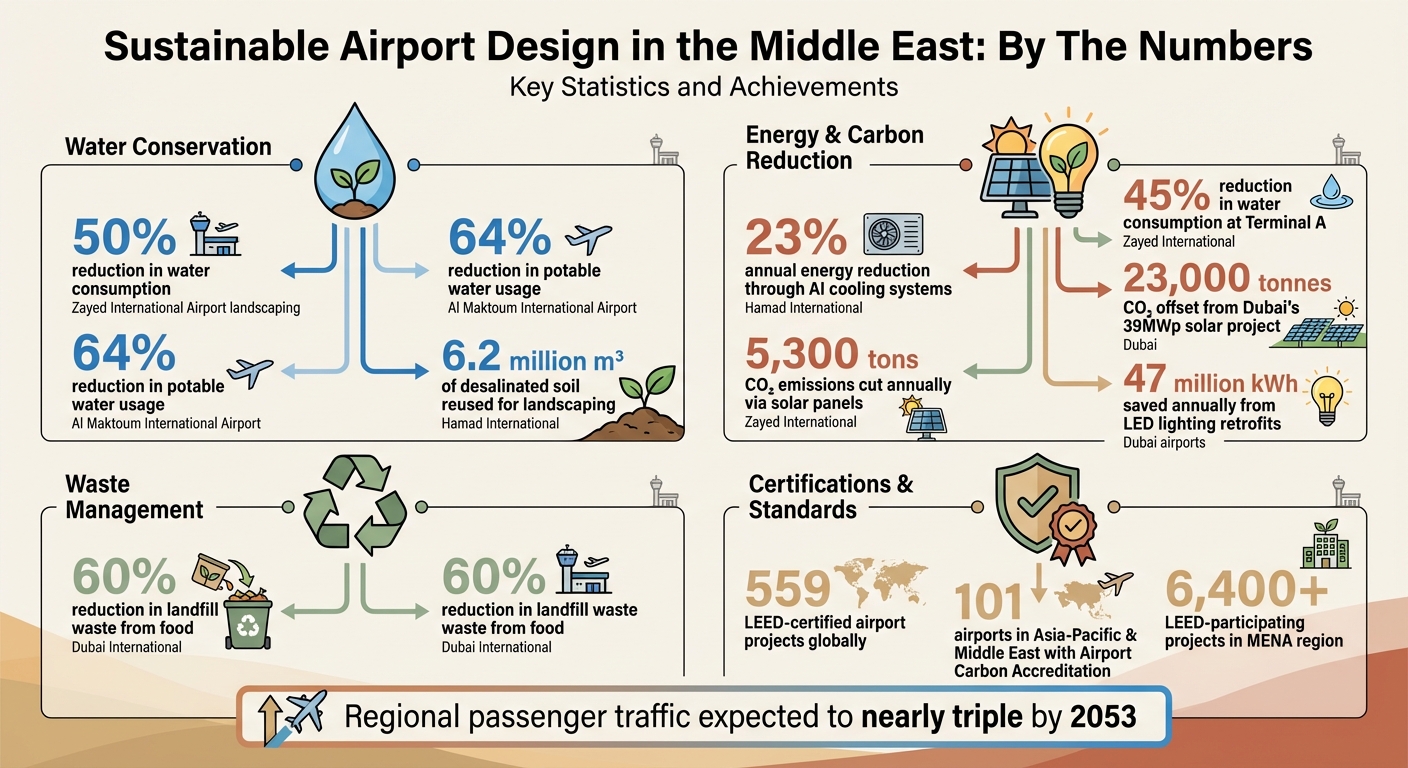
Sustainable Airport Design Impact Statistics in Middle East
Inside Kuwait’s $4.3B Mega Airport: The Engineering Marvel Defying Extreme Heat
sbb-itb-e205081
Architecture for Sustainability
Airports in the Middle East are reimagining architecture to align with the region’s harsh desert climate. This isn’t just about adding eco-friendly features – it’s about designing buildings that work with their environment to minimize energy use. Let’s explore some standout strategies, from using native plants to cutting-edge cooling systems, that showcase this thoughtful approach.
Using Native Plants and Landscaping
Incorporating desert-adapted plants into airport landscaping has proven to be an effective way to conserve water. These plants thrive with minimal irrigation, making them perfect for large-scale projects. At Zayed International Airport, native plants combined with moisture-retentive soils demonstrate how landscaping can be both practical and sustainable.
“This project is more than just a development – it’s a symbol of our commitment to innovation and sustainability. By using local resources and advanced technology, we’ve set a new benchmark for green infrastructure in the Middle East.”
- Khaled Abbas, Regional Director of Landscape and Client Relations, Dorsch Abu Dhabi
Hamad International Airport in Doha highlights another innovative approach. The airport reused 6.2 million cubic meters of desalinated excavated soil for landscaping and irrigates its plants exclusively with recycled wastewater. Similarly, Al Maktoum International Airport in Dubai is using constructed wetlands to filter stormwater for non-potable uses. These wetlands not only reduce potable water consumption by 64% but also create habitats for local wildlife.
Building Designs Inspired by Desert Environments
Drawing inspiration from the desert, architects are designing terminals that naturally combat heat. For instance, Kohn Pedersen Fox (KPF), led by Design Principal Mustafa Chehabeddine, unveiled Terminal A at Zayed International Airport in November 2023. The terminal features a roof shaped like sand dunes, reducing glazing along piers by 50% to lower cooling needs. The facility also achieved a 45% reduction in water consumption and generates 3MW of solar power annually through 7,500 solar panels, cutting CO₂ emissions by 5,300 tons each year.
“The undulating massing was inspired by the sand dunes in the immediate context of the terminal, as well as by the Emirati loose-fit dress costume that is designed to conceal and protect.”
- Mustafa Chehabeddine, Design Principal, Kohn Pedersen Fox
At Queen Alia International Airport in Jordan, Foster + Partners used modular concrete domes inspired by Bedouin tents. The high thermal mass of the concrete stabilizes internal temperatures despite extreme daily temperature swings. This design supports future expansion, aiming to increase capacity from 3.5 million to 12 million passengers by 2030. Advanced glazing techniques are also making a difference – Zayed International uses high-performance glass that lets in 34% of daylight while blocking 79% of solar heat gain.
Modern Cooling Systems for Energy Savings
Cooling systems in these airports combine advanced technology with smart design to cut energy use. At Hamad International Airport, a partnership with Siemens introduced “Demand Flow” technology. This system uses AI and CO₂ sensors to optimize cooling in real time, reducing energy consumption by 23% annually. By 2030, the airport aims to lower its relative carbon emissions by 30%. Since 2021, these efforts have already eliminated over 5,000 metric tons of CO₂ emissions.
“This collaboration with Siemens strongly aligns with our environmental sustainability goals by adopting innovative solutions and our commitment to investing in the latest technology that will reduce our environment footprint.”
- Michael McMillan, Senior Vice President, Facilities Management, Hamad International Airport
At Zayed International Airport, Transsolar and KPF implemented displacement ventilation, which delivers cooler air at floor level while allowing warmer air to rise. This method is especially effective in the terminal’s 164-foot-high departures hall, ensuring passenger comfort without wasting energy on unused upper zones. This approach is a game-changer for large spaces with high ceilings, cutting down on unnecessary energy use.
Energy Efficiency and Renewable Energy Use
Airports in the Middle East are stepping up their game by combining renewable energy with smart systems to improve energy efficiency and reduce their carbon footprints. These facilities, which consume vast amounts of energy, are uniquely positioned to generate clean power on-site. With projects like large-scale solar installations and intelligent lighting upgrades, airports are proving that operational efficiency and sustainability can work side by side.
Solar Panel Systems
Dubai’s airports are leading the charge in renewable energy adoption. In October 2024, Paul Griffiths (CEO of Dubai Airports) and Dr. Waleed Alnuaimi (CEO of Etihad ESCO) signed an agreement for a massive 39MWp solar project spanning Dubai International (DXB) and Dubai World Central (DWC). With 62,904 solar panels set to be fully operational by 2026, the project will generate 60,346 MWh annually and offset 23,000 tonnes of CO₂ emissions.
“Every kilowatt we generate from renewable sources brings us closer to shrinking our carbon footprint and future-proofing our operations. This is about setting the standard and leading the way for what a truly sustainable airport can achieve.”
- Paul Griffiths, CEO, Dubai Airports
Once complete, this initiative will supply 6.5% of DXB’s energy needs and 20% of DWC’s. Dubai has already made strides in solar energy, with a 5MWp installation at DXB Terminal 2 completed in July 2019. This earlier project, featuring 15,000 photovoltaic panels, now produces 7,483,500 kWh annually, cutting the terminal’s energy demand by 29% and saving AED 3.3 million each year. Beyond passenger terminals, the Emirates Engineering Centre added 39,960 solar panels in October 2024, generating 23,177 kWp. This system now meets 37% of the facility’s annual energy consumption and reduces CO₂ emissions by over 13,000 tonnes annually. These solar projects highlight the potential for airports to integrate renewable energy into their operations at scale.
LED Lighting Throughout Facilities
Lighting upgrades are another area where airports are cutting energy use. In June 2025, Dubai Airports and Etihad ESCO began the final phase of a massive lighting retrofit across DXB and DWC. This project involves replacing over 330,000 lighting units and is set to wrap up by late 2027. The expected impact? A reduction of 47 million kWh in annual energy consumption – enough to power more than 4,300 homes for a year. Concourse A at DXB, the largest area in this project, plays a key role in these upgrades, which are projected to save over AED 20 million annually.
Smart Building Systems
Smart systems are taking energy efficiency to the next level. At Al Maktoum International Airport, advanced automation, like on-demand displacement ventilation, uses sensors to adjust cooling rates based on real-time occupancy. This system, part of a master plan by Perkins&Will, is helping the airport move closer to net-zero energy use. Meanwhile, DXB’s “Follow the Greens” system optimizes aircraft taxiing paths, cutting fuel consumption and carbon emissions during ground operations.
These advanced systems aren’t just about saving energy – they also deliver measurable results. As Dr. Waleed Alnuaimi explained:
“This final phase of the lighting retrofit project with Dubai Airports is a testament to how strategic partnerships and innovative solutions can deliver measurable impact – from substantial energy savings to a reduced carbon footprint.”
- Dr. Waleed Alnuaimi
Water Conservation Methods
Water scarcity is a pressing issue in the Middle East, and airports in the region are stepping up with strategies to conserve water. By adopting advanced recycling systems, efficient fixtures, and smart sourcing practices, these facilities are making significant strides. In fact, some airports have managed to slash water usage by over 50% while maintaining top-tier operations.
Water Recycling and Reuse
Airports are finding innovative ways to capture and reuse water. For instance, Al Maktoum International Airport adopted a “whole systems” approach, as outlined in a sustainability plan by Perkins&Will in 2015. This plan includes greywater harvesting from sinks, collecting cooling tower condensate, and using constructed wetlands to filter stormwater. Paired with vacuum toilets, these measures have reduced potable water usage by 64%. The system treats wastewater from terminals as a resource, cycling it back into cooling towers and landscaping.
“Efficient appliances in the kitchens and low-flow fixtures and vacuum toilets in the washrooms could be combined with greywater harvesting and treatment, cooling tower condensate collection, bioswales, and other liquid reclamation measures for a total potable water reduction of 64%.”
- Perkins&Will
The UAE is pursuing ambitious goals, including Dubai’s commitment to achieving 100% wastewater recycling by 2030 and the UAE Water Security Strategy 2036’s aim of 95% reuse of treated water.
Efficient fixtures play a key role in complementing these recycling efforts.
Low-Flow Fixtures and Equipment
Modern water-saving fixtures are transforming daily operations. Vacuum toilets, which use far less water per flush compared to traditional systems, are now standard in many new terminals. When paired with greywater harvesting, these systems amplify water savings. High-efficiency faucets and showerheads further reduce potable water usage, while smart building systems monitor real-time consumption, helping to detect leaks and optimize water use.
Responsible Water Sourcing
In addition to recycling and efficient fixtures, airports are adopting responsible water sourcing practices to protect groundwater. At Zayed International Airport in Abu Dhabi, a landscaping project by Dorsch Global avoided depleting groundwater aquifers. Instead, volcanic soil imported from Hungary was used to retain moisture across 480,000 square meters (roughly 5.17 million square feet) of green space. This innovative approach, combined with native plants, reduced water consumption by 50%.
“The project also avoided tapping into groundwater aquifers, preserving these vital resources for future generations.”
- Staff Writer, Construction Week Online
Desert-friendly xeriscaping and moisture-retentive materials help lower water demand while protecting aquifers. Some airports are even incorporating 18-meter-high (59-foot) sand dunes and architectural shading to naturally regulate microclimates, reducing evaporation.
These approaches are shaping sustainable infrastructure that ensures the resilience of airport operations in the Middle East.
Green Certifications and Standards
Certifications are now playing a key role in validating sustainable practices in airports, particularly in the Middle East. These certifications provide frameworks to measure energy use, carbon emissions, and other environmental factors, showcasing a commitment to eco-friendly operations. Globally, as of December 2025, there are 559 LEED-certified and registered airport projects, covering an impressive 333 million square feet, signaling a growing shift toward sustainable aviation infrastructure.
LEED Certification for Airports
The LEED (Leadership in Energy and Environmental Design) system is the most widely recognized green building rating system for airports. For new constructions or major renovations, airports often aim for LEED for Building Design and Construction (BD+C). For facilities already in use for at least a year, LEED for Operations and Maintenance (O+M) is the standard.
A notable example is the Prince Mohammad Bin Abdulaziz International Airport in Madinah, which became the first commercial airport terminal in the MENA region to achieve LEED Gold certification for its terminal expansion. Following this milestone, Tibah Airport Operations Co. set LEED Silver as the minimum standard for all new construction projects at the airport.
“A minimum of LEED Silver certification is the standard for all new construction projects at the airport, but Gold for a project of this significance exemplifies our deep commitment to sustainable practices” – Sofiene Abdessalem, Managing Director, Tibah Airport Operations Co.
Hamad International Airport (HIA) in Doha has also embraced LEED standards. Its Central Concourse earned LEED Gold certification in March 2024, followed by the Concourse D + E Expansion receiving the same in November 2025. These projects incorporated features like solar-reflective materials and carbon dioxide sensors, achieving 30% lower energy use and 55% less water consumption compared to standard designs.
For airports with interconnected buildings, the LEED Campus Guidance simplifies certification by treating the entire airport as a single site, reducing costs and streamlining the process. Some facilities are even pursuing LEED for Cities and Communities certification to evaluate the sustainability of the entire airport campus instead of individual buildings.
Tracking Environmental Performance
Certifications aren’t just about design – they require ongoing performance tracking. Platforms like Arc monitor metrics such as energy, water, waste, transportation, and user experience, enabling triennial recertification based on operational data.
The Airport Carbon Accreditation (ACA) program offers a tailored framework for aviation facilities, featuring seven levels of certification, from Level 1 (Footprint) to Level 5 (Net Zero). By late 2025, 101 airports across the Asia-Pacific and Middle East regions were part of this program.
| ACA Certification Level | Primary Requirement |
|---|---|
| Level 1: Footprint | Calculate and report annual carbon emissions |
| Level 2: Management | Show evidence of effective carbon management and reductions |
| Level 3: Engagement | Include third-party emissions and engage stakeholders |
| Level 4: Transformation | Align long-term strategies with the Paris Agreement |
| Level 5: Net Zero | Achieve Net Zero for Scopes 1 & 2; address Scope 3 emissions |
For instance, Dubai International Airport (DXB) achieved Level 4 ‘Transformation’ accreditation in 2024/2025. Among its initiatives were optimized taxiing paths to cut fuel consumption and a food waste treatment plan with BEE’AH Group, reducing landfill waste by 60%.
Meanwhile, Sharjah Airport has adopted the ISO 14001:2015 environmental management system to handle day-to-day environmental impacts. The airport has transitioned its ground-handling fleet to electric vehicles and implemented a tree-planting program, with each tree absorbing approximately 23 kg of CO2 annually.
Planning for Long-Term Sustainability
Airports are now incorporating sustainability into their long-term expansion plans. Hamad International Airport has set a target to improve carbon efficiency per passenger by 30% by 2030, using 2015 as a baseline. This ensures that growth aligns with environmental goals.
Regional efforts are also gaining traction. The General Authority of Civil Aviation (GACA) in Saudi Arabia has introduced eco-design guidelines for airport buildings, helping them meet both global standards and local priorities. As of June 2024, the MENA region boasts over 6,400 LEED-participating projects, with Saudi Arabia leading in the number of certified buildings.
Reaching higher ACA certification levels requires airports to collaborate with third parties, like airlines and ground handlers, to cut emissions across the board. Some facilities are even adopting “regenerative design” principles, which aim to restore natural ecosystems and enhance quality of life, going beyond just minimizing environmental harm.
Conclusion
In the Middle East, sustainable airport design has become a cornerstone of modern aviation infrastructure. By embracing climate-conscious architecture and advanced energy systems, airports are significantly cutting resource use while accommodating rapid growth.
Take Zayed International, for example – it has slashed landscaping water consumption by 50%. Similarly, Dubai International has managed to reduce landfill contributions from food waste by an impressive 60%. These achievements highlight a comprehensive resource management strategy, where water, waste, energy, and carbon are treated as interconnected challenges rather than standalone issues. This approach is further validated through green certifications.
Programs like LEED standards and the Airport Carbon Accreditation initiative provide measurable frameworks to assess and recognize these sustainability efforts. With passenger traffic in the region expected to nearly triple by 2053, such certifications are vital to balancing economic expansion with environmental responsibility.
“Airports are no longer transit points, they are emerging as leaders in climate action and gateways to a sustainable future.” – Stefano Baronci, Director General, ACI Asia-Pacific & Middle East
FAQs
What’s the biggest sustainability challenge for Middle East airports?
The main challenge Middle East airports face in adopting sustainable practices is the high upfront cost of implementing green technologies. On top of that, they deal with regulatory hurdles, the need to align various stakeholders, and the difficulty of incorporating sustainable solutions into existing infrastructure without disrupting daily operations.
Operating in regions with limited water resources adds another layer of complexity. Airports often need to invest in expensive innovations like wastewater reuse systems and desalination technologies to address water scarcity.
Still, progress is being made. Many airports are pushing forward with initiatives in renewable energy, environmentally friendly infrastructure, and water conservation efforts, showing their commitment to a more sustainable future.
How do airports cut cooling energy in extreme heat?
Airports are tackling extreme heat challenges by adopting optimized district cooling systems equipped with advanced technologies like Demand Flow. These systems are designed to cut down energy consumption while also reducing CO2 emissions. A prime example is Hamad International Airport, which partnered with Siemens to implement cooling solutions aimed at achieving more sustainable energy use.
Which green certification should an airport target first?
Airports should focus on achieving LEED certification, a globally acknowledged benchmark for sustainable construction. This certification isn’t limited to individual buildings – it covers entire airport facilities. By adopting LEED standards, airports can address environmental concerns, promote social responsibility, and contribute to economic growth, making it a strong foundation for sustainability efforts.