
An Air Operator Certificate (AOC) is a mandatory approval for airlines to conduct commercial air transport. Issued by aviation authorities like the UAE’s GCAA or Saudi Arabia’s GACA, it ensures compliance with safety and operational standards. Acquiring an AOC involves a 5-phase process based on ICAO guidelines, covering eligibility, application, inspections, and certification. Here’s what you need to know:
- Eligibility: Operators must demonstrate financial stability, submit detailed business plans, and establish local headquarters.
- Application Process:
- Phase 1: Pre-Application (eligibility check, management personnel nomination).
- Phase 2: Formal Application (manuals, insurance, and financial proof submission).
- Phase 3: Documentation Review (gap analysis and corrections).
- Phase 4: Demonstration & Inspection (facility checks, test flights, safety systems).
- Phase 5: Certificate Issuance (approval for operations).
- Timeline: The process can take 2+ years. For example, Riyadh Air secured its AOC in 25 months.
- Costs: Beyond application fees, expenses include training (e.g., $2,676 for Aviation Auditor courses) and operational setup.
Compliance doesn’t end with certification. Regular audits, re-validations, and strict oversight ensure safety and adherence to regulations. Operators must remain vigilant to avoid penalties or disruptions.
This process is critical for airlines aiming to operate in the Middle East while maintaining safety and reliability standards.
ICAO GSI Operations – Air Operator Certification Process – TRAINER INTERVIEW
Eligibility Requirements for AOCs in the Middle East
Meeting eligibility requirements is a critical first step in obtaining an Air Operator Certificate (AOC) in the Middle East. Each country in the region has its own aviation authority with specific standards that operators must meet before they can even begin the formal application process. Generally, these requirements focus on proving financial stability and adhering to regulatory guidelines. Here’s a closer look at the requirements in two key countries:
UAE General Civil Aviation Authority (GCAA) Requirements
To apply for an AOC in the UAE, operators must meet several key conditions set by the GCAA:
- Establish a headquarters within the UAE.
- Obtain a valid Air Service License (ASL).
- Provide a business plan and evidence of funding to cover operations for at least the first 24 months.
Saudi Arabia General Authority of Civil Aviation (GACA) Requirements
In Saudi Arabia, GACA has outlined specific rules for operators, particularly those under GACAR Part 121, which applies to large commercial carriers. Applicants must demonstrate both financial stability and operational readiness. These criteria are further detailed during the formal application phase, forming a crucial part of the overall AOC process.
The 5-Phase AOC Application Process
5-Phase AOC Application Process for Middle East Airlines
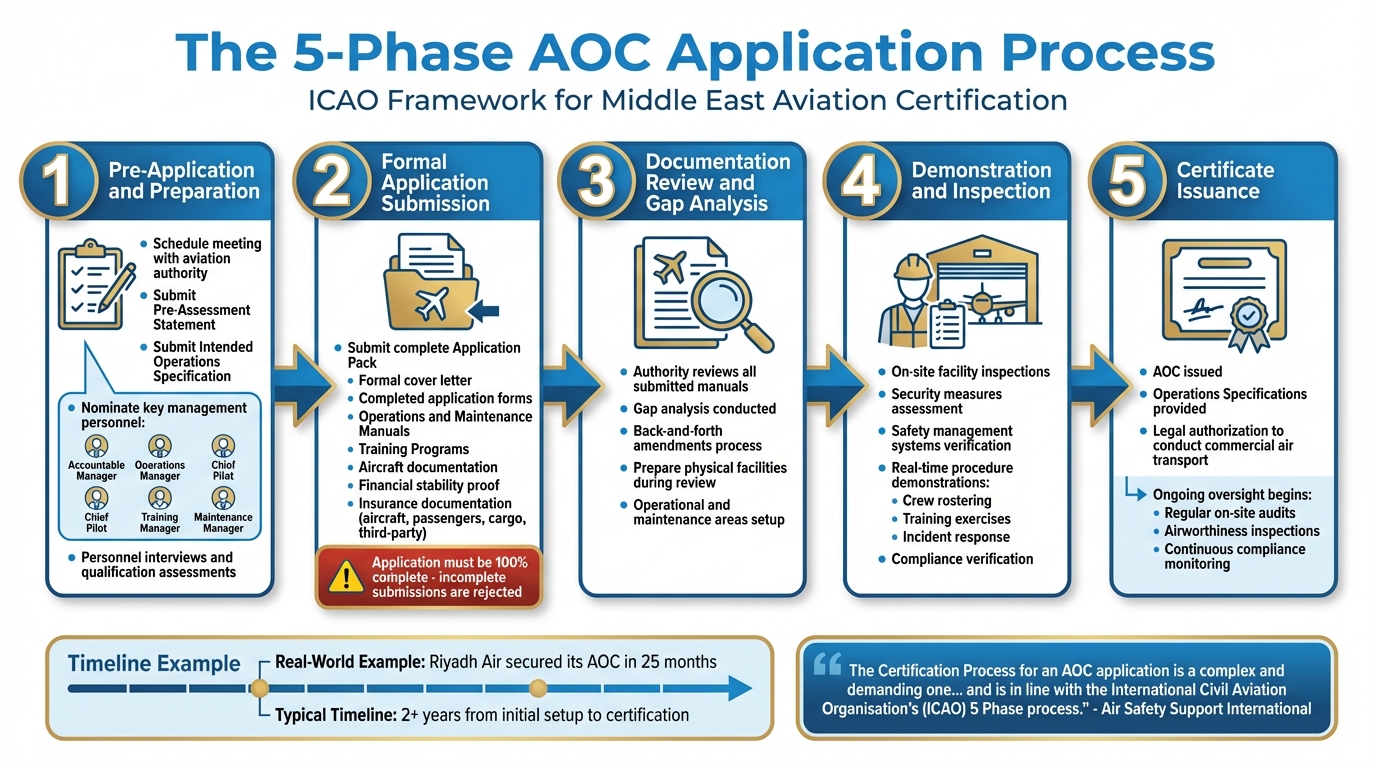
The Middle East AOC process is built around the International Civil Aviation Organization’s (ICAO) five-phase model. This structured approach ensures that operators meet strict safety and compliance standards, which are key to obtaining an Air Operator Certificate (AOC) in the region. While the overall framework remains the same, specific forms and regional criteria may differ depending on the aviation authority.
“The Certification Process for an AOC application is a complex and demanding one… and is in line with the International Civil Aviation Organisation’s (ICAO) 5 Phase process.” – Air Safety Support International
Here’s a breakdown of each phase, from initial preparation to certification, following ICAO’s guidelines.
Phase 1: Pre-Application and Preparation
This phase focuses on assessing whether your organization has the necessary resources, structure, and expertise to operate safely. Start by scheduling a meeting with the aviation authority to confirm eligibility and discuss regional requirements. At this stage, you’ll submit a Pre-Assessment Statement and an Intended Operations Specification, outlining your planned routes and operating areas.
It’s also crucial to nominate key management personnel, including the Accountable Manager, Operations Manager, Chief Pilot, Training Manager, and Maintenance Manager. These individuals will likely undergo interviews with the aviation authority to evaluate their qualifications and readiness for the specific aircraft and operations you’re proposing. Their performance in these assessments can heavily influence your organization’s readiness evaluation, so preparation is key.
Phase 2: Formal Application Submission
Once the pre-application phase is complete, you’ll move on to submitting a detailed Application Pack. This includes a formal cover letter, completed application forms, and finalized versions of all required manuals, such as Operations and Maintenance Manuals, as well as your Training Programs. Additionally, you’ll need to provide documentation for your aircraft and demonstrate financial stability, including proof of insurance for aircraft, passengers, cargo, and third-party liabilities.
Key Point: Aviation authorities will not begin reviewing your application unless it is 100% complete. Submitting incomplete documents is a common cause of delays, as authorities will reject the package outright rather than proceed with partial information.
Phase 3: Documentation Review and Gap Analysis
During this phase, the aviation authority carefully reviews your submitted manuals and identifies any gaps or areas requiring amendments. This back-and-forth process can take time, so maintaining open communication and responding promptly to feedback is essential.
While the documentation is under review, it’s a good idea to start preparing your physical facilities, such as operational and maintenance areas, for the next phase. Being proactive here can save valuable time and help you transition smoothly into the inspection stage once the documentation review is complete.
Phase 4: Demonstration and Inspection
This stage shifts from theory to practice. Inspectors will visit your facilities to verify compliance with safety and operational standards. They’ll assess your security measures, safety management systems, and overall readiness to manage commercial air transport operations. Expect to demonstrate various procedures in real-time, such as crew rostering, training exercises, and incident response.
Phase 5: Certificate Issuance
Once the aviation authority confirms that all regulatory and safety requirements have been met, they will issue your Air Operator Certificate (AOC) along with the associated Operations Specifications. These documents officially authorize you to conduct commercial air transport operations and serve as the legal framework for the authority to oversee your activities.
“The Air Operator Certificate (AOC) and the associated Operations Specifications, provide the basis for [the authority] to regulate the activities of an operator, and it is the means by which an air operator is authorised to conduct commercial air transport operations.” – Air Safety Support International
Receiving your AOC isn’t the end of the process – it marks the start of ongoing oversight. To ensure continued compliance, the authority will conduct regular on-site audits and inspections of your operations and airworthiness practices. This continued monitoring plays a critical role in maintaining safety and regulatory standards, which are explored further in the compliance section.
Country-Specific Differences in AOC Processes
The ICAO framework provides a global structure for the AOC process, but regional authorities often introduce additional layers of regulation. In the Middle East, many countries adhere to ICAO’s five-phase framework but also have unique requirements that influence both the timeline and the documentation needed. Here’s a closer look at how specific countries approach the process.
UAE GCAA Process Details
In the UAE, the General Civil Aviation Authority (GCAA) mandates that operators set up their Principal Place of Business within the country before initiating the AOC application. This step ensures that the operator is firmly rooted in the UAE, aligning with local regulatory expectations. The GCAA places a strong emphasis on having a qualified management team and adhering to protocols tailored to UAE standards. During the demonstration phase, the authority conducts thorough inspections of facilities to confirm compliance with safety and operational guidelines.
Saudi Arabia GACA Process Details
Saudi Arabia’s General Authority of Civil Aviation (GACA) also follows the ICAO framework but places particular importance on organizational readiness and operational compliance. The inspection phase is especially rigorous, with a detailed review to ensure the operator is fully prepared to meet operational demands.
Other Regional Authorities
In addition to the UAE and Saudi Arabia, other Middle Eastern countries contribute to a diverse AOC landscape. Across the region, ICAO has identified 11 Regional Safety Oversight Organizations (RSOOs). These organizations can sometimes issue AOCs on behalf of their member states, adding another layer of coordination to the process. This regional collaboration highlights the complexity of navigating AOC requirements in this part of the world.
sbb-itb-e205081
Timelines, Costs, and Required Documentation
Once eligibility and application steps are addressed, operators need to dive into the details of timelines, costs, and documentation. The process of obtaining an AOC (Air Operator Certificate) in the Middle East requires both time and financial resources, with requirements differing from country to country. For example, Saudi Arabia’s process typically takes about two years from initial setup to final certification. Riyadh Air illustrates this timeline well: founded on March 12, 2023, it secured its Passenger Air Transport Economic License on June 14, 2023, and its AOC on April 6, 2025 – approximately 25 months in total. A spokesperson for Riyadh Air shared:
“Riyadh Air has worked tirelessly in recent months to work towards the award of our AOC and completed all flying and technical requirements”.
This timeline is relatively quick compared to earlier cases. Back in 2016, privately-owned carriers like Al-Maha Airways and SaudiGulf Air faced a three-year wait between obtaining initial licenses and receiving their AOCs.
Costs Beyond Application Fees
The financial commitment goes far beyond application fees, covering areas like staffing, training, and compliance requirements. Key personnel are required to complete IATA-certified courses, with costs ranging from $2,150 to $3,550 per course. For example:
- Aviation Internal Auditor training: $2,676
- Station Management and Ground Handling Supervision: $3,550
Operating in the UAE, known for its premium aviation infrastructure, also means higher living costs. Aviation professionals in Dubai face monthly living expenses averaging $2,000 – significantly higher than the $600 average in some European training centers. These expenses, combined with training and operational costs, add up quickly.
Documentation and the ICAO Framework
Documentation requirements align with the ICAO five-phase framework, though each country incorporates its own modifications. For instance, Phase 1 requires a detailed letter of intent outlining specifics such as aircraft types, year of manufacture, registration marks, and the intended purpose of operations. Later, during Phase 4, operators conduct non-commercial test flights to demonstrate regulatory compliance. Riyadh Air, for example, began these test flights in September 2024, about seven months before receiving its AOC. These flights included routes like Riyadh to Jeddah using a leased Boeing 787-9.
Preparing for certification also involves meeting rigorous standards set by regulatory authorities like the UAE’s GCAA and Saudi Arabia’s GACA. These agencies require thorough documentation, from facility inspections to crew training records, ensuring operators are fully equipped to meet compliance demands.
Compliance Standards and Continuing Obligations for AOC Holders
After completing the detailed 5-phase AOC process, maintaining compliance becomes an ongoing responsibility. An AOC is only the beginning of mandatory adherence to regulations, with authorities like the UAE’s GCAA and Saudi Arabia’s GACA conducting regular inspections and audits. These reviews focus on operating bases – the hubs where operations are managed, staff are stationed, and records are kept. The goal is to ensure operators meet the operational, safety, and financial standards outlined in UAE CAR Part V and Saudi GACAR Part 121. To avoid disruptions, operators must establish clear local bases and have their documentation ready well before audits.
In Saudi Arabia, AOC holders face re-validation whenever regulatory updates occur. This ensures that operators remain compliant with the latest safety standards under GACAR. Oversight extends beyond domestic operators, targeting foreign-registered private aircraft that are based in or frequently visit Saudi Arabia. With an estimated 150 to 200 corporate jets connected to the country – and only about 30% directly registered with GACA – authorities are tightening permit requirements to increase oversight. Oliver Tebbit, Partner at Clyde & Co, highlighted the risks:
“Given that lower regulatory and oversight standards are applied to private, non-commercially operated aircraft, there is a risk to the public that safety and security standards could be compromised by the illegal charter market”.
Authorities are actively targeting “grey charters” – private aircraft being used illegally for commercial purposes. This enforcement protects licensed operators and ensures public safety. Consequences for non-compliance can include grounding, fines, or even aircraft confiscation. For example, SolitAir, which was awarded its AOC by the UAE GCAA in April 2025, emphasizes the importance of staying compliant. Founder & CEO Hamdi A. Osman remarked:
“Receiving the AOC from the UAE’s competent authority is a testament to our operational excellence and readiness to drive innovation in air cargo transportation”.
Remaining compliant requires operators to stay proactive, working closely with civil aviation authorities, especially during regulatory updates.
Conclusion
An Air Operator Certificate (AOC) confirms an airline’s legal authority to operate while ensuring compliance with safety and operational standards. It signifies that the operator has the expertise, organizational structure, and financial resources necessary to safeguard both employees and passengers. Without an AOC, commercial flight operations in the region cannot legally take place.
The certification process is no small feat. It involves navigating five demanding phases, which include assembling a qualified management team, preparing detailed operational manuals, implementing an approved Safety Management System (SMS), and demonstrating financial stability.
However, obtaining an AOC is just the beginning. It opens the door to ongoing regulatory oversight, with authorities conducting regular audits, requiring re-validation, and enforcing measures against non-compliance. In countries like the UAE, Saudi Arabia, and Qatar, these oversight efforts are becoming increasingly stringent.
To succeed, airlines should start early by establishing a robust quality management system, securing liability insurance, and maintaining a principal place of business in the region. Meeting these requirements not only ensures smooth operations but also strengthens public confidence and provides the legal framework to grow their route networks. An AOC is more than just a license – it’s the cornerstone for achieving lasting operational success in the aviation industry.
FAQs
What are the most common reasons AOC applications get delayed or rejected?
AOC applications frequently face delays or rejection because of safety and maintenance problems, such as a lack of skilled workers or unavailable mechanical parts. Additionally, procedural errors or non-compliance, like using aircraft with expired airworthiness certificates, are common culprits. Maintaining adequate staffing, ensuring necessary equipment is available, and strictly following regulations can help prevent these issues.
What manuals and proof documents are usually required before regulators review an AOC file?
Regulators usually mandate key manuals such as the Operations Manual, Maintenance Control Manual, and Emergency Response Manual. Additionally, supporting documents like aircraft registration, lease agreements, and maintenance arrangements are essential. These materials help confirm adherence to regulatory standards and make the certification process more efficient.
After an AOC is issued, what ongoing audits or re-validations should operators expect in the UAE or Saudi Arabia?
Operators in the UAE and Saudi Arabia need to be prepared for regular audits and re-validations to maintain compliance with regulatory standards. These audits typically cover areas such as safety management systems, operational safety oversight, and certificate amendments. The exact procedures for these checks are outlined in the guidelines issued by the GCAA (General Civil Aviation Authority) and GACA (General Authority of Civil Aviation).