Traveling with hunting gear on U.S. airlines requires strict compliance with TSA and airline-specific rules. Here’s what you need to know:
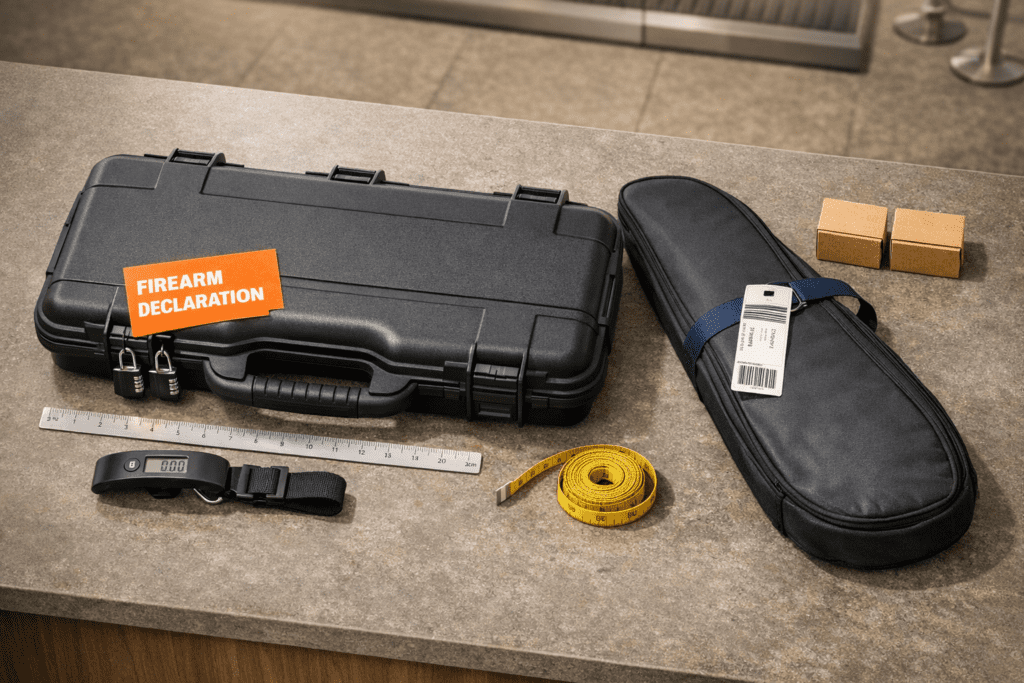
- TSA Rules: Firearms must be unloaded, locked in hard-sided cases, and declared at check-in. Ammunition must be stored in fiber, wood, or metal boxes and packed in checked baggage.
- Airline Policies: Airlines have varying limits on firearm quantity, ammunition weight, and packaging. For example:
- Alaska Airlines: Allows 50 lbs of ammo and no limit on firearms per case.
- United Airlines: Caps firearm cases at 62 inches and 5 firearms per case.
- JetBlue: Requires ammo in a separate case from firearms.
- Packing Tips: Use TSA-approved locks, arrive early, and double-check for stray ammunition to avoid fines (up to $15,000).
Proper preparation ensures a smoother experience. Review your airline’s specific policies and follow TSA guidelines to avoid delays or penalties.
Flying with Firearms and Hunting Gear – What We’ve Learned
sbb-itb-e205081
TSA Rules for Hunting Equipment
The TSA has specific rules for all hunting gear, which apply regardless of the airline you’re flying with. These rules are non-negotiable, and failing to follow them could result in fines of up to $15,000 or even the loss of TSA PreCheck privileges.
Firearms and Ammunition Requirements
TSA regulations require that all firearms be unloaded and packed in a locked, hard-sided case. You must declare each firearm to the airline representative at the ticket counter when checking in. The case needs to be secure enough to prevent unauthorized access – cases that can be easily pried open are not allowed.
“Firearms carried in checked bags must be unloaded, packed in a locked hard-sided container, and declared to the airline at check-in.”
– Transportation Security Administration
Ammunition is not allowed in carry-on luggage but can be packed in checked baggage if properly stored. Acceptable materials for storing ammunition include fiber, wood, or metal boxes. Additionally, all firearm parts – like frames, receivers, magazines, clips, bolts, and firing pins – must also go in checked luggage.
Bow and Archery Equipment Rules
If you’re traveling with bows and arrows, these must be packed in checked baggage, as they are not allowed in carry-on bags. Unlike firearms, TSA does not require you to declare archery equipment at check-in. However, using a hard-sided case is strongly recommended to protect your gear during transit.
For sharp items like broadheads, field points, or hunting knives, pack them securely in checked baggage. Broadheads should be removed from arrows and stored in a dedicated hard-sided container to ensure safety. Mechanical release aids, which resemble triggers, should also go in checked bags to avoid confusion during security checks. Always use TSA-approved locks on your cases – non-approved locks may be cut by security agents during inspections.
These federal guidelines serve as the baseline for the airline-specific policies that follow.
Airline-Specific Hunting Equipment Policies
While the TSA sets the baseline rules, each airline has its own specific requirements and fees for transporting hunting equipment. Knowing these details can help you avoid surprises at check-in and potentially save money.
American Airlines
American Airlines allows firearms in checked baggage with a 50 lb weight limit and a 102-inch size allowance (length + width + depth) for firearm and bow cases. This size exception is helpful for packing larger equipment without incurring oversized baggage fees. Archery gear is accepted as checked baggage, provided the case contains only archery-related items. At check-in, you must declare the firearm and include a signed card confirming it’s unloaded.
Delta Air Lines
Delta permits up to 50 lb and a 102-inch case size for firearms and archery equipment. Ammunition must be stored in its original manufacturer packaging or a container designed for small arms ammunition. For domestic flights, ammunition can be packed in the same locked case as the firearm. Like American Airlines, archery gear is treated as checked baggage when the case holds only bows, arrows, and related items.
United Airlines
United Airlines enforces stricter rules, limiting firearm and bow cases to a 62-inch linear dimension, with no size exceptions like those offered by American or Delta. For example, in November 2025, a traveler was charged $240 for checking an SKB double bow case that exceeded this limit. United defines an archery set as one bow case, one quiver with arrows, and one maintenance kit, all counting toward your checked baggage allowance. The weight limit remains 50 lb, and declaration procedures are required.
Southwest Airlines
Southwest sticks to the 50 lb weight limit for hunting equipment. Ammunition must be securely packed in boxes designed for small arms ammunition, such as those made of cardboard, wood, plastic, or metal. Bows and archery gear must be checked and count toward your bag allowance. Southwest’s policies closely align with TSA guidelines, making them straightforward for travelers.
Alaska Airlines
Alaska Airlines is a favored choice for hunters heading to remote areas. They accept firearms and archery gear in checked baggage, following TSA protocols. Ammunition must be properly packaged in an appropriate container. Experienced travelers often recommend using a soft-sided rifle case inside a TSA-compliant hard case for easier handling during connecting bush plane flights.
The table below highlights key differences among these carriers for quick reference.
Firearm and Ammunition Policy Comparison
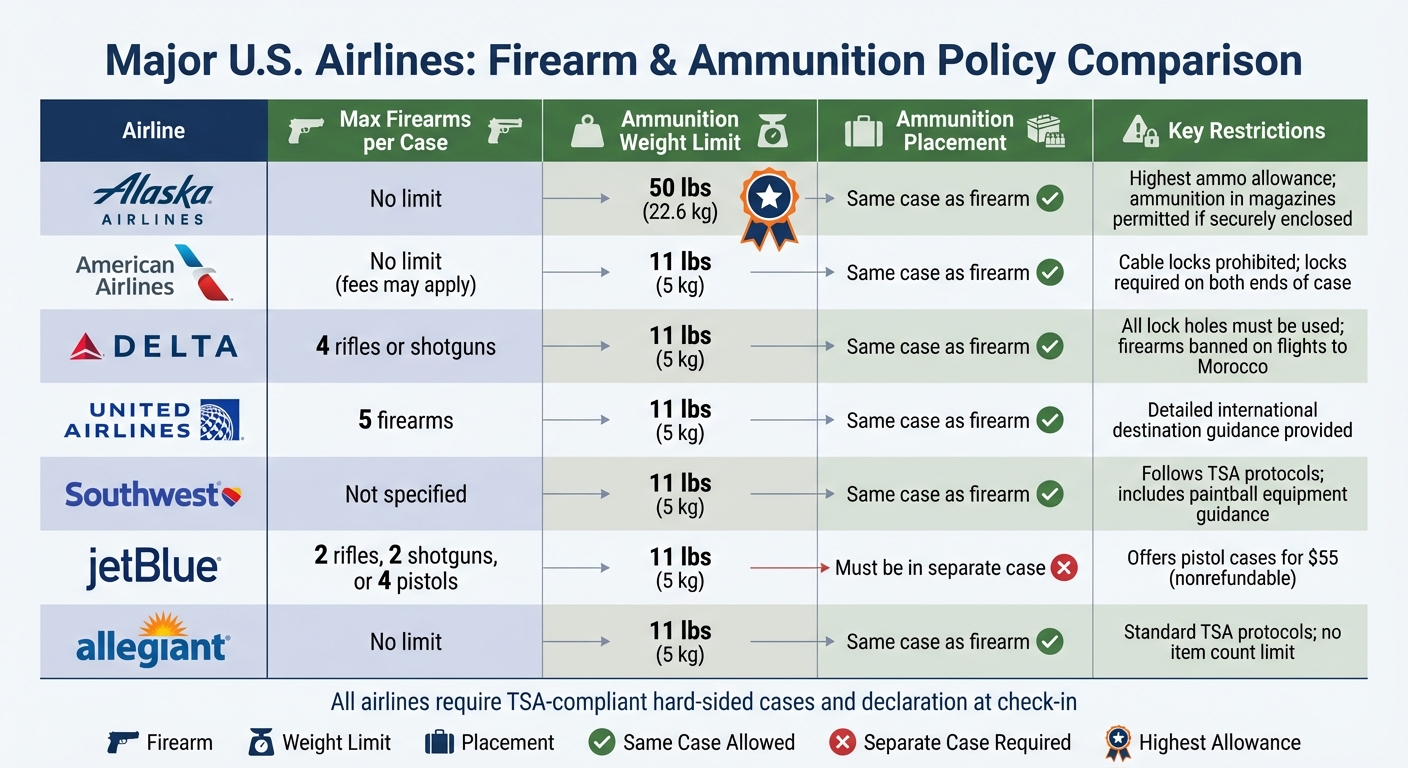
U.S. Airlines Hunting Equipment Policy Comparison Chart
While all major U.S. airlines follow the TSA’s baseline requirements for firearms and ammunition, the finer details of their policies can vary, making it important to know the specifics before you travel.
Limits on ammunition weight and firearm quantities differ across airlines, as highlighted in the table below. For example, Alaska Airlines allows up to 50 lbs (22.6 kg) of ammunition per passenger, which can be a great option for hunters or those heading on extended trips who prefer to bring their own ammo. In contrast, United Airlines caps each checked bag at 5 firearms, while JetBlue restricts passengers to 2 rifles, 2 shotguns, or 4 pistols per case. Delta Air Lines permits up to four rifles or shotguns per case. Meanwhile, American Airlines and Allegiant Air don’t impose specific limits on the number of firearms per case, though additional fees may apply for excess baggage.
Packaging requirements also show noticeable differences. Most airlines – including United, Southwest, Spirit, and Frontier – allow ammunition to be packed in the same hard-sided case as the firearm. However, JetBlue takes a stricter approach, requiring ammunition to be packed in a completely separate case from the locked firearm box. American Airlines also stands out by prohibiting the use of cable locks on firearm cases.
Airline Policy Comparison Table
| Airline | Max Firearms per Case | Ammunition Weight Limit | Ammunition Placement | Key Restrictions |
|---|---|---|---|---|
| Alaska Airlines | No limit | 50 lbs (22.6 kg) | Same case as firearm allowed | Highest ammo allowance; ammunition in magazines permitted if securely enclosed. |
| American Airlines | No limit (fees may apply) | 11 lbs (5 kg) | Same case as firearm allowed | Cable locks prohibited; locks required on both ends of the case. |
| Delta Air Lines | 4 rifles or shotguns | 11 lbs (5 kg) | Same case as firearm allowed | All lock holes must be used; firearms banned on flights to Morocco. |
| United Airlines | 5 firearms | 11 lbs (5 kg) | Same case as firearm allowed | Detailed international destination guidance provided. |
| Southwest Airlines | Not specified | 11 lbs (5 kg) | Same case as firearm allowed | Follows TSA protocols; includes paintball equipment guidance. |
| JetBlue | 2 rifles, 2 shotguns, or 4 pistols | 11 lbs (5 kg) | Must be in separate case | Offers pistol cases for $55 (nonrefundable). |
| Allegiant Air | No limit | 11 lbs (5 kg) | Same case as firearm allowed | Standard TSA protocols; no item count limit. |
When it comes to international travel, the rules become even more complicated. Both Frontier and Spirit Airlines prohibit firearms and ammunition on international flights, while JetBlue allows firearms but bans ammunition on such routes. Delta imposes country-specific restrictions, including a complete ban on firearms for flights to Morocco and unique packaging requirements for destinations like South Africa and the UK. Understanding these variations can help you better prepare for check-in and avoid unexpected issues.
Airport Procedures for Hunting Equipment
How to Declare Equipment at Check-In
When you get to the airline check-in counter – skip curbside or self-service kiosks – make sure to declare your firearm. It must be in a locked, hard-sided case. You’ll need to complete, sign, and date a firearms declaration card, which is then placed inside the case.
A TSA agent will inspect your firearm to confirm it’s unloaded and that the case meets the required standards. After the inspection, lock the case and keep the key or combination with you. Stay nearby in case further screening is needed.
Ammunition also needs to be declared and packed securely. Use the original manufacturer packaging or a sturdy fiber, wood, or metal box. Most airlines allow you to pack ammunition in the same hard-sided case as your firearm, as long as it’s properly secured. Once you arrive, your hunting equipment will likely be sent to a special services area or oversized luggage claim, not the standard carousel. Be ready to show identification to retrieve it.
Once everything is declared, follow these steps to make your airport experience smoother.
Tips for Smooth Travel
Arrive at the airport at least two hours before your flight when traveling with hunting gear. Before heading out, double-check your bags by emptying and repacking them. Stray ammunition can lead to hefty fines – up to $15,000.
“Passengers should pack for a trip starting with an empty bag to be sure they are not carrying prohibited items before they enter our checkpoints.” – Kim Jackson, Federal Security Director, TSA
Print a copy of your airline’s firearm policy and familiarize yourself with the laws at your destination, including any potential diversion points with stricter regulations. If your flight is diverted to a state with restrictive gun laws and you don’t have the necessary permit, ask the airline to hold and forward your firearm.
Conclusion
Traveling with hunting equipment requires careful attention to TSA and airline regulations. Federal rules mandate that firearms must be unloaded and stored in locked, hard-sided cases. Airlines often have additional requirements, such as weight limits, fees, and specific handling protocols.
Proper preparation can make the process much easier. Print out your airline’s firearm policy ahead of time, arrive at the airport at least two hours early, and familiarize yourself with the laws at your destination. Make sure your gear meets weight and packaging requirements, use locks that only you can access, and be prepared for your equipment to be treated as oversized baggage instead of showing up on the standard carousel.
“Planning ahead and packing properly can facilitate the screening process and ease your travel experience at the airport.” – Transportation Security Administration
Recent TSA statistics highlight the importance of following these rules. For instance, by October 2024, TSA officers in Alabama had already intercepted 98 firearms at security checkpoints, with fines reaching up to $15,000. Sticking to these guidelines not only simplifies your check-in process but also helps protect your rights as a traveler. By preparing thoroughly, you can ensure a safe, compliant, and stress-free journey.
FAQs
What should I do if TSA needs to open my locked gun case?
If the TSA needs to inspect your locked gun case, you’ll have to provide the keys or combination when asked. While the case must stay securely locked during transport, TSA agents may still need access for inspection. Make sure you’re ready to comply quickly to prevent any delays.
How do I avoid oversized fees for bow or rifle cases?
Airlines often have size restrictions for bow or rifle cases, and exceeding these limits can result in hefty fees. Most airlines stick to a 62-inch limit (length + width + height), though carriers like Delta and American Airlines are more lenient, allowing up to 102 inches.
Here’s how to stay within the rules:
- Measure your case: Double-check its dimensions to ensure it meets the airline’s size requirements.
- Choose a hard-sided case: Stick to one that fits within the allowed dimensions for added protection and compliance.
- Review airline policies: If your case is near the size limit, contact the airline directly to confirm their guidelines.
Staying prepared can help you avoid unnecessary charges and ensure smooth travel with your equipment.
What happens to my firearm if my flight is diverted to a restrictive state?
If your flight gets diverted to a state with strict firearm regulations, your firearm must meet that state’s legal requirements. If possessing or transporting it is prohibited, you might have to take alternative steps. These could include requesting the airline to send it to your original destination or refraining from claiming the checked bag that holds the firearm.