

Middle Eastern airlines rely on IOSA certification to meet global safety standards, reduce accident rates, and unlock international partnerships. Airlines with IOSA certification have consistently demonstrated safer operations compared to non-certified carriers, with accident rates 2.5 to 4 times lower. Beyond safety, IOSA is essential for IATA membership, enabling access to codeshare agreements and airline alliances.
In 2024, IOSA shifted to a risk-based audit model, focusing on higher-risk areas tailored to each airline’s operations. This update challenges carriers to maintain robust safety systems but also ensures more effective oversight. Airlines like Saudia and Royal Jordanian have successfully navigated these changes, showcasing their commitment to safety and operational reliability.
For airlines aiming to achieve and maintain IOSA certification, steps include internal audits, aligning with the updated IOSA Standards Manual, and regular renewal processes. Certification not only ensures compliance but also strengthens an airline’s reputation in the competitive global market.
What is IOSA Certification?
IOSA Definition and Purpose
The IATA Operational Safety Audit (IOSA) is a program designed to assess the operational management and control systems of airlines. It examines areas like flight operations, aircraft maintenance, cargo handling, and security to ensure a strong safety framework.
Built on three core principles – Safety, Effectiveness, and Integrity – IOSA aims to enhance global safety standards, reduce redundant audits, and enforce strict oversight. This program has had a tangible impact, saving the aviation industry from conducting over 6,400 unnecessary audits, which has led to considerable cost savings. For airlines in the Middle East, IOSA registration is not optional; it’s a requirement for IATA membership and is also mandatory for participation in the three major global airline alliances. This certification is a key asset for airlines seeking international partnerships and codeshare agreements, providing a competitive edge and facilitating global connectivity.
To qualify for IOSA certification, an airline must operate at least one multi-engine aircraft with a maximum takeoff weight of over 12,566 lbs (5,700 kg) for commercial passenger or cargo services. As of May 2024, there are 439 operators listed on the IOSA registry, including 103 non-IATA members who voluntarily use the certification as a benchmark for safety standards.
This program enforces its principles through a globally standardized audit framework.
IOSA’s Standardized Framework
IOSA uses a standardized approach to maintain consistent safety standards worldwide. Central to this is the IOSA Standards and Recommended Practices (ISARPs), which are developed in cooperation with major regulatory bodies like the FAA, EASA, and Transport Canada. The IOSA Standards Manual outlines 922 standards across eight critical areas: flight operations, operational control and flight dispatch, aircraft engineering and maintenance, cabin operations, ground handling, cargo operations, and operational security.
Airlines undergo a comprehensive audit that covers all ISARPs. Once they successfully pass, they are added to the IOSA registry for a two-year period. In 2024, IOSA introduced a risk-based model for renewal audits. This model adjusts the audit scope based on factors like an airline’s operational profile, safety record, and industry-specific risks – such as runway excursions. It also includes a maturity assessment to measure how well an airline manages its safety-critical systems.
To streamline compliance, IATA now offers the IOSA Standards Manual in XML format. This allows airlines to integrate the standards directly into their quality management systems, enabling continuous compliance rather than treating audits as one-off events. For Middle Eastern carriers, this digital approach supports their ability to maintain compliance and strengthens their position in international markets.
sbb-itb-e205081
Safety Risks for Non-IOSA Airlines in the Middle East
Increased Crash Rates and Safety Issues
As previously highlighted, non-IOSA airlines experience significantly higher accident rates. For carriers in the Middle East, this translates into serious safety and regulatory concerns. Without IOSA oversight, these airlines operate without a consistent framework for safety protocols or proactive risk management.
But the challenges go beyond the statistics. Non-IOSA airlines often struggle with deeper operational inefficiencies that can jeopardize overall safety.
Operational Weaknesses
Non-IOSA airlines face multiple operational hurdles that extend beyond accident data. Without IOSA certification, these carriers miss out on the rigorous standards outlined in the IOSA Standards Manual. This manual addresses critical areas such as cockpit procedures and the management of hazardous materials. The lack of adherence to such standards creates vulnerabilities across several operational areas, as summarized below:
| Operational Area | Risk Without IOSA Certification |
|---|---|
| Organization Management | Weak leadership structures and lack of accountability for safety |
| Flight Operations | Unstandardized cockpit procedures and inadequate pilot training |
| Maintenance Management | Irregular aircraft maintenance and uncertain airworthiness |
| Ground Operations | Higher likelihood of ramp accidents and handling mistakes |
| Aviation Security | Gaps in passenger and asset protection measures |
| Cargo Operations | Poor handling of hazardous goods and improper weight management |
The absence of IOSA certification also brings regulatory challenges. Many aviation authorities worldwide now integrate IOSA into their safety oversight frameworks. This means non-certified Middle Eastern airlines are subject to heightened scrutiny and may face restrictions from international regulators. Furthermore, without IOSA certification, these airlines are excluded from IATA membership and cannot join major global airline alliances. This exclusion cuts them off from profitable codeshare agreements and international partnerships. Instead of benefiting from IOSA’s streamlined auditing process – which has eliminated over 6,400 redundant inspections – non-certified airlines must deal with multiple, expensive audits from different jurisdictions.
These challenges highlight why IOSA certification is so critical for ensuring safety and operational reliability in the Middle Eastern aviation sector.
How IOSA Certification Solves Safety and Compliance Problems
Key Benefits of IOSA Certification
IOSA certification tackles significant operational challenges by using a risk-focused approach to improve safety and compliance. With an evaluation process that covers over 900 safety standards, it sets a global benchmark recognized by both regulators and passengers. One of its standout features is its ability to tailor the audit scope based on an airline’s specific risks, ensuring auditors concentrate on areas that require the most attention.
Instead of managing multiple costly audits across various jurisdictions, airlines benefit from a streamlined process. The certification also promotes the adoption of Safety Management Systems (SMS) and keeps its standards updated to align with the latest ICAO regulatory changes. Additionally, the audit assesses the maturity of an airline’s safety-critical systems, ensuring that compliance isn’t just on paper but is reflected in practical, reliable operations.
These advantages highlight how IOSA certification can drive regional success.
Middle Eastern Airlines with IOSA Success
Several Middle Eastern airlines illustrate how IOSA certification leads to measurable improvements in safety and operations. For instance, in October 2025, Saudia successfully renewed its IOSA registration for the 11th consecutive time under the updated Risk-Based IOSA framework. The audit covered eight critical operational areas, including Flight Operations, Maintenance Management, and Aviation Security. Capt. Mohamed Dahduli, Vice President of Safety at Saudia, shared:
“Safety is at the core of everything we do at Saudia. Renewing our IOSA registration once again reflects the strength of our safety culture and the robustness of our operational systems.”
Another notable example is Royal Jordanian. In April 2022, the airline renewed its IOSA registration, achieving full compliance with over 900 safety standards. The audit covered essential areas like Flight Operations, Engineering and Maintenance, Cabin Operations, and Corporate Security. Royal Jordanian has maintained continuous IOSA certification since its first audit in 2004. Vice Chairman & CEO Samer Majali remarked:
“Obtaining the IOSA registration is proof of RJ’s continued work to comply with air safety standards and adherence to international practices.”
These renewals reflect more than just regulatory adherence – they underscore the commitment to a strong safety culture and operational reliability, which are critical for Middle Eastern airlines as they expand their global reach.
Compliance Challenges for Middle Eastern Airlines
Implementing Risk-Based Oversight Systems
The introduction of the Risk-Based IOSA (RBI) framework in 2024 has brought significant hurdles for Middle Eastern airlines. Unlike the previous standardized approach, the RBI framework tailors audits to each airline’s specific operational profile, safety record, and audit history. This means airlines must ensure their internal data systems are robust since these factors now dictate the depth and frequency of audits.
One of the toughest new requirements is the maturity assessment. Auditors now evaluate how well an airline’s safety systems actually function in practice, rather than just reviewing their existence on paper. Airlines must prove that their safety programs are not only in place but are effective in day-to-day operations. For carriers with limited resources or underdeveloped safety infrastructures, this can be a daunting challenge.
The framework also requires airlines to stay aligned with evolving ISARPs, especially as new risks like runway excursions emerge. Airlines must carefully allocate resources, prioritizing higher-risk areas while managing less-critical standards that may receive less frequent auditing. This approach demands advanced internal oversight systems, which some regional airlines are still working to establish.
These internal demands are further complicated by the rigorous requirements for IATA membership.
IATA Membership Requirements
Achieving and maintaining compliance isn’t just about internal upgrades – airlines must also meet external criteria to maintain IATA membership. Since IOSA certification is a prerequisite for IATA membership, this becomes a critical regulatory milestone that affects an airline’s ability to engage in global aviation networks and partnerships. On top of that, financial and operational reviews required for IATA membership add another layer of complexity.
Currently, more than 450 airlines are listed on the IOSA Registry. However, keeping that status demands ongoing investment in safety systems, staff training, and thorough documentation. For smaller or newer Middle Eastern carriers, the combination of financial pressures, operational reviews, and the demands of the RBI framework can push their resources to the limit.
How to Achieve and Maintain IOSA Certification
Performing Internal Audits
Internal audits lay the groundwork for IOSA certification. Airlines must rely on qualified auditors who regularly check their processes against IOSA’s Standards and Recommended Practices. To maintain objectivity, these auditors should not evaluate processes they are directly involved in.
Mock audits are a helpful tool to uncover gaps in documentation, procedures, and implementation. After identifying these gaps, airlines can create a Corrective Action Plan (CAP). For instance, when Overland Airways worked with IATA experts, the process included three on-site visits and a full mock audit to confirm that both documentation and operational practices aligned with the updated manuals.
To tackle underlying issues, airlines can use root-cause analysis techniques like the “5 Whys” or fishbone diagrams. Immediate interim measures can stabilize risks while permanent solutions are developed. Integrating audit findings into the Safety Management System (SMS) helps airlines prioritize issues and track long-term trends.
Once these internal issues are resolved, airlines can move forward to the formal IOSA evaluation process.
IOSA Evaluations and Renewal Process
To qualify for IOSA certification, airlines must operate at least one multi-engine, two-pilot aircraft with a maximum takeoff weight exceeding 12,566 lbs (5,700 kg). After submitting the Initial IOSA Application form to IATA’s IOSA team, airlines undergo a full-scope initial audit, which examines compliance with every Standard and Recommended Practice outlined in the IOSA Standards Manual.
IATA suggests a structured three-step preparation process: conducting a readiness assessment, performing mock audits, and providing practical coaching. For example, Myanmar National Airlines followed this approach with support from IATA Consulting. This included implementing an Operations Management System, creating new operational departments, and conducting two thorough mock audits alongside on-the-job staff mentoring.
Once certified, airlines are listed in the IOSA Registry, joining over 450 other carriers worldwide. However, certification requires ongoing effort, as renewal audits are conducted every two years to ensure continued compliance. Airlines must also keep their operational manuals updated to align with national regulations and the latest IOSA Standards Manual.
These rigorous processes have fueled the success of many regional airlines.
Lessons from Regional Airlines
Regional carriers in the Middle East have shown various successful paths to achieving IOSA certification. Take SaudiGulf Airlines, for example. The airline secured IOSA certification and IATA membership in less than two years after launching operations in late 2016. This rapid success was driven by Chairman Tarik Abdulhadi Al Qahtani and CEO Samer Majali, with additional guidance from Saudi Arabia’s General Authority for Civil Aviation (GACA) to meet international safety standards.
A key factor in these success stories is the emphasis on comprehensive staff training. Airlines that enroll their teams in the one-week IOSA Airline Auditor Course build internal expertise, ensuring they are well-prepared for formal audits. This focus on training fosters a continuous culture of compliance, making safety and standards a part of everyday operations rather than a last-minute rush before renewal deadlines.
Risk-Based IOSA: Why Your Airline Should Prepare Early
Measurable Benefits of IOSA Certification
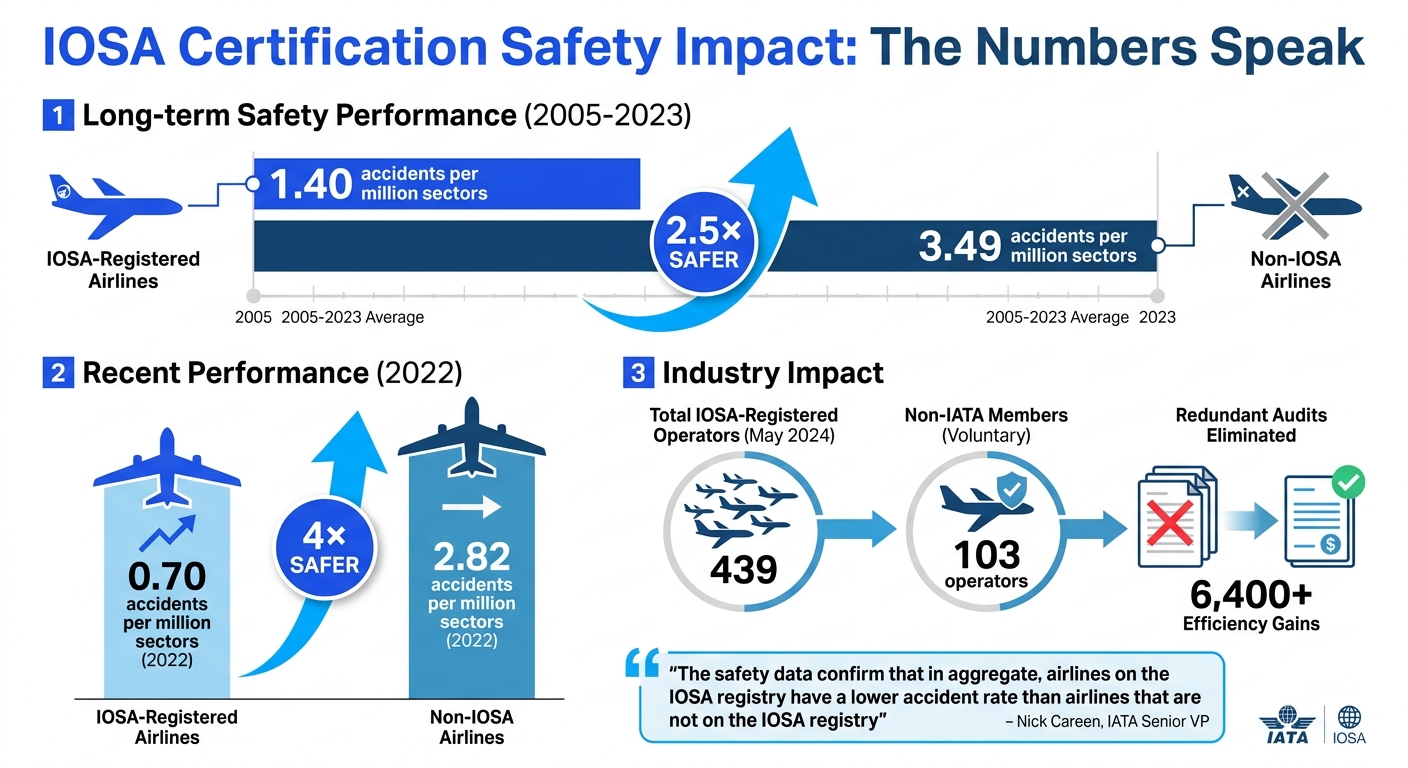
IOSA vs Non-IOSA Airlines Safety Performance Comparison 2005-2023
Better Safety and Compliance Data
Between 2005 and 2023, airlines listed on the IOSA registry reported an accident rate of 1.40 per million sectors – 2.5 times lower than the 3.49 rate recorded by non-IOSA carriers. In 2022, this gap became even more pronounced, with IOSA airlines achieving a rate of just 0.70 compared to 2.82 accidents per million sectors. Nick Careen, Senior Vice President of Operations, Safety, and Security at IATA, emphasized this distinction:
“The safety data confirm that in aggregate, airlines on the IOSA registry have a lower accident rate than airlines that are not on the IOSA registry”.
| Period | IOSA-Registered Airlines | Non-IOSA Airlines | Safety Improvement |
|---|---|---|---|
| 2005–2023 (Average) | 1.40 per million sectors | 3.49 per million sectors | 2.5× safer |
| 2022 | 0.70 per million sectors | 2.82 per million sectors | 4× safer |
Beyond safety performance, IOSA certification has streamlined operations by eliminating more than 6,400 redundant audits across the airline industry. This approach has not only reduced costs but also lightened the administrative load for carriers, particularly in the Middle East, where international partnerships are critical. These measurable improvements in safety and efficiency have strengthened the global reputation of Middle Eastern airlines.
Stronger International Reputation
The safety improvements linked to IOSA certification have also enhanced airlines’ reputations on the global stage. For example, Qatar Airways set a regional milestone by becoming the first airline worldwide to join the IOSA Registry in September 2003, showcasing the Middle East’s dedication to meeting international safety standards.
This certification also plays a key role in global rankings. In January 2026, Etihad Airways was recognized as the world’s safest airline by AirlineRatings.com, a distinction it earned through compliance with international audits like IOSA and its advanced safety systems. Emirates also ranked highly, securing the #5 spot in the same rankings.
IOSA certification is a prerequisite for IATA membership and is required by major global airline alliances. For Middle Eastern airlines that depend on international codeshare agreements, IOSA is not just a badge of honor – it’s a necessity for maintaining market access and partnerships. When Saudia renewed its IOSA registration for the 11th consecutive time in October 2025, Capt. Mohamed Dahduli, Vice President of Safety, Aviation Security & Quality, highlighted its importance:
“Safety is at the core of everything we do at Saudia. Renewing our IOSA registration once again reflects the strength of our safety culture and the robustness of our operational systems”.
As of May 2024, the IOSA registry included 439 operators, 103 of which are non-IATA members who voluntarily joined to showcase their commitment to safety standards. This growing participation reinforces IOSA’s position as the global benchmark for airline operational safety.
Conclusion
IOSA certification plays a key role for Middle Eastern airlines striving to establish themselves on the global stage. By simplifying safety audits, it not only reinforces a strong commitment to safety but also opens doors to crucial international partnerships and codeshare agreements.
The transition to a Risk-Based IOSA framework in 2024 has made this certification even more relevant. Unlike the older, uniform checklist approach, this updated model adapts audits to match each airline’s unique risk profile and operational maturity. This allows airlines to focus their resources on the most critical safety areas while continuously refining their safety systems. A prime example is Saudia, which successfully transitioned under this new framework in October 2025.
This shift has already led to notable achievements in the region. For instance, in January 2026, Etihad Airways earned recognition as the world’s safest full-service airline, while Emirates secured a spot among the top five in global safety rankings. These accomplishments highlight how prioritizing IOSA standards can drive operational excellence and strengthen competitive positioning.
For airlines still working to align with these standards, the path forward is clear. Embracing data-driven safety practices, performing regular internal audits based on the IOSA Standards Manual, and utilizing the joint audit report system to cut costs are essential steps. As the aviation industry leans more toward predictive and risk-based oversight, airlines that adapt will position themselves for lasting success.
FAQs
How does Risk-Based IOSA change the audit process?
Risk-Based IOSA improves the audit process by concentrating on areas within an airline’s operations that carry higher risks. By zeroing in on these critical areas, this approach allows for a more targeted and efficient assessment of safety compliance, enabling airlines to tackle essential safety issues more effectively.
What can stop an airline from getting IOSA certified?
An airline may fail to obtain IOSA certification if it falls short of meeting the operational management and control standards set forth or does not successfully pass the audit process designed to assess these systems. Adhering to these strict standards is a key requirement for certification.
How can IOSA certification help airlines win global partnerships?
IOSA certification plays a key role in helping airlines establish global partnerships. By offering a widely recognized standard for safety and operational practices, it helps airlines build trust with international partners. This trust not only strengthens collaboration but also boosts the airline’s reputation and attractiveness in the global aviation industry.