When traveling internationally, choosing between cash and cards isn’t about picking one – it’s about knowing when to use each. Here’s the short version:
- Cash: Ideal for small purchases, street vendors, tips, and areas with limited card acceptance. Beware of exchange rate markups and theft risks.
- Cards: Better for large transactions, hotel bookings, and rewards. Watch out for foreign transaction fees and dynamic currency conversion.
Quick Tips:
- Carry 10-20% of your budget in cash for flexibility.
- Use no-foreign-transaction-fee cards to save on fees.
- Pay in the local currency to avoid extra charges.
- Notify your bank before traveling to prevent account freezes.
- Split cash and cards across multiple secure locations.
Quick Comparison:
| Aspect | Cash | Card |
|---|---|---|
| Safety | High theft risk, irreplaceable | Fraud protection, easy to deactivate |
| Convenience | Great for small vendors and tips | Required for hotels, car rentals, and big purchases |
| Cost | No transaction fees, exchange markups | Foreign transaction fees (2-3%), better exchange rates |
| Acceptance | Limited to local markets, transport | Widely accepted but not everywhere |
| Budgeting | Easy to track spending manually | Automatic digital tracking |
A mix of both cash and cards ensures you’re covered for all situations. Use cash for smaller purchases and cards for larger ones to maximize security and minimize costs.
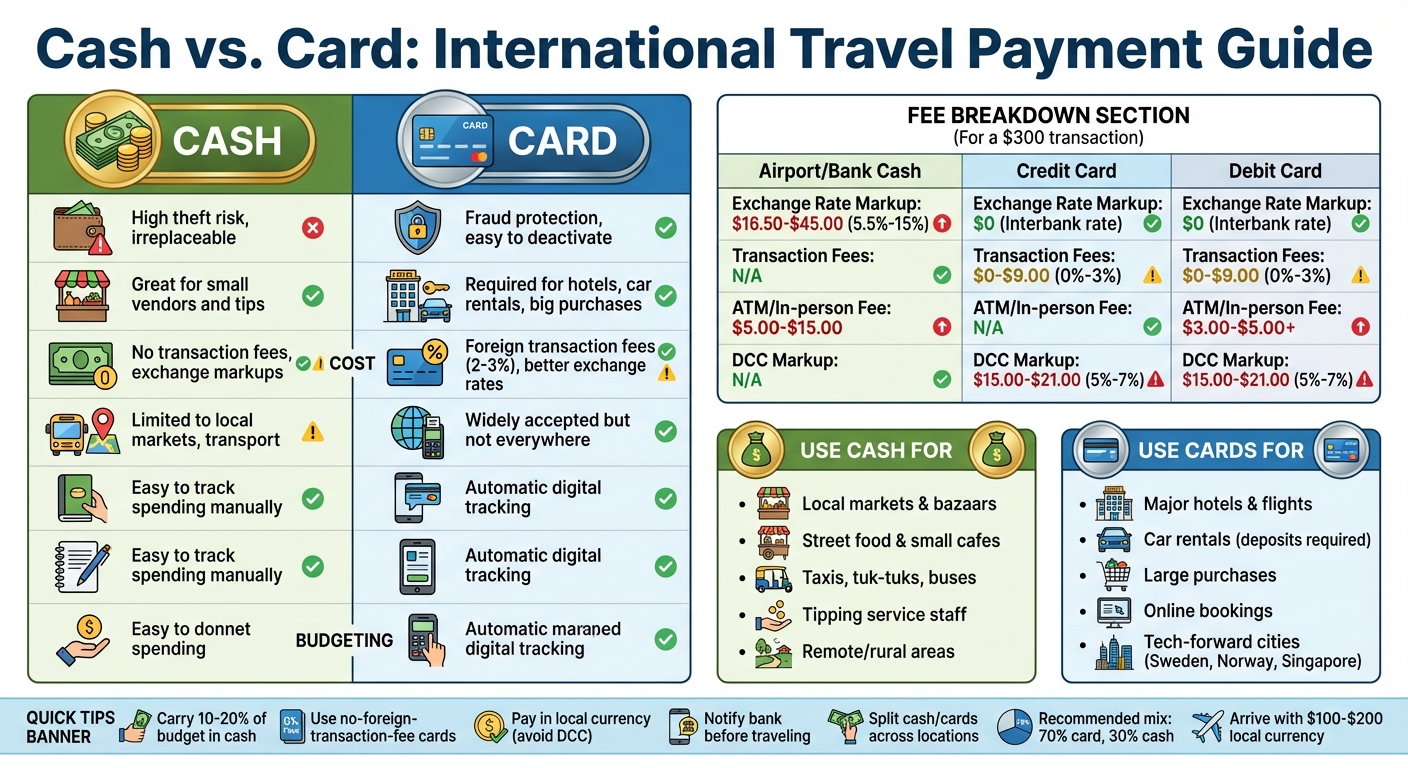
Cash vs Card Payment Methods for International Travel Comparison
Access Money While Traveling Internationally | What Actually Works
sbb-itb-e205081
Cash: Benefits and Drawbacks
Cash has its perks for international travelers, but it also comes with its fair share of risks.
Benefits of Cash
Cash is accepted almost everywhere – from bustling street vendors to vibrant local markets. It also gives you a physical sense of your spending, making it easier to stick to a budget and avoid overspending.
Unlike cards, cash doesn’t come with transaction fees, which can be as high as 2.5% per swipe. As travel expert Nick Harvey aptly says:
Cash is king when haggling at local bazaars.
Many merchants prefer cash since it spares them from paying card processing fees. This preference can sometimes lead to better deals for you.
Another big advantage? Cash works even when technology doesn’t. In places like Japan and Germany – where cash is still widely used – power outages or connectivity issues won’t leave you stranded.
However, these benefits don’t come without challenges.
Drawbacks of Cash
The biggest downside to cash is that it’s irreplaceable if lost or stolen. Unlike cards, which can be blocked and replaced, lost cash is simply gone. Carrying large sums also makes you a target for pickpockets, especially in crowded areas like markets or transit hubs. And unlike cards, there’s no fraud protection to fall back on.
Managing multiple currencies adds another layer of hassle. Exchanging money at airport kiosks can cost you – rates are often 10% to 15% worse than market rates. Plus, large bills can be inconvenient. Street vendors may not have change, and losing a high-value note stings far more than losing smaller denominations.
Cash Comparison Table
| Aspect | Pros | Cons |
|---|---|---|
| Safety | No risk of digital fraud or card skimming | Cannot be replaced if stolen; high theft risk |
| Convenience | Works during power outages; no technology needed | Bulky to carry; requires finding exchange locations |
| Cost | No per-transaction fees after exchange | Poor rates at airports and tourist centers |
| Acceptance | Essential for tips, markets, taxis, and small vendors | Some hotels or car rentals may refuse cash |
| Budgeting | Immediate visibility of funds | Difficult to manage across multiple currencies |
Cards: Benefits and Drawbacks
When compared to cash, cards offer a mix of advantages and challenges, especially for international payments.
Benefits of Cards
Enhanced Security: Cards provide a layer of safety that cash simply can’t match. If your card is lost or stolen, you can deactivate it quickly using your bank’s mobile app. Plus, most cards come with $0 liability for unauthorized transactions. As Travis Cormier, COO of 10xTravel, puts it:
“If you lose your cash, then that money is gone. If you lose your card, it may be an inconvenience, but you can at least cancel it and get a new card reissued and you’re not liable for any unauthorized purchases.”
Cards are also indispensable for certain types of transactions. For instance, hotels and car rental companies often require credit cards for security deposits, and you’ll need one to pre-book flights or tours online. Another perk? Card issuers typically offer better exchange rates than airport kiosks or currency exchange services. Many travel cards even let you earn rewards – like points, miles, or cashback – on your international spending. Some premium cards add extra perks like trip cancellation insurance, baggage delay protection, and even travel medical coverage.
Additionally, digital statements make it easier to track your spending in real time, automatically logging your transactions. Mobile wallets further simplify payments, eliminating the need to carry physical cards.
Drawbacks of Cards
Fee Structures: One of the biggest downsides of using cards internationally is the fees. Most cards charge foreign transaction fees ranging from 2% to 3% on every purchase. If you’re using a debit card to withdraw cash from an ATM, expect to pay $2 to $7 per transaction. Credit card cash advances are even more expensive due to high fees.
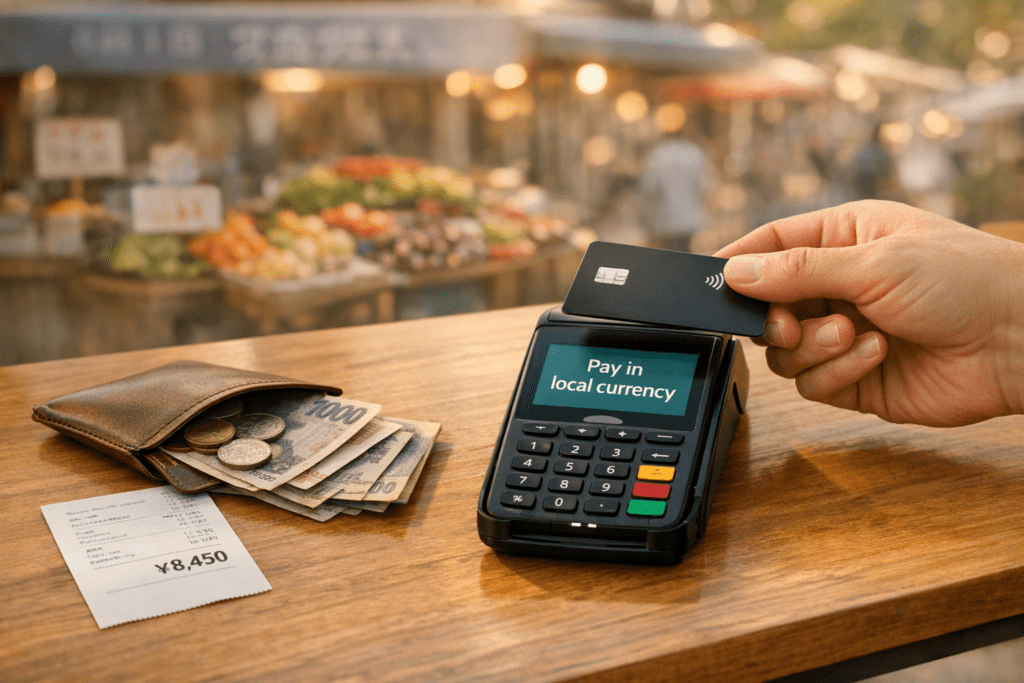
Dynamic Currency Conversion: When offered the option to pay in U.S. dollars instead of the local currency, it’s best to decline. This service, known as dynamic currency conversion, often adds a 5–7% markup to the exchange rate provided by your bank.
Limited Acceptance: While cards are widely accepted at hotels and large retailers, smaller vendors, street food stalls, and local markets often operate on a cash-only basis. In certain regions, chip-and-PIN technology is the norm, and older magnetic stripe cards might not work at automated kiosks or gas stations. Additionally, networks like American Express and Discover tend to have more limited acceptance compared to Visa and Mastercard.
Technical and Account Issues: Using your card abroad can sometimes trigger your bank’s fraud alert system, leading to a temporary freeze on your account until you verify the activity. Hotels and car rental companies also place holds on your card, which can temporarily reduce your available credit limit.
Card Comparison Table
| Aspect | Pros | Cons |
|---|---|---|
| Safety | $0 liability for fraud; easy to freeze | Risk of ATM skimming; potential for account freezes |
| Convenience | Widely accepted for hotels and bookings; supports mobile wallets | Not accepted at many small vendors and street markets |
| Cost | Better exchange rates; rewards like points or cashback | Foreign transaction fees (2–3%); ATM charges ($2–$7) |
| Acceptance | Essential for car rentals and hotel deposits | Limited at small vendors and rural areas |
| Tracking | Automatic digital logging in apps | None |
Fees and Costs Breakdown
Understanding the real costs of using cash versus cards while traveling internationally can help you save a significant amount of money. Though the differences may not be obvious at first, a closer look at the numbers reveals just how much you can save by making smarter choices.
Exchange Rates vs. Card Fees
Credit cards with no foreign transaction fees are often the most economical choice for travelers, offering savings of about 8.59% compared to airport currency exchanges and 5.60% compared to traditional bank exchanges. This is because these cards use the interbank exchange rate, which doesn’t include the profit markups added by banks or airport kiosks.
Airport kiosks are notoriously expensive, with exchange rates that can be 10% to 15% worse than market rates. For instance, a 2025 study found that exchanging $300 for Euros resulted in an average exchange rate of 1.1327 with credit cards versus 1.2379 at airport kiosks. That’s a loss of $25 to $45 on a single $300 exchange at the airport.
Standard credit and debit cards often charge foreign transaction fees of 2% to 3% on international purchases. For example, spending $1,000 abroad could cost you an extra $20 to $30 – unless you use a travel-focused card that waives these fees.
ATM withdrawals come with their own set of charges. Banks usually impose a flat fee of $3.00 to $5.00 per transaction, plus 1% to 3% of the withdrawal amount, and some ATMs tack on an operator surcharge of $2.00 to $10.00. A $300 withdrawal using a debit card could therefore cost anywhere from $0 to $20 in fees.
Dynamic Currency Conversion (DCC) is another hidden expense to watch out for. When merchants or ATMs offer to charge you in U.S. dollars instead of the local currency, they apply an inflated exchange rate, adding 5% to 7% to your bill. For a $300 purchase, this could mean an extra $15 to $21. Worse, DCC doesn’t exempt you from your card’s foreign transaction fees, so you might end up paying both.
Some banks also charge flat fees for in-person currency exchanges. For example, Huntington charges $15.00, Bank of America $7.50, and Chase $5.00. Combined with exchange rate markups, these fees can make in-person exchanges almost as expensive as airport kiosks.
With so many potential charges, knowing how to minimize costs is crucial for any traveler.
How to Reduce Costs
- Pay in local currency to avoid Dynamic Currency Conversion fees.
- Use no-fee travel cards, which can save you about $30 for every $1,000 spent by waiving foreign transaction fees.
- Notify your bank before traveling to avoid account freezes due to suspected fraud.
- Withdraw larger amounts at ATMs to reduce flat fees.
- Avoid credit card cash advances entirely. These incur immediate interest (averaging 22.76%) and fees of around $11.91 to $13.15, meaning a $300 cash advance could cost between $24.50 and $40.74.
The table below provides a quick comparison of costs to help you plan effectively.
Fee Comparison Table
| Fee Type | Cash (Airport/Bank) | Credit Card | Debit Card |
|---|---|---|---|
| Exchange Rate Markup | 5.5% – 15% ($16.50 – $45.00 on $300) | ~0% (Interbank rate) | ~0% (Interbank rate) |
| Transaction Fee | N/A | 0% – 3% ($0 – $9.00 on $300) | 0% – 3% ($0 – $9.00 on $300) |
| ATM/In-person Fee | $5.00 – $15.00 | N/A (unless cash advance) | $3.00 – $5.00+ |
| DCC Markup | N/A | 5% – 7% ($15.00 – $21.00 on $300) | 5% – 7% ($15.00 – $21.00 on $300) |
| Operator Surcharge | N/A | N/A | $2.00 – $10.00 |
Safety and Security Tips
Losing your wallet while traveling abroad is a nightmare. Cash is gone for good, and while cards can be canceled, the hassle is real. The best way to avoid such stress? Use smart strategies for both cash and cards. Carrying too much cash makes you an easy target for pickpockets, especially in crowded places. On the other hand, cards come with their own risks, like skimming and digital fraud, but these can be avoided with the right precautions.
Here’s how to stay one step ahead and protect your money while traveling.
Protecting Your Cash
When it comes to cash, the key is to spread it out. Keep some in your wallet, some in a money belt under your clothes, and the rest in a hotel safe. A clever trick? Use the “one shoe” rule: place one of your shoes in the safe to ensure you won’t forget your valuables. For daily use, carry smaller bills to avoid flashing large sums. You might also want to carry a decoy wallet with a small amount of local currency and expired cards – something you can hand over if you’re ever mugged. For larger amounts, a hidden neck pouch or money belt is much safer than a backpack.
Cash isn’t the only thing that needs protection; your cards do too.
Protecting Your Cards
Cards require a proactive approach to keep them secure. Start by using payment platforms like Apple Pay or Google Pay, which don’t share your actual card details.
“Whenever possible, use tap to pay with your phone or watch. It’s the most secure way to pay because you don’t need to pull out your wallet and it reduces the risk of card skimming and fraud.”
- Jessica Merritt, CFEI
Set up transaction alerts through your bank’s app. This allows you to monitor activity in real time and freeze your card if you notice anything suspicious. U.S. law also provides some peace of mind: if you report a lost or stolen debit card within two business days, your liability for unauthorized charges is capped at $50.
Before your trip, notify your bank about your travel plans to avoid having legitimate transactions flagged as fraud. It’s also smart to carry at least two cards – one Visa and one Mastercard – stored in separate places. That way, if one is lost or rejected, you’ll still have a backup.
To prevent digital pickpocketing, use an RFID-blocking wallet. When withdrawing cash, stick to ATMs inside reputable banks or hotels, as these are less likely to have skimming devices. Lastly, write down your bank’s international collect-call number and keep it somewhere safe, since standard 800 numbers might not work overseas.
When to Use Cash vs. Cards
Deciding whether to use cash or a card while traveling can make a big difference in how smoothly your trip goes. The right choice often depends on your location and what you’re purchasing. Based on the pros and cons already discussed, here’s how to decide when to use each payment method.
Best Uses for Cash
Cash is ideal for smaller, everyday purchases. Think about local markets, small cafes, or street food stalls – places that often don’t have card readers or prefer cash to avoid extra fees. It’s also the go-to for transportation like taxis, tuk-tuks, or buses, which typically require cash payments.
“Cash is king when haggling at local bazaars.”
- Nick Harvey, The Travel Tinker
Cash is also handy for tipping and covering small, unexpected charges. In rural or remote areas where internet access might be unreliable, cash becomes a necessity for basic transactions.
Best Uses for Cards
Cards shine when it comes to larger purchases and reservations. Airlines, hotels, and tour companies often require cards for deposits or to hold bookings. They’re also essential for car rentals and hotel check-ins, where incidental holds are common. Beyond convenience, cards offer benefits like fraud protection and rewards programs. In tech-forward destinations like Sweden, Norway, and Singapore, cards dominate, and most retailers and attractions accept them.
Managing Multiple Currencies
When traveling across borders, managing multiple currencies is another challenge. Multi-currency cards can simplify things by letting you use different currencies without juggling physical cash. On the other hand, carrying cash means frequent exchanges, higher fees, and the risk of ending up with leftover money that’s hard to exchange later. A good rule of thumb is to rely on cards for about 70% of your spending and keep 30% in cash for flexibility. Arriving with around $200 in local currency is also smart for immediate expenses like transportation and meals.
| Scenario | Preferred Method | Reason |
|---|---|---|
| Major Hotels & Flights | Credit Card | Needed for deposits; offers rewards and fraud protection |
| Local Markets & Bazaars | Cash | Easier for haggling; many vendors don’t accept cards |
| Public Transport (Taxis/Buses) | Cash | Digital payments often unavailable |
| Tipping | Cash | Service staff appreciate direct cash tips |
| Remote/Rural Areas | Cash | Internet issues make card payments unreliable |
| Multi-Country Trips | Travel Cards | Simplifies holding multiple currencies without bulky cash |
Combining Cash and Cards
When it comes to international travel, the best approach isn’t choosing between cash or cards – it’s knowing how to use both wisely. Many travel experts suggest following the 70/30 rule: use cards for about 70% of your expenses and keep 30% in cash. This method lets you enjoy the perks of card rewards and enhanced security while still having cash on hand for small purchases or unexpected situations.
Recommended Payment Mix
Start your trip with $100–$200 in local currency to cover basic expenses during your first few days, like transportation or meals [10, 13]. For larger transactions, rely on a no-foreign-transaction-fee credit card to sidestep the typical 3% surcharge.
It’s also smart to carry at least two credit cards, stored in separate places – preferably one Visa and one Mastercard [10, 16]. And don’t forget to distribute your cash across multiple locations, such as a hotel safe, a money belt, and your daily wallet, for added security [10, 11].
Having a solid payment plan in place can make your travel experience smoother and more worry-free.
Planning with Flight Booking 247

With your payment strategy sorted, you can focus on planning the rest of your trip. Flight Booking 247 provides 24/7 support for booking international flights, connecting you with a travel concierge who can help you find the best deals in real time. Their round-the-clock service ensures that any flight changes or unexpected issues are addressed promptly, so you can arrive at your destination stress-free. Whether you’re booking domestic or international flights, their personalized assistance means one less thing to worry about as you manage your travel budget and payment strategy.
FAQs
How much cash should I bring abroad?
When deciding how much cash to carry for your trip, consider your destination, the length of your stay, and the expenses you expect to incur. It’s smart to bring enough cash to cover initial costs, like transportation and small purchases. For larger or unexpected expenses, using cards is often more practical. This strategy helps ensure a mix of safety, convenience, and flexibility during international travel.
Should I pay in local currency or U.S. dollars?
When traveling internationally, it’s usually a smart move to pay in the local currency. Doing so helps you steer clear of dynamic currency conversion (DCC) fees, which often come with unfavorable exchange rates and additional charges. Opting to pay in U.S. dollars or your home currency can end up costing more. To stretch your budget and get the most out of your money, always select the local currency option whenever it’s offered.
What’s the cheapest way to get cash overseas?
The most budget-friendly way to access cash abroad is to exchange your currency ahead of time through services that provide better rates. Avoid exchanging money at airports or in tourist hotspots, as these locations often have poor rates and high fees.
Another smart option is using a debit or credit card that doesn’t charge foreign transaction fees. These cards typically offer more competitive exchange rates compared to physical currency exchanges.
Be cautious of airport kiosks, hotel currency exchange desks, and certain ATMs, as they often come with hidden fees that can add up quickly. Planning ahead can help you avoid unnecessary expenses.