Traveling with fragile items can be tricky since airlines often limit their liability for damage. Here’s a quick breakdown of how major airlines handle fragile items:
- Delta Air Lines: Offers a liability limit of $3,800 for checked baggage but requires fragile items to be in original, factory-sealed packaging or a Limited Liability Release must be signed. You can also purchase a cabin seat for delicate items (up to 165 lbs).
- United Airlines: Liability for fragile items is capped at $1,500 for checked baggage. Fragile stickers are available, but they don’t guarantee extra care. Cabin seat purchases are allowed for larger items under 165 lbs.
- ANA: Strongly advises keeping fragile items in the cabin. Liability for checked fragile goods is limited to $1,700 under international rules. No special handling services are provided.
- Porter Airlines: Requires fragile items to be properly packaged for checked baggage and mandates a Limited Release tag, which waives liability. Cabin transport is preferred when possible.
Quick Comparison
| Airline | Liability Limit (Checked Baggage) | Special Handling Options | Key Notes |
|---|---|---|---|
| Delta Air Lines | $3,800 | Cabin seat for items up to 165 lbs | Requires original packaging or liability waiver |
| United Airlines | $1,500 | Cabin seat for items up to 165 lbs | Fragile stickers available but no guaranteed care |
| ANA | $1,700 (International) | None | Advises cabin-only transport for fragile items |
| Porter Airlines | None (Waiver Required) | None | Prefers cabin transport; requires Limited Release tag |
To protect your items, pack them securely, use hard-sided luggage, and keep valuable or delicate belongings in the cabin whenever possible.
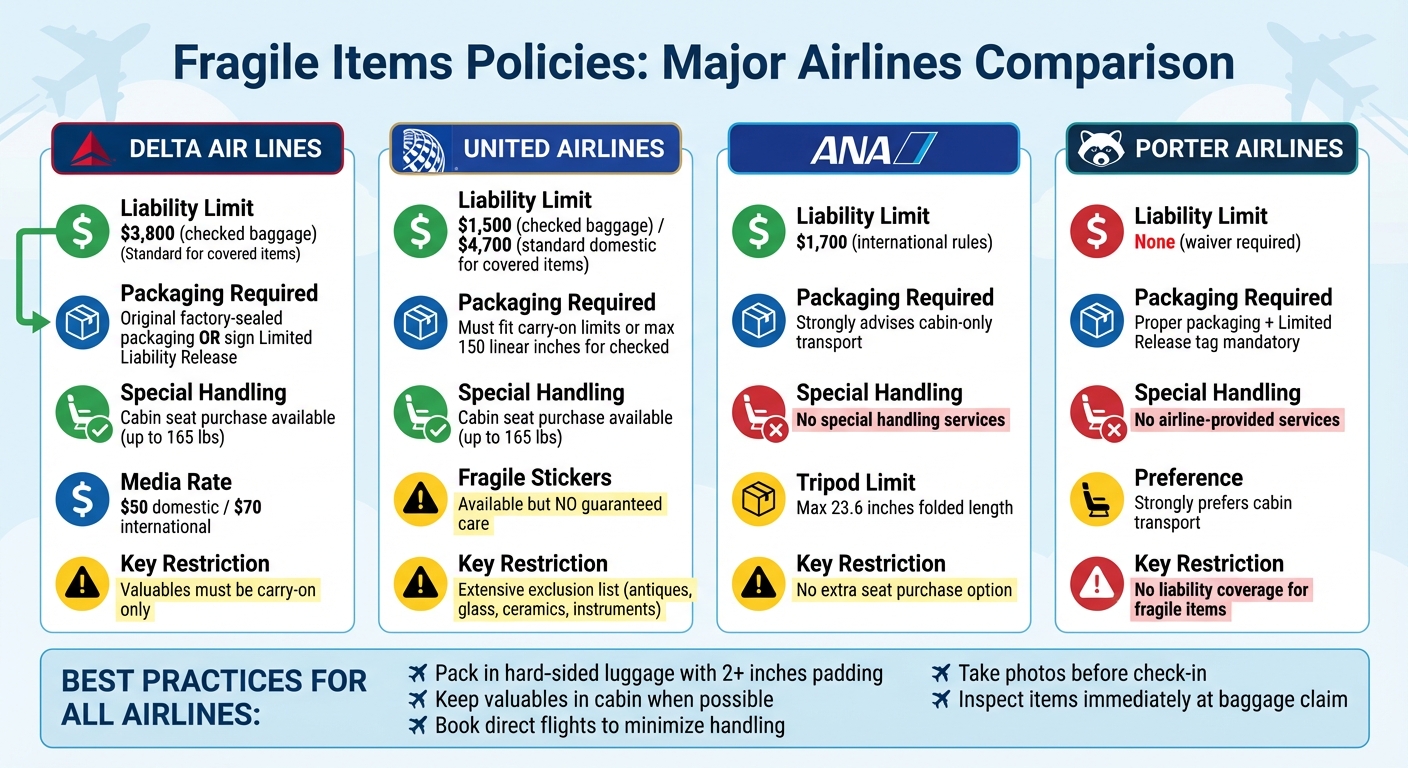
Major Airlines Fragile Items Policy Comparison Chart
1. Delta Air Lines
Packaging Requirements
Delta allows fragile items to be carried in either checked or carry-on baggage, but there’s a catch: they must be in their original factory-sealed packaging with protective materials provided by the manufacturer. If not, you might have to sign a Limited Liability Release, which means Delta won’t be responsible for any damage. Certain items have specific rules:
- Christmas trees need their root ball or cut base and branches wrapped in burlap-like material.
- Cremated remains must be stored in wood or plastic containers that can be x-rayed by the TSA without being opened.
On top of that, valuables like computers, jewelry, cash, and other irreplaceable items are not allowed in checked baggage and must be carried on with you.
Liability Limits
Delta’s domestic liability for damaged or lost items is capped at $3,800 per passenger. This limit can create issues for passengers with high-value items. For example, in March 2026, artist Chika experienced $5,000 in damage to her Rimowa suitcases during a Delta flight. Since she didn’t declare the higher value or pay the necessary fees, she was left covering the difference herself. Aviation.Direct explains:
“To receive full reimbursement for items exceeding standard liability, travelers would have to submit an additional value declaration and pay the corresponding fees in advance – a step many passengers neglect during the regular check-in process.” – Aviation.Direct
If you’re traveling with fragile or high-value items that exceed $3,800, it’s essential to declare their value at check-in and pay the extra fees to ensure full coverage.
Special Handling Procedures
For items that are too delicate or bulky to fit in standard baggage storage, Delta offers Cabin-Seat Baggage. This service allows you to purchase an extra seat to secure your item safely. The item must weigh no more than 165 lbs (75 kg) and be secured with a seatbelt in a seat near a bulkhead or divider. To arrange this, you’ll need to contact Delta Reservations in advance.
Additionally, media professionals traveling with equipment like cameras or sound gear can take advantage of discounted flat rates: $50 USD for domestic flights and $70 USD for international flights when valid credentials are shown.
sbb-itb-e205081
2. United Airlines
Packaging Requirements
United Airlines has specific rules for transporting fragile items. If a musical instrument or another delicate item fits within the airline’s carry-on size limits, it can be brought on board. Larger instruments, however, must not exceed 150 linear inches (381 cm) in size or weigh more than 165 lbs (75 kg) to qualify for checked baggage. Smaller fragile items that fit in the overhead bin or under the seat can also be carried on. These packaging guidelines are essential, but understanding how United handles liability for such items is equally important.
Liability Limits
When it comes to fragile items, United Airlines does not provide separate liability limits. Passengers can request “FRAGILE” stickers at check-in to alert baggage handlers, but these stickers do not guarantee special care or additional protections. To minimize risks, travelers should consider taking photos of their fragile items before the flight and review the airline’s liability policies thoroughly.
Special Handling Procedures
United Airlines offers additional options for handling fragile items. If an item is too delicate for the cargo hold, passengers can purchase an extra seat in the cabin, provided the item weighs no more than 165 lbs (75 kg). The cost for this service equals the price of an adult ticket, plus taxes and fees.
Additionally, United uses a “Piece Concept” for baggage fees, meaning charges are applied per bag instead of by total weight. This means that combining smaller items into one larger bag could lead to extra fees. For items that exceed standard baggage limits or require extra care, United Cargo offers services like “UASecure”, which ensures professional handling and monitoring. Media professionals traveling with equipment such as cameras or sound gear may also benefit from a preferred rate of $50 USD on domestic flights, provided they present valid credentials.
3. ANA
Packaging Requirements
ANA strongly recommends keeping fragile items like musical instruments, paintings, and glassware with you in the cabin to minimize the risk of damage. Similarly, electronic devices such as laptops and cameras should also stay with you during the flight to ensure their safety.
For folded camera tripods and monopods, the maximum allowed length is 23.6 inches (60 cm). Bluetooth-enabled selfie sticks are permitted, but they must be set to a non-transmitting mode. If you’re traveling with devices containing lithium or lithium-ion batteries, it’s essential to check for any additional rules or restrictions before your trip.
This focus on cabin-only carriage directly influences the airline’s liability policies.
Liability Limits
Unlike Delta and United, ANA exclusively relies on in-cabin carriage for fragile items. By requiring passengers to keep these items with them, ANA reduces the risk of liability associated with damages to checked fragile items. This approach is consistent with broader industry practices, where airlines typically offer limited liability for checked fragile goods.
Special Handling Procedures
ANA does not provide extra handling services for fragile items. This means options like purchasing an additional seat or using specialized cargo services are not available. For instance, if a tripod or monopod exceeds the 23.6-inch (60 cm) folded length limit, passengers must arrange alternative solutions. International travelers should also check for country-specific carry-on restrictions, as some destinations enforce unique rules for certain items.
4. Porter Airlines
Packaging Requirements
Porter Airlines has specific rules when it comes to checking fragile items. They only accept fragile items as checked baggage if they are properly packaged, and passengers must sign a Limited Release tag at check-in. This waiver shifts liability to the passenger. If your fragile items aren’t packaged correctly, Porter may either refuse them or require you to sign the liability waiver.
The airline strongly suggests bringing fragile items into the cabin instead, as long as they fit within the size and weight limits for carry-on baggage. This preference for cabin transport is similar to ANA’s approach, though Porter does permit fragile items to be checked under certain conditions.
Let’s look at how these packaging rules affect the airline’s liability.
Liability Limits
Porter Airlines does not take responsibility for damage to fragile, perishable, or valuable items. By requiring passengers to sign a Limited Release tag, the airline minimizes its liability for any damage to fragile goods in checked luggage. Essentially, this policy transfers the risk to passengers who decide to check these items instead of carrying them onboard.
Special Handling Procedures
Porter doesn’t offer any extra handling services for fragile items beyond its standard procedures. However, passengers can take advantage of airport porter services. These baggage handlers are trained to manage delicate items and use specialized carts to transport luggage. They assist with moving bags from your vehicle to the check-in counter or from the baggage claim area to your pickup location. While this service isn’t directly provided by Porter Airlines, it adds an extra layer of care during critical points of your trip.
This policy highlights Porter’s stance on passenger responsibility, especially when compared to airlines that offer more in-cabin options for fragile items.
How to Safely Pack Fragile Items for Air Travel Essential Tips & Tricks for a Hassle-Free Journey
Pros and Cons
Airlines have varying approaches to handling fragile items, and knowing these differences can help you better protect your belongings. Here’s a quick look at how some major airlines handle fragile item policies:
| Airline | Pros | Cons |
|---|---|---|
| Delta Air Lines | • Accepts fragile items in original factory-sealed containers without requiring a liability waiver • Allows passengers to purchase a cabin seat for items weighing up to 165 lbs |
• Excludes fragile, perishable, and valuable items from liability coverage • Requires a limited liability release for items not in original packaging • Cabin-seat purchase is priced at the best available published fare |
| United Airlines | • Offers a standard domestic liability limit of $4,700 for covered items • Provides multiple reporting options, including an app, chat, and text (“BAGS” to 32050) • Extends a 7-day reporting window for international damage claims |
• Maintains a long list of exclusions, such as antiques, chinaware, glass, ceramics, and musical instruments • Lacks specialized handling for fragile items, leaving passengers responsible on domestic flights |
| ANA | • Covers fragile items under international liability if accepted for transportation • Provides protection under the Montreal Convention with a liability limit of approximately $1,700 |
• Offers limited publicly available guidance on handling fragile items • The international liability limit of $1,700 is much lower than the domestic limit |
| Porter Airlines | • Recommends passengers carry fragile items in the cabin to reduce risks | • Does not offer liability coverage or dedicated special handling for fragile items in checked baggage |
For international flights, airlines are required by the Montreal Convention to compensate passengers for fragile goods they accept for transport. However, the liability cap is often around $1,700. While airlines like United offer multiple ways to report issues, their extensive exclusion lists can limit coverage for fragile items.
Conclusion
Each airline has its own way of handling fragile items, reflecting different priorities. Delta Air Lines stands out with its cabin-seat baggage program, allowing travelers to secure items up to 165 lbs in the passenger cabin. Plus, Delta waives liability releases if the item stays in its original, sealed packaging. On the other hand, United Airlines generally excludes fragile items from its baggage liability, relying on standard tagging procedures. For international travel, carriers like ANA follow the Montreal Convention, which limits liability for checked items, similar to many other international airlines.
That said, “fragile” stickers often don’t guarantee extra care. To protect your items, focus on sturdy packing. Use a double-box method with at least 2 inches of padding, and opt for hard-sided luggage. Taking photos of your packed item before check-in can also support any claims in case of damage.
Whenever possible, book direct flights to minimize handling risks. For high-value or delicate items, keeping them in the cabin is your safest bet.
If fragile items are part of your travel plans, Flight Booking 247 offers around-the-clock access to a travel concierge. They can help you find airlines with better reputations for handling delicate items and assist in securing cabin-seat options for oversized or sensitive belongings. Always inspect your items immediately after baggage claim and file a Property Irregularity Report if you notice any damage.
FAQs
How do I declare a higher value for a fragile item at check-in?
When traveling with a fragile item, it’s important to take extra precautions to ensure its safety. If the item holds significant value, consider purchasing additional coverage or a limited liability waiver, as standard liability might not fully protect it. Make sure the item is securely packaged to prevent damage during transit.
At check-in, inform the airline staff about the fragile nature of your item. They can assist with any necessary documentation or special handling procedures. Keep in mind that some airlines may require you to sign a Limited Liability Waiver or provide an explicit value declaration for the item. To avoid surprises, contact your airline ahead of time to understand their specific policies and requirements.
When is buying an extra cabin seat for a fragile item worth it?
Buying an extra cabin seat can be a smart choice for items that are too big, fragile, or important to risk checking or carrying on. This option ensures the item is securely strapped in with a seatbelt and kept in a seat with a physical divider, offering extra care and protection throughout the flight.
What should I do immediately if my fragile item is damaged after a flight?
If your fragile item gets damaged during a flight, it’s important to file a baggage claim with the airline right away. Airlines are generally responsible for either repairing the item or compensating you for the damage caused during transport. If the item can’t be repaired, compensation is usually calculated based on its value and depreciation. Don’t delay – each airline has different deadlines for filing claims, so acting quickly is crucial.