

Flight cancellations can cost you thousands in non-refundable expenses like flights, hotels, and tours. Travel insurance helps recover these costs if your trip is canceled for a covered reason, such as illness, severe weather, or job loss. It can also reimburse out-of-pocket expenses like meals or hotel stays during delays. Here’s what you need to know:
- Covered Reasons: Illness, injury, family emergencies, severe weather, job loss, or airline issues.
- Reimbursement: Typically 100% of prepaid, non-refundable costs (e.g., flights, hotels, tours).
- Additional Coverage: Cancel For Any Reason (CFAR) allows cancellations for any reason but reimburses only 50%-75%.
- Documentation: Proof of cancellation, receipts, and refund denials are crucial for claims.
- Timing: Purchase insurance early (within 14-21 days of booking) to maximize benefits, including waivers for pre-existing conditions.
Act quickly during cancellations, notify insurers immediately, and keep all related documents to streamline your claim process. CFAR offers more flexibility but at a higher cost. Always review your policy’s fine print to ensure it meets your needs.
Trip Cancellation Travel Insurance Explained (What Is Covered?)
sbb-itb-e205081
Which Flight Cancellations Does Travel Insurance Cover?
Travel insurance can step in to cover flight cancellations, but only for specific, pre-defined reasons. Knowing these scenarios is key to recovering nonrefundable costs tied to your trip. Here’s a breakdown of the situations where travel insurance typically reimburses cancellations.
Cancellations Initiated by Airlines
When an airline cancels your flight – whether due to bankruptcy, operational issues, or weather-related disruptions – travel insurance may cover the nonrefundable parts of your prepaid travel expenses. However, if the airline provides a full cash refund for the canceled flight, the insurance will only reimburse other prepaid costs, such as hotel stays or tours. Always contact the airline first to request a refund, as insurers only cover amounts the airline doesn’t reimburse. It’s essential to get official documentation, like cancellation notices or confirmations, to support your claim.
Severe weather events often fall into a different category, with specific conditions for coverage.
Cancellations Due to Weather
Weather-related cancellations are covered when travel becomes impossible, not just inconvenient. For instance, blizzards, hurricanes, or wildfires that cause airport closures or make your destination uninhabitable could qualify. Coverage applies if the weather leads to the suspension of airline services or the official closure of an airport.
One critical detail to remember is the “known event” rule. To be covered, you must purchase your travel insurance at least 24 hours before a severe weather alert, such as a winter storm warning, is issued. Once a storm is named or a warning is announced, it’s too late to obtain coverage for that specific event. Be prepared to provide official weather advisories and proof of airport closures when filing your claim.
When external factors aren’t the cause, personal emergencies can also qualify as covered reasons.
Cancellations Due to Personal Circumstances
Travel insurance often covers cancellations stemming from personal emergencies. These include sudden illness or injury, the hospitalization or death of a close family member, involuntary job loss, significant home damage (like from a fire or flood), or even being summoned for jury duty. To make a claim, you’ll need to provide documentation, such as a doctor’s note for illnesses, a death certificate or hospital records for family emergencies, or termination letters for job-related issues. For home emergencies, police or fire department reports are typically required.
What Costs Does Travel Insurance Reimburse After a Flight Cancellation?
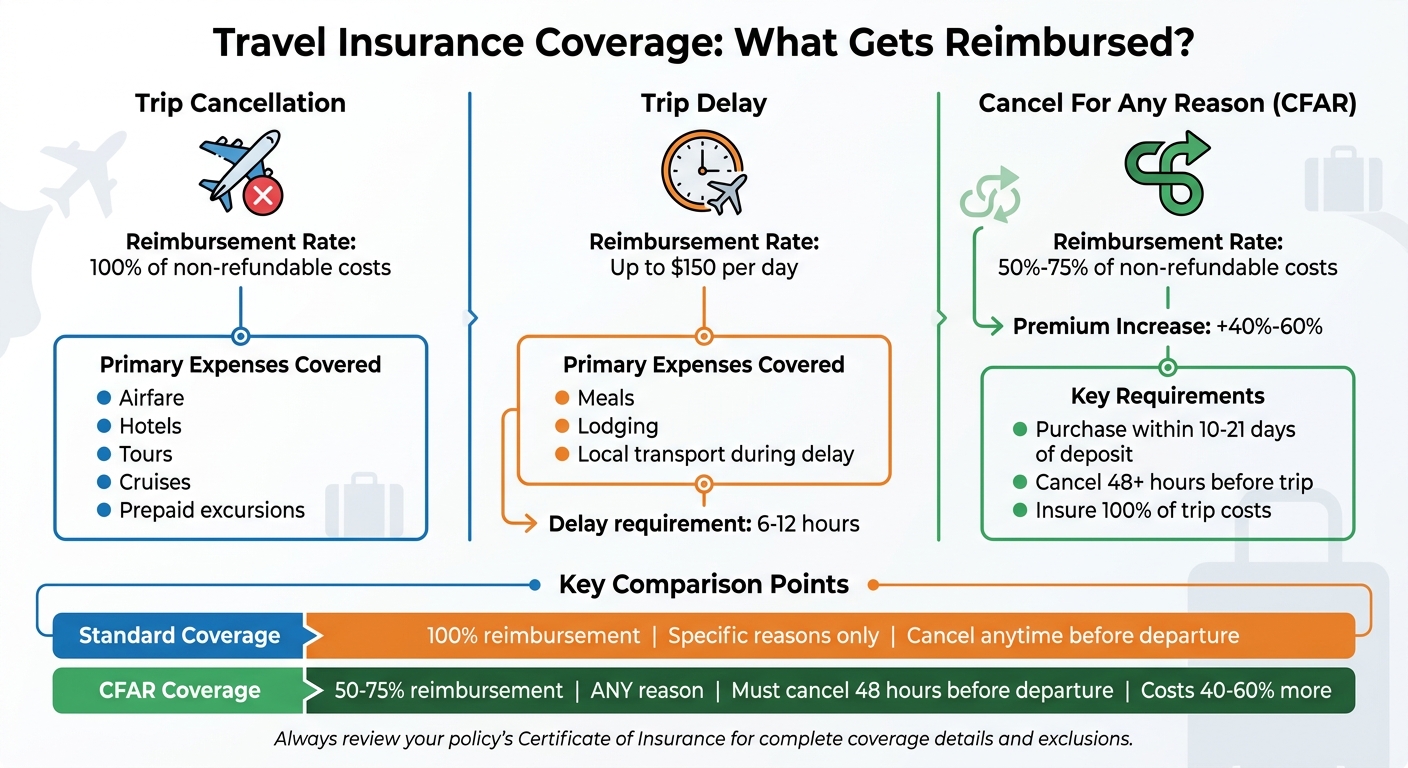
Travel Insurance Coverage Types and Reimbursement Rates Comparison
Knowing what travel insurance covers can make a big difference when a flight cancellation throws your plans off track. Typically, it reimburses 100% of non-refundable, prepaid expenses like flights, hotels, tours, cruises, rental cars, and pre-booked excursions – as long as the cancellation is due to a covered reason. To ensure you recover all eligible expenses, it’s important to insure the full value of your trip. These reimbursements help ease the financial burden when unexpected disruptions force you to adjust your travel plans.
Rebooking Costs and Alternative Transportation
If your flight gets canceled and you need to rebook or find alternative transportation, travel insurance can cover the associated costs. This includes rebooking fees and any additional charges for new flights that help you stay on schedule or return home early. Keep in mind, U.S. law mandates airlines to refund the ticket price if they cancel a flight and you decide not to travel. In such cases, insurance can cover other non-refundable expenses.
Travel delays can also lead to extra costs, such as accommodations or meals, which may be covered under your policy.
Hotel Stays and Meals
For delays lasting 6–12 hours, travel insurance often reimburses reasonable costs for overnight stays, meals, and local transportation, like taxi rides to and from a hotel. These benefits usually have daily limits, commonly around $150 per day. To make a successful claim, you’ll need to save receipts and official documentation for all incurred expenses. It’s worth noting that U.S. airlines aren’t legally required to provide accommodations or meals during weather-related delays, though some may offer amenities for issues within their control, like maintenance problems.
Prepaid Trip Expenses
In addition to covering immediate adjustments, travel insurance protects the money you’ve already spent on non-refundable reservations. This includes prepaid hotel stays, tours, and other activities that you can’t use because of a cancellation. To maximize your chances of reimbursement, notify travel suppliers – such as hotels or tour operators – within 72 hours of realizing you need to cancel.
| Coverage Type | Typical Reimbursement | Primary Expenses Covered |
|---|---|---|
| Trip Cancellation | 100% of non-refundable costs | Airfare, hotels, tours, cruises, and prepaid excursions |
| Trip Delay | Up to $150 per day | Meals, lodging, and local transport during the delay |
| Missed Connection | Cost of new arrangements | Expenses to catch up to a trip after a missed flight |
Cancel For Any Reason (CFAR) Coverage
While standard travel insurance typically covers specific incidents like illness or natural disasters, Cancel For Any Reason (CFAR) coverage takes things a step further. It allows you to cancel your trip for literally any reason – whether you’ve had a change of heart or feel uneasy about your destination – and still recover a portion of your non-refundable expenses.
Adding CFAR to your policy does come at a cost, increasing your premium by 40% to 60%. For example, if your trip costs $3,500, you’d pay around $223 extra on average for CFAR. Timing is crucial here: most insurers require you to purchase CFAR within 10 to 21 days of making your initial trip deposit. Miss that window, and you won’t be eligible for this coverage. This flexibility makes CFAR stand out compared to standard cancellation policies.
CFAR vs. Standard Trip Cancellation Coverage
The biggest distinction between CFAR and standard trip cancellation coverage lies in flexibility versus reimbursement. Standard travel insurance reimburses 100% of your non-refundable costs, but only for specific, covered reasons like illness, injury, or severe weather. On the other hand, CFAR gives you the freedom to cancel for any reason but typically covers only 50% to 75% of your prepaid expenses.
Another key difference is timing. Standard policies often let you cancel right up to your departure date, while CFAR requires you to cancel at least 48 hours before your trip begins. If flexibility is your priority and you’re willing to accept a reduced reimbursement rate, CFAR might be the better choice.
CFAR Reimbursement Rates and Purchase Requirements
CFAR policies vary in reimbursement rates and eligibility rules, making it important to understand the details. Most plans reimburse between 50% and 75% of your non-refundable trip costs, depending on the provider. For instance, plans like iTravelInsured Travel LX and Trip Protection Choice offer the higher 75% reimbursement rate, provided you purchase the coverage within 20 days of your initial deposit.
To qualify for CFAR, you generally need to insure 100% of all prepaid, non-refundable trip expenses. If you underinsure even one part of your trip, you risk losing CFAR benefits entirely.
Another important note: CFAR isn’t available in every state. For example, New York residents often don’t have access to this add-on. Before purchasing, check whether your state allows CFAR and confirm the exact purchase window with your insurer. Keep in mind that the eligibility clock starts ticking with your first trip payment, whether it’s a flight, hotel, or any other prepaid expense – so don’t delay.
How to File a Claim for a Canceled Flight
Filing a claim for a canceled flight is straightforward if you act quickly and have all the necessary documentation. Most travel insurance policies require you to notify your insurer within 24 hours of the cancellation, though some allow up to 20–30 days. Missing this deadline can put your claim at risk, so it’s crucial to contact your insurer as soon as you know your flight is canceled. Before filing, reach out to the airline to request a refund and obtain written proof if your refund request is denied. This step is essential for ensuring you can claim any non-refundable expenses.
Damian Tysdal, Founder of CoverTrip, emphasizes:
Most claims aren’t denied because something wasn’t covered – they’re denied because the traveler didn’t follow the right process, missed a deadline, or couldn’t produce the receipts they needed.
Roughly 20% of claims may require additional paperwork.
Documents You’ll Need
To strengthen your claim, you’ll need to gather the following:
- Proof of Cancellation: This could be an email, app notification, or a letter from the airline explaining the reason and timing of the cancellation.
- Booking and Payment Records: Include original booking confirmations (e.g., e-tickets, hotel reservations, or prepaid activity invoices) along with proof of payment, such as credit card statements.
- Proof of Non-Refundability: Provide documentation of the airline’s refund policy and a written denial of your refund request.
- Expense Records: Keep itemized receipts for any additional costs, such as rebooking fees, meals, or hotel stays.
- Refund or Credit Documentation: If you’ve received partial refunds, vouchers, or travel credits, include proof of these, as insurers will only reimburse your remaining out-of-pocket expenses.
To stay organized, scan and save receipts and notifications as you receive them. Digital copies are easier to manage and less likely to be misplaced during your trip. Clearly label these files to streamline the claims process. While insurers often accept digital scans or photocopies, hold onto the original documents until your claim is fully resolved.
Steps to Submit Your Claim
Once you’ve compiled all your documents, follow these steps to file your claim:
Most insurers offer online portals or mobile apps for quick digital submissions. Start by logging into your insurer’s claims portal and completing the claim form. Fill out all sections thoroughly and mark non-applicable fields as “N/A”. Upload all your documentation at once to avoid delays caused by missing paperwork.
Claims are typically processed within 10–20 business days, with most resolved in 4–6 weeks. In some cases, insurers may approve reimbursements in as little as 7–10 days. Policies generally require that you submit a completed claim within 90 days of the covered event. If you don’t hear back within the expected timeframe, contact your insurer’s claims department, provide your claim number, and request an update.
What Travel Insurance Doesn’t Cover
While travel insurance can provide a financial safety net for many unexpected issues, it’s crucial to understand what it doesn’t cover. Even the most extensive policies have their limits, and knowing these in advance can help you avoid surprises when filing a claim. As Squaremouth puts it:
“Travel insurance is designed to financially protect you against unavoidable disruptions that are beyond your control… Events outside these criteria are not covered”.
In short, anything that doesn’t fall under the category of unforeseen emergencies is typically excluded. These exclusions are clearly outlined in your policy’s Certificate of Insurance, making it essential to read through it carefully before your trip.
Voluntary Cancellations Without CFAR
Deciding not to travel? Standard travel insurance won’t cover that. Whether it’s due to travel anxiety, a fear of flying, or simply deciding the trip isn’t worth it, voluntary cancellations are not reimbursed under most policies.
If you want flexibility to cancel for any reason, consider adding a Cancel for Any Reason (CFAR) upgrade to your policy. Without it, changing your mind is entirely on your dime.
Pre-Existing Conditions and Known Events
When it comes to medical issues or predictable events, standard policies have strict guidelines. For example, cancellations tied to pre-existing medical conditions – those diagnosed or treated within 60 to 365 days before purchasing your policy – are not covered. Conditions like heart disease, diabetes, asthma, or recent injuries typically fall under this category. However, some insurers offer a pre-existing condition waiver if you buy your policy early – usually within 14 to 21 days of your initial trip deposit – and insure the full trip cost.
Similarly, coverage for known events is off the table. If a tropical storm has already been named, a government travel advisory is issued, or a strike is publicly announced, policies purchased after these events won’t cover related cancellations. For instance, if you’re considering insurance to protect against a storm, check if it’s already named – if it is, it’s deemed foreseeable and excluded from coverage.
Other common exclusions include routine medical visits, normal pregnancy and childbirth, participation in high-risk adventure sports, unlawful acts, substance abuse, and incidents related to war or civil unrest.
To avoid misunderstandings, always review your Certificate of Insurance for a full list of exclusions.
Conclusion: Getting the Right Flight Cancellation Coverage
Finding the right travel insurance means aligning your policy coverage with the total cost of your trip – not just your initial deposit. If you underinsure, you risk reduced reimbursements or even denied claims, so your policy limit should account for all prepaid, nonrefundable expenses. Timing is also key: purchasing your policy within 14 to 21 days of your first trip deposit can waive pre-existing condition exclusions and ensures coverage for events that happen after purchase.
If you’re looking for more flexibility beyond standard reasons like illness or severe weather, think about adding Cancel For Any Reason (CFAR) coverage. While CFAR costs 40% to 60% more than a standard plan and typically reimburses only 50% to 75% of nonrefundable expenses, it allows you to cancel for any reason. Just make sure to buy CFAR within the 14- to 21-day window after your initial deposit and cancel at least 48 to 72 hours before your trip. Proper documentation is crucial for securing your reimbursement.
When cancellations happen, acting quickly can protect your nonrefundable costs. Keep all related documents handy, and request written confirmation from airlines detailing what they will and won’t reimburse. Insurers only cover the portion of expenses that you cannot recover elsewhere.
Speed is critical during cancellations. Notify your insurer and travel suppliers immediately to minimize losses. Damian Tysdal, Founder of CoverTrip, highlights this important step:
The single most important rule of travel insurance claims: call your insurer as soon as something goes wrong. Don’t wait until you get home.
For extra support in managing cancellations or booking changes, you might consider using Flight Booking 247 (https://flightbooking247.com). Their 24/7 travel concierge service offers personalized assistance to help you navigate these challenges when you need it most.
FAQs
Does travel insurance cover a cancellation if the airline offers a voucher instead of a refund?
Travel insurance can help with cancellations, but only if the reason falls under the policy’s listed covered causes. If your airline issues a voucher instead of a refund, most travel insurance policies won’t cover that scenario. Always review your policy carefully to understand what situations are included.
How do I know if a weather disruption counts as a “known event”?
When a weather disruption is labeled as a “known event”, it means it has already been publicly announced or forecasted – think severe winter storms or official weather warnings. This designation can impact your travel insurance coverage, particularly for trip cancellations or delays. To understand how it might affect you, review the specific terms of your policy carefully.
What happens if I didn’t insure 100% of my prepaid trip costs?
If you didn’t insure the full cost of your prepaid trip, you might only receive partial coverage for cancellations or interruptions. This means you could end up paying out-of-pocket for any expenses tied to the uninsured parts of your trip.