

The Middle East aviation sector is undergoing major changes in 2026, driven by policies that encourage investment, modernize regulations, and expand infrastructure. Here are the top five policies reshaping the region:
- Saudi Arabia’s Vision 2030 Framework: Allows 100% foreign ownership in aviation, simplifies licensing, and targets $100 billion in investments by 2030.
- UAE’s Free Zones: Offers 100% foreign ownership, tax exemptions, and streamlined operations, attracting global aviation businesses.
- GCC Unified Regulations: Standardizes licensing and compliance, making it easier for airlines to operate across member states.
- Qatar’s Incentives for Infrastructure: Introduces a $1 billion program covering up to 40% of eligible costs, boosting aviation investment.
- Modernized Frameworks by GCAA and GACA: Aligns with international standards, improves airspace management, and facilitates workforce mobility.
These policies aim to boost foreign investment, simplify operations, and position the Middle East as a global aviation hub. By 2026, the region expects to handle over 300 million seats annually and generate $260 billion in GDP, reflecting the success of these initiatives.
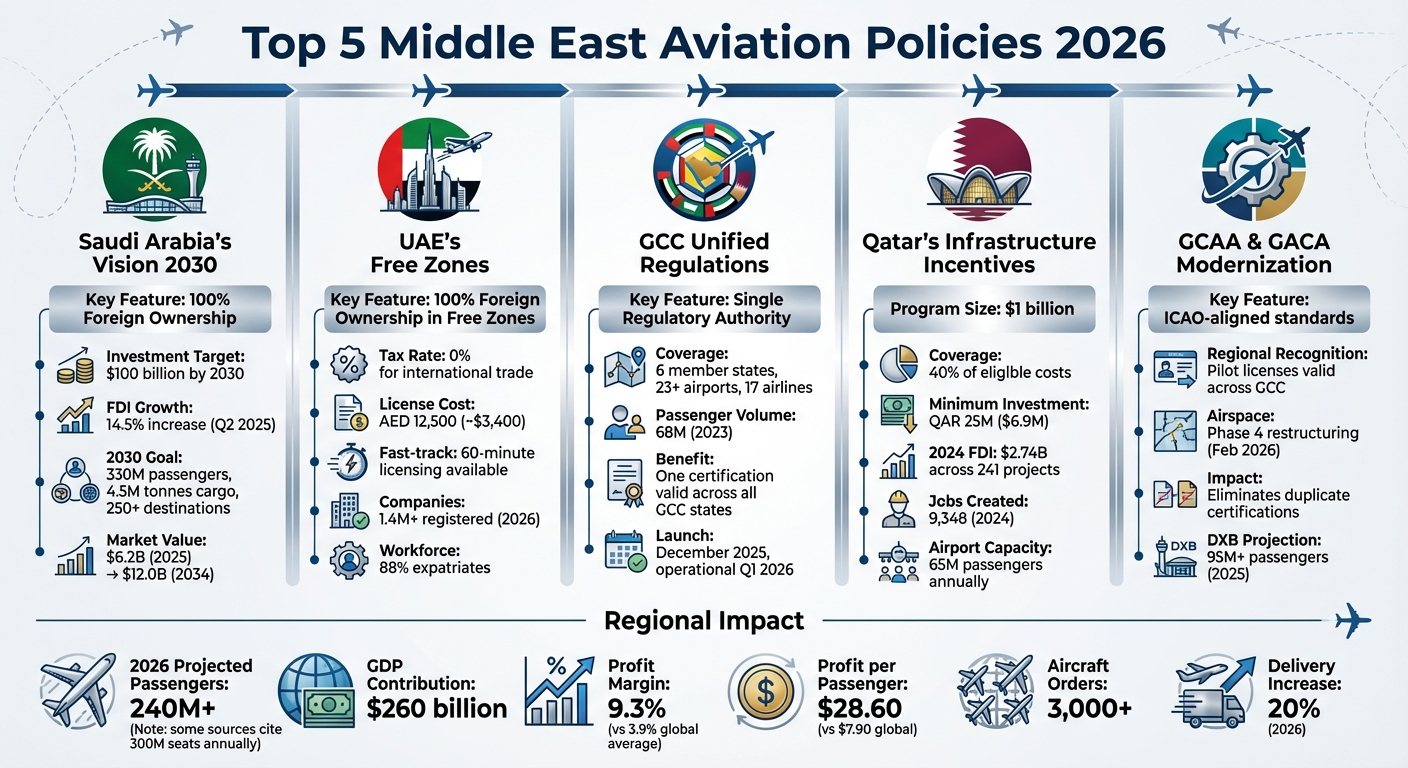
Top 5 Middle East Aviation Policies 2026: Investment Benefits and Key Features
1. Saudi Arabia’s Vision 2030 Aviation Ownership and Investment Framework

Impact on Foreign Investment in Aviation
Saudi Arabia has taken bold steps to reshape its investment landscape, particularly in aviation. By removing the requirement for a local partner, the Kingdom now allows 100% foreign ownership in the sector. Starting in February 2026, this policy will extend to publicly listed companies, lifting the 49% ownership cap and enabling international investors to hold majority or full control. These reforms have already shown results: foreign direct investment (FDI) net inflows rose by 14.5% year-over-year, hitting $6.1 billion in the second quarter of 2025.
The General Authority of Civil Aviation (GACA) has also introduced an ambitious economic framework aimed at attracting $100 billion in aviation investment by 2030. Key initiatives include airport privatization and measures to boost competitiveness. Meanwhile, the Ministry of Investment (MISA) has simplified licensing, making it easier for international firms to enter the market. Special Economic Zones further sweeten the deal with incentives like reduced corporate taxes and exemptions on customs duties for aviation-related businesses.
These changes are setting the stage for a more competitive and investor-friendly aviation sector.
Support for Airline Ownership and Operations
Saudi Arabia is also making it easier for airlines to operate within its borders. GACA has introduced updated regulations that streamline the process for obtaining carrier licenses and removed certain economic hurdles.
In December 2025, Riyadh Air made headlines by partnering with IBM to launch the world’s first AI-native airline, integrating intelligent automation from the very beginning. Flyadeal, another prominent player, expanded its operations in January 2026 by adding five new routes from its Madinah hub, increasing its weekly capacity by 40%.
Alignment with Regional and Global Aviation Standards
By 2030, Saudi Arabia aims to handle 330 million passengers, move 4.5 million tonnes of cargo, and connect to over 250 global destinations. In February 2025, Red Sea International Airport introduced a 35% blend of Sustainable Aviation Fuel (SAF) in collaboration with Red Sea Global and Arabian Petroleum Supply Company. This initiative marked the Kingdom’s first SAF offering, cutting aircraft emissions by up to 35% per flight.
“These changes create a dynamic and competitive market, benefiting both passengers and investors.” – GACA President
The Kingdom’s aviation market, valued at $6.2 billion in 2025, is expected to nearly double, reaching $12.0 billion by 2034. For foreign investors, obtaining a MISA investment license is the first step. This license serves as a gateway before addressing sector-specific requirements set by GACA. Additionally, companies aiming for government contracts are encouraged to establish their regional headquarters in Saudi Arabia through the RHQ Program.
sbb-itb-e205081
2. UAE’s 100% Foreign Ownership Policy in Aviation Free Zones
Impact on Foreign Investment in Aviation
The UAE has reshaped the aviation investment landscape by allowing 100% foreign ownership in free zones. This policy gives international companies full equity and profit rights, making the region more attractive for global investors. It also positions aviation hubs like Dubai South as key players in the industry.
Dubai South, for example, is becoming a hub for Maintenance, Repair, and Overhaul (MRO) and Advanced Air Mobility (AAM) operations. Bombardier plans to open a dedicated service and maintenance facility in Abu Dhabi by late 2026, reducing reliance on European centers for its business jets. Similarly, flydubai is set to complete a new aircraft maintenance center at Dubai South by the end of 2026, featuring hangar capacity and integrated engineering services.
In 2025 alone, the UAE recorded 250,000 new company registrations, bringing the total to over 1.4 million by early 2026. With expatriates making up 88% of the population, the country offers a skilled workforce that aviation businesses can tap into. On top of that, setup costs remain competitive. For instance, Meydan Free Zone offers a regular business license for AED 12,500 (around $3,400), while its “Fawri” fast-track option costs AED 15,000 and guarantees licensing within 60 minutes.
Support for Airline Ownership and Operations
Aviation companies operating in these free zones enjoy simplified processes and significant benefits. Foreign investors have full control over operations and profits, free from the need for local agents. Additionally, companies face no withholding taxes and can repatriate profits without restrictions.
The UAE’s tax structure adds further appeal. While mainland companies are subject to a 9% corporate tax on profits over AED 375,000, free zone entities enjoy a 0% tax rate for international trade and services. On top of this, the UAE’s Corporate Tax Law exempts income from international air transportation.
“100% foreign ownership is a built-in feature of UAE free zones, designed for global entrepreneurs who require control, speed, and clarity.” – Meydan Free Zone
Alignment with Regional and Global Aviation Standards
The UAE’s regulatory updates showcase its commitment to attracting global aviation investors. Recent amendments to the corporate framework align with international standards, introducing features like multiple share classes, drag-along/tag-along rights, and simplified re-domiciliation processes.
The aviation sector is also preparing for the future. The General Civil Aviation Authority (GCAA) is finalizing an eVTOL certification framework that covers pilot licensing and vertiport standards. This supports initiatives like Joby Aviation‘s partnership with Dubai’s Roads and Transport Authority to launch air taxi services by 2026.
“Certification readiness determines whether advanced air mobility remains demonstrative or becomes commercially bankable.” – Manuela Vergel, Associate Editor, Aviation Business Middle East
These regulatory improvements align with broader efforts across the Middle East to simplify aviation ownership and investment, further boosting the UAE’s role as a global aviation leader.
3. GCC Standardization of Aviation Regulations and Licensing
Impact on Foreign Investment in Aviation
The GCC’s shift toward a Unified Civil Aviation Authority simplifies the landscape for foreign investors. Instead of dealing with six individual regulatory systems, businesses now adhere to one cohesive set of standards. This change significantly reduces the bureaucratic challenges that often discourage international companies. With fewer administrative hurdles, resources can be better allocated to advancing innovation and improving infrastructure.
The region is home to over 23 international airports and 17 national airlines, with six airlines ranked among the top 50 globally in 2024. In 2023 alone, GCC airlines transported around 68 million passengers, underscoring the region’s growing prominence as a global aviation hub.
Support for Airline Ownership and Operations
The unified aviation authority has streamlined processes, removing the need for airlines to undergo duplicate certifications and audits. This means airlines can operate seamlessly across all six member states without repeating compliance procedures. Additionally, pilot licenses and technical credentials issued in one GCC country are now valid throughout the region.
“It eliminates duplication – no more multiple certifications, redundant audits, and repeated compliance headaches for airlines. These are all critically important, so doing them once to the same standard will make the region stronger.” – Kamil Alawadhi, Regional Vice President, Africa and Middle East, IATA
A practical demonstration of this unified approach came in December 2025, when the UAE and Bahrain introduced the “One Stop Travel” pilot program. This initiative allows passengers to complete immigration and security checks solely at their departure airport, removing the need for these procedures at their destination.
Alignment with Regional and Global Aviation Standards
The GCC’s regulatory framework aligns with ICAO Standards and Recommended Practices, ensuring the region adheres to internationally recognized safety and security benchmarks. Headquartered in the UAE and approved during the 46th GCC Summit in Bahrain in December 2025, the new authority also oversees the creation of a Unified Upper Airspace. This initiative is designed to enhance efficiency and reduce environmental impact in regional flight operations.
The standardized regulations also extend to emerging sectors like Advanced Air Mobility (AAM), laying the groundwork for innovative projects. This cohesive approach enhances the region’s leverage in negotiations with global aircraft manufacturers and service providers. By unifying regulations, the GCC is setting the stage for future reforms that aim to attract investment and elevate operational standards across the aviation sector.
4. Qatar’s Investment Incentives for Aviation Infrastructure Development
Impact on Foreign Investment in Aviation
In May 2025, Qatar rolled out a $1 billion program aimed at attracting both local and international investors. This initiative offers to cover 40% of eligible expenses – such as construction, equipment, and employee costs – over a five-year period, provided investors commit at least QAR 25 million ($6.9 million).
The updated Foreign Investment Law (Law No. 1/2019) and its 2026 amendments now allow up to 100% foreign ownership in most sectors, pending approval from the Ministry of Commerce and Industry. Free zones like QFZ and QSTP further sweeten the deal with perks like 20-year renewable tax holidays, zero customs duties on exports, and full profit repatriation. These efforts bore fruit in 2024, when Qatar secured $2.74 billion in foreign direct investment across 241 projects, creating 9,348 jobs.
“This initiative is a renewed testament to our unwavering commitment to create a world-class investment environment, that not only drives sustainable economic growth but also delivers long-term value to our partners.” – H.E. Sheikh Faisal bin Thani bin Faisal Al Thani, Minister of Commerce and Industry and Chairman of the Advisory Council
These incentives are part of broader reforms designed to strengthen Qatar’s aviation sector.
Support for Airline Ownership and Operations
Qatar has also introduced measures to enhance airline operations. The Logistics Package, part of the national incentives framework, encourages investments in infrastructure, automation, and advanced logistics services to support airline efficiency. In a significant move, Invest Qatar and Boeing signed an MoU in May 2024 to establish Boeing Aerospace Doha LLC. This partnership aims to bolster the local aerospace sector through research, technological innovation, and startup support.
Qatar Airways, which operates more than 150 Boeing aircraft with 112 additional planes on order as of mid-2024, benefits directly from these initiatives. Boeing’s commitment to workforce development in Qatar is evident through its $1.5 million investment in STEM education and training since 2009.
These operational improvements align Qatar’s aviation sector with global standards and best practices.
Alignment with Regional and Global Aviation Standards
Qatar’s aviation investments are closely tied to its long-term economic goals, including the Third National Development Strategy (NDS3) and Qatar National Vision 2030. The country’s focus on competitiveness is reflected in its 11th-place ranking on the IMD World Competitiveness Index 2024 and 19th-place ranking in the World Bank’s Logistics Infrastructure sub-index.
Hamad International Airport (DOH) showcases Qatar’s commitment to excellence. After being named the world’s best airport by Skytrax in 2024, it ranked second globally in 2025, thanks to expanded capacity with the completion of concourses D and E. The airport now accommodates up to 65 million passengers annually. Qatar Airways also reported record profitability of $2.15 billion – a 28% increase – while maintaining the region’s highest share of connecting traffic at 84%.
These achievements highlight Qatar’s role in advancing aviation standards regionally and globally.
Facilitation of Infrastructure and Workforce Growth
To streamline operations, the Invest Qatar Gateway simplifies incentive applications and licensing, enabling faster project launches in the aviation sector. The incentives program also supports workforce development by covering employee-related costs and creating high-skilled jobs to meet industry demands.
Boeing’s partnership further underscores this workforce focus, fostering local talent through research and innovation.
“This expanded collaboration will consolidate our position as the leading aerospace partner to Qatar, providing societal and economic benefits in line with Qatar’s third National Development Strategy and the Qatar National Vision 2030” – Kuljit Ghata-Aura, Boeing Middle East President
5. Modernized Regulatory Frameworks by GCAA and GACA
Impact on Foreign Investment in Aviation
Building on earlier regional reforms, the updated regulatory frameworks introduced by the UAE’s General Civil Aviation Authority (GCAA) and Saudi Arabia’s General Authority of Civil Aviation (GACA) are reshaping investment and operational standards across the Middle East. In December 2025, the Gulf Cooperation Council (GCC) officially launched the GCC Civil Aviation Authority (GCC-CAA), headquartered in the UAE. This unified body collaborates with national regulators like the GCAA and GACA to streamline aviation standards across all six GCC member states. The result? A more efficient system that eliminates duplicate certifications and redundant audits for companies operating across the region.
These phased regulations aim to create a competitive, investor-friendly market. By aligning with broader policy changes in the region, they’re helping to bolster investor confidence while improving operational efficiency.
“Aviation can be a powerful enabler of tourism, logistics and broader foreign direct investment, yet capital will flow only if ambitions are translated into bankable projects with clear risk/return profiles.” – Linus Bauer, Founder, Bauer Aviation Advisory
Alignment with Regional and Global Aviation Standards
The GCC-CAA’s foundational regulations, set to be fully operational by Q1 2026, are designed to align with International Civil Aviation Organization (ICAO) Standards and Recommended Practices. This alignment ensures that the Middle East meets global benchmarks for safety and efficiency while providing a unified framework for the region’s 17 national airlines and over 23 international airports.
In February 2026, the UAE’s GCAA launched Phase 4 of its airspace restructuring project. This initiative aims to optimize air traffic management and handle increasing traffic volumes. These harmonized standards not only uphold global safety practices but also support labor mobility and infrastructure development, making the region more attractive for global partnerships.
Facilitation of Infrastructure and Workforce Growth
One of the most practical outcomes of this unified regulatory framework is the regional recognition of pilot licenses. This means credentials issued in one GCC state are now valid across all six member countries. By eliminating the need for multiple certifications, the framework enhances labor mobility for aviation professionals. Additionally, standardized maintenance and safety protocols reduce operational inefficiencies, allowing airlines to allocate resources toward growth and innovation.
“The Unified GCC Civil Aviation Authority has the potential to be an effective catalyst for transformation in the Middle East.” – Kamil Alawadhi, Regional Vice President, Africa and Middle East, IATA
Dubai International Airport (DXB) offers a clear example of the infrastructure growth these frameworks support. The airport is projected to exceed 95 million passengers in 2025. For investors, the Q1 2026 implementation of GCC-CAA regulations marks a pivotal moment to assess new cross-border licensing and operational standards.
Conclusion
The five aviation policies discussed earlier are reshaping the Middle East’s role in global aviation. These initiatives are not only attracting foreign investment but also fueling economic growth across the region. By 2026, Middle East carriers are expected to achieve a net profit margin of 9.3%, more than double the global average of 3.9%. This translates to a profit of $28.60 per passenger – nearly quadruple the global benchmark of $7.90. Such impressive performance is the result of carefully crafted policy reforms.
Key decisions, like Saudi Arabia’s Vision 2030 aviation strategy and the UAE’s 100% foreign ownership zones, have turned the region into one of the most appealing aviation markets for investors. Major projects, such as Dubai’s $35 billion Al Maktoum International terminal, highlight the scale of opportunities created by these policies.
“The Middle East’s position as the most profitable region in 2026… underscores the benefits of strategic investment, supportive policy frameworks, and the region’s role as a global connecting hub.” – Kamil Al-Awadhi, IATA Regional Vice President, Africa and Middle East
Beyond profitability, streamlined regulations and robust infrastructure further strengthen the market. Simplified processes have cut red tape and boosted investor confidence. With over 3,000 aircraft orders already placed and a 20% rise in aircraft deliveries anticipated in 2026, the region is scaling its aviation capacity to match ambitious growth targets. By 2026, the Middle East is projected to handle 240 million passengers, supported by policies emphasizing efficiency and adherence to international standards.
For travelers navigating this growing aviation network, services like Flight Booking 247 provide 24/7 support for booking, modifying, or canceling flights, ensuring a smooth travel experience. These modernized policies are not just transforming the region’s aviation landscape – they’re setting the stage for the Middle East to lead globally in profitability, operational efficiency, and forward-thinking growth. Together, these initiatives are shaping the region into a powerhouse of aviation innovation and connectivity.
FAQs
Which Middle East country is easiest for 100% foreign-owned aviation companies in 2026?
Qatar stands out as the most accessible country in the Middle East for 100% foreign-owned aviation companies in 2026. Unlike other nations in the region, it allows full foreign ownership without the need for a local sponsor. This policy significantly simplifies the process for international investors looking to enter the aviation market.
How will GCC unified licensing impact airline and pilot operations across member states?
The GCC’s unified licensing aims to align regulations across its member states, making certification processes simpler and more straightforward. By streamlining these standards, airlines and pilots can operate more efficiently, benefiting from improved consistency and smoother collaboration throughout the region. This step represents a push toward stronger regional cooperation in aviation.
What do Qatar’s aviation incentives cover, and who qualifies for the 40% cost support?
Qatar offers aviation incentives that can cover up to 40% of eligible local investment costs. This support extends to various expenses, including business setup, construction, leases, equipment, and employee-related costs. Investors, both local and international, operating in fields such as advanced industries, logistics, IT, digital, and financial services, may be eligible for these benefits.