
Deciding between Australia and New Zealand for business migration? Here’s a quick breakdown of their latest visa options and requirements as of 2026:
- Australia: Post-2024, Australia has shifted focus to visas emphasizing innovation and skills. Key options include:
- National Innovation Visa (subclass 858): For high achievers in innovation.
- Temporary Work Visa (subclass 400): For short-term technical roles.
- Skilled Work Regional Visa (subclass 491): For regional business opportunities.
- Previous business visa programs, like Subclass 188 and 132, were discontinued in 2024.
- New Zealand: In 2025, New Zealand introduced the Business Investor Work Visa, replacing the Entrepreneur Work Visa. Key features:
- Standard Route: NZD $1 million investment (~$620,000 USD) for a 3-year residency pathway.
- Fast-Track Option: NZD $2 million (~$1.24 million USD) for a 12-month residency pathway.
- Business Visitor Visa: Short-term option for up to 3 months, processed within 2 weeks for 80% of applications.
Quick Comparison
| Feature | Australia | New Zealand |
|---|---|---|
| Program Status | Discontinued (BIIP) | Active (Business Investor Work Visa) |
| Investment Requirement | N/A (No direct investment visas) | NZD $1M (Standard) / NZD $2M (Fast-Track) |
| Age Limit | Typically 55 or younger | 55 or younger |
| Processing Time | 8–38 months (old programs) | 80% in 2 weeks (Business Visitor Visa) |
| Residency Pathway | Provisional to permanent | 3 years (Standard) / 12 months (Fast-Track) |
Key Takeaways:
- Australia offers opportunities for skilled professionals and innovators but lacks direct business investment pathways.
- New Zealand provides a clear route for investors with faster processing and lower entry barriers for short-term visits.
Choose based on your business goals, investment capacity, and residency plans.
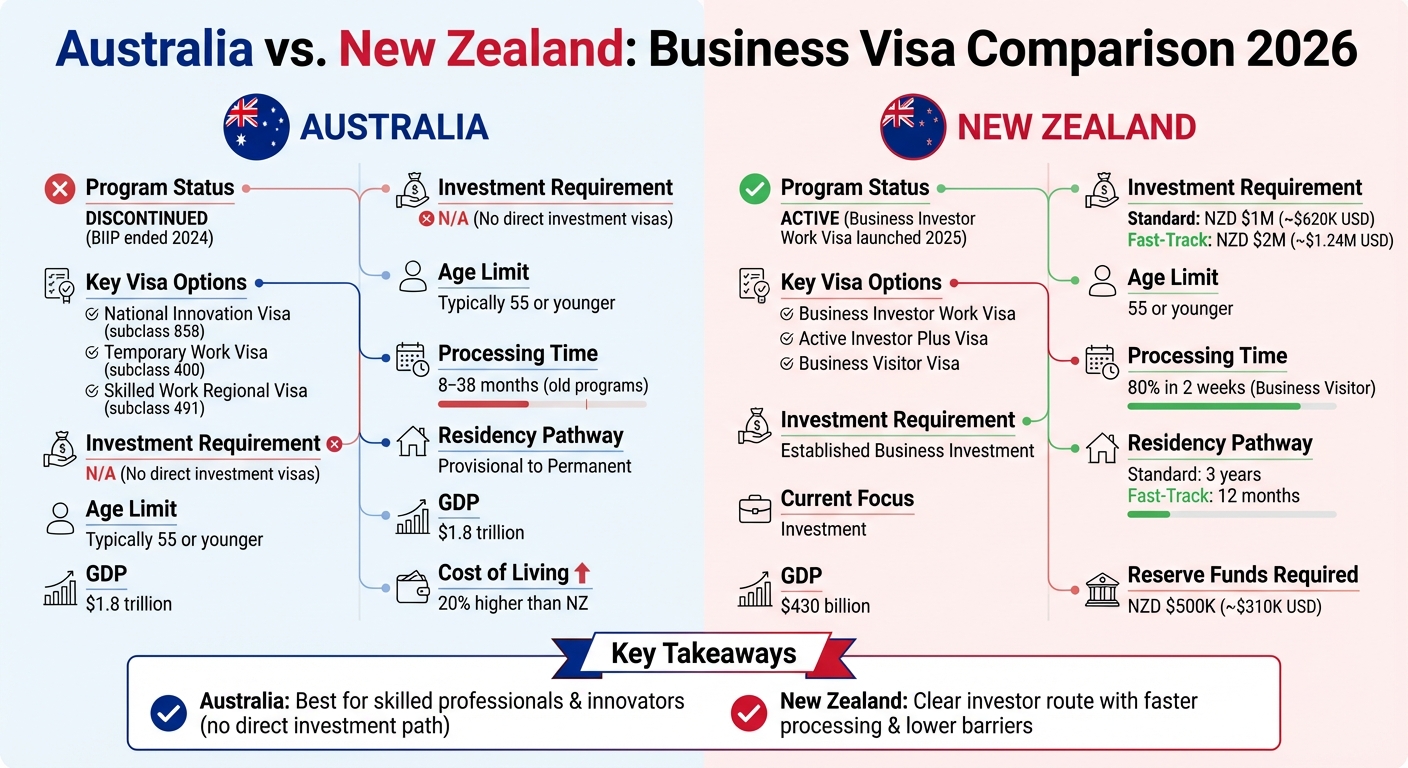
Australia vs New Zealand Business Visa Requirements 2026 Comparison Chart
New Business Investor Visa in New Zealand | Everything You Need to Know
sbb-itb-e205081
Australia Business Visa Requirements
In 2024, Australia officially discontinued the Business Innovation and Investment Program (BIIP). By September of that year, refunds were issued for withdrawn BIIP applications. As a result, Subclass 188 and Subclass 132 visas stopped accepting new applications, though existing cases are still being processed. Below is a summary of the key business visa types that were previously available to U.S. entrepreneurs and investors.
Main Business Visa Types
Although the BIIP has been phased out, understanding the previous visa categories offers insight into historical requirements and pathways. Subclass 188 included five streams tailored to U.S. entrepreneurs and investors:
- Business Innovation: Required a minimum annual turnover of $308,000 USD.
- Investor: Demanded a designated investment of $920,000 USD.
- Significant Investor: Required an investment of $3.07 million USD.
- Premium Investor: Called for a $9.2 million USD investment.
- Entrepreneur: Required at least $123,000 USD in third-party funding.
Subclass 132, on the other hand, featured two streams:
- Significant Business History: Required a minimum annual turnover of $1.84 million USD.
- Venture Capital Entrepreneur: Required access to $614,000 USD in venture capital funding.
Additionally, the Business Innovation and Investment (Permanent) Visa (Subclass 888) provided a pathway to permanent residency for those holding a Subclass 188 visa.
Eligibility and Required Documents
To apply for any Australian business visa, applicants needed a nomination from either a state or Austrade. The process involved submitting an Expression of Interest (EOI) through SkillSelect and waiting for an invitation from the Department of Home Affairs. Most streams required a minimum of 65 points, though exceptions applied to the Significant Investor, Premium Investor, and Venture Capital streams.
While the general age limit for applicants was 55, some states allowed waivers for individuals who could demonstrate substantial economic contributions. For the Entrepreneur stream, English proficiency was a necessary requirement at the time of invitation.
Processing Times and Fees
Processing times varied depending on the completeness of the application and the applicant’s responsiveness to additional information requests. Key factors included health assessments, character evaluations, and national security checks, all of which could impact the timeline.
New Zealand Business Visa Requirements
In 2025, New Zealand replaced its Entrepreneur Work Visa with the Business Investor Work Visa, shifting its focus toward attracting investors to manage established businesses rather than launching new ventures. This approach contrasts with Australia’s emphasis on innovation and specialized skills.
Main Business Visa Types
The updated framework provides clear options for experienced investors. The Business Investor Work Visa, which now replaces the Entrepreneur Work Visa, is aimed at investors interested in acquiring and managing existing businesses in New Zealand. It offers two investment options:
- Standard Route: Requires an investment of NZD 1,000,000 (about $620,000) and offers a three-year pathway to residence.
- Fast-Track Option: Requires a higher investment of NZD 2,000,000 (about $1,240,000) and shortens the residence pathway to just 12 months.
Eligible businesses must have been operating for at least five years and employ a minimum of five full-time staff members.
The Active Investor Plus Visa, updated in April 2025, caters to high-value investors interested in a mix of passive and active investments. Meanwhile, the Accredited Employer Work Visa (AEWV) remains an option for skilled professionals with job offers from accredited employers. However, this visa does not permit self-employment and is not intended for business ownership.
Eligibility and Required Documents
Applicants must meet several criteria to qualify:
- Be 55 years old or younger.
- Have at least three years of senior management or self-employment experience.
- Prove English proficiency (e.g., an IELTS score of 5.0 or equivalent).
- Meet health and character standards, verified through recent medical exams and police certificates.
Additionally, applicants must maintain reserve funds of NZD 500,000 (around $310,000) separate from their business investment to support themselves and their families.
The application process requires thorough documentation, including due diligence reports from a qualified New Zealand statutory accountant and lawyer. Applicants must also provide evidence of no prior business-related investigations by the Serious Fraud Office or New Zealand Police. Certain types of businesses, such as drop-shipping, gambling, tobacco, adult entertainment, convenience stores, and fast food franchises, are excluded from eligibility. To transition to residence, visa holders must create at least one new full-time job for a New Zealand citizen or resident.
Processing Times and Fees
The Business Investor Work Visa costs approximately $7,614 (NZD 12,380). This fee covers both the application and immigration levy, with the visa valid for up to four years. The process begins with a 12-month establishment stage, followed by an operating stage. Evidence of business purchase and operation must be provided within the first nine months.
For comparison, the Accredited Employer Work Visa starts at about $955 (NZD 1,540), with 80% of applications processed within 6.5 weeks. Short-term Business Visitor Visas, which allow stays of up to three months for meetings or negotiations, cost around $210 (NZD 341) and are processed within two weeks for 80% of applicants. These fees and timelines differ from Australia’s post-2024 visa adjustments, reflecting New Zealand’s unique approach.
Cost and Processing Time Comparison
Understanding the financial and time commitments for business visas is crucial for effective planning. Australia’s Business Innovation and Investment Program (BIIP) officially ended, with refunds for withdrawn applications beginning in September 2024. On the other hand, New Zealand introduced its Business Investor Work Visa in November 2025, creating a fresh framework for business immigration.
Comparison Table
Here’s a side-by-side look at how these two countries differ in terms of business visa features:
| Feature | Australia (BIIP – Now Ceased) | New Zealand (Current Programs) |
|---|---|---|
| Program Status | Ceased; refunds available since Sept 2024 | Active since November 2025 |
| Standard Business Visa Fee | Varies (refunds available) | $7,614 (NZD $12,380) |
| Minimum Investment | Varied by stream | $620,000 (Standard) / $1,240,000 (Fast-track) |
| Required Reserve Funds | Not specified | $310,000 (NZD $500,000) |
| Processing Time (90%) | 8–38 months depending on stream | Varies; pending standardization |
| Residency Pathway | Provisional to Permanent | 3 years (Standard) / 12 months (Fast-track) |
| Age Limit | Varied by stream | 55 years or younger |
This table highlights the key differences, but let’s unpack some of the details for better clarity.
In Australia, processing times varied significantly by visa stream before the BIIP was discontinued. For example, the Investor stream took up to 38 months for 90% of applications, while the Entrepreneur stream was faster at just 8 months. The Significant Investor visa (Subclass 188C) took 26 months for most cases. These extended timelines often impacted planning for business migration.
In contrast, New Zealand’s new visa programs offer more streamlined options. For instance, the Active Investor Plus Visa costs about $16,943 (NZD $27,470) and requires a minimum investment of $3.1 million (NZD $5 million) for the Growth category or $6.2 million (NZD $10 million) for the Balanced category. For shorter visits, New Zealand’s Business Visitor Visas start at $210 (NZD $341) and are processed within two weeks for 80% of applications.
The pathway to residency also differs. New Zealand’s Business Investor Resident Visa, which follows the initial work visa, costs about $9,173 (NZD $14,890). This two-step process contrasts with Australia’s former system, which often bundled provisional and permanent residency pathways into a single program.
These distinctions in cost, processing times, and residency requirements play a critical role in shaping the decision-making process for business migrants.
Main Differences and What to Consider
Points Systems and Sponsorship Requirements
One major difference lies in how employers sponsor workers. In Australia, companies must become “Standard Business Sponsors”, a process that immigration expert Myer Lipschitz describes as burdensome. It involves obligations like covering the repatriation costs for the worker’s family and contributing up to AU$7,200 to an industry training fund. This can make it challenging for smaller businesses to participate.
New Zealand, on the other hand, operates under an “Accredited Employer” system. With about 24,823 accredited employers – nearly seven times more than Australia’s 3,580 active sponsors – this system is designed to be more accessible, particularly for small to medium enterprises, which make up 97% of New Zealand’s businesses. The two countries also differ in their points systems for residency. Australia uses points-tested visas under its General Skilled Migration program, which do not require a job offer. Meanwhile, New Zealand employs a “six-point pathway” in its Skilled Migrant Category. Points are awarded based on factors like qualifications, professional registration, and salary. For instance, earning three times the median wage (NZD $100.68 per hour) secures the maximum six points, creating a direct path to residency. These differences in sponsorship and scoring methods shape distinct wage and residency conditions in each country.
Wage Requirements and Residency Options
The salary thresholds also vary significantly. Australia’s Subclass 482 visa mandates a minimum annual salary of AUD $73,150, along with an 11% compulsory superannuation contribution. In New Zealand, the wage threshold aligns with the median wage, which rose to NZD $33.56 per hour as of August 18, 2025, translating to roughly NZD $65,749 per year. For US business travelers in trades or hospitality, New Zealand’s lower salary requirement can be a key advantage.
Residency paths also differ. Subclass 482 visa holders in Australia must work two years with the same employer to qualify for residency. In contrast, New Zealand offers a “Straight to Residence” pathway for Tier 1 roles and requires 24 months of work (not necessarily with one employer) for Tier 2 roles. Additionally, Australia’s age cap for eligibility is typically 45, while New Zealand allows applicants up to age 56.
Practical Tips for US Travelers
Beyond these structural differences, there are practical considerations for US business travelers. Factors like processing times, healthcare, education benefits, work experience, and language requirements can influence decisions.
New Zealand processes 80% of Accredited Employer Work Visas within 6.5 weeks, whereas Australia’s Subclass 482 visa can take several months.
Healthcare and education benefits also vary. New Zealand AEWV holders qualify for state-funded healthcare on visas lasting two or more years, and their children can access government-subsidized education. In Australia, 482 visa holders must obtain private health insurance, and additional fees may apply for children attending public schools.
Work experience and language requirements differ as well. Australia requires at least two years of relevant work experience and proof of English proficiency for all 482 visa applicants. In New Zealand, many AEWV roles do not have a minimum work experience requirement, and English proficiency is primarily needed for lower-skilled roles (ANZSCO level 4 or 5). Professionals in IT, healthcare, or engineering might lean toward Australia’s visa if they meet the higher salary and experience thresholds. Meanwhile, those in trades or industries with fewer entry barriers may find New Zealand’s system more appealing.
Conclusion
Main Points
Deciding on the right business visa largely depends on your specific goals and circumstances. If you’re considering New Zealand, you’ll find a quicker and more straightforward process – 80% of Business Visitor Visa applications are completed within just two weeks. New Zealand also offers active visa pathways like the Business Investor Work Visa, which provides flexible options for investors. On the other hand, Australia has paused several business visa streams, including Subclasses 188 and 888, making its pathways more limited at the moment.
Australia does, however, boast access to a significantly larger economy, with a GDP of approximately $1.8 trillion compared to New Zealand’s $430 billion. But this larger market comes with higher living costs – around 20% more than in New Zealand – and stricter sponsorship requirements.
For short-term business visits, U.S. travelers heading to New Zealand can use the New Zealand Electronic Travel Authority (NZeTA) for stays under three months. In contrast, Australia’s requirements for similar visits involve more detailed documentation.
These differences highlight the unique strengths of each country, helping you weigh which option aligns better with your business goals.
Which Country to Choose
If faster processing times and lower entry barriers are priorities, New Zealand might be the better fit. It’s particularly appealing for small to medium-sized businesses and professionals, thanks to its streamlined visa processes. Additionally, its residency pathway, which is open to applicants up to age 55, adds flexibility for those considering long-term options.
For investors, New Zealand’s Business Investor Work Visa offers a quicker route to residency with a minimum investment of NZD $2 million. This visa can potentially lead to residency within just 12 months.
Once you’ve made your decision, Flight Booking 247 (https://flightbooking247.com) is available around the clock to assist with flight arrangements, helping you transition smoothly from planning to travel.
FAQs
What business visa options does Australia offer since the BIIP ended?
Australia has discontinued the Business Innovation and Investment Program (BIIP). However, there are other pathways available for those looking to migrate. These include the Subclass 482 (Skills in Demand) visa, the Subclass 491 visa designed for small business owners, and a new Business Investor Visa. The Business Investor Visa offers investment options of $1 million or $2 million NZD, potentially paving the way to permanent residence.
What counts as an eligible business for New Zealand’s Business Investor Work Visa?
An eligible business for New Zealand’s Business Investor Work Visa must meet specific criteria. It must be a lawful entity, have been established for at least five years, and operate legally within New Zealand. Additionally, the business must have a purchase price of at least NZD $1 million (excluding property and GST), with the investor holding at least 25% ownership. The business is also required to employ a minimum of five staff members.
What additional costs should I budget for New Zealand’s investor pathway?
When preparing for your investment visa, it’s important to account for more than just the required NZD $1 million or $2 million investment. Additional costs can include legal fees, due diligence expenses, and fund transfer charges. The visa application itself costs NZD $12,380. On top of that, you might face expenses related to business acquisition, consulting services, and ongoing compliance requirements. Planning for these extra costs ahead of time can help ensure a smoother application process and set you up for a successful investment journey.