
Flying between the U.S. and Europe? Here’s what you need to know: carry-on rules differ significantly. U.S. airlines are lenient with larger bags (up to 22 x 14 x 9 inches) and rarely enforce weight limits. European airlines, however, impose stricter size limits (around 55 x 40 x 20 cm) and enforce weight restrictions (usually 7–10 kg). Budget airlines like Ryanair often charge extra for full-size carry-ons unless you pay for an upgrade.
Key Differences:
- U.S. Airlines: Larger size limits, no weight checks, free personal item (around 18 x 14 x 8 inches).
- European Airlines: Smaller size limits, strict weight checks, personal item often limited to 40 x 25 x 20 cm with standard fares.
- Fees: European carriers may charge $20–$60 for non-compliant bags at the gate.
Tip: Always pack for the stricter European rules to avoid surprise fees, especially on connecting flights. Check your airline’s policies before you travel.
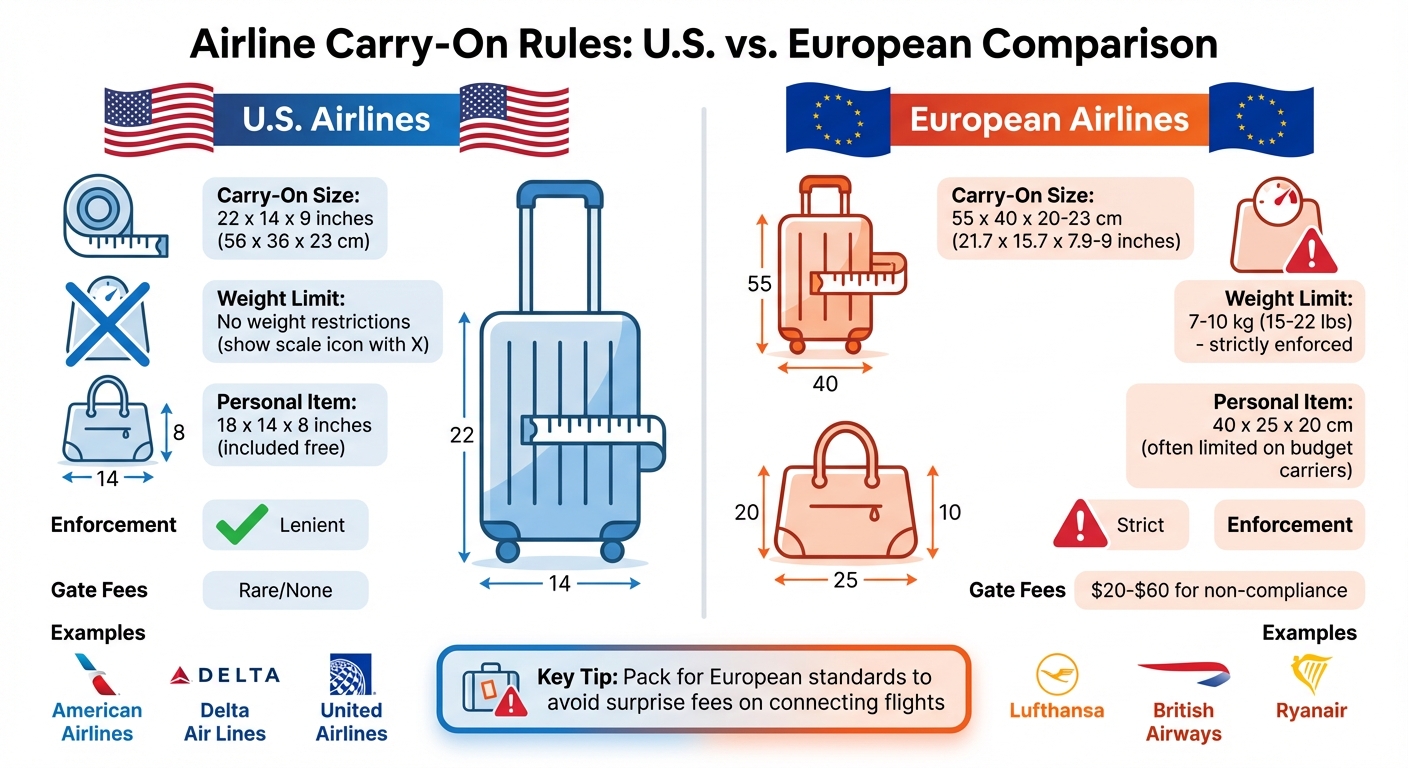
U.S. vs European Airlines Carry-On Rules Comparison Chart
Main Differences Between U.S. and European Airline Carry-On Rules
How Carry-On Policies Are Set
Carry-on rules are determined by each airline, as there are no universal regulations governing these policies. Instead, these rules have evolved based on regional market trends and what customers in those areas expect.
In the U.S., airlines generally lean toward more relaxed, customer-focused policies, often skipping strict weight checks. On the other hand, European airlines – especially budget carriers – operate in a competitive market where charging for extras is the norm. This leads to tighter restrictions and stricter enforcement of carry-on rules. These differences influence how rules are applied at the gate.
Size and Weight Limits Compared
U.S. airlines generally allow carry-on bags up to 22 x 14 x 9 inches (56 x 36 x 23 cm). European airlines, however, enforce slightly smaller size limits, typically around 55 x 40 x 20–23 cm. For example, Lufthansa permits bags up to 55 x 40 x 23 cm, while Ryanair’s limit is 55 x 40 x 20 cm.
Another key difference lies in weight restrictions. U.S. airlines rarely impose or enforce weight limits, focusing instead on whether the bag fits in the overhead bin. European carriers, however, often enforce weight limits ranging from 7 to 10 kg (15–22 lbs). Lufthansa, for instance, caps carry-on weight at 8 kg, while Ryanair and Wizz Air allow up to 10 kg. These variations in size and weight limits directly impact how rules are enforced during boarding.
How Strictly Airlines Enforce Rules at the Gate
U.S. airlines are typically more lenient at the gate, only checking bag dimensions when overhead bins are full or a bag is clearly oversized. In contrast, European airlines – particularly budget carriers like Ryanair, Wizz Air, and easyJet – are much stricter. They frequently use bag sizers and scales at boarding, charging fees on the spot for non-compliance. Travelers may also be required to check or repack their bags if they exceed the limits.
This strict enforcement also applies to personal items. Many European budget airlines only allow a small personal item for free, usually limited to about 40 x 25 x 20 cm (15.75 x 9.84 x 7.87 inches). Bringing a full-size cabin suitcase often requires an additional fee or a ticket upgrade.
Carry-On Rules on Major U.S. Airlines
Standard U.S. Carry-On Size and Weight Policies
When it comes to carry-on baggage, U.S. airlines have a pretty consistent approach. The standard size limit for carry-on bags across major carriers is 22 x 14 x 9 inches (56 x 36 x 23 cm). This size is meant for the main carry-on bag that goes into the overhead bin.
One thing that stands out about U.S. airlines is their relaxed stance on weight restrictions for international flights. Unlike some other regions, gate agents are more concerned about whether your bag fits in the overhead compartment than how much it weighs. This gives travelers more freedom when packing for long-haul trips. This uniformity makes flying with major U.S. airlines a more predictable experience.
In addition to a carry-on, passengers are allowed one personal item, such as a backpack, laptop bag, or purse. These items usually measure around 18 x 14 x 8 inches and must fit under the seat in front of you. This two-item allowance is standard for economy class passengers on international routes and doesn’t come with extra fees.
Policies for American Airlines, Delta Air Lines, and United Airlines

The major U.S. carriers – American Airlines, Delta Air Lines, and United Airlines – stick closely to these standard dimensions and maintain a relaxed enforcement policy. The carry-on size limit is the same across the board: 22 x 14 x 9 inches, with no weight restrictions.
| Airline | Carry-On Size | Weight Limit | Personal Item |
|---|---|---|---|
| American Airlines | 22 x 14 x 9 inches | None | Laptop bag, purse, or small backpack |
| Delta Air Lines | 22 x 14 x 9 inches | None | Small backpack, laptop bag, or purse |
| United Airlines | 22 x 14 x 9 inches | None | Briefcase, purse, or small item |
These airlines are known for being traveler-friendly when it comes to enforcement. Gate agents typically don’t weigh bags or use sizing devices unless the overhead bins are full or a bag clearly exceeds the size limit. This approach is noticeably more relaxed than the stricter policies often seen on European airlines, making U.S. carriers a more forgiving choice for those who might pack a little extra.
Carry-On Rules on Major European Airlines
Standard European Size and Weight Limits
European airlines are known for their strict carry-on rules. Most carriers limit bag dimensions to 55 x 40 x 20–23 cm (about 21.7 x 15.7 x 7.9–9 inches) and enforce weight restrictions between 7–10 kg (15–22 pounds).
For travelers from the U.S., these rules can come as a shock. Unlike American airlines, which rarely weigh carry-ons and mainly check if they fit in the overhead bin, European airlines are much stricter. Bags are often measured and weighed at both check-in and the gate. If your bag exceeds the limits, you’ll need to check it on the spot – and pay hefty fees. This difference in enforcement is one of the most noticeable adjustments for Americans flying within Europe. These general rules provide the framework for the more specific policies of individual airlines.
Full-Service vs. Budget Airlines in Europe
European airlines fall into two distinct categories when it comes to carry-on policies: full-service carriers and budget airlines.
- Full-service airlines like Lufthansa, British Airways, and Air France typically include one cabin bag and a small personal item with the base ticket. Weight allowances for cabin bags usually range from 7–12 kg, depending on ticket class. These policies are more in line with what U.S. travelers might expect, offering consistency and predictability.
- Budget airlines such as Ryanair, easyJet, and Wizz Air, however, operate differently. They only include a small personal item in the base fare, while a standard carry-on requires an additional fee. These airlines are also known for their strict enforcement, with steep penalties for unpaid larger bags at the gate. For those connecting through Europe after a transatlantic flight, these rules can lead to unexpected fees if you’re packed according to U.S. standards.
Policies for Lufthansa, British Airways, and Ryanair
Below is a comparison of carry-on policies for three major European airlines:
| Airline | Carry-On Size | Weight Limit | Personal Item | Notes |
|---|---|---|---|---|
| Lufthansa | 55 x 40 x 23 cm (21.7 x 15.7 x 9.1 in) | 8 kg (17.6 lb) | Laptop bag or handbag included | Standard policy for economy class |
| British Airways | 56 x 45 x 25 cm (22 x 18 x 10 in) | 23 kg (50.7 lb) | Personal item up to 40 x 30 x 15 cm | One of the most lenient European policies |
| Ryanair | 55 x 40 x 20 cm (21.7 x 15.7 x 7.9 in) | 10 kg (22 lb) | Only with Priority; basic fare includes small under-seat bag only | Strict enforcement; high fees for noncompliance at the gate |
Lufthansa offers a standard European carry-on policy with an 8 kg weight limit and one personal item included in all fares. British Airways, on the other hand, is more accommodating, allowing bags up to 23 kg, though overhead space shortages on full flights may still result in gate-checking. Ryanair, as a budget airline, only includes a small under-seat bag in its basic fare. A standard cabin suitcase requires purchasing Priority boarding or an extra add-on, with strict enforcement and steep penalties for violations.
sbb-itb-e205081
Packing Tips for U.S.-Europe Travel
Choosing a Carry-On That Meets Both Standards
When preparing for a trip between the U.S. and Europe, it’s smart to pack with the stricter rules in mind. Opt for a carry-on that fits within the tighter European airline dimensions while still adhering to typical U.S. size limits. This way, you’ll avoid last-minute surprises and reduce the chance of having to check your bag at the gate.
Weight is just as important as size. A lightweight suitcase – ideally under 7 lbs when empty – gives you more room to pack without exceeding limits. Look for features like compression straps, a slim profile, and a dedicated laptop compartment to keep your bag organized and within the allowed dimensions. If your suitcase has an expandable zipper, keep it zipped flat for European flights to avoid any issues.
Once your bag is sorted, it’s time to fine-tune your packing strategy, especially if your trip involves connecting flights.
Managing Weight Limits on Connecting Flights
If your journey includes a connection from a U.S. airline to a stricter European carrier, pack according to the European airline’s rules. Aim to keep your main bag within 7–8 kg (15–17.6 lbs). Wearing your heaviest shoes and jacket during the flight is a simple trick to lighten your carry-on. If you’re close to the weight limit, shift heavier items to your personal item, as some airlines only weigh the overhead bag.
For added flexibility, carry essentials in your personal item in case your carry-on ends up being gate-checked during the European leg of your trip. A compact daypack can also come in handy for redistributing items if needed.
Checking Airline Rules Before Your Flight
To avoid any surprises, double-check airline policies at multiple points: when booking, a week before departure, and 24 hours before your flight. Use the airline’s website, app, or your booking confirmation to confirm the exact carry-on dimensions, weight limits, and whether your fare includes a full-size carry-on or just a personal item. Keep in mind that policies can vary by fare class and route, and many European budget airlines charge extra for overhead bags.
If navigating these details feels overwhelming, services like Flight Booking 247 can simplify the process. They can verify the carry-on rules for your specific airline and fare, flag stricter European segments, and help you decide whether it’s more cost-effective to pay for a carry-on, check a bag, or upgrade your fare. Their 24/7 concierge service provides clear guidance, ensuring you’re well-prepared for your U.S.–Europe journey.
Watch This BEFORE You Travel: CARRY- ON LUGGAGE RULES 2025 ✈️ (TSA, Europe & What NOT to Pack!)
Conclusion
Navigating carry-on rules can feel like a maze, but understanding the differences between U.S. and European airlines can save you from unexpected fees and delays. In the U.S., airlines tend to allow larger carry-ons with less focus on weight restrictions. European carriers, on the other hand, enforce stricter size and weight limits – usually around 55 x 40 x 20 cm and 7–10 kg. For example, Ryanair reserves full-size carry-ons for priority passengers and charges fees ranging from €50 to €70, while British Airways permits bags up to 56 x 45 x 25 cm and 23 kg, though they enforce these limits more rigorously than most U.S. airlines.
To avoid last-minute surprises, always double-check the specific rules of your airline before flying. Policies can vary widely – not just between U.S. and European carriers, but also between budget and full-service airlines, and even by fare class. A bag that sails through security in one city might face stricter scrutiny during an international connection.
Choosing a carry-on that fits the strictest standards – under 55 x 40 x 20 cm and 8–10 kg – can help you stay compliant across all routes. Make it a habit to review the latest guidelines on your airline’s website or app, and keep potential fees in mind if you’re flying with budget carriers in Europe.
For added peace of mind, Flight Booking 247 provides round-the-clock concierge support to help you navigate carry-on policies and ensure a hassle-free travel experience.
FAQs
What are the size and weight restrictions for carry-on bags on European airlines?
Most European airlines permit carry-on bags with dimensions up to 21.6 x 15.7 x 7.8 inches (55 x 40 x 20 cm) and a weight limit of about 17.6 lbs (8 kg). That said, these limits can vary depending on the airline, so it’s always smart to confirm your carrier’s specific guidelines before your trip.
European airlines are often more rigorous about enforcing these rules, so make sure your bag meets the requirements to avoid extra fees or the hassle of checking it at the gate.
What are the best ways to avoid extra fees on budget European airlines?
When flying with budget European airlines, avoiding extra fees starts with understanding their baggage rules. These carriers often have stricter size and weight limits for carry-ons compared to U.S. airlines, so it’s essential to pack light and double-check that your bag meets their requirements.
Booking your tickets early can help you snag lower fares, and it’s wise to add baggage or seat selections during the booking process – fees at the airport are usually higher. Staying flexible with your travel dates and times can also unlock better deals. And don’t overlook airline newsletters or alerts; they’re a great way to stay in the loop about promotions or discounts that could help you save.
Why do carry-on baggage rules differ between U.S. and European airlines?
Carry-on baggage rules differ noticeably between U.S. and European airlines, shaped by varying regulations, business approaches, and passenger needs. U.S. airlines generally permit larger or additional carry-on items without extra fees, focusing on convenience and enhancing the travel experience.
On the other hand, European airlines tend to impose stricter size and weight restrictions. This approach helps them maintain efficient operations and offer lower ticket prices. These contrasting policies highlight the distinct priorities and operational strategies of airlines in the two regions.