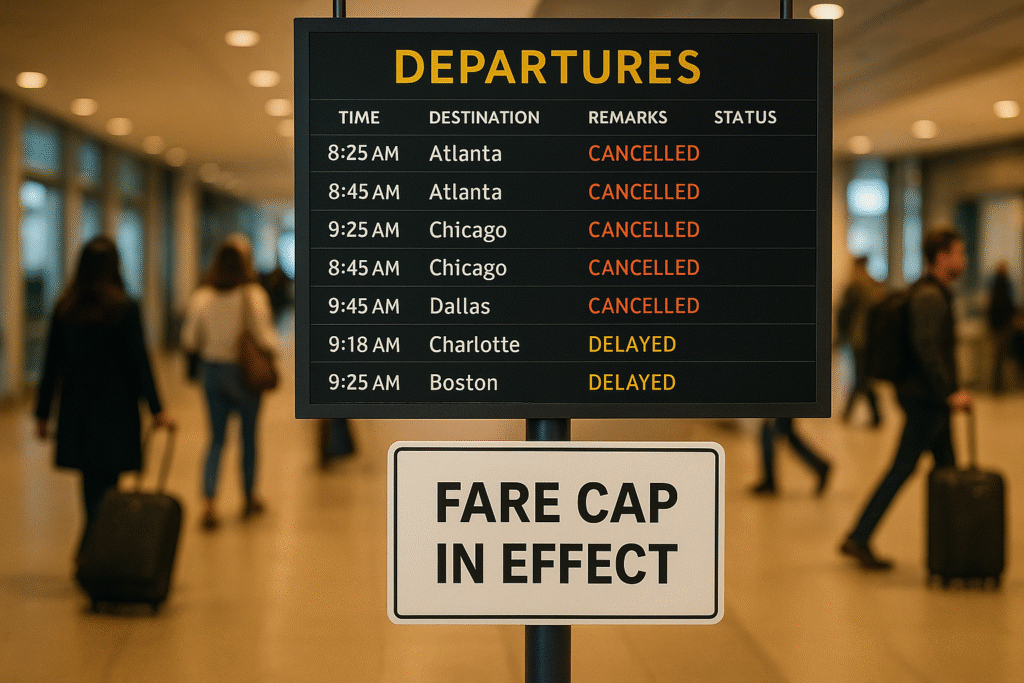
When emergencies strike, airfare prices often surge, leaving travelers struggling to find affordable options. To address this, airlines may implement fare caps – limits on ticket prices during crises. These caps aim to keep flights accessible when demand spikes. However, enforcement is challenging due to technical, legal, and operational hurdles.
Here’s a quick breakdown:
- What are fare caps? Price limits airlines set during emergencies to prevent excessive airfare hikes.
- How are they monitored? The U.S. Department of Transportation (DOT) oversees pricing trends and investigates complaints but relies on voluntary airline compliance.
- Challenges: Automated pricing systems, limited seat availability, and inconsistent communication make enforcement difficult. Legal gaps further complicate regulation.
- Traveler tips: Book directly with airlines, act quickly when prices are reasonable, and report suspected price gouging to the DOT or your state’s attorney general.
While fare caps help curb price exploitation, travelers should stay informed and act decisively to secure affordable flights during crises.
Travelers paying thousands to get home as 3 US airlines announce price caps
Government Rules and Oversight
The U.S. government employs a multi-layered approach to keeping tabs on airline pricing during emergencies. These oversight measures shed light on the boundaries airlines must work within when setting fare limits. To better understand this, let’s look at how the Department of Transportation (DOT) plays a role in monitoring pricing practices.
U.S. Department of Transportation Role
The Department of Transportation (DOT) keeps a close eye on airfare spikes during emergencies and investigates complaints about price gouging. Instead of enforcing direct fare caps, the DOT leans on public pressure and voluntary airline actions to address concerns.
The DOT’s strategy prioritizes monitoring and investigation over direct control. During emergencies, it tracks fare trends on major routes, identifying patterns that might require deeper scrutiny or enforcement. However, the department operates within a limited regulatory framework, often relying on airlines to voluntarily comply with pricing standards rather than imposing mandatory caps.
Efforts to manage airline price gouging at the federal level are largely tied to proposed legislation and ongoing oversight. Current laws don’t explicitly target airfare pricing, leaving the DOT to address concerns within its existing authority.
Federal and State Price Gouging Laws
The legal landscape for protecting travelers from excessive airfare hikes is complex. Federal law does not currently regulate airline price gouging, leaving most protections to individual state laws and proposed federal measures. This gap in national consumer protection has sparked efforts to address the issue.
One such effort is the “Price Gouging Prevention Act of 2024” (S.3803), introduced in the Senate in February 2024. This bill aims to outlaw price gouging at the federal level and expand the Federal Trade Commission’s power to tackle excessive pricing practices.
At the state level, most states have their own price gouging laws, which typically go into effect when a state of emergency is declared. However, applying these laws to airline tickets is tricky. The interstate nature of air travel complicates enforcement, as flights often cross state lines. Additionally, states differ in how they define “essential goods and services.” While some include transportation, others focus on necessities like food, water, and fuel.
Public Complaints and Investigations
Public involvement plays a critical role in holding airlines accountable. Traveler complaints often trigger DOT investigations and public scrutiny, prompting airlines to adjust their pricing under regulatory and public pressure.
Travelers can file formal complaints with the DOT, which tracks and investigates these concerns. This process has proven effective in several instances, where airlines have voluntarily reduced fares or introduced fare caps after facing public backlash and government monitoring.
While not as direct as mandatory regulations, this combination of public engagement and government oversight creates an informal but impactful system of accountability for airline pricing during emergencies.
How Airlines Set Fare Caps
In times of crisis, airlines face the challenge of balancing their revenue goals with the urgent need to assist in evacuations. To address this, they take swift action to adjust their pricing systems, which would otherwise raise fares automatically during spikes in demand.
Airline Fare Cap Policies
To ensure affordability and avoid accusations of price gouging, airlines establish fare caps during emergencies. This often involves canceling higher-priced ticket options and restructuring fare systems to make travel more accessible. These adjustments allow airlines to step in with manual pricing strategies when emergencies arise.
Pricing Changes During Emergencies
In critical situations, airlines take control of their pricing systems by manually overriding automated fare increases. This approach helps maintain reasonable pricing and aligns with government oversight to ensure fairness.
For assistance during such fare changes, travelers can rely on Flight Booking 247’s round-the-clock concierge service for support.
Problems with Fare Cap Enforcement
Enforcing fare caps in real-time comes with a host of challenges, often leaving travelers with fewer options and more confusion during emergencies.
System and Operational Challenges
Airlines face significant technical obstacles when trying to quickly implement fare caps in emergency situations. Their automated pricing systems, designed for efficiency, are not easily adaptable to sudden changes.
During crises, the surge in booking attempts can overwhelm servers, leading to website crashes. Adding to the chaos, discrepancies often arise between official airline sites and third-party booking platforms, creating confusion over actual fares.
Seat inventory management becomes another headache. Airlines need to juggle routine bookings with urgent evacuation demands. This often results in fare-capped seats selling out quickly, leaving many travelers with only higher-priced options. Complicating matters further, systems may struggle to differentiate between genuine emergency travelers and those simply looking for cheaper tickets.
Delays in communication make things worse. While pricing teams may update fare caps promptly, customer service representatives often lag behind in receiving this information. This disconnect leads to inconsistent and sometimes incorrect guidance being offered to travelers.
Legal and Ethical Dilemmas
The legal landscape around airline price gouging is murky. Since airlines operate under federal jurisdiction, many state-level price gouging laws don’t apply to airfares, creating a gray area when it comes to defining and enforcing fair pricing during emergencies.
Airlines also face the challenge of balancing their dynamic pricing models with the need to shield travelers from excessive costs. While regulatory agencies can investigate complaints and issue penalties, these processes are often too slow to provide immediate relief when it’s most needed.
Ethical considerations further complicate the issue. For example, airlines might choose to cap fares on specific evacuation routes while maintaining regular pricing on other flights. While this policy benefits some, it leaves others at a disadvantage, raising questions about fairness.
Impact on Travelers
For travelers, these enforcement hurdles translate into limited access to affordable fares. Even when fare caps are in place, the limited number of seats available at these lower prices often forces many to pay premium rates.
Customer service becomes another pain point during high-demand periods. Long wait times and inconsistent information can leave travelers scrambling for answers at critical moments. On top of that, rapid fare fluctuations can cause unexpected price hikes, further complicating travel plans.
The financial strain is particularly harsh on those least equipped to handle sudden fare increases. Travelers often face additional costs when rebooking or seeking refunds, including change fees and fare differences, as conditions evolve quickly.
In such chaotic situations, having professional assistance can make all the difference. Services like Flight Booking 247 offer round-the-clock concierge support, helping travelers navigate their options and secure flights when airline systems are overwhelmed.
While fare caps are designed to protect travelers, the challenges in enforcing them often dilute their intended benefits.
Tips for Travelers During Emergencies
When airlines struggle to maintain fare caps effectively, travelers must take matters into their own hands to avoid overpaying and secure necessary flights during crisis situations.
How to Report Price Gouging
If you suspect price gouging, it’s important to know your rights. Price gouging protections often kick in when a disaster is officially declared by a governor or the president. While airlines can set their own prices, drastically increasing fares to exploit a crisis can qualify as price gouging.
Start by addressing the issue directly with the airline. Speak with customer service representatives at the airport or contact the airline’s consumer office at their corporate headquarters. By law, airlines must acknowledge complaints within 30 days and provide a full response within 60 days.
Make sure to gather all relevant documentation. Note the airline’s name, flight details (including route, date, and price), and take screenshots of the fare at the time of booking. Keep a record of any interactions with airline representatives, including dates and names.
If the airline doesn’t resolve your concern, file a complaint with the U.S. Department of Transportation’s Office of Aviation Consumer Protection. These complaints help regulators identify patterns in the industry and could lead to enforcement actions or new rules. When submitting your complaint – whether online or by mail – include your full contact details and a detailed account of your experience. Mail complaints can be sent to:
Office of Aviation Consumer Protection, U.S. Department of Transportation,
1200 New Jersey Avenue, SE, Washington, DC 20590.
Additionally, report the issue to your State Attorney General. Many states have laws against price gouging that come into effect during declared disasters. Most states accept complaints via phone, email, or online portals.
Once you’ve reported the issue, move quickly to secure your travel plans.
Booking Flights During Emergencies
Booking flights during emergencies requires a smart and strategic approach. Always book directly on airline websites to access the most accurate pricing and availability. Third-party platforms may not reflect real-time updates on fare caps or seat availability.
Act fast when you find a flight at a reasonable price. Fare-capped seats tend to sell out quickly, so compare options across airlines and departure times without delay. This quick decision-making is crucial when inventory is limited.
Monitor multiple airlines simultaneously, as each carrier may have different fare cap policies or timelines for implementing them. This can give you more options and potentially better deals.
Consider alternative airports or routes. Flying to a nearby city and completing the journey by car might save you money compared to inflated emergency fares. Flexibility with your travel dates can also make a big difference, as prices can fluctuate significantly within just 24 hours during a crisis.
Keep your payment information and travel documents handy. In emergencies, systems can be overwhelmed, and deals may disappear quickly. Being prepared ensures you can finalize your booking before seats sell out or prices change.
Using Flight Booking 247 for Help

When emergencies make booking flights chaotic, having expert assistance can simplify the process. Flight Booking 247 offers 24/7 concierge support to help travelers navigate these challenging situations.
This service connects you directly to a travel concierge by phone, avoiding automated systems and long hold times. With access to real-time flight deals and inventory from multiple airlines, they provide accurate and up-to-date pricing – all in one place.
Professional help can be a game changer in rapidly evolving conditions. These concierges monitor multiple flight options, manage rebookings if your original flight is canceled, and interpret complex fare rules that might be difficult to understand. Their expertise is particularly useful when airlines introduce emergency policies with limited or unclear communication.
Beyond booking new flights, Flight Booking 247 can assist with changes or cancellations due to shifting emergency conditions. This saves you time and money when every minute matters. By securing fare-capped prices before they sell out, the service helps ensure you’re not overpaying during a crisis, giving you peace of mind and efficient travel solutions.
Conclusion
Fare caps play a crucial role in protecting travelers from unfair pricing during emergencies. By setting maximum limits on fares, these policies help ensure that essential travel remains affordable, regardless of income level. In times of crisis, this safeguard prevents price gouging when people are most vulnerable and need to travel urgently.
The success of fare caps, however, depends on a combination of government oversight, airline adherence, and traveler awareness. Despite these measures, enforcement challenges and system breakdowns can create gaps, leaving travelers to navigate the complexities on their own.
Airlines face the tricky task of balancing operational costs with their responsibility to the public during emergencies. While some airlines take proactive steps to implement fare caps effectively, others may struggle with technical issues or inconsistent enforcement. This inconsistency highlights the importance of travelers staying informed and prepared, as relying solely on airline policies may not always guarantee fair pricing.
For travelers, knowing your rights is key. Being able to document instances of suspected price gouging, filing complaints with the right agencies, and acting quickly when reasonably priced tickets become available are vital steps to securing fair fares during a crisis.
When emergencies create booking chaos and time-sensitive decisions, professional support can make a significant difference. Services like Flight Booking 247’s concierge provide round-the-clock assistance, helping travelers find fare-capped flights in real time. This kind of expert guidance is especially valuable when airline policies shift suddenly or communication becomes unclear during rapidly changing situations.
Fair pricing during emergencies requires vigilance and action from all sides. With clear knowledge of your rights, prompt decision-making, and access to expert support, you can confidently navigate the challenges of emergency travel and avoid falling victim to price exploitation.
FAQs
How do airlines use fare caps to manage ticket prices during emergencies?
During emergencies like natural disasters, airlines often introduce fare caps to curb price spikes and make tickets more accessible for those who need to travel urgently. These caps establish a maximum price for tickets, helping to ensure fairer access during critical situations.
That said, fare caps can also lead to fewer seats being offered at these reduced rates. Airlines might limit the number of tickets available at the capped price, making it tougher for travelers to snag an affordable seat – especially as demand skyrockets. If you’re looking to benefit from these capped fares, booking as early as possible is key to securing your spot.
What should I do if I think an airline is unfairly raising ticket prices during an emergency?
If you think an airline might be unfairly hiking ticket prices during a crisis, you can turn to Flight Booking 247 for help. Their travel concierge team is available around the clock to assist with booking flights, making changes, or even canceling reservations. With their personalized service, they can guide you through tough situations and help you find the best options when you need them most.
Why is it difficult for the Department of Transportation to enforce fare caps during emergencies?
Enforcing fare caps during emergencies is no simple task, and several hurdles make it even trickier. Airlines use dynamic pricing systems that adjust fares based on demand, which means prices can change quickly and unpredictably. This makes real-time monitoring and ensuring compliance a tough job.
On top of that, the sheer number of flights and transactions during a crisis can overwhelm existing monitoring systems. Regulatory action adds another layer of complexity, as the Department of Transportation often faces legal restrictions on how much it can intervene in airline pricing. All these factors underline the importance of having clear policies in place and fostering collaboration between airlines and regulators to safeguard travelers during emergencies.