
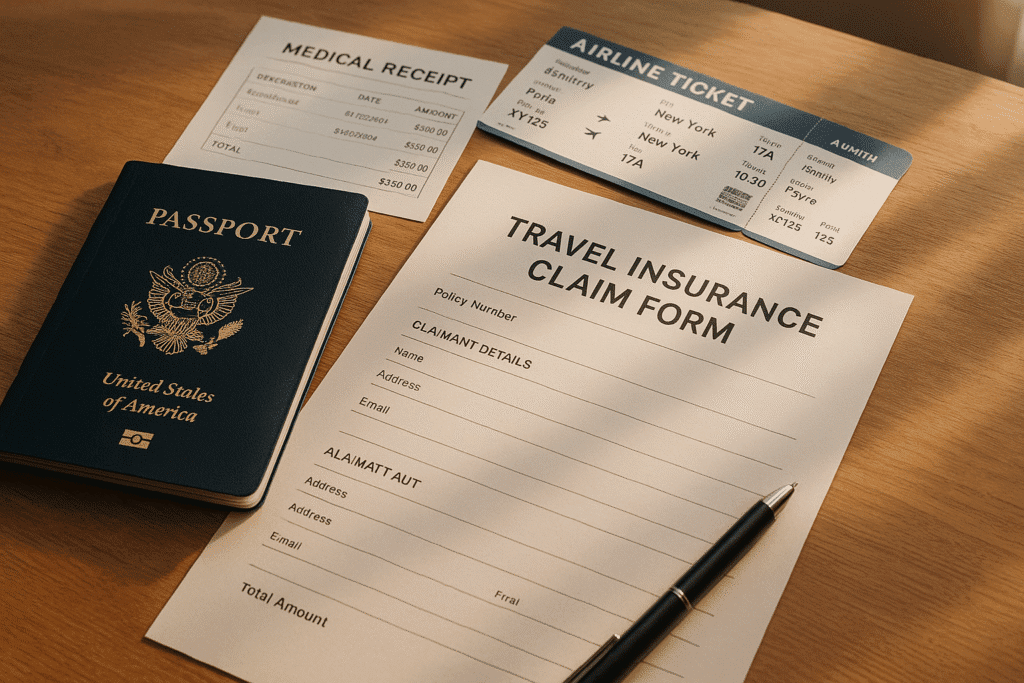
Filing a travel insurance claim can feel overwhelming, but having the right documents makes the process smoother and faster. Here’s what you need to know:
- Common Claim Types: Medical emergencies, trip cancellations, delays, and baggage issues are the most frequent claims.
- Why Documentation Matters: Insurers rely on your evidence – like receipts, medical reports, or photos – to validate claims. Missing documents can lead to delays or denials.
- Digital Submissions: Online filing is quicker, but insurers now scrutinize claims more closely to prevent fraud. Ensure your documents are clear and complete.
- Key Deadlines: Most claims must be submitted within 90 days, and some (like baggage issues) require action within 24–48 hours.
Required Documents by Claim Type:
- Medical Claims: Itemized bills, a physician’s statement, and hospital records.
- Trip Cancellation/Interruption: Proof of unused tickets, original itinerary, and evidence for cancellation (e.g., medical or employer letters).
- Delays: Airline delay notifications, receipts for extra expenses, and your travel itinerary.
- Baggage Issues: Incident reports, receipts/photos of items, and airline compensation details.
Tips for Filing:
- Organize documents with clear file names (e.g., John.Smith_MedicalBill_10-19-2025.pdf).
- Submit claims promptly to avoid complications.
- Keep copies of everything for your records.
How Do Travel Insurance Claims Work? – InsuranceGuide360.com
Required Documents by Claim Type
Different types of claims require specific sets of documents to ensure smooth and efficient processing. Here’s what you need to know for each type.
Medical Claims
Medical claims often demand the most detailed documentation since insurers need to verify both the necessity of the treatment and the expenses incurred. Start with an itemized bill that lists each service and its cost, along with a medical report or an Attending Physician’s Statement from your doctor. This report should explain your condition, the treatment you received, and how it relates to your travel.
If you were hospitalized, include hospital records and receipts for all medical-related expenses, such as prescription drugs or rented medical equipment. Don’t forget to provide a completed claim form and signed payment and privacy authorizations. For claims involving injuries, a physician’s statement detailing the cause and severity of the injury is essential. In situations involving a third party – like a car accident – you’ll also need to fill out a subrogation form.
Proper documentation, including bills, reports, and authorizations, is key to ensuring your medical claim is processed without unnecessary delays. Now, let’s look at the paperwork needed for trip cancellation or interruption claims.
Trip Cancellation or Interruption
For trip cancellation or interruption claims, the focus is on proving your original travel plans and providing evidence for why they were disrupted. Start by submitting unused tickets or e-ticket receipts to show the value of your unutilized travel arrangements. Your original itinerary is critical, as it outlines your bookings for flights, accommodations, tours, and other prepaid services. Additionally, include proof of payment, such as credit card statements or copies of processed checks.
To substantiate the reason for cancellation, provide appropriate documentation. For medical cancellations, include medical reports or a physician’s statement. For bereavement-related claims, a death certificate is required. If work obligations caused the cancellation, supply an official letter from your employer. Insurers may also request a letter from your travel provider confirming the cancellation or interruption, along with details of any refunds or credits issued, as these may affect the settlement amount.
Services like Flight Booking 247 can be particularly helpful in retrieving booking confirmations, itineraries, or proof of ticket changes, especially when you need documentation outside regular business hours. Now, let’s shift to the requirements for delay-related claims.
Trip Delay or Missed Connection
If you’re filing a delay claim, you’ll need three main types of documents. First, obtain proof of delay from the airline or travel provider, such as an official notification or delay statement. Second, keep receipts for any additional expenses you incurred, like meals, hotel stays, or transportation, as these will support your claim. Lastly, include your original travel itinerary to show how the delay disrupted your schedule and caused missed connections.
Most insurers process delay claims within 30–45 days after receiving all the necessary documents. For baggage-related issues, however, the process requires immediate attention and specific evidence.
Baggage Damage or Loss
When dealing with baggage damage or loss, acting quickly is crucial. Obtain a claim form as soon as you notice the issue, as many insurers have strict reporting deadlines. Gather itemized receipts or other proof of ownership for the lost or damaged items. Photographic evidence of the damage can also strengthen your claim. Additionally, secure an incident report from the relevant authority – this could be the airline’s baggage service office or, in cases of theft, a police report.
Some insurers might ask for a copy of your baggage tag and documentation of any compensation received from the airline. This helps them coordinate benefits and avoid duplicate payments. Keep in mind that baggage claims often have very short reporting windows, sometimes as little as 24–48 hours, so prompt action is essential.
How to Submit Your Claim
Once you’ve gathered the necessary documents, here’s how to submit your claim without any hiccups.
Setting Up Your Account and Choosing the Claim Type
Start by registering online using your policy number and personal details. After registering, select the appropriate claim type to access the necessary forms and instructions. Once your account is set up, you can begin uploading your documents.
You’ll be assigned a unique claim number, which will serve as your reference for all future communications. This helps keep your claim details and personal information well-organized.
Uploading Your Documents
Submitting your documents digitally is often the quickest route, with confirmation typically arriving within 24 hours. In contrast, mailed claims may take up to five days to process. Many insurers also provide mobile apps, allowing you to snap photos of your documents and upload them directly from your phone.
When uploading files, use formats like PDF, JPEG, or PNG, and name them clearly for faster processing (e.g., Doe_MedicalBill_10-19-2025.pdf).
If digital submission isn’t an option, you can send photocopies by mail or email. Be sure to include a cover letter with your policy and claim numbers.
For flight-related claims, where time-sensitive documents like booking confirmations or cancellation notices are needed outside regular business hours, services such as Flight Booking 247 can assist. They provide around-the-clock access to essential travel documentation that may be required for your claim.
Keeping Records
Always keep copies of everything you submit, including dates, confirmation numbers, and key communications. Set up a dedicated folder – either digital or physical – to store all claim-related materials.
If you don’t hear back within a week of submitting your claim, reach out to your insurer’s claims team with your backup documents to confirm receipt. Keeping thorough records is especially important in case of technical issues or disputes.
Additionally, save all correspondence from your insurer, such as emails, letters, and notes from phone calls. A clear communication trail can be invaluable, ensuring a smoother process if questions or complications arise during your claim review.
Special Documentation Requirements
When filing an insurance claim, the standard paperwork is often enough. However, in certain situations, additional documentation becomes necessary to ensure your claim is processed smoothly. Without this extra evidence, delays – or even denials – can occur.
Pre-Existing Medical Conditions
If your claim involves a pre-existing medical condition, insurers usually require detailed, up-to-date medical records. These should include clinical notes or a comprehensive medical history from your doctor, dated within the past 90 days. The records need to outline your diagnosis, current treatment plan, medications, and any recent test results that confirm your condition was stable at the time of travel. Sometimes, insurers may also ask for an Attending Physician Statement. Missing or incomplete medical documentation is one of the most common reasons claims are delayed or denied.
Let’s shift focus to claims for cancellations unrelated to health.
Non-Medical Cancellations
If you need to cancel your trip due to unexpected non-medical reasons, you’ll need official proof to back up your claim. For instance, if you’re called for jury duty or subpoenaed, providing an official notice with your name, the required dates, and evidence of your mandatory presence is essential. Similarly, if an emergency like theft, an accident, or property damage disrupts your plans, a police report detailing the event and its impact on your travel is typically required.
Now, let’s address how to handle baggage claims without receipts.
Baggage Claims Without Receipts
Lost receipts are a common stumbling block for baggage claims, with about 30% of claimants unable to provide original purchase records. If you don’t have receipts, you can still support your claim with alternative proof. This might include clear photos of the items, credit card or bank statements showing the purchases, or product documentation like warranty cards or original packaging. Additionally, a written statement listing each item’s brand, model, purchase date, and estimated value can strengthen your case. However, keep in mind that insurers may reduce reimbursements due to depreciation or payout limits when original receipts aren’t available. On the bright side, many insurers now accept digital documents and other alternative forms of proof.
Document Requirements by Claim Type
Having the right documents can mean the difference between a quick claim approval and frustrating delays. Each claim type has its own set of requirements, and missing even one document can lead to requests for additional details, dragging out the process.
Here’s a detailed breakdown of what’s needed for different types of claims, along with common pitfalls to avoid:
| Claim Type | Required Documents | Additional Notes / Common Mistakes to Avoid |
|---|---|---|
| Medical | Completed claim form; attending physician’s statement; itemized medical bills; proof of payment; accident/police report (if applicable) | Always submit original, detailed receipts and ensure all documents come from licensed providers. Incomplete paperwork is a common cause of delays. |
| Trip Cancellation/Interruption | Completed claim form; proof of a covered reason (e.g., doctor’s note or death certificate); original and updated itineraries; receipts for non-refundable expenses; documentation of denied refunds from travel providers | A frequent mistake is not obtaining written confirmation from airlines or hotels that refunds were denied. This is critical for claim approval. |
| Trip Delay/Missed Connection | Completed claim form; official proof of delay from the airline; receipts for additional expenses; original and rescheduled travel itineraries | Always get written proof of delay while still at the airport. Airline-issued documentation is mandatory. Skipping this step can result in claim rejection. |
| Baggage Loss/Damage | Completed claim form; property irregularity report from the carrier; receipts or photos proving ownership; documentation of the carrier’s response or any offered compensation | Filing a report with the airline immediately is essential. The property irregularity report must be obtained before leaving the airport. This is a common oversight. |
| Car Rental Collision Damage | Completed claim form; rental agreement; police report; repair invoices or damage estimates | Even for minor incidents, a police report is usually required. Be sure to contact local authorities at the scene to avoid complications later. |
To make the process even smoother, organize your documents digitally with clear and descriptive file names (e.g., Jane.Smith_Medical_Bill_10-19-2025.pdf). This makes it easier for claims processors to locate and review your files.
When submitting claims involving foreign treatment or expenses, convert all amounts to U.S. dollars and include documentation of the currency conversion. Dates should follow the MM/DD/YYYY format. For medical claims overseas, translated records are often necessary. Filing promptly ensures you can gather all necessary documents from airlines, hotels, and medical providers before they become harder to retrieve.
If you booked through a service like Flight Booking 247, their 24/7 support team can assist by quickly providing essential documentation like booking confirmations, change records, and official airline statements. These documents are especially important for trip cancellation or delay claims.
Finally, always keep both digital and physical copies of your documents. This helps prevent loss during processing and keeps things moving efficiently. Comprehensive and well-organized submissions are key to speeding up claim approvals and reducing follow-ups.
Best Practices for Travel Insurance Claims
To ensure your travel insurance claim gets processed quickly and efficiently, it’s important to follow a few tried-and-true strategies. With over 60% of claims now being filed online since 2020, digital tools have made the process faster – if you know how to navigate them effectively.
Start with thorough preparation before filing your claim. Did you know that incomplete documentation causes nearly 40% of travel insurance claim delays in the U.S.? Avoid this common pitfall by downloading your insurer’s claim form and gathering all necessary documents specific to your claim type. Taking the time to get everything in order upfront can save you weeks of back-and-forth. Once you have what you need, digitize and organize your files for seamless submission.
Keep your digital files well-organized to make the process even smoother. Use clear, descriptive file names that include your name, the document type, and the date – like “Sarah.Johnson_Medical_Receipt_10-19-2025.pdf”. Submit all your documents together to reduce the likelihood of additional information requests. Many insurers now offer online dashboards with real-time updates, so you can easily track your claim’s progress.
Always back up your submissions, both digitally and physically. Save screenshots of confirmation pages, keep email receipts, and store copies of your documents. This way, you’ll have proof of submission if any technical glitches occur.
Timing is critical, so submit your claim promptly, ideally within 20–30 days of the incident. This ensures details are still fresh and easier to verify. If you booked through Flight Booking 247, their 24/7 support team can provide key documents like booking confirmations and airline statements, which are often required for trip-related claims.
After submitting your claim, stay proactive. If you don’t get a confirmation within 24–72 hours, follow up. If there’s still no response after a week, reach out to support. Similarly, respond quickly to any requests for additional information to keep everything moving along.
FAQs
What should I do if I can’t locate all the required documents for my travel insurance claim?
If you’re missing some of the required documents for your travel insurance claim, don’t panic – there are ways to handle the situation. The first step is to reach out to your insurance provider and explain what’s missing. They can often suggest acceptable alternatives or guide you on how to get replacement documents.
Typically, insurers might ask for things like proof of travel (such as flight itineraries or boarding passes), receipts for expenses, or medical reports. If you’re unclear about what’s required, request a detailed checklist to make sure you’re covering all the bases. Acting promptly and keeping an open line of communication with your provider can make the process much smoother.
What can I do to make sure my travel insurance claim is processed quickly?
To get your travel insurance claim processed without unnecessary delays, it’s crucial to provide all the required documents accurately and in full. Typically, you’ll need items like proof of travel (such as flight itineraries or booking confirmations), receipts for expenses, and any relevant medical or police reports. Be sure to carefully review your insurer’s specific documentation requirements to avoid any hiccups.
If your travel plans hit a snag, having dependable support can make a world of difference. Flight Booking 247 offers round-the-clock assistance for booking, modifying, or canceling flights. This kind of service can be a lifesaver when you need updated travel details or new documentation to support your insurance claim.
What should I do if my travel insurance claim is delayed or denied because of missing documents?
If your travel insurance claim hits a snag due to missing documents, the first step is to revisit your policy. Look closely at the list of required documents – things like receipts, medical records, or travel confirmations – and make sure you’ve got everything in order. Accuracy and completeness are key here.
Once you’ve double-checked your paperwork, reach out to your insurance provider. Ask them directly why your claim has been delayed or denied, and get clear instructions on what they need from you to move things along. Stay polite but firm, and make sure to document every call or email for your records.
While Flight Booking 247 is available around the clock to help with booking, changing, or canceling flights, any issues related to travel insurance claims should be addressed directly with your insurance company.