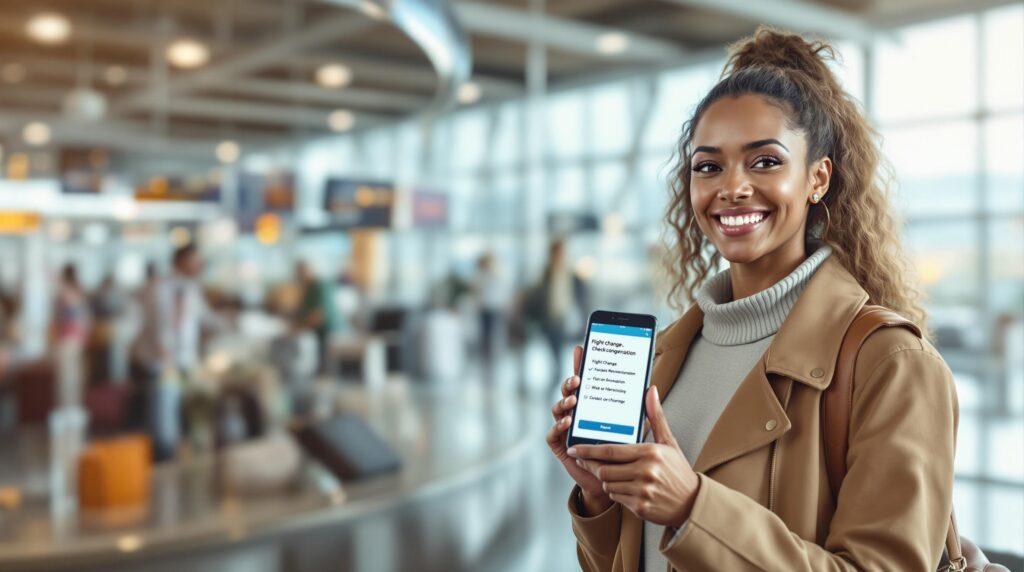
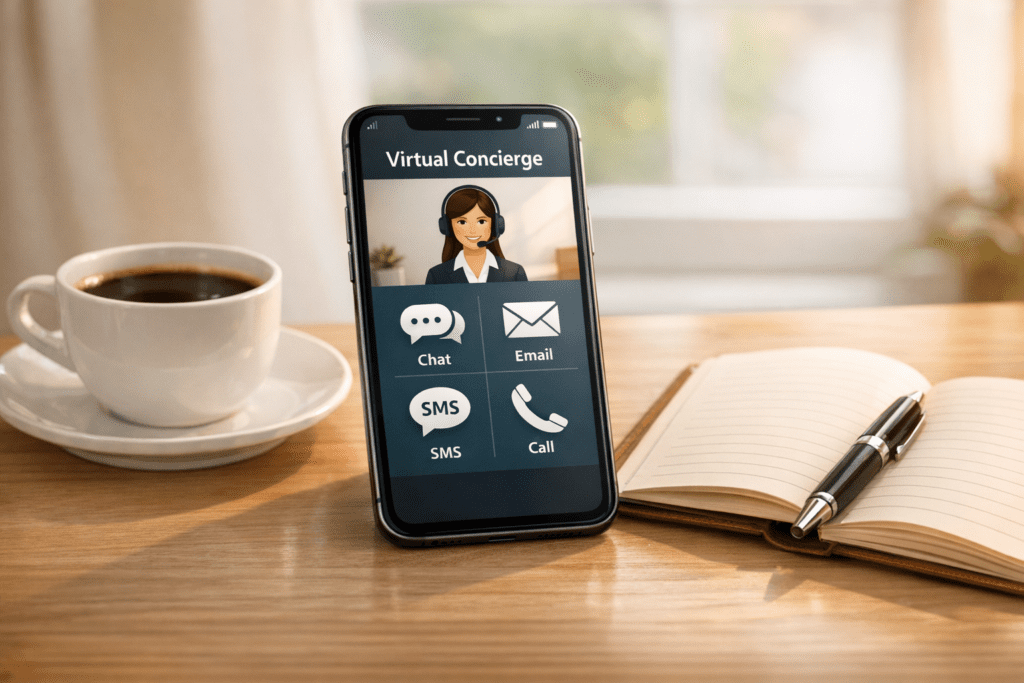
Virtual concierge systems are transforming customer service in travel by offering digital solutions for tasks traditionally handled by human concierges. These systems integrate into apps, kiosks, and messaging platforms, providing contactless service options that became especially popular post-pandemic. Here’s a quick summary of the key communication channels they use:
- Chat and Messaging Platforms: Ideal for real-time responses to routine questions. Platforms like WhatsApp and in-app messaging are popular, especially among travelers under 35.
- Email: Best for detailed, non-urgent communication like booking confirmations or receipts. However, response times can lag.
- SMS: Perfect for urgent updates like flight changes, with a 98% open rate and most messages read within 3 minutes.
- Phone Support: Preferred for complex or urgent issues, offering a human touch but at a higher cost to maintain.
- Web Portals and Mobile Apps: Provide self-service options for straightforward tasks, such as check-ins or room controls.
Each channel has strengths and limitations, making a multi-channel approach essential for addressing both routine and complex customer needs. Combining AI for efficiency with human support for personalized assistance ensures a balanced and effective system.
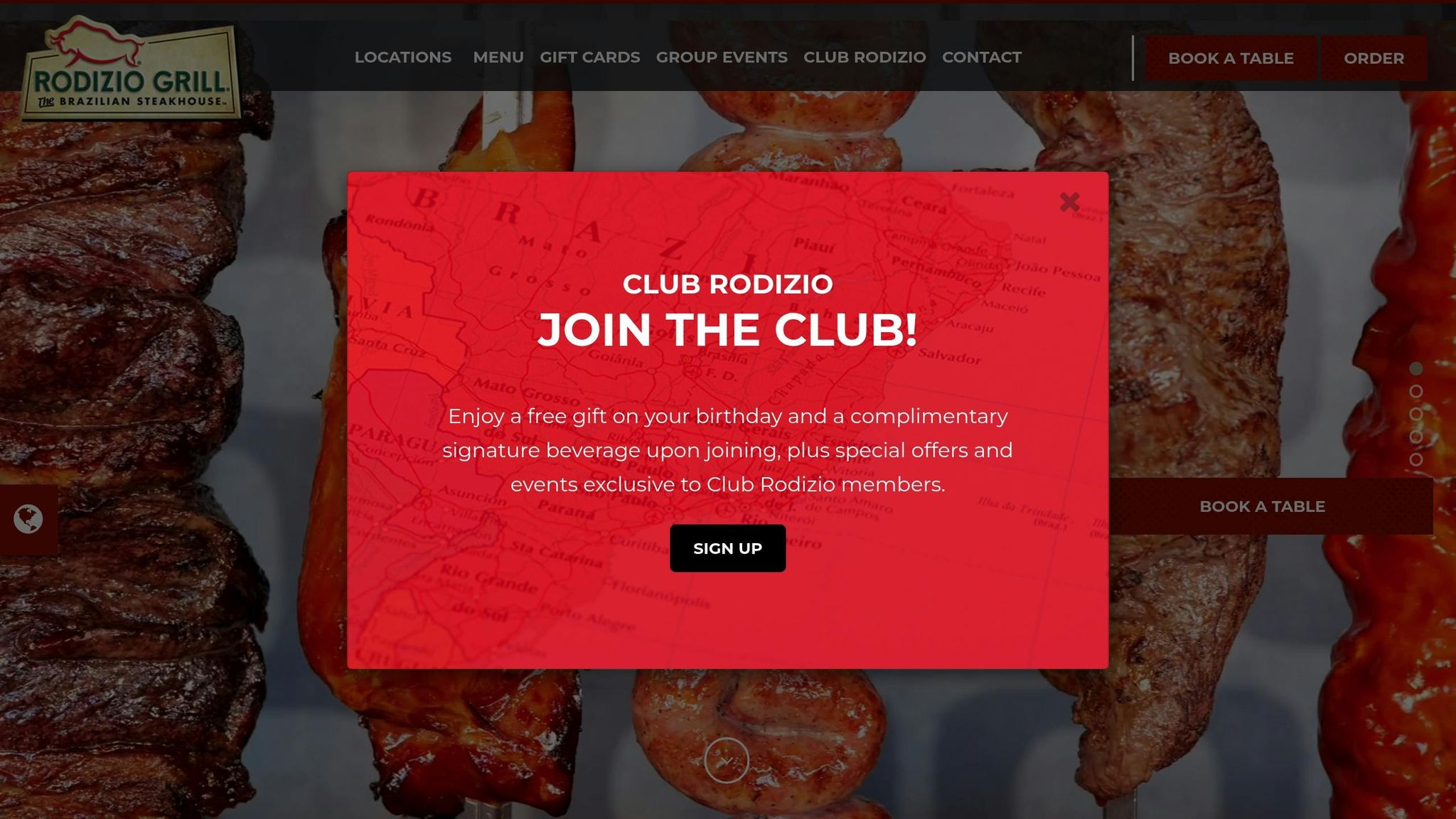
Rodizio Grill Streamlines Guest Communication With Hostie’s Always-On Virtual Concierge
Main Communication Channels in Virtual Concierge Systems
Virtual concierge systems rely on five main communication channels to handle everything from simple inquiries to urgent, complex situations.
Chat and Messaging Platforms
Live chat widgets, WhatsApp, and in-app messaging are at the heart of virtual concierge systems. These tools shine in real-time interactions, helping travelers find answers quickly while juggling other tasks. While AI-powered messaging efficiently handles routine questions, 67% of customers still prefer human assistance for more complicated issues.
Interestingly, nearly 25% of hotel guests actively use messaging platforms, a level of engagement that rivals email open rates. For example, after adopting the AI-driven Revinate Ivy messaging platform, One King West Hotel & Residence reduced the need for manual staff intervention by 50–60% and resolved most inquiries within 13 minutes.
This highlights the importance of blending AI for straightforward queries with smooth transitions to human agents for more nuanced needs. Younger travelers, especially those under 35, are particularly drawn to messaging apps like WhatsApp and Facebook Messenger, with 50% favoring these platforms.
“We love Ivy. It is really easy to set up and our guests love the convenience of having their questions answered without needing to call or visit the front desk.” – Troy Reil, Director of Operations, Portola Hotel & Spa
In addition to real-time messaging, email plays a key role in providing detailed, trackable communication.
Email Communication
Email adds another layer to the communication mix, offering a reliable way to share detailed information and maintain records. It’s the preferred method for sending booking confirmations, payment receipts, itinerary updates, and post-visit review requests. The ability to create a permanent record is especially valuable for travelers who need documentation for expense reports or trip planning.
However, email does have its challenges. While travelers expect responses within 2.5 hours, many businesses take up to a full workday to reply. This makes email more suitable for pre-trip planning and follow-up communications rather than time-sensitive updates.
SMS and Text Messaging
With an impressive 98% open rate, SMS is perfect for delivering urgent updates like flight changes, gate information, or arrival details. Most texts are read within three minutes, making this channel highly effective for time-critical messages.
Not only is SMS quick, but it’s also cost-efficient. Resolving a support ticket via text costs about half as much as handling it over the phone. Additionally, 78% of U.S. consumers say text is the fastest way to reach them for purchases, though many travel companies have yet to fully embrace this channel. The main drawback? The 160-character limit, which requires messages to be concise.
Fred’s Appliance offers a glimpse into SMS’s potential – after implementing text-based customer service, they cut their call volume by 50%, freeing up phone lines for more complex issues.
While SMS excels at quick updates, more intricate problems often require a personal touch via phone.
Phone and Voice Support
Despite the rise of digital tools, phone support remains the go-to option for handling urgent or complex travel issues.
Services like Flight Booking 247 provide round-the-clock phone support, helping travelers manage real-time booking changes or emergencies like missed connections. In critical moments, the reassurance of speaking to a real person can be invaluable.
That said, phone support is the most expensive channel to maintain, and younger travelers often avoid it due to phone anxiety.
Web Portals and Mobile Apps
Web portals and mobile apps offer travelers self-service options for resolving routine issues. In fact, 61% of customers prefer self-service for straightforward tasks. These platforms can provide location-based recommendations, integrate with IoT devices for room controls, and even feature virtual assistants to guide users.
Take Virgin Hotels’ virtual assistant, Lucy, for example. Embedded in their mobile app, Lucy serves as a contactless room key and lets guests control lighting, thermostats, and TVs directly from their smartphones. This reduces the need for front desk interactions while enhancing convenience.
However, adoption can be hindered by friction – unlike SMS, which works on any phone, apps require downloads and logins. To overcome this, apps need to offer clear value, such as exclusive features or genuine convenience, to make the extra steps worthwhile.
Communication Channel Comparison: Performance and Applications
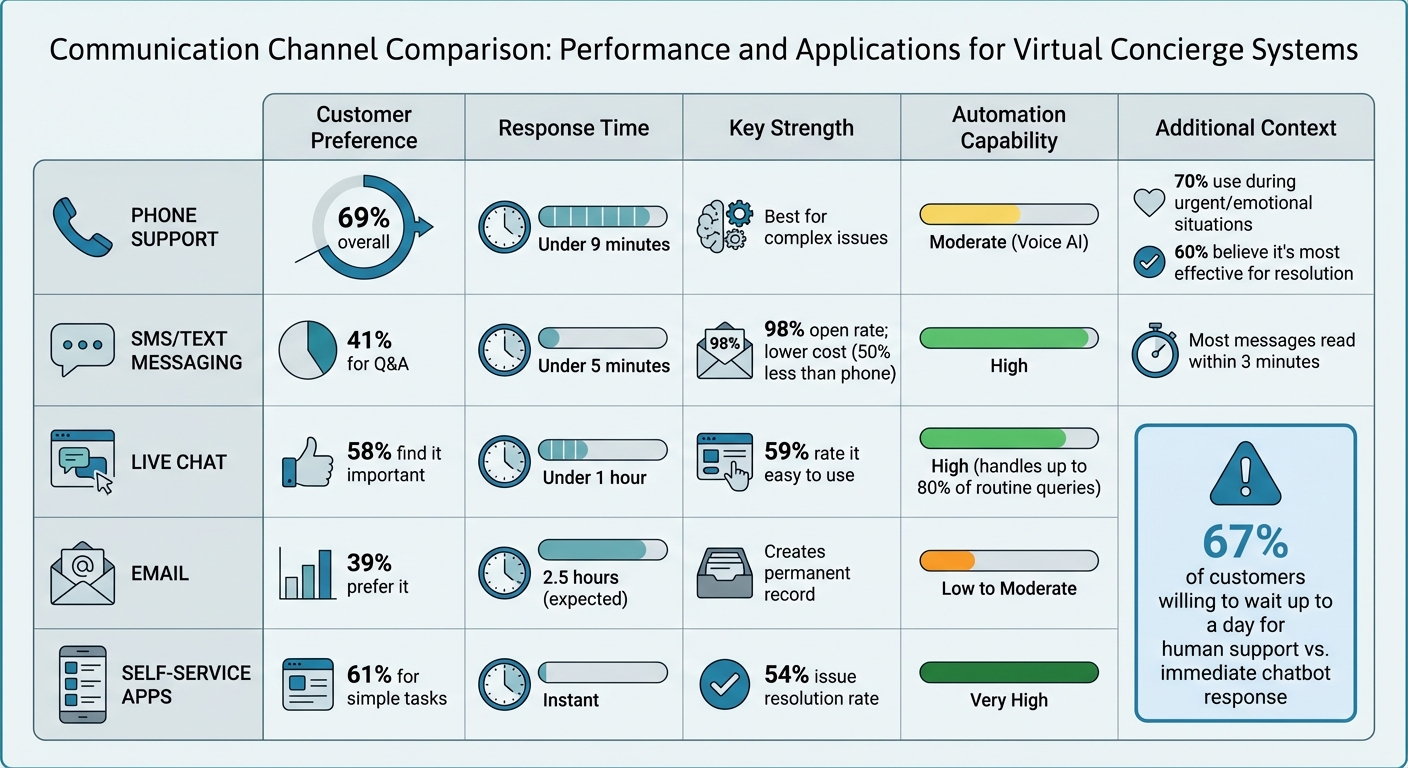
Virtual Concierge Communication Channels: Performance Comparison
Virtual concierge systems rely on various communication channels, each tailored to meet specific customer needs. This section dives into how these channels perform and where they’re best applied.
Phone support remains a favorite among consumers. Studies reveal that 69% of customers prefer phone support for customer service, with 70% turning to it during urgent or emotionally charged situations. Additionally, 60% believe voice communication is the most effective way to resolve issues.
SMS and messaging platforms shine when speed and cost are priorities. With a 98% open rate and most messages read within three minutes, SMS is ideal for time-sensitive updates. It’s also cost-effective, with SMS-based support tickets costing about 50% less than phone-based ones. However, only 41% of customers prefer SMS for interactive queries, making it better suited for straightforward notifications rather than in-depth discussions.
Email is a natural fit for detailed, non-urgent communication. While 39% of customers choose email for such cases, travelers tend to expect responses within 2.5 hours, even though many companies take up to a full business day to reply. This makes email more effective for follow-ups and documentation rather than real-time problem-solving.
Communication Channel Comparison Table
| Channel | Customer Preference | Response Time | Key Strength | Automation Capability |
|---|---|---|---|---|
| Phone | 69% overall | Under 9 minutes | Best for complex issues | Moderate (Voice AI) |
| SMS | 41% for Q&A | Under 5 minutes | 98% open rate; lower cost | High |
| Live Chat | 58% find it important | Under 1 hour | 59% rate it easy to use | High (handles up to 80% of routine queries) |
| 39% prefer it | 2.5 hours | Creates a permanent record | Low to Moderate | |
| Self-Service Apps | 61% for simple tasks | Instant | 54% issue resolution rate | Very High |
The data highlights a clear trend: customers lean toward human-mediated channels for complex or emotionally sensitive situations. For example, 67% of consumers are willing to wait up to a day for human support rather than receive an immediate response from a chatbot. Similarly, 67% of luxury travelers specifically request human staff for customized itineraries. While human interaction remains indispensable for nuanced issues, automated channels excel at handling routine tasks with efficiency.
sbb-itb-e205081
How to Use Communication Channels Effectively in Virtual Concierge Systems
Practical virtual concierge systems are designed to combine various communication options, prioritizing user convenience and seamless interaction.
Using Multi-Channel Support
A strong system gives guests the freedom to choose how they want to communicate. By integrating tools like web chat, mobile apps, SMS, WhatsApp, phone support, and in-room tablets into a single platform, these systems ensure a smooth experience. What’s key here? Keeping a complete conversation history so guests never have to repeat themselves. For instance, a traveler might start a conversation via SMS, switch to a live call for detailed assistance, and later receive a booking confirmation through email. With intelligent routing, simple requests are handled by chatbots, while more complicated issues are seamlessly passed on to human agents.
Combining Automation with Human Support
The best systems strike a balance between automation and human expertise. AI-powered chatbots manage straightforward questions – like providing Wi-Fi passwords or check-out times – while more complex matters are automatically escalated to live agents. This setup ensures guests can pick up right where they left off, without repeating themselves.
Take Flight Booking 247 as an example. It automates routine tasks, such as searching for real-time deals and sending confirmations via email or SMS, while also offering 24/7 live phone support for itinerary changes. This hybrid approach blends the efficiency of automation with the reassurance of human interaction, giving travelers reliable help for both simple and more intricate needs.
Conclusion
Tailoring communication channels to meet customer needs is key to the success of virtual concierge services. Studies reveal that platforms integrating chat, SMS, voice support, and mobile apps – where AI handles routine inquiries and humans take on more complex issues – consistently deliver high customer satisfaction. Take Revinate Ivy, for instance: their platform automates over 60% of tasks through WhatsApp and SMS, while seamlessly escalating complicated requests to live agents for personalized assistance. Each channel plays a unique role, especially in urgent or intricate situations.
The phone remains a standout option for high-stakes scenarios. For example, Flight Booking 247 connects travelers with live concierges around the clock, enabling real-time flight bookings, changes, and cancellations. By combining automated searches with human expertise, they help customers navigate tricky airline policies.
Flexibility across multiple channels also fosters loyalty by allowing customers to interact in the way they prefer. A traveler might explore options on a web portal, make a phone call for tailored advice, receive booking confirmations via email, and get real-time updates through SMS. Keeping a record of conversations ensures guests don’t have to repeat themselves, streamlining the entire experience.
FAQs
How do virtual concierge systems combine AI and human support?
Virtual concierge systems blend AI-powered automation with live human assistance to create an efficient and user-friendly service. The AI component takes care of tasks like interpreting natural language, responding to frequently asked questions, and handling quick actions such as booking flights or modifying itineraries. If the system encounters more complex or sensitive issues – like a missed flight or a billing problem – it seamlessly escalates the situation to a human agent. This approach ensures that users receive the support they need without having to start over.
Take Flight Booking 247 as an example. This service utilizes a hybrid model where AI handles straightforward requests and provides real-time updates, while human agents step in for more nuanced tasks like rebooking flights or finding the best deals. By merging the speed and efficiency of AI with the empathy and problem-solving skills of human agents, virtual concierge systems offer responsive and customer-focused support across various channels, including chat, email, and phone.
Why is SMS the best option for urgent travel updates?
SMS stands out as a powerful tool for urgent travel updates because text messages are delivered almost instantly and are usually read within minutes. In fact, compared to email, SMS is more than twice as popular for time-sensitive alerts, ensuring travelers receive crucial information exactly when they need it.
This speed and dependability make SMS the go-to option for sharing real-time updates like flight changes, cancellations, or other essential notifications.
What are the main drawbacks of using email in virtual concierge systems?
Email serves as a dependable communication tool for virtual concierge systems, providing a clear, written record of conversations and catering to guests who prefer to communicate on their own schedule. It’s particularly useful for those who value having a documented exchange. However, it often falls short in delivering the quick, on-demand responses that today’s travelers expect from round-the-clock concierge services.
One of the main drawbacks of email is its slower response time, as guests tend to check their inboxes less frequently compared to mobile messaging apps. This delay can lead to lower engagement rates. Furthermore, email’s static nature makes it challenging to offer the real-time, interactive experiences or tailored recommendations that can elevate a guest’s experience. Another hurdle is the complexity of integrating email with other systems, which can result in fragmented guest records and create inefficiencies for staff trying to provide seamless service.
While email remains a useful option for certain scenarios, pairing it with faster and more dynamic channels – such as live chat or phone support – can better align with the needs of modern travelers and ensure a more satisfying experience.