

Airlines in the region face mounting obstacles – from grounded fleets to blocked transactions – due to international sanctions. These restrictions disrupt flight routes, limit access to spare parts, and impose hefty fines for violations. For instance, 50% of Iran’s airline fleet was grounded by 2019 due to parts shortages, and penalties for non-compliance can reach $302,584 per violation or double the transaction’s value.
Key challenges include:
- Flight disruptions: Airlines reroute to avoid restricted airspace, causing delays and increased fuel costs.
- Financial hurdles: Sanctions freeze assets, block aircraft purchases, and force risky workarounds like shell companies.
- Compliance risks: Secondary sanctions target entities indirectly linked to banned parties, complicating operations.
To navigate these challenges, airlines are adopting stricter screening, real-time transaction monitoring, and contract clauses to ensure compliance. Tools like automated screening systems, AI for risk detection, and robust financial filters are becoming essential for managing sanctions effectively.
Middle Eastern airlines must prioritize compliance to minimize risks and maintain operations in a rapidly shifting regulatory environment.
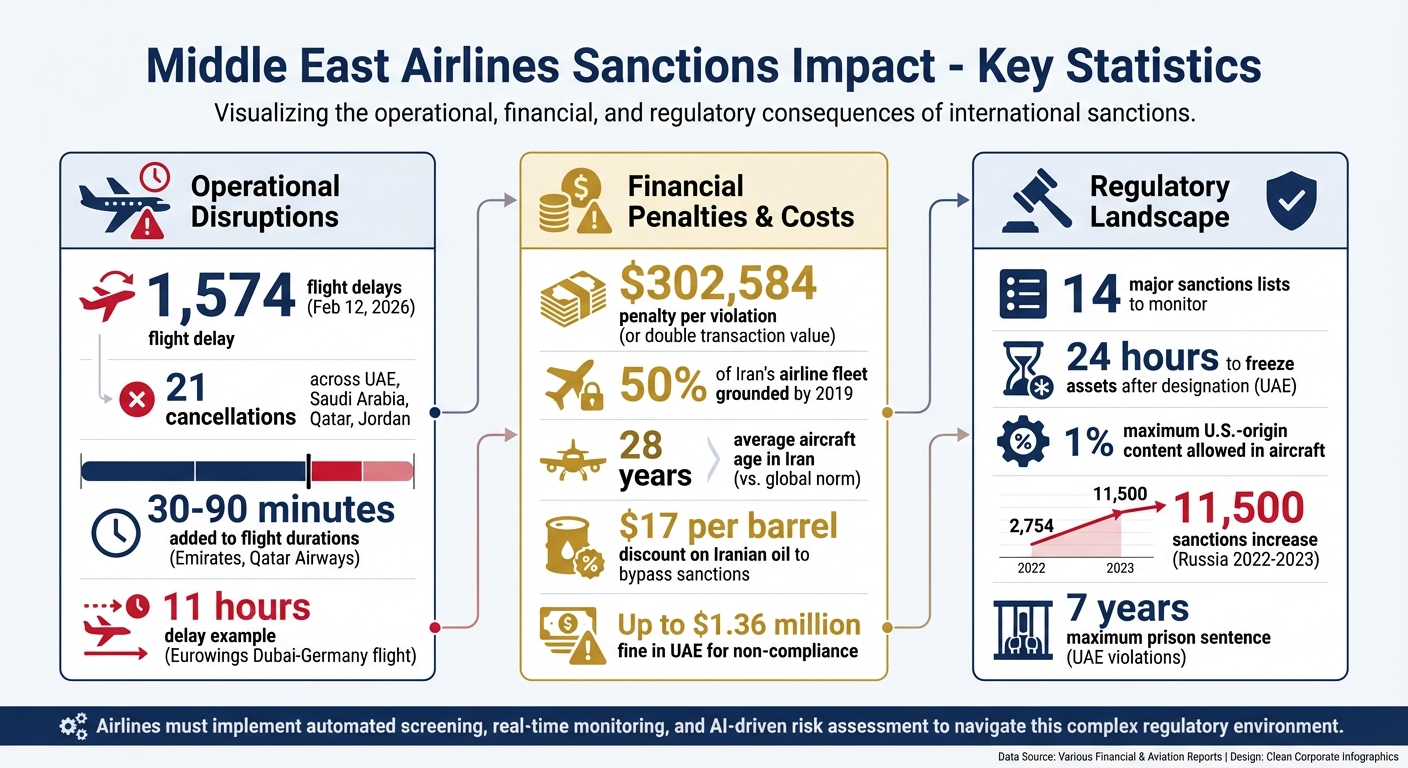
Middle East Airlines Sanctions Impact: Key Statistics and Compliance Costs
Main Challenges Created by International Sanctions
Operational Disruptions
Sanctions have thrown a wrench into aviation operations, forcing airlines to reroute flights, extend travel times, and manage logistical headaches. For instance, on February 12, 2026, aviation trackers reported a staggering 1,574 flight delays and 21 cancellations across key hubs in the UAE, Saudi Arabia, Qatar, and Jordan. Major carriers like Emirates and Qatar Airways now face extended flight durations – adding anywhere from 30 to 90 minutes – to avoid restricted airspace.
Low-cost carriers are hit even harder. Take Wizz Air, for example. In January 2024, the airline had to introduce mandatory refueling stops in Larnaca, Cyprus, for westbound flights from Dubai and Abu Dhabi. Why? Skirting Iranian and Iraqi airspace made direct routes a no-go. Similarly, a Eurowings flight from Dubai to Germany on January 24, 2026, ended up delayed by 11 hours due to a refueling stop in Greece. IndiGo went a step further, canceling all flights to destinations like Tbilisi, Almaty, Baku, and Tashkent until February 11, 2026, citing Iranian airspace closures.
The ripple effects extend beyond delays. Lufthansa Group, including Swiss International Air Lines and Austrian Airlines, suspended overnight flights to Tel Aviv and Amman in January 2026. This decision aimed to minimize risks of air defense misidentifications by operating only during daylight hours. Meanwhile, airlines are grappling with spare parts shortages, resorting to “cannibalization” – stripping parts from grounded planes to keep others operational.
These disruptions don’t just inconvenience passengers – they also take a toll on airlines’ bottom lines, squeezing revenue streams further.
Financial Constraints
The financial landscape is equally challenging. Sanctions freeze assets, block transactions, and restrict aircraft purchases. For example, airlines are barred from acquiring or leasing aircraft with more than 1% U.S.-origin content.
Some airlines have turned to creative, albeit risky, workarounds. In February 2024, Macka Invest Company Limited, a Gambia-based front company, acquired two Airbus A340 jets from Lithuania. Officially bound for the Philippines, these planes instead ended up in Tehran, joining Mahan Air’s fleet. Similarly, in 2022, Avro Global Limited transferred four aircraft to Mahan Air by exploiting loopholes: storing planes in South Africa, re-registering them in Burkina Faso, and orchestrating an “emergency landing” in Iran during a flight supposedly headed to Uzbekistan.
Airlines are also leaning on shadow banking systems for international fund transfers. Meanwhile, Iranian oil exporters offer discounts of up to $17 per barrel to buyers willing to risk sanctions. But the cost of maintaining Iran’s aging fleet – averaging 28 years, more than double the global norm – adds another layer of financial strain.
These financial pressures make it even harder for airlines to navigate the maze of regulatory requirements.
Regulatory Compliance Risks
Sanctions create a minefield of compliance challenges, particularly for airlines and their supply chains. Non-U.S. carriers can face secondary sanctions for significant transactions with sanctioned entities, even if there’s no direct U.S. involvement.
A case in point: In November 2022, authorities blocked eight aircraft operated by a Maltese airline after it transported family members of a Russian individual listed on the U.S. OFAC Sanction List. And new EU regulations now require exporters to include clauses like “No-Russia” and “No-Belarus” in contracts, effectively banning the re-export of aircraft and parts to those regions.
“If any person has knowledge that the aircraft has been operated or maintained in violation of the EAR, no such person may ‘sell, transfer, export, reexport, finance, order, buy, remove, conceal, store, use, loan, dispose of, transport, forward, or otherwise service’ the aircraft.”
– Jonathan M. Epstein, Partner, Holland & Knight LLP
Even routine services – like refueling, catering, ticketing, or ground support – can trigger enforcement actions. Aircraft operated or maintained in violation of export laws become “tainted”, meaning no one with knowledge of the violation can legally sell, lease, or service them. This creates a domino effect, impacting everyone from maintenance crews to fuel providers and insurers. The stakes are high for every link in the aviation supply chain.
sbb-itb-e205081
US-Iran Tensions Disrupt Middle East Air Travel | Major Airlines Cancel Flights | MOJO STORY
Compliance Strategies for Middle East Airlines
To navigate stringent international aviation standards under sanctions, Middle Eastern airlines need to adopt proactive measures to manage compliance risks effectively. These strategies focus on enhanced screening processes, financial transaction monitoring, and robust contract measures.
Improved Passenger and Cargo Screening
Investing in automated screening tools has become indispensable. These systems integrate with flight management platforms to continuously check passengers, crew, and cargo partners against multiple global watchlists, such as the UN Consolidated List, OFAC, the EU Sanctions List, the UK HM Treasury list, and regional lists like the UAE Local Terrorist List. Advanced algorithms help identify aliases, typos, and transliteration variations, assigning percentage-based match scores. Airlines can set thresholds to prioritize high-risk cases.
Screening efforts shouldn’t stop at passengers. Airlines must also vet aircraft owners, the ultimate beneficial owners (UBOs) of cargo partners, and individuals indirectly connected to sanctioned parties, often referred to as “shadow listed” individuals. Non-compliance in the UAE carries severe consequences, including up to seven years in prison and fines nearing $1.36 million. For example, in November 2022, the U.S. Department of the Treasury’s OFAC sanctioned Emperor Aviation, a Maltese operator, and embargoed eight jets linked to a sanctioned Russian billionaire.
“Sanctions screening (whether automated or manual) must be performed prior to the onboarding of a customer and/or the facilitation of an occasional transaction and on an ongoing basis (at least daily) thereafter.”
– CBUAE Rulebook
UAE regulations now require larger airlines to fully automate their screening systems, while smaller operations must automate updates for key lists like the UN Consolidated List and the UAE Local Terrorist List. Maintaining a whitelist of cleared false positives can streamline future screenings, provided these lists are periodically reviewed.
Screening alone isn’t enough – monitoring financial transactions is another critical layer of compliance.
Monitoring Financial Transactions
Airlines must monitor financial transactions in real-time, using filtering tools to screen payment data against global sanctions lists before processing. This involves analyzing specific fields in SWIFT messages, such as the originator, beneficiary, intermediary banks, and free-text fields like Field 70, which often contains details about the payment’s purpose.
Compliance teams should also identify “shadow entities” indirectly linked to sanctions. Systems should flag red flags like payments routed through high-risk jurisdictions, transactions involving offshore shell companies, or cases of payment structuring.
| Transaction Data Element | Screening Relevance |
|---|---|
| Originator/Beneficiary Names | Key for identifying sanctioned individuals or entities |
| Bank Identifier Codes (BICs) | Crucial for geographic and list-based sanctions |
| SWIFT Field 70 | Helps detect prohibited payment purposes |
| ISINs | Identifies sanctioned securities or assets |
The sanctions landscape has evolved rapidly. For instance, the number of sanctions on Russian individuals and businesses surged from 2,754 before the 2022 Ukraine invasion to nearly 11,500 by early 2023. In the UAE, failing to freeze assets within 24 hours of a designation can result in fines of up to $1.36 million. Regular data validation – ideally every 12 to 18 months – ensures screening systems remain accurate and complete. A risk-based approach, tailored to an airline’s geographic and operational exposure, determines when manual reviews are necessary.
Beyond monitoring, strong contractual agreements further secure compliance.
Contract Clauses and Partner Audits
Contracts play a vital role in sanctions compliance. EU regulations now mandate “No Russia” and “No Belarus” clauses in agreements for exporting or leasing aircraft, engines, and parts, prohibiting re-export to these regions. Aircraft leasing agreements should also require ongoing sanctions compliance checks throughout the contract’s duration.
Airlines should demand detailed disclosure of Ultimate Beneficial Owners and corporate structures to identify indirect links to sanctioned parties. This requirement should extend to vendors, landlords, tenants, and maintenance, repair, and overhaul (MRO) firms. Including clauses that allow independent audits of a partner’s sanctions screening processes is also advisable.
Recent enforcement cases highlight the importance of these measures. In April 2025, a joint investigation by the U.S. BIS and FBI led to a 70-month prison sentence for a Russian national involved in exporting controlled aircraft parts from U.S. suppliers to Russia via shell companies. Similarly, in February 2025, an Israeli freight forwarder received a two-year prison sentence for illegally exporting avionics equipment to sanctioned Russian airlines.
Audits should focus on uncovering smuggling schemes involving shell companies or third-country intermediaries that obscure the final destination of aircraft parts. Conducting these reviews after “trigger events” – such as regulatory changes or shifts in a partner’s business profile – ensures that hidden entities are subject to the same sanctions measures.
Technology and Tools for Compliance Management
In addition to standard compliance measures, advanced technology is now a game-changer for ensuring real-time adherence to sanctions. The right tools can transform sanctions compliance into a streamlined, automated process, especially for Middle Eastern airlines that face unique challenges. High passenger volumes, Arabic name transliterations, and constantly changing sanctions lists make manual screening almost impossible. Modern compliance tools integrate directly with flight management systems like Leon, Avianis, or FL3XX, enabling automatic checks of passenger, crew, and cargo data.
Automated screening platforms like PnrGo and Streamlane are designed to monitor and update data from 14 major sanctions lists, including the UAE Local Terrorist List and the UN Consolidated List. These tools use fuzzy logic to identify name variations, typos, and transliterations, providing match scores based on percentages. Airlines can set thresholds, such as 90% for red alerts and 70% for yellow, to customize their screening process.
But automation isn’t just about speed. These tools pave the way for AI-driven risk assessments. AI and machine learning can analyze massive datasets in real time, uncovering complex risk patterns while reducing false positives. For example, Al Jazeera Finance achieved a 500% decrease in false-positive detections with AI-driven screening, while Sohar International cut compliance alerts from 312,000 to 102,000. These technologies also support continuous monitoring, shifting from one-time onboarding checks to daily re-screening of customers, vendors, and partners.
“AI-powered sanctions frameworks are not plug-and-play – they must be tailored to each institution’s systems, risk profile and operational reality to turn compliance into strategic strength.”
– EY
Optical Character Recognition (OCR) tools further enhance compliance by converting paper-based cargo and trade finance documents into electronic formats for automated checks, eliminating errors from manual data entry. Corporate intelligence tools also help identify Ultimate Beneficial Owners (UBOs) indirectly linked to sanctioned entities. The Central Bank of the UAE now expects larger airlines to deploy fully automated systems capable of managing increased transaction volumes and complexity.
Automation vs. Manual Screening
| Feature | Manual Screening | Automated Screening |
|---|---|---|
| Speed | Slow and resource-intensive | Real-time, instant checks across lists |
| Accuracy | Prone to human error and missed updates | Uses fuzzy logic for name variations |
| Scalability | Struggles with high traffic volumes | Easily scales with transaction volume |
| List Updates | Hard to track frequent changes | Updates automatically and continuously |
| Cost | High labor and operational costs | Lower costs due to reduced manual effort |
| Auditability | Difficult to maintain logs | Automated trails simplify regulatory reporting |
Automated systems also maintain privacy by processing queries without directly accessing original government databases, avoiding external tracking by public agencies.
To improve efficiency, airlines can maintain a “white list” of cleared false positives, ensuring periodic reviews for accuracy. For smaller operations, semi-automated tools are permitted by the Central Bank of the UAE, provided they automatically update key sanctions lists like the UN Consolidated List and the UAE Local Terrorist List.
Beyond basic automation, AI takes compliance to the next level by spotting sophisticated evasion strategies.
AI and Data Analytics for Risk Assessment
Building on automated tools, AI introduces a new level of precision in risk detection. It doesn’t just match names; it identifies complex evasion tactics that manual reviews often miss. Machine learning algorithms can uncover indirect exposure through hidden ownership layers, shell companies, and “shadow listed persons” – entities controlled by sanctioned individuals but not officially listed. These systems provide real-time monitoring as sanctions lists update, sometimes just minutes before a flight’s departure.
AI can also analyze diverse datasets, such as SWIFT payment data, cargo details, and corporate ownership records, flagging risks like payments routed through high-risk jurisdictions or transactions involving offshore shell companies. It’s particularly effective for identifying dual-use goods in cargo that could be diverted to restricted areas.
Explainable AI is becoming essential, as compliance teams need clear reasoning behind alerts to make informed decisions. Airlines can fine-tune AI tools with risk-based calibration, adjusting thresholds according to their operations and geographic focus. For instance, an airline with extensive Russian cargo operations might set stricter thresholds than one focused on domestic routes.
“The new system has improved our detection accuracy and processing efficiency, allowing us to meet regulatory demands with confidence.”
– Ramy Mansour, Vice President Legal Compliance, Mastercard Transaction Services EU
Generative AI is also proving useful for interpreting complex international regulations and simplifying legal jargon for compliance teams. This is especially crucial in the Middle East, where airlines navigate overlapping sanctions from the UN, EU, U.S., UK, and local authorities. Airlines are encouraged to adopt no-code policy engines, enabling compliance leaders to quickly adjust rules and thresholds without external vendor reliance. This ensures they can respond swiftly to changing regulations or geopolitical developments.
Conclusion: Building Long-Term Compliance Capacity
For Middle Eastern airlines, sanctions compliance isn’t a one-time task – it’s an ongoing process that demands constant attention. With the rapid increase in sanctions over recent years, airlines must adopt multi-layered frameworks that integrate automated technology, operational controls, thorough documentation, and specialized training at every step of the customer and cargo journey. These measures expand on the screening and monitoring strategies discussed earlier.
To stay ahead, airlines need to take a proactive stance. Instead of reacting to new sanctions, they should regularly assess risks and review their existing controls. For instance, embedding screening tools directly into Flight Management Systems can automate checks during booking and dispatch. Real-time monitoring is especially critical, as sanctions lists can change just minutes before a flight departs.
“Compliance is no longer just about the next audit. It is about building confidence in how your organization operates every day.”
– Bostonair Group
The stakes couldn’t be higher. Non-compliance carries severe financial and legal risks. For example, over 400 leased jets were grounded in Russia in 2022 due to sanctions, underscoring the immense liabilities involved.
To address these challenges effectively, airlines need compliance programs tailored to their operational scale. Large carriers handling high transaction volumes should rely on fully automated systems, while smaller operators might find semi-automated tools more practical. Regardless of size, every airline must maintain a robust, risk-based approach. Standardizing processes across departments – ticketing, finance, and cargo – ensures consistency, while automated alerts for “trigger events”, like sudden changes in a partner’s corporate structure or unusual payment routes through high-risk areas, further reinforce compliance efforts.
Building this long-term capacity is essential for navigating today’s unpredictable geopolitical landscape with confidence and security.
FAQs
What triggers secondary sanctions for airlines?
Secondary sanctions for airlines come into play when they participate in or assist with unauthorized transfers of aircraft, goods, technology, or services to countries or entities under sanctions. Airlines can also face penalties if they facilitate activities that support designated terrorist groups or sanctioned regimes. These actions can result in enforcement measures and serious economic repercussions.
How can airlines cut sanctions screening false positives?
Airlines have a lot to gain by tackling false positives in sanctions screening, and advanced tools like AI and machine learning are making that easier. These technologies can analyze contextual details and learn from previous decisions, improving accuracy over time.
Fine-tuning screening parameters, such as adjusting match score thresholds, is another way to cut down on unnecessary alerts. On top of that, ensuring high-quality data – like verifying birth dates or addresses – plays a big role in reducing false positives while staying compliant with sanctions regulations.
What contract clauses best prevent illegal re-exports?
The best way to prevent illegal re-exports is by including contract clauses that explicitly prohibit re-exportation to certain destinations, such as Russia. A key example is the EU’s “no re-export to Russia” clause, found in Article 12g of Council Regulation 833/2014. These clauses should be a standard part of export contracts and must clearly detail remedies for any breaches. This approach helps ensure compliance and reduces the chances of sanctions violations.