
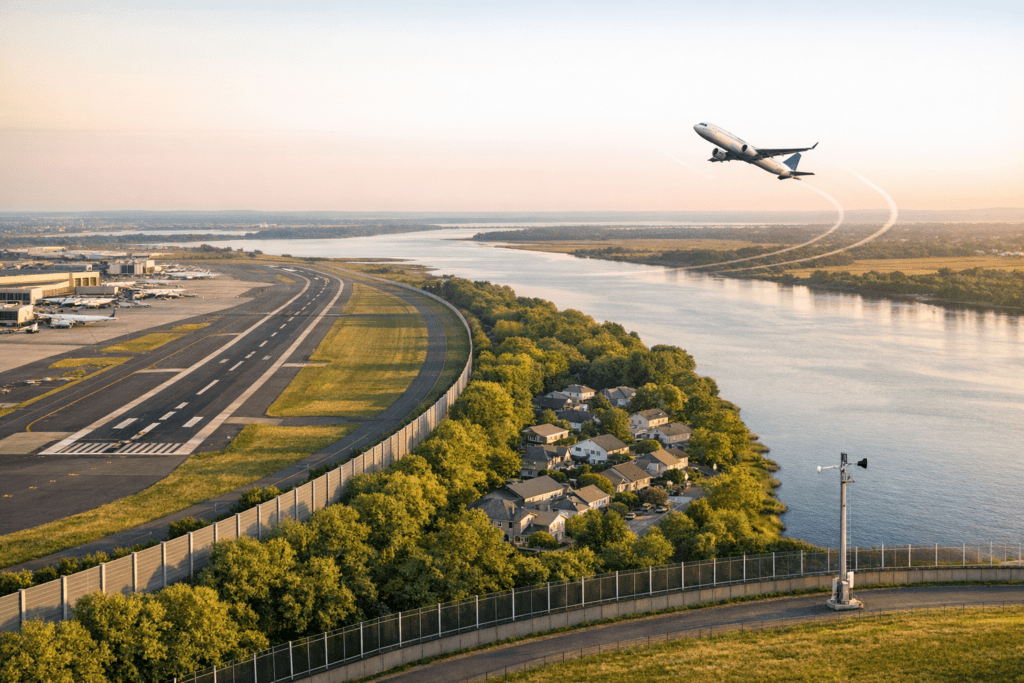
- Reduce Noise at the Source: Encourage airlines to use quieter aircraft by implementing fee structures that reward quieter models and penalize noisier ones. Phasing out older, noisier planes is also key.
- Land-Use Planning: Use noise contour maps to guide zoning decisions, restrict residential development in high-noise zones, and implement sound insulation programs for existing buildings.
- Noise Abatement Procedures: Optimize flight paths using satellite navigation to avoid populated areas, implement quieter takeoff and landing techniques, and adjust flight schedules to minimize nighttime disruptions.
- Monitoring and Transparency: Install Noise and Operations Monitoring Systems (NOMS) to collect data, measure noise levels, and share findings with the public through digital platforms.
- Community Engagement: Build trust by addressing complaints, involving stakeholders in planning, and educating residents about noise management efforts.
These strategies align with the International Civil Aviation Organization‘s (ICAO) Balanced Approach, ensuring airports address noise issues while balancing safety and economic factors.
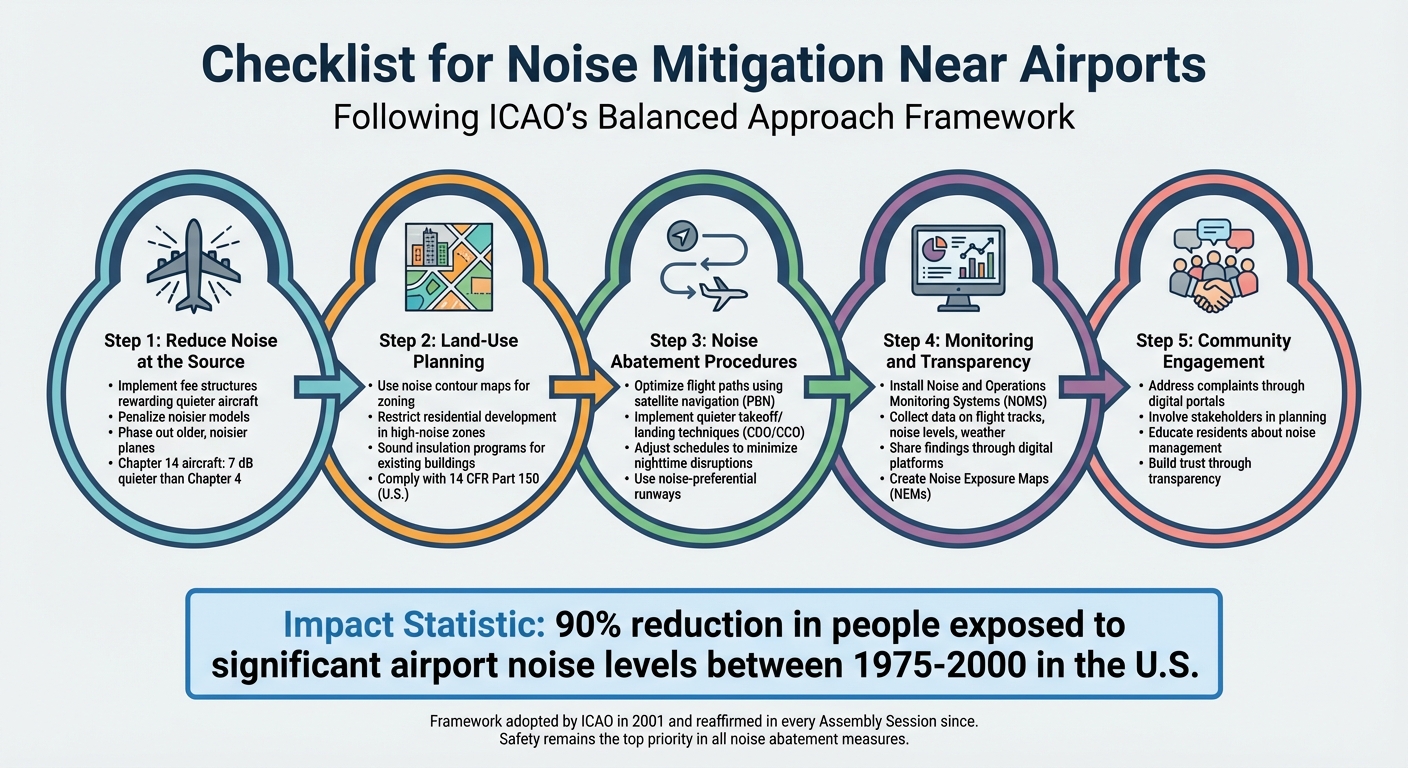
ICAO Balanced Approach to Airport Noise Management: 5-Step Framework
Aircraft Noise Basics Part 2 – Efforts Underway to Reduce Aircraft Noise
Airport Noise Monitoring Systems
Noise and Operations Monitoring Systems (NOMS) play a key role in managing airport noise. The National Academies of Sciences, Engineering, and Medicine describe these systems as tools that “collect, manage, analyze, and communicate data such as flight tracks and procedures, aircraft identification, noise measurements, noise abatement program performance, and weather”. Without precise data, airports can’t gauge the effectiveness of noise reduction efforts or address concerns from nearby communities. These systems form the foundation for the mitigation strategies discussed below.
Installing Noise Monitoring Equipment
Airports use fixed and portable noise monitors to gather continuous data near runways and flight paths. Fixed monitors provide ongoing data, while portable units address specific community concerns or verify noise contours in targeted areas. Linking noise events to specific aircraft automatically turns raw data into actionable insights for noise reduction programs. Including weather data in these systems is also important, as it helps account for how weather conditions affect sound propagation. For those considering the implementation or upgrade of a NOMS, the ACRP Research Report 237 provides a detailed 50-page framework outlining costs and benefits.
Integration with Noise Mapping Tools
Modern systems go beyond monitoring – they integrate noise data with advanced tools like AEDT and INM to map noise impacts. This allows airports to create Noise Exposure Maps (NEMs) in compliance with 14 CFR Part 150 noise compatibility planning requirements in the U.S.. By comparing real-world measurements with predicted flight track data, airports can objectively evaluate how well their noise abatement programs are working. Such integration also supports more transparent communication with the public.
Sharing Data with Communities
Effective noise monitoring doesn’t stop at data collection – it extends to clear communication with the community. Transparency builds trust, and many airports now share noise trends and flight tracking information openly. As the National Academies explain, “NOMSs are also used to respond to community noise complaints and provide stakeholders with information about aircraft activity and noise, thus fostering trust and transparency”. In 2025, ICAO published a “Report on Good Practices of Noise Monitoring Systems”, offering guidance on managing noise through collaboration with stakeholders. Additionally, digital portals now allow residents to view near-real-time data, submit questions, and better understand the flight operations linked to the noise they experience.
Incentivizing Quieter Aircraft and Fleets
Effective noise monitoring is just the first step in reducing airport noise. Financial incentives play a crucial role in encouraging airlines to modernize their fleets and adopt quieter operations. By charging higher fees for noisier aircraft and rewarding quieter ones, airports create a strong economic motive for airlines to upgrade. For example, in the United States, the number of people exposed to significant noise levels dropped by about 90% between 1975 and 2000. This dramatic improvement largely stems from fleet modernization driven by smart pricing strategies. In rapidly growing urban areas near airports, like those in the Middle East, such measures are essential to managing noise levels effectively.
Reduced Fees for Quieter Aircraft
Many airports base their landing fee structures on standards outlined in ICAO Annex 16, which includes Chapters 3, 4, and 14. The latest Chapter 14 standards require new aircraft to be at least 7 decibels quieter than those meeting Chapter 4 standards. Airports reward airlines operating Chapter 14 aircraft with lower fees, while imposing higher charges on noisier planes, especially those flying unscheduled night operations. Night flights often face penalties with fee multipliers ranging from 5x to 8x during restricted hours, further incentivizing airlines to adjust their schedules. These pricing strategies not only encourage the adoption of quieter aircraft but also push for stricter operational controls to reduce community noise impacts.
Phasing Out Older Aircraft
Many airports have taken steps to phase out older, noisier aircraft. For instance, Chapter 2 aircraft are now banned at numerous airports, and even some of the loudest Chapter 3 models face operational restrictions. These regulations have evolved over time, starting with bans on Non-Noise Certificated aircraft in the 1980s, shifting to Chapter 2 in the 1990s, and now targeting certain Chapter 3 models. Importantly, these measures focus on actual noise performance rather than simply the age of the aircraft. Airports also consider economic factors, particularly for operators in developing regions, ensuring that noise reduction efforts are balanced with the financial realities of fleet upgrades. As fleets become quieter, further improvements in flight operations help to minimize noise even more.
Promoting Noise-Friendly Operations
Reducing noise isn’t just about upgrading fleets – it’s also about how planes are flown. Airports encourage operational techniques like Continuous Descent Operations (CDO), which allow aircraft to descend with minimal engine thrust, cutting both noise and fuel use during landing. Similarly, Continuous Climb Operations (CCO) optimize departure profiles to lower noise and emissions. These approaches benefit both the environment and airline operating costs. Additionally, Noise Abatement Departure Procedures (NADPs) are implemented to reduce noise during takeoff. These procedures are customized for each airport’s layout to ensure safety while minimizing noise impacts on nearby communities.
Optimizing Flight Paths and Operations
How aircraft navigate through airspace plays a crucial role in reducing noise exposure for surrounding communities. While fleet upgrades and operational techniques are important, modern flight path strategies can significantly lessen the impact of noise while maintaining safety standards. These strategies align with the International Civil Aviation Organization (ICAO) framework, building on earlier efforts to protect urban areas from excessive noise.
Performance-Based Navigation (PBN)
Performance-Based Navigation (PBN) relies on satellite technology to guide aircraft along precise flight paths, making it easier to avoid densely populated areas compared to traditional navigation methods. This technology enables planes to follow exact routes within narrow corridors, limiting the overall area affected by noise. Airports implementing PBN must decide whether to concentrate flight paths or alternate them to distribute the impact.
Before adopting PBN, airports should conduct thorough environmental assessments using frameworks like ICAO Doc 10031 to fully understand the potential effects of these changes. Training for both pilots and air traffic controllers is equally important. As the National Business Aviation Association explains:
“A more thorough understanding by the pilots and the controllers as to what the procedures are, as well as the reasons behind them, is the key to success”.
To support compliance, tools like visual aids, electronic approach systems, and clear signage at pilot information centers are essential. These measures work in tandem with previous fleet and operational improvements to further reduce noise impacts on local communities.
Night Flight Restrictions
Adjusting flight schedules is another effective way to minimize noise, especially during nighttime hours when disturbances are more pronounced. Noise during sleep hours can lead to significant community disruption, so airports like London Heathrow and Frankfurt impose higher surcharges or outright bans on nighttime operations to mitigate these effects. Such restrictions must align with the Balanced Approach framework, carefully balancing cost considerations with the economic needs of airlines, including those from developing nations.
Departure Path Alternation
Alternating departure paths is a strategy designed to distribute noise more evenly across different areas, rather than concentrating it over the same neighborhoods repeatedly. This method uses Standard Instrument Departures (SIDs) and Obstacle Departure Procedures (ODPs) to establish predefined routes that balance safety with noise reduction goals. In some cases, air traffic controllers may use radar vectors to adjust aircraft paths in real time, which can shift the noise footprint. However, this also transfers the responsibility for obstacle clearance to the controller.
Distance plays a key role in reducing perceived noise levels, as increasing the distance between aircraft and communities can significantly lower the impact. Airports are also encouraged to designate noise-preferential runways during sensitive hours, directing flights over water or unpopulated areas whenever possible. By alternating routes, airports can spread noise exposure more evenly, alleviating the burden on individual neighborhoods and creating a more balanced approach to noise management.
sbb-itb-e205081
Land Use Planning and Restrictions
Careful urban planning around airports is key to managing noise exposure effectively. The International Civil Aviation Organization (ICAO) highlights land-use planning and management as one of the four main strategies in its Balanced Approach to Aircraft Noise Management. This approach underscores the importance of combining operational measures with well-thought-out land-use decisions to lessen the impact of noise on nearby communities.
Noise Contour Mapping
Noise contour maps are the foundation of effective land-use planning. In the U.S., airports adhere to 14 CFR Part 150 to create formal Noise Exposure Maps (NEMs), which identify areas most affected by noise. These maps rely on detailed data, including flight paths, aircraft types, and operational frequency. To ensure accuracy, the FAA provides a Noise Exposure Map Checklist that outlines all the necessary data points for map submission. Additionally, the compatibility tables in AC 150/5020-1 help local authorities align zoning decisions with noise levels. By integrating Noise Monitoring Systems with mapping tools, airports can validate their models and adjust maps as operations change over time. These maps are then used to guide zoning and building strategies, reducing the impact of noise on communities.
Land-Use Compatibility
Once noise contours are established, local governments can implement targeted land-use policies to address noise issues. For example, new residential developments can be restricted in high-noise areas. Under Part 150 regulations, airports create Noise Compatibility Programs (NCPs) that outline steps to reduce incompatible land uses in affected zones. The compatibility tables in AC 150/5020-1 provide clear recommendations on which types of land use are suitable for different noise environments. Coordination between airport operators and local planners is vital to ensure that urban development aligns with airport noise management goals.
Sound Insulation Programs
For existing buildings in high-noise areas, sound insulation programs offer practical relief by reducing interior noise levels. Developed under 14 CFR Part 150, these programs identify eligible properties and apply acoustical treatments to achieve Noise Level Reduction targets. Effective insulation goes beyond just upgrading windows and doors – it often includes improvements to HVAC systems and ventilation to maintain indoor air quality. Many modern programs now incorporate energy-efficient systems and sustainable materials, offering additional benefits to homeowners. Resources like ACRP Report 89 from the Airport Cooperative Research Program provide detailed guidance on implementing these programs, covering everything from acoustical engineering to community outreach.
Community Engagement and Collaboration
Addressing noise issues effectively isn’t just about technical fixes – it’s about building strong relationships between airports, local governments, and the communities they impact. The International Civil Aviation Organization (ICAO) introduced the Balanced Approach in 2001, emphasizing the importance of structured consultations with all stakeholders. This approach ensures that every stage, from assessing noise levels to implementing solutions, involves collaboration. According to this framework, aircraft noise remains the primary factor behind negative community reactions to airport operations and expansion efforts. To make noise mitigation efforts successful, airports need to combine technical strategies with meaningful community involvement.
Complaints Management Systems
Modern complaint systems, like digital noise portals, make it easier for residents to report and track noise issues while promoting transparency and accountability. The most effective systems integrate with Airport Noise Monitoring Systems (NMS), allowing airport staff to connect specific complaints to real-time flight data and recorded noise events. It’s also crucial to educate residents about the factors contributing to noise annoyance, such as volume, duration, frequency, and nighttime disturbances. Adding a formal dispute resolution process to these systems can further help address concerns before they escalate.
Collaborating with Stakeholders
Effective noise management depends on strong partnerships between airports, airlines, air traffic control, and local planners. For instance, airports can share noise mapping data with urban planners to help guide land-use decisions and avoid placing sensitive facilities like schools and hospitals in high-noise areas. The ICAO Balanced Approach encourages exploring all available options to find cost-effective solutions before resorting to strict operational restrictions. Regular coordination meetings can also focus on implementing noise-preferential runways and flight routes. These measures should align with local planning goals while prioritizing safety at every step.
Educational Initiatives
Educating the public is key to bridging the gap between community expectations and airport operations. Tools like NoiseQuest and the ACRP Report 15 toolkit provide airports with resources to develop communication programs. These initiatives can explain critical noise metrics, such as the FAA-defined Day-Night Average Sound Level (DNL) threshold of 65 dBA for significant exposure. They also clarify the 10 dBA penalty applied to nighttime flights, which equates one nighttime flight to ten daytime flights in terms of noise impact. Additionally, sharing transparent data from Noise Monitoring Systems helps communities understand noise trends and fosters trust.
Conclusion
Reducing aircraft noise near airports effectively requires the ICAO Balanced Approach. This framework, adopted in 2001 and reaffirmed in every Assembly Session since, tackles noise issues on an airport-by-airport basis through four key strategies: noise reduction at the source, land-use planning, operational procedures, and operating restrictions. These strategies combine technological advancements with community-centered solutions.
On the technical side, advancements in technology and operations have made a noticeable difference in cutting noise levels. For instance, optimized Air Traffic Management can deliver meaningful reductions in noise and emissions in the short to medium term, all without the need for costly new equipment. Tools like Noise and Operations Monitoring Systems also play a critical role by collecting data such as flight paths, noise levels, and weather conditions. This fosters trust and transparency among stakeholders.
However, technical fixes alone won’t solve the problem. Community engagement is just as important. Aircraft noise continues to be the leading cause of community dissatisfaction when it comes to airport operations and expansions. To address this, early and proactive involvement with stakeholders during the planning stages is crucial. Modern noise management also requires balancing trade-offs between noise reduction, fuel efficiency, and CO2 emissions, ensuring decisions align with the aviation sector’s commitment to achieving net-zero carbon emissions by 2050.
Safety, of course, remains the top priority. Operational restrictions should only be considered after all other options have been thoroughly explored. Any noise abatement measures, such as using noise-preferential runways and routes, must always prioritize safety above all else. By following this balanced approach, airports can protect community well-being while maintaining the vital connectivity they provide.
FAQs
How do Noise and Operations Monitoring Systems (NOMS) help manage airport noise more effectively?
Noise and Operations Monitoring Systems (NOMS) give airports a real-time, data-driven snapshot of noise levels and flight operations. These systems gather detailed data, including flight paths, aircraft types, noise levels, weather conditions, and noise-abatement efforts, creating a comprehensive database that can be used to spot trends and address problem areas.
With this information, airport managers can pinpoint the aircraft, routes, or procedures responsible for the most noise. They can then make operational adjustments – like tweaking flight schedules or modifying runway usage – to minimize the impact on surrounding communities. The data can also be shared openly with local residents and officials to address noise complaints, building trust and ensuring regulations are met.
Unlike occasional surveys, NOMS provide continuous monitoring, allowing airports to track the effectiveness of noise-reduction measures over time. This ongoing approach helps airports demonstrate progress to regulators and the public, improving noise management, enhancing the quality of life for nearby residents, and aligning with both regulatory and community expectations.
How can airports encourage airlines to use quieter aircraft?
Airports have several strategies to encourage airlines to switch to quieter aircraft, blending rules with financial perks. For instance, they might restrict noisier planes from operating during nighttime hours or set limits on flights based on their noise output. On the financial side, offering reduced landing fees or tax credits for quieter planes gives airlines a solid reason to upgrade their fleets.
Operational adjustments also play a role. Techniques like optimizing flight paths, using steeper climb-outs, or reducing thrust settings can significantly cut noise levels without requiring new aircraft. Many airports also charge noise surcharges for flights exceeding specific noise thresholds, making quieter operations a more cost-effective choice. Over time, these combined efforts not only reduce noise pollution but also push airlines toward investing in quieter, more efficient technologies.
How does involving the community help reduce airport noise impacts?
Involving the local community plays a crucial role in tackling airport noise challenges. When airport operators, airlines, and residents engage in open communication, it fosters trust and helps everyone grasp the factors behind the noise – like flight paths or operational schedules. Keeping communities informed about potential measures, such as adjusted flight routes or night curfews, increases the likelihood of gaining their support.
Community involvement also gives residents a platform to voice their concerns and propose tailored solutions. Ideas like soundproofing grants, landscaping buffers, or better land-use planning often emerge from these discussions. By integrating this feedback, airports can adopt noise-reduction strategies that are practical, budget-friendly, and widely embraced. This collaboration not only addresses noise issues effectively but also turns residents into partners, paving the way for long-term solutions.