
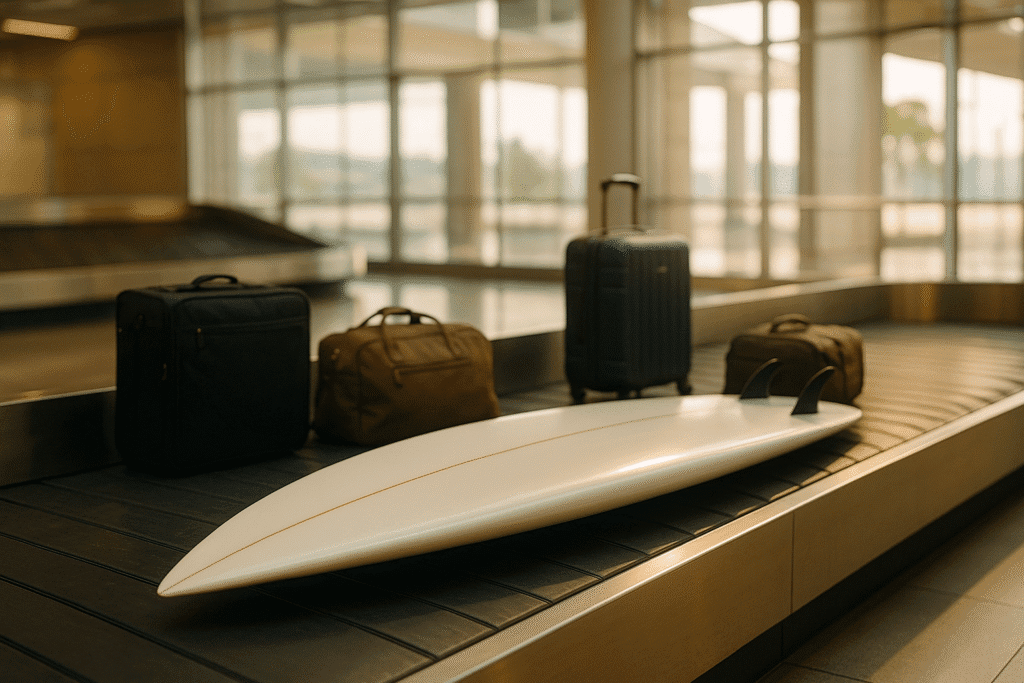
Traveling with a surfboard in 2025? Airlines have varying fees, weight limits, and size restrictions, so understanding their policies is essential to avoid surprises. Here’s a quick rundown of key points:
- Fees: Range from $30 (Delta domestic) to $200 (United international). Hawaiian Airlines offers inter-island rates as low as $25.
- Weight Limits: Most airlines allow 50-100 lbs. Overweight fees start at $100.
- Size Restrictions: Typically capped at 115 linear inches, but some airlines (like JetBlue) have stricter limits.
- Number of Boards: Some airlines let you pack multiple boards in one case, while others (e.g., JetBlue) require one board per case.
Quick Tips:
- Book your surfboard in advance to save money.
- Use a padded or hard-shell case for protection.
- Check your airline’s specific rules before booking.
For detailed airline policies, keep reading.
Surfboard Baggage Fees For EVERY Airline! (Best Options)
Surfboard Baggage Policies in 2025
Airlines categorize surfboards as sporting equipment, which means they come with specific rules around weight, size, and packaging. These guidelines help determine whether you’ll face extra fees when traveling with your board.
Here’s what you need to know:
- Weight and Size Limits: Airlines typically calculate weight limits by including the surfboard, its case, and any accessories. For size, they use the combined linear dimensions of the board and its packaging. Keep in mind that these limits may differ between domestic and international flights.
- Fee Variations: Fees can differ depending on the route and season. Domestic flights often have different charges compared to international ones, and some routes may even offer reduced or waived fees. However, failing to meet the airline’s guidelines can lead to additional costs.
- Extra Charges: Traveling with multiple boards, exceeding size limits, or waiting until the last minute to declare your board can result in higher fees. To avoid this, it’s best to register your surfboard when booking your ticket.
- Discount Opportunities: Some frequent flyer programs and airline-branded credit cards provide discounts on surfboard fees, so it’s worth checking if you qualify.
- Packaging Requirements: Airlines have varying standards for packaging. While some allow soft bags, others may require hard cases, especially for oversized boards or international travel. Always confirm your airline’s specific requirements ahead of time.
Planning ahead and understanding these policies can save you from unexpected hassles and extra costs when traveling with your surfboard.
1. Delta Air Lines

Delta Air Lines treats surfboards as standard checked baggage, meaning they fall under the same fee structure as regular luggage.
Surfboard Fee (USD, One-Way)
For most domestic routes, Delta charges $30 for the first checked bag and $40 for the second. If you’re flying between Honolulu and Maui, the fee drops to $20. Importantly, surfboards don’t carry any additional sporting equipment fees beyond these standard charges.
That said, if your surfboard weighs more than 50 lbs, you’ll need to pay an overweight baggage fee on top of the standard fee. It’s always a good idea to weigh your board before heading to the airport.
Weight Limit (lbs)
Delta’s weight limit for checked bags is 50 lbs. If your surfboard exceeds this, overweight fees will apply. Keep in mind that Delta won’t accept items weighing more than 100 lbs.
Maximum Dimensions (inches)
Surfboards and their cases must stay within 115 linear inches. For Delta Connection flights, there’s an additional restriction: boards longer than 72 inches aren’t allowed.
Number of Boards Allowed Per Bag
You can pack up to two surfboards per bag, provided they’re packed together and meet the weight and size requirements.
Next, let’s take a look at United Airlines’ surfboard policies.
2. United Airlines
United Airlines handles surfboards differently than Delta, classifying them as special checked items instead of standard baggage. This means you’ll pay extra fees beyond the usual checked bag charges, which can add up quickly.
Surfboard Fee (USD, One-Way)
United charges between $100 and $200 per one-way trip for surfboards, based on your route and the size of your board bag. These fees are in addition to the standard checked bag fee, which is typically around $35 for domestic flights.
However, for flights within California, United often waives the surfboard fee, leaving you to pay just the standard checked bag fee of about $35. This makes United an appealing option for surfers traveling up and down the West Coast.
Weight Limit (lbs)
While United adheres to standard airline weight restrictions, the exact weight limit for surfboard bags isn’t clearly outlined. If your board bag exceeds the usual checked baggage weight limits, you should anticipate additional overweight fees.
Maximum Dimensions (inches)
For most United flights, surfboard bags can be up to 115 linear inches, which is in line with policies from other major airlines. However, if you’re flying on a United Express flight, the limit drops significantly to 80 linear inches. This smaller allowance could be an issue for longer boards, so be sure to confirm the type of aircraft for your flight.
Number of Boards Allowed Per Bag
United requires surfboards to be packed in suitable board bags. Their policy also includes wakeboards and paddleboards, giving you some flexibility when packing multiple boards.
Next, we’ll take a look at how American Airlines handles surfboard transportation.
3. American Airlines
American Airlines includes surfboards under its “water sports boards” category in their sports equipment policy, which means there are no additional special item fees.
Surfboard Fee (USD, One-Way)
For surfboards weighing up to 50 lbs, the airline charges its standard checked baggage fee: $35 if paid online or $40 at the airport for domestic routes within the U.S., Puerto Rico, and the U.S. Virgin Islands.
If your surfboard weighs between 50 lbs and 70 lbs, an extra $100 overweight fee applies. This change took effect on April 17, 2024, when American Airlines updated its overweight charges for sports equipment.
Weight Limit (lbs)
Surfboard bags can weigh up to 70 lbs. This higher limit gives travelers some flexibility to pack additional gear without immediately triggering overweight fees.
Maximum Dimensions (inches)
The maximum size for surfboard bags is 115 linear inches (length + width + height).
Number of Boards Allowed Per Bag
You can pack multiple boards in one bag, and it will still count as a single checked item. This means you only pay one baggage fee, provided the total weight stays within the 70-pound limit.
To avoid damage, make sure to remove or secure keels, fins, and any sharp parts before packing your surfboard bag.
4. JetBlue
JetBlue treats surfboards as specialized sports equipment for both domestic and select international flights. Here’s a breakdown of the fees and restrictions you need to know if you’re planning to bring your surfboard along.
Surfboard Fee (USD, One-Way)
JetBlue charges $100 per surfboard as a specialized fee. This is in addition to any standard checked baggage fees tied to your ticket. For example, if your ticket doesn’t include a free checked bag, you could face an extra $45 charge on top of the surfboard fee.
If your surfboard case measures between 63–80 inches or weighs between 51 and 99 lbs, you’ll also incur an oversized or overweight fee of $150.
Weight Limit (lbs)
Surfboard cases must weigh 99 lbs or less. JetBlue will not accept any surfboards exceeding this weight.
Maximum Dimensions (inches)
The maximum allowable dimension for a surfboard case is 80 inches in any single direction (length, width, or height). If your board surpasses this limit, JetBlue won’t accept it.
Number of Boards Allowed Per Bag
JetBlue permits one surfboard per case. If you’re traveling with more than one board, you’ll need a separate case for each, and each case will incur its own $100 fee.
To keep your board safe, it’s recommended to use a hard-sided case.
5. Hawaiian Airlines

Hawaiian Airlines has surfboard policies designed with Hawaii’s surfing community in mind. As Hawaii’s flag carrier, they recognize the unique needs of surfers traveling to and from the islands and have adjusted their rules to accommodate them.
Surfboard Fee (USD, One-Way)
For one-way travel, Hawaiian Airlines charges $75 per surfboard on both domestic and international flights. What’s great is that this fee covers the specialized handling of your board, so you won’t have to worry about standard baggage fees piling on top of it.
For inter-island flights within Hawaii, the fee drops to $25, acknowledging that many surfers hop between islands in search of the perfect wave.
Weight Limit (lbs)
Surfboard cases can weigh up to 100 lbs without incurring extra overweight fees, giving you room to pack additional gear in the same case.
If your case weighs more than 100 lbs, there’s an overweight fee of $100 for cases in the 101-150 lbs range. However, cases exceeding 150 lbs won’t be accepted at all.
Maximum Dimensions (inches)
The airline allows surfboard cases up to 115 linear inches (the sum of length, width, and height). This is a more flexible policy compared to some airlines that impose stricter dimension limits.
Number of Boards Allowed Per Bag
You can pack multiple boards in one case, as long as the total weight stays under 100 lbs and the case meets size restrictions. This means you could bring two or even three shorter boards and still only pay the single $75 fee.
Hawaiian Airlines advises using a hard-shell or heavily padded soft case to protect your boards. They also recommend removing the fins and securing them separately inside the case to minimize the risk of damage during transit.
Next, we’ll take a look at how other airlines handle surfboard policies.
6. Alaska Airlines
Alaska Airlines keeps things simple when it comes to surfboard policies, aligning them with its standard baggage fee structure. As long as your surfboard is properly packed, it will be treated like a regular checked bag. Plus, the airline waives the usual oversize fees for surfboards, making it a budget-friendly choice for surfers.
Surfboard Fee (USD, One-Way)
The cost to check a surfboard case with Alaska Airlines is straightforward:
- First case: $35 (counted as your first checked bag)
- Second case: $45
- Additional cases: $150 each
While standard oversized baggage typically costs $150, this fee is waived for surfboards.
Weight Limit (lbs)
Surfboard cases are allowed to weigh up to 50 lbs without any extra charges. If your case weighs between 51–100 lbs, you’ll need to pay a $100 overweight fee. Cases exceeding 100 lbs won’t be accepted.
Maximum Dimensions (inches)
Alaska Airlines allows surfboard cases to measure up to 115 inches in linear dimensions. On flights operated by Boeing 737 or Airbus aircraft, the length can also go up to 115 inches. This is great news for those traveling with longboards or multiple shorter boards. However, it’s always a good idea to confirm the aircraft type when booking.
Number of Boards Allowed Per Bag
Each surfboard or paddleboard case can hold up to two boards and still count as a single checked item. To qualify, the boards must be securely packed in a proper surfboard case designed for transport.
Next, let’s take a look at the surfboard policies of Copa Airlines.
7. Copa Airlines
Copa Airlines allows surfboards as oversized sports gear, but you’ll need to book their transport when purchasing your ticket – or at least 48 hours before your flight – to secure space, as availability is limited.
The airline does not take responsibility for surfboard damage, so it’s essential to remove sharp edges and keels and pack your board securely in a protective case.
Surfboard Fee (USD, One-Way)
Copa Airlines charges fees based on your flight type and membership status:
- Domestic flights: $50
- International (to/from/via Panama): $100
- Other international flights:
- Regular passengers and ConnectMiles members: $150
- ConnectMiles Prefer Members & Star Alliance Gold: Free within baggage allowance; otherwise, $150
Weight Limit (lbs)
Surfboard cases weighing up to 100 lbs are included in the standard fee. Anything over this weight must be shipped as cargo.
Maximum Dimensions (inches)
The maximum allowed dimensions for surfboard cases are 115 linear inches. Cases exceeding this size must also be shipped as cargo.
Number of Boards Allowed
You can pack up to three surfboards or bodyboards in a single case, which will count as one piece of sports equipment. However, on Boeing 737 MAX 9, 737-700, and 737-800 aircraft, only five surfboard bags are permitted per flight. If you’re traveling during peak surf season, it’s a good idea to reserve your spot early.
Next: Frontier Airlines.
(All information is based on Copa Airlines policies.)
8. Frontier Airlines

Frontier Airlines, recognized as an ultra-low-cost carrier, has specific rules for surfboards classified as oversized sports equipment. However, details for 2025 are still pending confirmation.
To ensure you’re fully prepared, it’s a good idea to reach out to Frontier Airlines directly. They can provide the most up-to-date information on fees, size and weight restrictions, and booking requirements, which may differ depending on your route.
Next up, we’ll take a look at how TAP Portugal handles surfboard policies, offering another approach to traveling with your gear.
9. TAP Portugal

TAP Portugal recognizes surfboards as special sports equipment, but you’ll need to arrange their transport ahead of time. The airline provides specific guidelines for surfboard handling on international routes connecting Europe, Africa, and the Americas. This continues the trend of airlines offering tailored services for surfboard enthusiasts.
Surfboard Fee Overview
TAP Portugal charges an additional fee for surfboards on international routes. The amount depends on your route and travel class. It’s a good idea to declare your surfboard when booking your ticket to avoid higher last-minute fees.
Weight Restrictions
The airline enforces weight limits for packaged surfboards. If your surfboard exceeds the standard weight allowance, you may face extra charges or need to arrange special cargo handling. Be sure to check the current weight limits before your trip.
Size Limitations
Your surfboard must fit within the airline’s maximum dimensions for proper handling. Confirm that the packed length, width, and height of your board meet TAP Portugal’s requirements. Using a hard case to pack your surfboard is strongly recommended for international travel.
Traveling with Multiple Surfboards
Planning to bring more than one surfboard? Keep in mind that each additional board will incur its own fee.
For the latest updates on fees and restrictions, check TAP Portugal’s official guidelines or consult with a travel concierge to ensure a smooth journey.
10. Iberia

Iberia has specific rules for transporting surfboards, treating them as special sports equipment. To ensure your board is accepted, you’ll need to call the airline at least 24 hours before your flight to confirm availability in the cargo hold.
The policy is clear but firm – each passenger is allowed to bring only one surfboard. Make sure to arrive at the airport early, as surfboards require special handling during check-in and loading. Since they can’t be treated like regular luggage, airline staff will determine the best way to transport them. This may lead to additional handling fees. Below are the details on fees, weight limits, dimensions, and other restrictions for bringing your surfboard on an Iberia flight.
Surfboard Fee (USD, One-Way)
The cost of transporting a surfboard depends on your route and how you book:
- Long-haul flights: $140 if booked online, $190 at the airport
- Short-haul flights: $50 online, $85 at the airport
- Medium-haul flights: $60 online, $95 at the airport
If you’re flying from Brazil, you’re in luck – there’s a flat rate of $60 for one board, making it one of the cheapest options for surfers.
Weight Limit (lbs)
Packaged surfboards must weigh no more than 50.7 lbs (23 kg) to avoid extra charges. Boards weighing between 50.7 lbs and 70 lbs (32 kg) will incur additional fees. Boards over 70 lbs may not be accepted.
Maximum Dimensions (inches)
Iberia allows surf, kite, and wave boards up to 11 ft 4 in (3.5 m) in length. Bodyboards and boogie boards must stay within 39.4 x 19.7 x 7.9 in (100 x 50 x 20 cm).
Number of Boards Allowed Per Passenger
Each passenger is limited to one surfboard. If you need to bring more, consider coordinating with friends or shipping the extra boards separately.
11. IcelandAir
IcelandAir takes a thoughtful approach when it comes to transporting surfboards. Classified as special sports equipment, surfboards need to be booked in advance through the airline’s website or by contacting customer service. This ensures space availability and helps you steer clear of higher check-in fees. Plus, IcelandAir’s baggage team is trained to handle such items with care, making it a solid option for surfers traveling to destinations in North America, Europe, or Iceland.
The airline’s fees, weight limits, and size restrictions can vary, so it’s a good idea to check IcelandAir’s website for the most up-to-date guidelines. This will help you avoid any surprises at the airport and ensure your gear meets their requirements.
If you’re looking for extra help with booking or navigating airline policies, Flight Booking 247 is available around the clock to assist with planning your trip and securing the best travel options.
12. Flight Booking 247

Flight Booking 247 isn’t an airline, but it’s a handy travel service for surfers – or anyone – planning trips with their boards or other gear. This service provides 24/7 support to help manage bookings, make changes, or even cancel flights. Their travel concierge connects you with live operators who can quickly secure reservations or tweak your itinerary on the spot.
This service shines when dealing with last-minute changes or unexpected travel hiccups. The concierge offers two tiers of support: a basic helpline for flight information and a more tailored option for personalized booking assistance. While they can’t waive airline fees or bypass restrictions, they give you access to real-time flight searches and expert advice, helping you make smarter travel decisions and ensuring your trip goes as smoothly as possible.
Surfboard Fees Comparison Table
Use the table below to compare 2025 surfboard fees and restrictions across airlines.
| Airline | Fee | Weight Limit | Size Limit | Boards Per Case | Special Notes |
|---|---|---|---|---|---|
| Delta Air Lines | $30-$40 domestic | 50 lbs | 115 linear inches | Up to 2 | Delta Connection flights: max 72 inches |
| United Airlines | $100-$200 + baggage fee | Standard limits | 115 linear inches (80 on Express) | Multiple allowed | California waiver available |
| American Airlines | $35-$40 + overweight fees | 70 lbs | 115 linear inches | Multiple allowed | $100 fee for 50-70 lbs |
| JetBlue | $100 + baggage fee | 99 lbs | 80 linear inches | One per case | $150 oversized fee if 63-80 inches |
| Hawaiian Airlines | $75 ($25 inter-island) | 100 lbs | 115 linear inches | Multiple allowed | No standard baggage fees |
| Alaska Airlines | $35-$45 | 50 lbs | 115 linear inches | Up to 2 | Oversize fees waived |
| Copa Airlines | $50-$150 | 100 lbs | 115 linear inches | Up to 3 | 48-hour advance booking required |
| Frontier Airlines | Contact airline | Contact airline | Contact airline | Contact airline | 2025 policies pending |
| TAP Portugal | Varies by route | Standard limits | Standard limits | Multiple allowed | 24-hour advance notice required |
| Iberia | $50-$190 | 50.7 lbs | 11 ft 4 in length | One per passenger | 24-hour advance notice required |
| IcelandAir | Varies | Varies | Varies | Contact airline | Advance booking required |
Check the tips below for advice on navigating surfboard policies while traveling.
Tips for Traveling with Surfboards in 2025
Traveling with surfboards in 2025 doesn’t have to be a hassle if you plan ahead. Here are some practical tips to make the process smoother:
Check airline surfboard policies before booking:
Not all airlines treat surfboards the same. Some might charge hefty fees, while others are more lenient with size and weight. Always review the latest policies of your chosen airline to avoid surprises.
Know the rules for board cases:
Airlines often limit the number of boards you can pack in a single case. Double-check these guidelines to avoid extra charges or complications at check-in.
Stick to weight and size limits:
Airlines can be strict about dimensions and weight, especially on regional flights. Remove any unnecessary gear to ensure you stay within the limits.
Protect your surfboard:
Invest in a sturdy case, preferably one with ample padding or a hard shell, to shield your board from damage during transit.
Reserve space for your board in advance:
Some airlines require advance notice if you’re bringing a surfboard. This is especially important for regional flights, where space can be more limited.
Get expert help if needed:
If juggling multiple airline policies feels overwhelming, consider using a service like Flight Booking 247. Their travel concierge team is available 24/7 to help you find flights with the best surfboard allowances and clarify any confusing policies.
Arrive early at the airport:
Surfboards often require special handling, so give yourself extra time to check in and avoid last-minute stress.
Carry a small repair kit:
Pack a basic repair kit in your carry-on for quick fixes. If your board gets a ding, you’ll be ready to patch it up and hit the waves without delay.
Traveling with your surfboard can be stress-free with a little preparation and the right tools.
Conclusion
Surfboard fees for airlines can differ widely in 2025, so it’s a smart move to check each airline’s policy before booking your flight.
Hawaiian Airlines often stands out for being more accommodating to surfers, with reasonable terms for transporting surfboards on regional routes. On the other hand, some budget airlines might charge higher fees, which could significantly impact your travel expenses.
Keep in mind that airlines typically have specific weight and size restrictions for surfboards. Even small differences in fees can add up, especially if you’re traveling with multiple boards or have connecting flights. Notifying the airline in advance about your surfboard can help you steer clear of last-minute hassles.
If you’re looking for expert assistance, Flight Booking 247 offers a 24/7 concierge service to help you find affordable travel options tailored to your needs, including surfboard transport.
FAQs
How can I avoid extra fees when flying with a surfboard on airlines with strict size and weight rules?
Traveling with a surfboard? Avoiding extra fees starts with knowing your airline’s size and weight restrictions. Typically, airlines allow a maximum linear dimension of 115 inches and a weight limit of 70 pounds for surfboards. However, policies can vary, so it’s smart to check your airline’s specific rules before heading to the airport.
To keep your board safe and your wallet happy, pack it in a lightweight yet sturdy bag. This not only protects your board but also helps keep the overall weight down. Some airlines even count surfboards under 9 feet as part of your checked baggage allowance – details like this can save you a lot of money. A bit of planning goes a long way in avoiding surprise fees and making your trip hassle-free.
Do any airlines offer discounts or waive surfboard fees through frequent flyer programs or credit card benefits?
As of 2025, there’s no verified information about airlines specifically waiving surfboard fees or offering discounts through frequent flyer programs or credit card perks. That said, some airlines might reduce fees or offer benefits to premium passengers or members of their loyalty programs. To stay informed, it’s best to check directly with your airline or review the travel perks included with your credit card.
How can I pack my surfboard to meet airline requirements and keep it safe during travel?
To keep your surfboard safe and meet airline guidelines, pack it in a sturdy, padded board bag that’s at least 6 inches longer than your board. Start by removing the fins – store them in a fin box or wrap them in a towel to keep them secure. Scrape off any wax to avoid a sticky mess or melting during the flight. For added protection, focus on the most vulnerable spots like the nose, tail, and rails. Use bubble wrap, foam pipe insulation, or even duct tape to cushion these areas. If your board bag comes with wheels, it’ll make hauling it through the airport much easier. Following these tips can help your board arrive in top shape, ready to hit the waves.