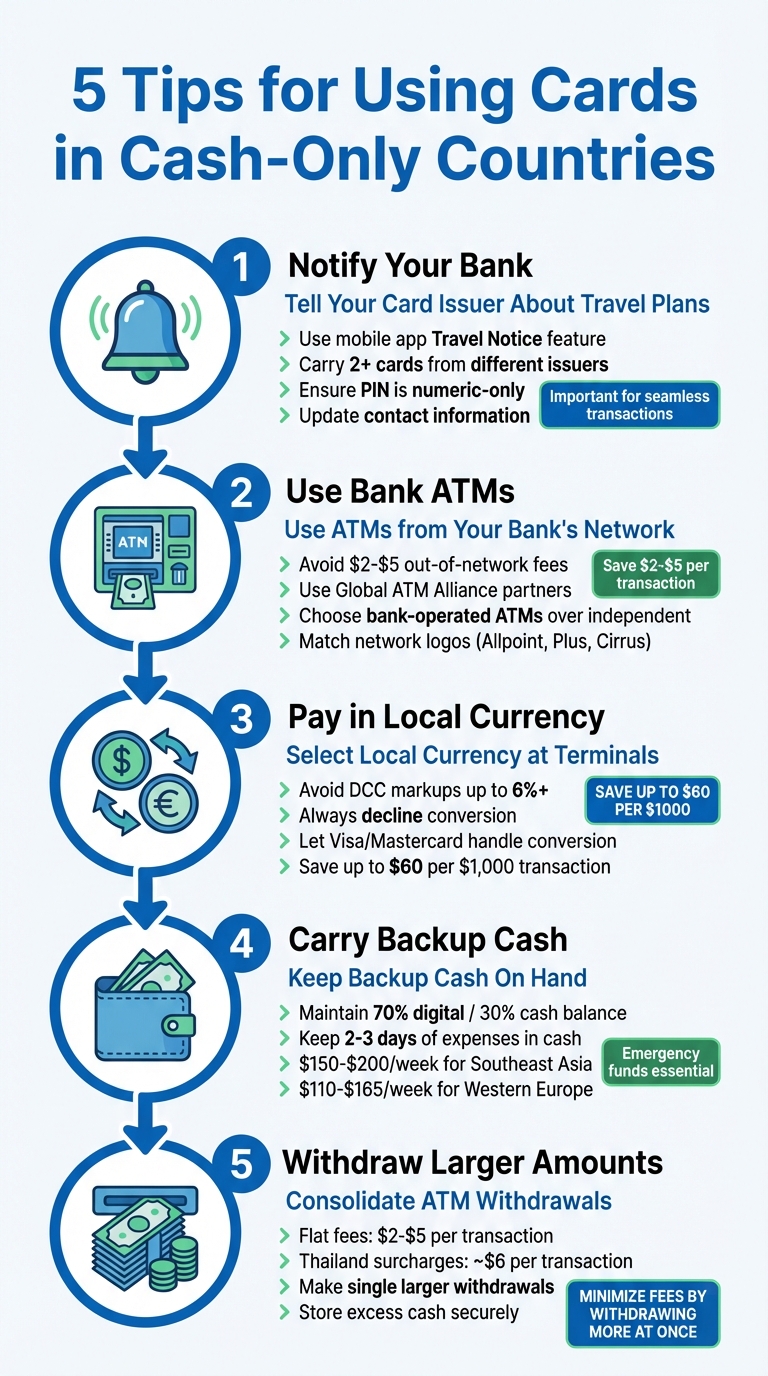
Traveling to a country where cash dominates can be tricky if you rely heavily on cards. Many businesses prefer cash, and card transactions often come with fees or complications. However, with a bit of preparation, you can avoid unnecessary costs and manage payments smoothly. Here are five practical tips:
- Notify Your Bank: Let your card issuer know about your travel plans to avoid freezes or declines. Carry at least two cards from different issuers as a backup.
- Use Bank ATMs: Withdraw cash from ATMs within your bank’s network to minimize fees. Avoid independent ATMs with hidden charges.
- Pay in Local Currency: At ATMs or payment terminals, always choose the local currency to avoid costly conversion fees.
- Carry Backup Cash: Keep some local currency for places that don’t accept cards, like markets or taxis. Store it securely.
- Withdraw Larger Amounts: To reduce ATM fees, make fewer, larger withdrawals instead of multiple small ones.
5 Essential Tips for Using Cards in Cash-Only Countries
How to Handle Credit Cards and Cash During International Trips
sbb-itb-e205081
1. Tell Your Card Issuer About Your Travel Plans
Your bank’s fraud detection system is designed to flag unusual activity – like an unexpected ATM withdrawal in Tokyo or a restaurant charge in Buenos Aires. While this helps protect you from fraud, it can also lead to your card being frozen at the worst possible time. Imagine being abroad and suddenly unable to access cash for food, transportation, or emergencies. To avoid this hassle, it’s a good idea to let your card issuer know about your travel plans in advance.
Many banks make this simple by offering a “Travel Notice” feature in their mobile apps or online banking platforms. If your bank doesn’t provide this option, just call the number on the back of your card and share your travel dates and destinations, including any layovers.
That said, some major issuers like Chase and Capital One no longer require or even accept travel notices. They rely on advanced fraud detection systems and the added security of EMV chip technology. As Chase explains:
“This is considered an outdated practice due to advancements in fraud detection technology”.
Even if your bank doesn’t need a travel notice, make sure your contact information is up to date. This way, they can reach you with alerts or verification requests while you’re abroad.
It’s also smart to carry at least two cards from different issuers as a backup. A Harvard student shared this advice:
“Have at least two credit/debit cards abroad. One of my card accounts was frozen, and I would have been in trouble if I hadn’t had a backup”.
Finally, ensure your card’s PIN is numeric. Many ATMs overseas only accept number-based keypads, so this small detail can save you from unnecessary frustration.
2. Use ATMs from Your Bank’s Network
Choosing the right ATM while abroad can help you avoid unnecessary fees. Using out-of-network ATMs often comes with charges ranging from $2.00 to $5.00, plus an additional 1%–3% foreign transaction fee. In tourist hotspots, these fees can climb even higher – some ATMs in Thailand, for instance, tack on a flat $6.00 per transaction.
To save money, stick to ATMs within your bank’s network or those in a partnership program. Banks like Bank of America, HSBC, and Citibank participate in alliances such as the Global ATM Alliance, which can reduce or even eliminate fees. To locate these ATMs abroad, take advantage of your bank’s locator tools.
Before you travel, plan ahead by using your bank’s ATM locator or Visa/MasterCard tools to identify fee-free machines. If your bank is part of the Allpoint network, which includes over 55,000 ATMs globally, downloading the Allpoint app can make finding nearby locations much easier.
Opt for bank-operated ATMs rather than independent machines. Travel expert Rick Steves offers this advice:
“When possible, withdraw cash from a bank-run ATM located just outside that bank”.
Bank-run ATMs are generally more secure and help you avoid costly Dynamic Currency Conversion (DCC) markups, which can reach up to 13%. Steer clear of standalone ATMs, especially those advertising “no fee” withdrawals, as they often hide extra charges in poor exchange rates and high surcharges.
Check the back of your card for network logos like Allpoint, Plus, or Cirrus. Matching these logos with those displayed on the ATM ensures compatibility and helps you sidestep unnecessary fees.
3. Select Local Currency at ATMs and Payment Terminals
When you’re asked which currency to use at an ATM or payment terminal, always pick the local currency. This small decision can save you from hefty Dynamic Currency Conversion (DCC) fees and poor exchange rates.
While paying in your home currency might seem convenient, it comes with significant downsides. DCC markups can climb as high as 6% or more. For instance, if your hotel bill is $1,000 and you opt to pay in your home currency instead of the local one, you could end up paying an extra $60 in unnecessary charges. This aligns with the earlier advice about steering clear of avoidable fees.
By choosing the local currency, your card network – Visa or Mastercard – handles the conversion, typically applying rates that are much closer to the mid-market rate. As Katy Nastro from Going explains:
“Always select the local currency and ‘deny conversion’ rate so you not only get the local currency’s best rate calculated by your bank, but you also avoid the percentage markup for real-time conversion”.
In simpler terms, this ensures you benefit from your bank’s exchange rate without the added costs of DCC. It’s another way to keep more money in your pocket while traveling.
Always decline conversion if prompted. Some terminals may default to your home currency, so take a moment to review the screen before completing your transaction. Jeff Opdyke, a personal finance expert from International Living, emphasizes:
“When you choose to pay in dollars, you’re allowing the merchant or the merchant’s processing company to choose the exchange rate. And [you are] 1,000 percent guaranteed they are going to choose a rate that is disadvantageous to your bank account”.
In short, paying in the local currency is one of the easiest ways to avoid hidden costs and maximize your travel budget.
4. Keep Backup Cash and Use Cards at Accepting Locations
Even the most dependable cards can fail unexpectedly, so it’s smart to have some backup cash in the local currency. In many cash-heavy countries, cards might not be accepted at places like street food stalls, small corner shops, public transportation, or local markets. Having enough cash on hand to cover 2 to 3 days of incidental expenses is a good rule of thumb.
Experts suggest maintaining a balance of 70% digital payments and 30% cash for flexibility. For instance, if you’re traveling in Southeast Asia, carrying $150–$200 in local currency per week can cover essentials like tuk-tuk rides, street food, and small purchases. In Western Europe, a weekly cash reserve of $110–$165 might suffice for similar expenses.
Be strategic with how you use your cash and cards. Save your cards for transactions with well-established businesses. Major hotel chains like Hilton, Marriott, and Hyatt not only accept cards but often require one for incidentals [31, 32]. Similarly, car rental companies, airlines, upscale restaurants, and large retailers in shopping malls typically accept cards. Using cards at these places often comes with perks like better exchange rates and purchase protection, which cash transactions can’t offer.
However, be aware that in some cash-heavy regions, businesses may tack on a processing fee of 3% to 10% for card payments. In such cases, cash can be the more cost-effective choice.
To minimize risk, distribute your backup cash across different secure locations. Keep some on you for daily use and stash the rest in a hotel safe, money belt, or hidden compartment. This way, you’re prepared without putting all your funds at risk.
5. Withdraw Larger Amounts to Reduce ATM Fees
ATM fees usually come with a flat charge, ranging from $2 to $5 per transaction, no matter how much you withdraw. If you’re making frequent small withdrawals, those fees can add up fast. For example, five $5 withdrawals could cost you an extra $25 in fees alone.
To avoid this, it’s smarter to consolidate your withdrawals. Travel blogger Sarah Going shares her approach:
“If you are dealing with a debit card that charges fees, consider consolidating your ATM withdrawals. I generally try to get all the cash I’ll need for my stay at once (that way, I only pay one ATM fee)”.
Plan ahead, calculate how much cash you’ll need, and make a single, larger withdrawal to cut down on fees.
This tip is especially helpful in countries where ATM fees are high. Take Thailand, for example – ATM surcharges there can reach around $6 per transaction. In some places, like Vietnam, low withdrawal limits (about $125 or 2 million dong) can force you into making multiple transactions, each with its own fee.
That said, carrying large amounts of cash comes with its own risks. Withdraw only what you need for daily expenses and store the rest in a secure location. Balancing security with cost-saving strategies is key to managing your money efficiently while traveling.
For added safety, stick to bank-operated ATMs located in secure, well-lit areas, and always shield your PIN. If your withdrawal limit isn’t enough, contact your bank to request a temporary increase. And don’t forget – keeping your cash safe is just as important as saving on fees.
Conclusion
Traveling to cash-heavy destinations doesn’t mean you have to abandon your cards entirely – it just requires a bit of preparation. Before your trip, take some time to research your destination’s payment landscape. Knowing where cash is essential and where cards are accepted can save you from last-minute stress.
A good approach is to have a “primary and backup” plan. Use a low-fee ATM card as your main source for withdrawing cash, and keep a backup card or some extra cash on hand for emergencies. For bigger expenses like flights or hotels, prioritize using your card. This not only adds a layer of security but also helps you earn rewards. Save cash for smaller, everyday purchases like meals or transportation.
To stay protected, carry two cards and store them in separate places – one with you and the other in a secure spot, like a hotel safe or money belt. This way, if one is lost or compromised, you’ll still have access to funds.
And don’t forget the basics: notify your bank about your travel plans, always choose the local currency when paying with your card, and consolidate ATM withdrawals to cut down on fees. With these strategies in place, you’ll be ready to handle any payment situation with ease and avoid unnecessary expenses.
FAQs
What’s the best way to avoid high ATM fees when withdrawing cash abroad?
If you want to cut down on ATM fees while traveling, look into getting a debit or credit card designed for travelers. Many of these cards waive foreign transaction fees and ATM withdrawal charges, letting you access local currency without the usual 1–3% surcharge or extra fees from overseas banks.
Before heading out, contact your bank to understand any fees that may still apply and let them know about your travel plans to prevent any disruptions. Another tip: withdraw larger sums at once. This way, you can reduce the number of transactions and save more on fees.
Why should I let my bank know about my travel plans?
Letting your bank know about your travel plans can help ensure your credit or debit card works without a hitch while you’re overseas. Many banks rely on automated fraud-prevention systems that flag transactions outside your usual spending patterns – like purchases made in a foreign country – as potentially suspicious. If you don’t notify them in advance, your card might get temporarily blocked, leaving you unable to pay for essentials like meals, lodging, or transportation.
Providing your travel dates and destinations beforehand allows your bank to approve legitimate transactions in those areas while still keeping an eye out for real fraud. Plus, it makes it easier for them to reach you quickly if they spot any unusual activity, saving you time and sparing you unnecessary stress during your trip.
What should I do if my card is declined in a country that mainly uses cash?
If your card gets declined while you’re traveling in a country where cash is king, don’t panic. Start by reaching out to your card issuer’s international support line. Once connected, verify your identity and find out if the problem stems from a fraud alert or restrictions on foreign transactions. Request that they fix the issue or activate your card for international use.
While waiting for the situation to be resolved, turn to a backup payment option. This could be a second card or the emergency cash you’ve tucked away. It’s always smart to have some local currency on hand, especially in places where electronic payments might not be an option.