Flying budget airlines in Europe can save you money – but only if you know the rules. Here’s what you need to know:
- Budget airlines dominate over 60% of Europe’s aviation market, offering fares as low as $11. However, extra fees for luggage, seat selection, and other add-ons can significantly increase costs.
- Top players include Ryanair, easyJet, and Wizz Air. Ryanair focuses on secondary airports for ultra-low fares, easyJet operates from major hubs like London Gatwick, and Wizz Air connects Central and Eastern Europe with affordable pricing.
- Secondary airports keep fares low but may require longer travel times to city centers, potentially offsetting savings.
- Hidden fees are common. For example, Ryanair’s airport check-in fee can reach $60, and Wizz Air charges up to $49 for name corrections.
- Booking early, packing light, and checking in online can help you avoid unnecessary expenses.
Quick Tip: Compare total costs, not just base fares, to find the best deal. Use tools like Skyscanner or services like Flight Booking 247 for real-time price tracking and support.
Low-cost airlines have transformed European travel, but planning ahead is key to keeping your trip affordable.
How To Use Budget Airlines In Europe? – Europe Travel Pros
Top Low-Cost Airlines in Europe
Europe’s budget airline market is bustling with competition, with several major players leading the charge. Each airline has carved out its niche, leveraging distinct strategies to appeal to travelers looking for affordable options. Let’s dive into the key players and what sets them apart.
Ryanair
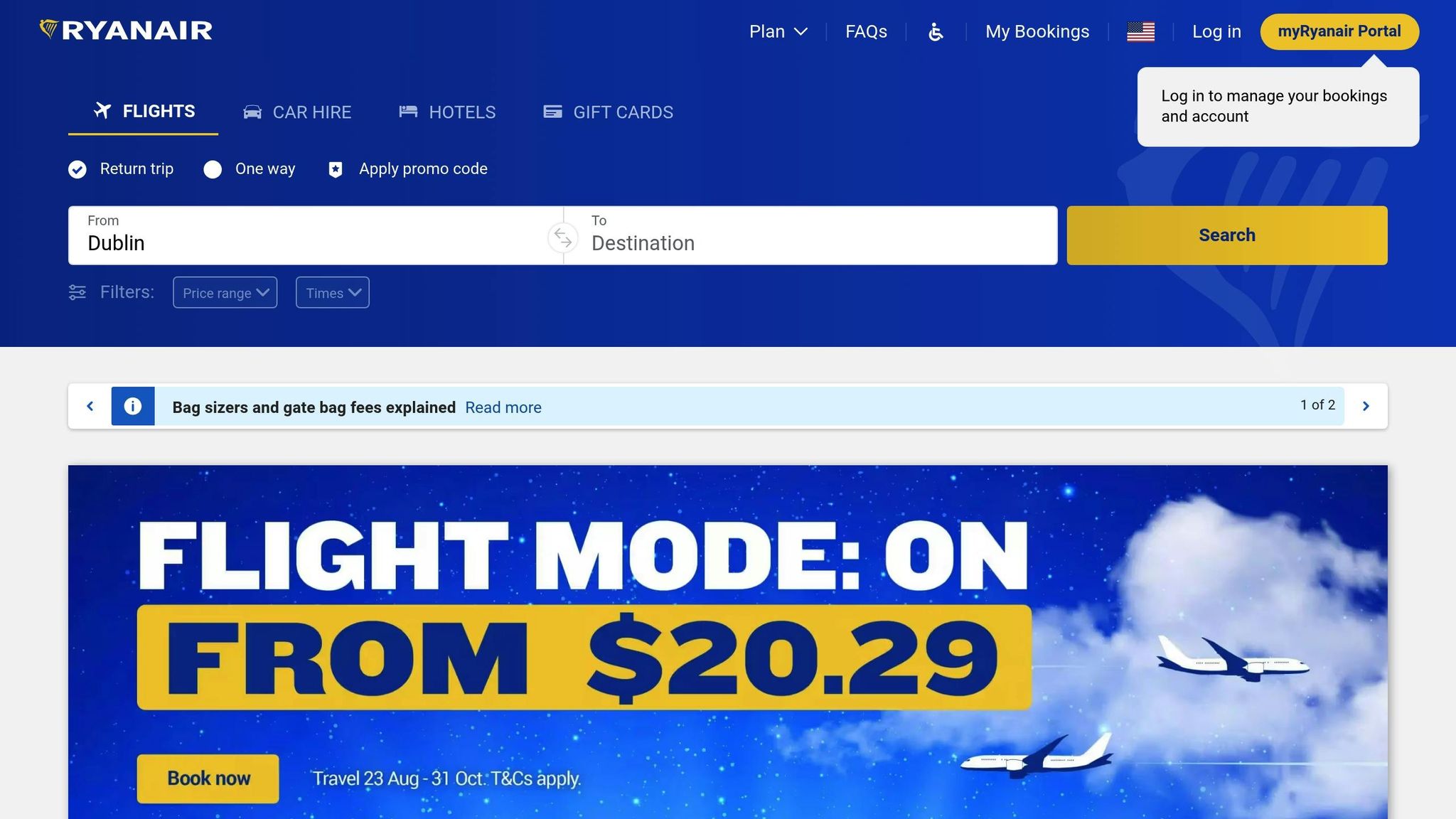
Ryanair holds the title of Europe’s largest low-cost airline. Based in Ireland, this carrier operates a fleet of over 600 planes and transported more than 184 million passengers in 2024. Its extensive network spans 40+ countries, covering Europe, North Africa, and the Middle East.
The airline’s business model revolves around ultra-low fares and the use of secondary airports, which keeps costs low and allows for some of the cheapest ticket prices in the market. Ryanair’s main hubs include Dublin, London Stansted, and Milan Bergamo. Dublin is its busiest hub, offering 185 destinations and boasting a 73% retention rate, followed by London Stansted with 132 destinations (69% retention) and Bergamo with 124 destinations (65% retention).
As of 2021, Ryanair operated out of 84 bases, serving 225 airports across 37 countries with over 2,100 routes. The airline takes inspiration from Southwest Airlines, focusing on quick turnarounds and high aircraft utilization to maximize efficiency.
Ryanair has also introduced a subscription service called Ryanair Prime, priced at $102 annually. Members enjoy perks such as free seat reservations and travel insurance.
“Ryanair has been delivering the lowest fares (and the best services) in Europe for the last four decades, and we’re now extending our price leadership with the launch of our exciting new subscriber discount scheme – Ryanair ‘Prime'”
- Dara Brady, CMO of Ryanair
easyJet
Unlike Ryanair, easyJet focuses on major airports, offering passengers better accessibility to key European cities. Its network spans over 1,000 routes and connects more than 160 airports in 37 countries. Some of its primary hubs include London Gatwick, Milan, Berlin, and Paris (Charles de Gaulle and Orly).
In 2022, easyJet operated an average of 1,335 daily flights, achieving a 70% on-time arrival rate with an average delay of just 21 minutes. The airline continues to expand, announcing 26 new routes for summer 2025, including its first sub-Saharan service to Cape Verde. This new route will launch on March 31, 2025, with flights operating three times a week from London Gatwick.
“We’re proud to be releasing such an incredible range of new routes and package holidays today, providing more choice for customers to visit more of the places they love across Europe and to experience some incredible new destinations. This includes a milestone route for easyJet to beautiful Cape Verde, our first ever sub-saharan service.”
- Ali Gayward, easyJet UK Country Manager
While easyJet’s base fares are higher than Ryanair’s, the airline emphasizes transparent pricing and a smoother customer experience.
Wizz Air
Wizz Air has established itself as a powerhouse in Central and Eastern Europe. With its main hub in Budapest, the airline serves as a bridge between major cities in the region and Western Europe. Known for its competitive pricing, Wizz Air also offers an annual membership for $647, which gives travelers access to select flights for as little as $10.80 each. This appeals to frequent flyers seeking consistent, low-cost travel options.
By focusing heavily on Central and Eastern Europe, Wizz Air has built a strong network and reputation for affordability and connectivity in these regions.
Other Budget Airlines
Beyond the big three, several other airlines add to Europe’s low-cost travel options by focusing on specific regions.
- Vueling: Operating primarily from Barcelona and Rome, Vueling caters to Mediterranean routes and leisure travelers.
- Eurowings: Based in Cologne, Düsseldorf, and Hamburg, Eurowings focuses on key markets within Germany.
- Norwegian: With hubs in Oslo, London Gatwick, and Helsinki, Norwegian specializes in serving the Nordic region.
| Airline | Main Hubs | Regional Focus |
|---|---|---|
| Ryanair | Dublin, London Stansted, Milan Bergamo | Pan-European |
| easyJet | London Gatwick, Milan, Berlin, Paris | Major European cities |
| Wizz Air | Budapest | Central/Eastern Europe |
| Vueling | Barcelona, Rome | Mediterranean |
| Eurowings | Cologne, Düsseldorf, Hamburg | Germany-focused |
| Norwegian | Oslo, London Gatwick, Helsinki | Nordic region |
Each airline’s strategy reflects the dynamic and diverse nature of Europe’s budget airline sector, offering travelers a range of affordable options tailored to different needs and destinations.
Popular Routes and Destinations
Expanding on the earlier discussion about saving money while traveling, let’s dive into how European budget airlines connect travelers to key destinations without hefty price tags. These airlines make it easier than ever to explore Europe, offering hundreds of routes that link major cities and vacation hotspots at impressively low fares.
Major City Connections
Low-cost airlines thrive on connecting Europe’s bustling metropolitan areas, catering to both business and leisure travelers. These city-to-city routes are the backbone of budget airline networks, offering frequent and affordable options.
London stands out as a hub for budget travel across Europe. Airlines like easyJet offer competitive routes from London Luton to destinations like Berlin Brandenburg for $101.48 in July 2025 and Milan Malpensa for $75.79. Even more enticing, flights from Liverpool to Majorca Palma are as low as $29.32 in August 2025.
Manchester also plays a key role, especially for travelers in Northern England. From here, easyJet flights to Munich start at $50.11 in August 2025, while routes to Lanzarote are available from $75.79 in the same month.
Mediterranean destinations continue to draw budget travelers. For instance, flights from Bristol to Rhodes are priced at $61.11 in September 2025, offering access to the Greek islands from smaller UK cities.
The competition among airlines on popular routes – like London to Paris, Madrid to Rome, or Berlin to Amsterdam – keeps fares low and schedules flexible. While these major city routes offer convenience, budget airlines also rely heavily on secondary airports to maintain their low-cost advantage.
Secondary Airports Explained
One of the ways budget airlines keep fares so low is by operating out of secondary airports. These airports charge lower fees, helping airlines cut costs and pass those savings on to passengers. Their simpler setups also mean reduced congestion, fewer delays, and faster turnaround times, allowing airlines to maximize aircraft usage.
However, there are trade-offs. Secondary airports are often located farther from city centers, which can mean longer travel times and additional expenses for ground transportation. Some may also have limited connectivity, making it harder to access your final destination. In cities without secondary airports, budget airlines may avoid operating altogether due to the high fees at primary airports.
The importance of secondary airports has grown significantly over the years. Back in 2001, only nine European airports had low-cost carriers providing 50% or more of available seats. By 2019, the correlation between low-cost carrier traffic and overall airport traffic had risen to 0.69, highlighting how central these airlines have become to European travel.
For savvy travelers, it’s worth researching transportation options from secondary airports before booking. Sometimes, the added cost and time of ground transportation might outweigh the savings on airfare. In such cases, flying into a primary airport might be the better choice.
Interestingly, budget airlines are increasingly operating from primary airports to attract business travelers. Yet, secondary airports remain a cornerstone of their cost-saving strategies. As Sherry, former Director of Route Development at Ryanair and current Aviation Director at Edinburgh Airport, explains:
“The main parameters for route development are costs, demand potential and operational elements.”
Pricing Structure and Hidden Costs
When it comes to European budget airlines, the low fares you see advertised are often just the starting point. While these base prices can be incredibly tempting – sometimes as low as $11 on Ryanair – the final cost can easily double or triple once you factor in necessary add-ons. Knowing how these pricing structures work can help you plan better and avoid those last-minute surprises at checkout. This guide breaks down the components of these costs so you can make smarter booking decisions.
Understanding Base Fares
Budget airlines keep their base fares low through a practice called unbundling. Essentially, the ticket price covers just the flight itself, with everything else – like baggage, seat selection, or even checking in at the airport – offered as optional extras. This strategy can reduce base fares by about 11%. For example, around one-third of easyJet passengers stick to just the fare and a free under-seat bag, skipping any additional services.
Competition also plays a big role. When multiple airlines operate on the same route, fares tend to drop. Interestingly, full-service carriers might even increase their prices if budget airlines control less than 19% of the market. But once low-cost carriers exceed that threshold, full-service airlines start lowering their fares to stay competitive. Other factors, such as flight distance, local economic conditions, and the number of airports serving your destination, also influence base prices.
Kate Sherry, Ryanair’s former Director of Route Development, explained their approach to pricing:
“Ryanair believes more in lowering cost in terms of feeding into profitability than generating fares and ancillary revenue would be considered in the breakeven point analysis.”
How to Avoid Hidden Costs
To keep your travel expenses in check, it’s crucial to understand the fee structures of budget airlines.
- Pack Light: Stick to the free personal item allowance, typically a small bag that fits under the seat. Need more space? Pre-book carry-on or checked baggage online for lower fees. For instance, Ryanair charges $14–$27 for a 10kg bag if booked online, but that jumps to $26–$39 at the airport.
- Check In Online: Avoid fees by checking in online within the airline’s specified timeframe. Ryanair charges up to $60 for airport check-in, while Wizz Air’s fee is around $33. Printing your boarding pass at home or using a mobile app can also save you from airport printing fees, which can climb as high as $60.
- Double-Check Your Booking: Errors can be costly. Ryanair charges up to $126 online and $175 at the airport for name corrections, while Wizz Air charges about $49 for the same service.
- Seat Selection: While airlines charge $5–$50 for seat selection, some carriers, like Ryanair, offer family-friendly policies. For example, one parent may be required to pay a small fee (around $4) to reserve a seat, but the rest of the family can sit together for free.
Airline Comparison Table
Here’s a quick look at how major European budget airlines stack up when it comes to fees:
| Service | Ryanair | easyJet | Wizz Air |
|---|---|---|---|
| Airport Check-in Fee | Up to $60 | Varies by route | $33 |
| Checked Bag (20kg, Online) | $20–$55 | From $8.75 | $9–$104 |
| Checked Bag (20kg, Airport) | $44–$66 | Higher than online | Min $66 (peak season) |
| Name Change Fee | $126 online / $175 airport | Varies | $49 |
| Flight Cancellation | Limited refunds | $38 online / $44 call center | $66 (up to 14 days before) |
| Seat Selection | From $4 | $5–$50 per seat | Varies by route |
| Overweight Baggage | $12/kg | Varies | Varies |
This table highlights how fees can vary widely between airlines, making it essential to calculate your total travel cost before booking.
An easyJet spokesperson summed up their approach:
“easyJet customers only pay for the ancillary products they want so we aim to provide customers with choice and this enables us to keep fares low. Around a third of easyJet’s customers choose to only pay for the fare and free under seat bag without adding any extras.”
Wizz Air, on the other hand, focuses on flexibility:
“As an ultra-low-cost carrier, we allow passengers to choose which services they wish to purchase so we can offer the most affordable travel opportunities in the entire industry.”
Keep in mind, fees can also fluctuate with the season. For instance, Wizz Air’s checked bag prices for a 10kg bag range from $5 to $77 online, while a 20kg bag starts at $66 at the airport during peak season.
Total Cost Matters
A flight that seems like a bargain at first can end up costing more than expected once you add all the extras. For example, a Ryanair ticket priced at $44 rose to $83 after including seat selection and an upgraded carry-on, while an easyJet flight ended up at $76. Don’t forget to factor in other costs, like transportation from secondary airports, before you finalize your booking.
For those who find this process overwhelming, services like Flight Booking 247 (https://flightbooking247.com) offer 24/7 support to help you compare prices in real time and avoid costly mistakes during booking.
Travel Tips for Flying Low-Cost in Europe
Flying with budget airlines in Europe can be a great way to save money, but it requires some planning and smart strategies. From booking early to packing efficiently, these tips will help you make the most of your trip without breaking the bank.
Book Early for the Best Deals
If you’re looking for the lowest fares, booking early is key. Travel expert Rick Steves highlights this in his advice:
“To get the lowest fares, book long in advance. The cheapest seats sell out fast (aside from occasional surprise sales). Note that it is much less expensive to pay baggage fees – and there will be baggage fees – when you book your ticket. Don’t wait until you get to the airport.”
For flights within Europe, the best prices are often found 50 to 101 days before your departure. Budget airlines frequently offer tickets between major European cities for as little as $50 to $250. Timing also matters – flying early to midweek can cut costs by 13% to 20%, while opting for connecting flights instead of nonstop routes can save you up to 25%.
When searching for flights, consider using incognito or private browsing mode to avoid price increases based on your search history. Tools like Skyscanner and Kiwi.com can help you compare options, including baggage fees, so you get a clearer picture of the total cost.
Travel Light
Packing efficiently is a must when flying with budget airlines, as overweight or oversized luggage can lead to hefty fees. Always check the specific size and weight limits for your airline ahead of time, and weigh your bag before heading to the airport.
Streamlining your packing can make a big difference. Fiona Spinks, founder of Following Fiona, shares a simple yet effective tip:
“Rolling each item instead of folding sounds simple, yet it makes a surprising difference. Rolled clothes stack snugly along your case’s length and come out with fewer creases, so you spend less time hunting for an iron at your hotel.”
For casual items, rolling works well, while folding may be better for formal attire. Packing cubes are another great tool – they keep your belongings organized and save space. Additionally, wearing your bulkiest clothes during the flight can free up room in your bag. Spinks also suggests:
“Choose a carry-on case with exterior pockets for items you will need in transit. A book, snacks or the clear liquid bag can live outside the main compartment so you are not opening the whole case in a crowded queue.”
Don’t forget the TSA’s 3-1-1 rule for liquids: each container must be 3.4 oz (100 ml) or smaller, and all containers must fit into a single quart-sized clear bag per traveler. Bringing your own snacks and drinks can also help you avoid overpriced onboard purchases.
Use Flight Booking 247 for Help

Navigating the complexities of budget airlines can be tricky, but having expert support can make the process much smoother. Flight Booking 247 (https://flightbooking247.com) offers round-the-clock assistance for booking, changing, or canceling flights. Their travel concierge service can be especially helpful when dealing with low-cost carriers’ fee structures.
Consider this: revenue from additional airline services skyrocketed to about $103 billion last year, compared to $40 billion in 2013. Meanwhile, hidden fees cost travelers an estimated $1.6 billion annually. With expert guidance, you can compare total costs across airlines and find the best time to book. Flight Booking 247 also provides real-time deal tracking, so you don’t have to spend hours monitoring prices yourself. Their support can be invaluable if you need to adjust your plans or navigate complicated airline policies.
Making the Most of Low-Cost Airlines
Low-cost airlines have transformed travel in Europe, offering affordable ways to visit multiple countries without stretching your budget. To truly benefit from these options, a bit of planning and flexibility can go a long way.
Timing is everything when it comes to saving money. This summer, airfares have dropped by 10%, with the average ticket costing $817 compared to $892 last year. Flying during off-peak seasons or midweek – like on a Tuesday or Wednesday – can save you as much as $179 per ticket on flights to Europe.
Flexibility in your travel plans can also lead to big savings. For example, consider flying into alternative airports such as Dublin or Brussels, which often have cheaper fares. From there, you can use regional budget airlines or trains to reach your final destination. A one-way flight from London to Amsterdam with a budget carrier might cost as little as $50, compared to over $200 on major airlines. Adjusting your route slightly could save you hundreds.
Understanding how low-cost airlines operate can help you avoid unexpected expenses. For example, planning ahead by checking in online, measuring your luggage carefully, and reviewing fee structures can prevent surprise charges. Airlines have increasingly relied on revenue from extra services, which grew from $40 billion in 2013 to $103 billion last year. Being prepared can save you from adding to that total.
If navigating these details feels overwhelming, expert help is available. Services like Flight Booking 247 (https://flightbooking247.com) offer 24/7 assistance to help you compare costs, avoid common mistakes, and find the best deals in real-time. Their travel concierge service can be especially helpful if you need to make last-minute changes or understand complex fee policies.
Finally, remember to account for additional costs like seat selection, which typically ranges from $3 to $33. With a little preparation and the right strategies, low-cost airlines can make exploring Europe affordable and accessible, opening doors to adventures that might have seemed out of reach not long ago.
FAQs
How can I avoid extra charges when flying with budget airlines in Europe?
To avoid extra fees when flying with European budget airlines, start by checking the airline’s rules on baggage, seat selection, and other potential charges before buying your ticket. Many low-cost carriers have fees for checked luggage, so it’s smart to travel light and stick to carry-on bags that meet the airline’s size and weight restrictions.
When making your booking, skip add-ons like priority boarding or travel insurance unless they’re absolutely necessary. Another tip: book directly on the airline’s website to sidestep additional charges from third-party platforms. Lastly, double-check your booking details and get to the airport early to avoid any penalties for last-minute changes or missed check-in deadlines.
What are the pros and cons of flying with budget airlines to smaller airports in Europe?
Flying into smaller, secondary airports with budget airlines can be a smart move for those looking to save money. These airports often come with lower ticket prices because of reduced airport fees and less congestion. Plus, they tend to be less crowded, which can make check-ins quicker and the overall travel experience less stressful.
That said, there are a few things to keep in mind. Secondary airports are usually located farther from city centers, which can mean longer transfer times and possibly higher transportation costs to reach your destination. On top of that, these airports might not offer as many amenities – think fewer dining options or lounges. And don’t forget, budget airlines often tack on extra fees for things like checked bags or choosing your seat. Make sure to weigh these factors when planning your trip to avoid any unexpected costs or inconveniences.
What is Ryanair Prime, and what perks does it offer?
Ryanair Prime: A Subscription for Frequent Flyers
Ryanair Prime is a yearly membership tailored for travelers who frequently fly with Ryanair and want to save money while adding a touch of convenience to their trips. For just $79 a year, members unlock a range of perks, including free reserved seating, complimentary travel insurance, and access to 12 exclusive seat sales every year.
If you’re someone who often books with Ryanair, this membership can help you trim costs on flights and seat selections, all while enjoying a few added benefits to make your journeys smoother.