
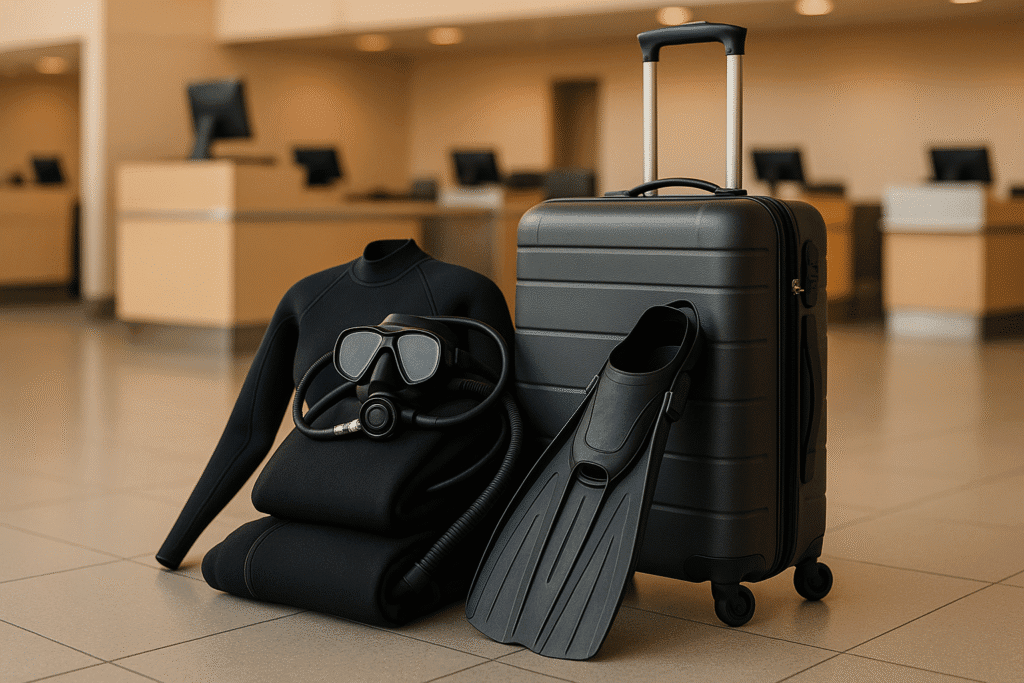
Planning a scuba diving trip? Knowing airline fees for scuba gear can save you money and headaches. Airlines classify scuba equipment differently – some treat it as standard baggage, while others charge extra for oversized sports gear. Here’s a quick breakdown:
- Alaska Airlines: Scuba gear counts as regular checked baggage. Affordable domestic option.
- American Airlines: Standard baggage fees apply, but weight/size limits could mean extra charges.
- Delta Air Lines: No extra fees for scuba gear; treated as standard baggage. Loyalty perks may waive fees.
- Air Canada: Sports gear policies apply. Fees vary by route; good for Caribbean/Central America trips.
- Turkish Airlines: Requires advance reservation for scuba gear. Fees depend on route and gear size.
Key Tip: Always check airline policies before your trip to avoid surprises, especially for items like tanks and dive knives.
1. Alaska Airlines
If you’re flying with Alaska Airlines and need to bring scuba diving gear, you’re in luck – they allow it as checked baggage. Just make sure your equipment is packed securely in a case specifically designed for diving gear, whether it’s soft-sided or hard-sided. It’s also a good idea to double-check their current baggage policies before your trip to avoid any surprises.
2. American Airlines
American Airlines allows scuba diving equipment to count as standard checked baggage. The fees and restrictions depend on your flight type, route, and travel class. If you have elite status or use certain credit cards, you might qualify for extra baggage allowances. To avoid surprises, it’s always a good idea to check the fee details before heading to the airport.
Fee for Scuba Gear
Scuba gear is subject to the same fees as standard checked baggage. These fees are consistent across both domestic and international flights. Be sure to review the airline’s latest fee schedule before your trip to stay prepared.
Weight and Size Limits
American Airlines has specific weight and size limits for all checked baggage. If your scuba gear goes over these limits, you may face additional charges for overweight or oversized items. To avoid unexpected costs, measure and weigh your equipment ahead of time.
Special Conditions
When traveling with scuba diving equipment, there are a few rules to keep in mind. Compressed air tanks must be empty before check-in. Dive knives should always go in your checked luggage, not your carry-on. And for items like dive computers or cameras, it’s best to keep them in your carry-on to prevent damage or loss.
3. Delta Air Lines
In 2019, Delta made a welcome change by removing the $150 specialty sports bag fee for scuba gear purchased on or after July 17. Now, scuba equipment is treated as standard checked baggage.
Fee for Scuba Gear
Delta doesn’t charge a separate fee for scuba gear. Instead, it falls under their regular checked baggage policy. For domestic flights within the U.S., the cost is $35 for the first checked bag and $45 for the second bag if you’re flying in Delta Comfort or Delta Main and don’t have elite status.
Fees vary for international flights, depending on your route and ticket type. However, if you’re a Delta SkyMiles Medallion Member or have certain Delta SkyMiles American Express cards, you can check your first bag for free – including your scuba gear.
Make sure to review Delta’s baggage guidelines to confirm your gear complies with their weight and size requirements.
Weight and Size Limits
Delta has specific size and weight restrictions for all checked baggage, including scuba equipment. Your gear must weigh 50 lbs (23 kg) or less and measure no more than 62 linear inches (length + width + height). If you’re flying Delta One or Delta First, you’re allowed up to 70 lbs (32 kg) before overweight fees apply.
If your gear exceeds these limits, expect to pay for overweight or oversized baggage. To avoid unexpected charges, weigh and measure your equipment before heading to the airport.
Special Conditions
Certain pieces of scuba equipment require extra attention. Scuba tanks must be completely empty, with the regulator valve disconnected to comply with TSA regulations. The tank must also have an opening for visual inspection by security.
Battery-powered dive lights need special handling as well. Underwater torches measuring 7 inches (18 cm) or shorter can be carried on, while longer ones must be checked. Additionally, dive knives and other sharp tools should always go in your checked luggage.
If you’re unsure about any additional fees or restrictions, it’s a good idea to check with a Delta agent at the gate before your flight.
4. Air Canada
Air Canada, like many major airlines, has specific rules when it comes to transporting scuba diving equipment. Classified under sports gear, scuba equipment is subject to particular baggage policies. These include fees, weight and size restrictions, and handling procedures, which can differ depending on whether you’re flying domestically or internationally. If you’re an elite member, you might enjoy more favorable terms. It’s always a good idea to double-check Air Canada’s latest guidelines before your trip. Much like policies from Alaska Airlines, American Airlines, and Delta, comparing fees ahead of time can save you from unexpected surprises.
5. Turkish Airlines

Turkish Airlines has specific rules when it comes to traveling with diving equipment. To ensure everything is handled smoothly, passengers are required to make a reservation for their scuba gear in advance. Additionally, they must provide details about the size of the equipment so it can fit within the aircraft’s limitations. These steps can affect how fees are calculated and how the gear is managed during transit.
Fee for Scuba Gear
Scuba gear is typically allowed as checked baggage on Turkish Airlines. However, the fees depend on factors like the flight route and the size of the equipment. To avoid surprises, it’s best to check the airline’s official baggage policy or reach out to their customer service for the latest details.
Special Conditions
Turkish Airlines also has specific packing rules for scuba equipment. Items like cylinders, buoyancy vests, underwater flashlights, and harpoons must meet their guidelines. Failing to follow these rules – or neglecting to reserve or declare your gear’s size – could result in delays at check-in or even a refusal to check in the equipment. Always double-check the requirements to ensure a hassle-free experience.
Pros and Cons
When organizing your dive trip, managing fees and equipment logistics is crucial. Each airline has its own rules for handling sports gear, so let’s break down the benefits and drawbacks of several carriers when it comes to transporting scuba equipment.
| Airline | Pros | Cons |
|---|---|---|
| Alaska Airlines | – Affordable fees for sports equipment – Clear weight guidelines – Strong West Coast domestic network |
– Limited international routes – May require connections for East Coast travel – Possible size restrictions |
| American Airlines | – Extensive domestic and international coverage – Loyalty program benefits – Clear, consistent policies |
– Higher fees on certain routes – Complex fee structure – Less flexibility for oversized gear |
| Delta Air Lines | – Reliable sports equipment handling – Wide global network – Known for quality service |
– Higher costs – Requires advance notice for some items |
| Air Canada | – Good access to Caribbean and Central American dive spots – Reasonable international fees |
– Currency exchange complications for U.S. travelers – Varying customs processes – Limited U.S. domestic routes |
| Turkish Airlines | – Connects to diverse dive locations through Istanbul – Advance reservations ensure space |
– Requires early booking – Complicated size declaration process |
This table highlights the key considerations for selecting an airline to make your scuba trip as seamless as possible.
Conclusion
After a thorough review, it’s clear that picking the right airline for your scuba diving trips can make a big difference in keeping costs down and ensuring a smooth journey. The decision really hinges on balancing cost, convenience, and the destinations you plan to visit.
Alaska Airlines is a solid choice for domestic travelers on a budget, thanks to its straightforward weight guidelines. However, international trips may require additional connections. American Airlines and Delta shine with their extensive route networks and added perks – Delta stands out for its reliable handling of equipment, while American’s loyalty program offers attractive benefits. For those diving in the Caribbean or Central America, Air Canada is a practical option, though you’ll need to account for currency exchange rates. Meanwhile, Turkish Airlines is ideal for adventurous divers heading to the Mediterranean or Red Sea, but early planning and careful attention to baggage size requirements are essential.
To avoid unexpected fees, it’s important to match your travel habits and destinations with the airline’s policies. If you’re an occasional diver, Alaska Airlines’ low fees and simple rules are likely your best bet. For frequent dive travelers, American and Delta offer the convenience of broad networks and loyalty perks. For global diving enthusiasts, Turkish Airlines’ worldwide reach is worth the added effort in planning.
Be sure to review each airline’s specific policies – covered in detail above – to ensure your next dive trip is both cost-effective and hassle-free.
How Flight Booking 247 Can Help

Planning a dive trip involves more than just finding the cheapest flight – it’s about understanding every detail, especially when it comes to airline baggage fees and policies for your scuba gear. That’s where Flight Booking 247 steps in with their round-the-clock travel concierge service.
With their 24/7 support, you can connect with live operators who’ll help you navigate flight options and airline policies, ensuring you’re fully informed about baggage fees and any restrictions. Instead of spending hours comparing fees yourself, their specialists handle the search in real time, giving you a clear picture of your total travel costs.
For international trips, they go the extra mile by breaking down currency conversions, explaining differences in baggage allowances, and alerting you to last-minute promotions. This means you can plan your journey with confidence, knowing you have the most accurate and up-to-date information at your fingertips.
One of their standout features? A no hold time guarantee. Whether you’re booking months ahead or dealing with last-minute changes, you’ll get immediate assistance to adjust your travel plans without delays – perfect for the unpredictable nature of dive trip schedules.
FAQs
How can I pack my scuba gear to meet airline weight and size limits and avoid extra fees?
To sidestep extra fees, make sure to review your airline’s baggage policies regarding weight and size limits. Most airlines typically allow checked luggage to weigh up to 50 pounds with a total linear dimension of 62 inches. If you’re traveling with sporting equipment like scuba gear, some airlines might have specific allowances, so it’s worth confirming these details ahead of time.
When packing your scuba gear, opt for a sturdy yet lightweight dive bag that complies with the airline’s size restrictions. Weigh your packed bag at home to ensure it stays within the weight limit. If it’s over, consider removing non-essential items or splitting heavier gear across multiple bags. A little preparation can save you both time and unexpected charges at the airport.
How can I reserve space for my scuba gear in advance with Turkish Airlines?
If you’re planning to bring scuba gear on your Turkish Airlines flight, you’ll need to provide some essential details: your flight number, travel date, booking class, route, and ticket number. You can make reservations for sports equipment, including scuba gear, as early as 355 days before your flight and up to two hours before departure. The airline’s online booking system makes it easy to secure space for your gear within this window.
Booking early is a smart move – it helps guarantee availability and avoids any last-minute complications.
Can loyalty programs or airline credit cards help reduce baggage fees for scuba gear on airlines like American and Delta?
If you’re a scuba diver looking to save on baggage fees, loyalty programs and airline credit cards can be a game changer. Many airline credit cards, like those from Delta or American Airlines, offer perks such as a free first checked bag. This benefit alone can save you up to $70 per flight.
Frequent flyers with elite status in airline loyalty programs also enjoy additional baggage allowances, which can significantly cut down costs when traveling with scuba gear. Considering airlines in the U.S. typically charge $35–$70 per checked bag on domestic flights, these perks can make a big difference for divers hauling their equipment.