Missed a flight or faced a long delay? You could be entitled to up to $660 in compensation under EU Regulation 261/2004. Here’s what you need to know:
- Who qualifies? Flights departing from EU airports or arriving in the EU on EU-based airlines, with delays of 3+ hours.
- Compensation amounts:
- $275 for flights under 930 miles.
- $430 for flights 930–2,175 miles.
- $660 for flights over 2,175 miles.
- What’s covered? Meals, drinks, accommodation for overnight delays, and refunds for delays over 5 hours.
- Exceptions: Airlines are not liable for delays caused by extraordinary circumstances like severe weather or airport staff strikes.
- How to claim: Gather documents (boarding pass, receipts, delay proof), verify eligibility, and submit a claim to the airline.
Knowing your rights can help you get the compensation you deserve. Keep reading for a detailed breakdown of eligibility, claim steps, and tips for success.
How I got 600€ for a delayed flight (Step by Step) – EC261 Compensation
What is EU Regulation 261/2004
EU Regulation 261/2004, often referred to as EU261, is a European Union law designed to protect air passengers when their travel plans are disrupted. It establishes passengers’ rights in cases of flight delays, cancellations, or denied boarding. Essentially, the law ensures that travelers are treated fairly and compensated when disruptions fall under the airline’s responsibility. For example, EU261 mandates compensation if a delay or cancellation causes passengers to arrive at their final destination more than three hours later than planned. This regulation primarily aims to address the inconvenience and lost time caused by significant travel interruptions.
Which Flights Are Covered
The scope of EU261 depends on where the flight departs from, where it lands, and the airline operating it.
- Flights departing from an EU airport are covered, no matter which airline operates them.
- Flights arriving in the EU are only covered if they are operated by an EU-based airline. Non-EU airlines landing in the EU are generally excluded unless the disruption occurs during the EU leg of a connecting flight booked under a single reservation.
Additionally, the regulation extends its coverage to flights to or from Iceland, Norway, and Switzerland. In rare cases, EU261 might even apply to certain domestic flights in the United States if they are part of an itinerary originating in the EU. For codeshare flights, passengers should confirm eligibility by checking with the operating airline.
When Compensation Does Not Apply
There are exceptions to EU261’s compensation rules. Airlines are not obligated to pay compensation when disruptions result from “extraordinary circumstances” – events beyond their control that could not have been avoided even with reasonable precautions . However, even under these circumstances, airlines must still provide passengers with meals, accommodations, and assistance with rebooking.
Examples of extraordinary circumstances include:
- Severe weather that makes flying unsafe
- Strikes unrelated to the airline, such as those by airport staff, air traffic control, or border security
- Acts of terrorism or sabotage
- Security threats
- Political or civil unrest
- Hidden manufacturing defects requiring the grounding of an aircraft fleet
Situations that typically do NOT qualify as extraordinary circumstances:
- Most technical issues that arise during maintenance or from failure to maintain the aircraft
- Collisions with mobile boarding stairs
- Strikes by airline staff (internal disputes)
“If you are not sure whether extraordinary circumstances apply to your flight, but have read about your other rights and think you might have a case, you can make a claim to your airline for compensation. The airline should explain to you the reason for the disruption. If they consider it was due to extraordinary circumstances they will need to clearly set out why. If they reject your claim then you can consider whether to pursue it further.” – UK Civil Aviation Authority
When airlines deny claims based on extraordinary circumstances, they must provide clear explanations. If you’re uncertain about your eligibility, it’s worth submitting a claim, as the airline is required to prove why compensation should not be granted.
Next, we’ll break down who qualifies for these compensations and under what conditions.
Who Can Claim Compensation
Not all flight delays qualify for compensation under EU261. To determine eligibility, passengers must meet specific criteria related to timing, distance, and the circumstances of the delay. Let’s break it down.
Delay Time and Flight Distance Requirements
To qualify for compensation, your flight must arrive at its final destination at least three hours late. This rule applies regardless of how long the delay was at departure. For instance, if your flight was delayed by four hours at takeoff but arrived only two hours late, you wouldn’t be eligible.
The compensation amount depends on the distance of your flight, measured in kilometers. Here’s the breakdown:
| Flight Distance | Compensation Amount |
|---|---|
| Up to 1,500 km (932 miles) | €250 (~$270) |
| 1,500 – 3,500 km (932 – 2,175 miles) | €400 (~$430) |
| Over 3,500 km (2,175 miles) | €600 (~$650) |
These amounts are fixed and don’t depend on your ticket price. Whether you booked a budget fare or paid full price, you’re entitled to the same compensation if you meet the eligibility requirements.
Additionally, you must have a confirmed reservation and check in at least 45 minutes before departure, unless your airline specifies otherwise on your ticket or in their communications.
Eligible vs Non-Eligible Situations
Your nationality doesn’t affect your eligibility under EU261 – this regulation applies to all passengers, regardless of where they’re from. However, there are a few exceptions. Tickets purchased through special discounts, such as employee perks, don’t qualify, but frequent flyer award tickets do.
While meeting the delay and distance criteria is essential, other factors play a role. For example, a passenger traveling from Frankfurt to New York faced a five-hour delay and arrived more than three hours late. The airline initially denied compensation, citing “operational issues.” However, since operational issues don’t count as extraordinary circumstances, the passenger was entitled to €600 (~$650). After legal action, the court ruled in the passenger’s favor.
Some situations disqualify passengers from compensation, even if their flight is delayed. For instance, you won’t be eligible if:
- You’re denied boarding due to health, safety, or security reasons.
- You lack valid travel documents.
- You miss a connecting flight because of delays at security checks or failure to board on time at a transfer airport.
The airline’s explanation for the delay is also critical. Extraordinary circumstances, such as severe weather or air traffic control strikes, can exempt airlines from paying compensation. However, airlines must prove these conditions applied.
For instance, in a 2022 case involving TAP Portugal, the European Court of Justice ruled that the death of a pilot scheduled to operate a flight did not qualify as an extraordinary circumstance. The court stated that staff absences are part of the airline’s normal operations.
Why Many Passengers Don’t Claim
Although nearly one in five flights is delayed, only 55% of eligible passengers file claims. Many travelers are unaware of their rights or assume the process is too complicated to navigate. Understanding these rules is crucial to ensure you don’t miss out on compensation you’re entitled to receive.
How to Claim Your Compensation
Filing a compensation claim under EU261 requires careful attention to detail and proper documentation. Here’s how you can navigate the process step by step.
Step 1: Gather Your Documents
Start collecting all relevant documents as soon as your flight delay happens. These include:
- Boarding passes
- Ticket confirmation or travel itinerary
- Written confirmation from the airline explaining the delay (ask airline staff at the airport)
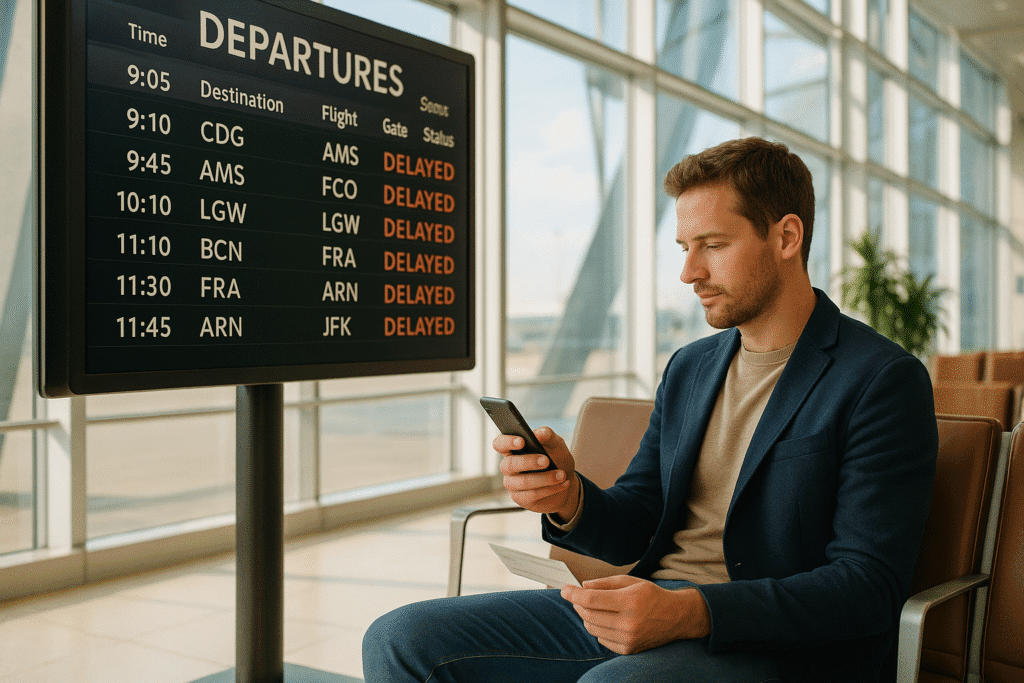
Keep receipts for any unexpected expenses and save all communications with the airline, such as emails, text messages, or letters. If you speak with airline representatives over the phone, jot down the date, time, and names of the individuals you spoke with. Photos of departure boards showing the delay or crowded gate areas can also strengthen your case. If other passengers were also affected, consider asking for their contact details or written accounts of their experience. Once all this is in hand, check if your situation qualifies under EU261.
Step 2: Verify Your Eligibility
Confirm that your flight meets the requirements for compensation under EU261. You’ll need details like your flight number, departure and arrival airports, as well as the scheduled and actual times. This information helps establish your claim. If you’re unsure, ask the airline for a detailed explanation of the delay’s cause. Verifying these details is a critical step before moving forward.
Step 3: Submit Your Claim to the Airline
Reach out to the airline’s customer service through their official website or a dedicated compensation portal. Many airlines offer specific forms for EU261 claims, making it easier to submit your request. Include all necessary documents and provide a clear, factual account of the situation. Be sure to note any claim reference numbers for tracking purposes. While some airlines respond quickly – within 24 to 48 hours – others may take up to a week. Don’t be discouraged if your claim is initially denied; airlines sometimes reject valid claims, hoping passengers won’t pursue them further.
Step 4: Follow Up and Escalate If Needed
Airlines typically respond within six to eight weeks. If you haven’t received a reply after two months, send a follow-up email referencing your original claim number. Persistence is key. If the airline rejects your claim and you believe it’s valid, consider escalating the matter. You can contact your country’s aviation enforcement authority for assistance. In the United States, for example, you can file a complaint with the Department of Transportation if you feel entitled to a refund or compensation. Keep detailed records of all correspondence – dates, claim numbers, and any explanations provided – as they’ll be crucial if further action is needed. For itineraries involving connecting flights or multiple airlines, you may need to file separate claims for each segment of your journey.
Compensation Amounts and Other Rights
Now that you understand eligibility and the steps for filing a claim, let’s dive into the potential compensation amounts and additional rights you’re entitled to.
Payment Amounts by Flight Distance and Delay
Under EU Regulation 261/2004, the compensation you may receive is tied to the distance of your flight and the length of the delay at your final destination. Depending on these factors, passengers could receive a fixed amount ranging from €250 to €600 per person, provided the delay meets specific requirements.
Here’s a breakdown of compensation tiers:
| Flight Distance | Required Delay for Compensation | Compensation Amount |
|---|---|---|
| Up to 930 miles (up to 1,500 km) | 3+ hours | €250 (≈$270) |
| 930–2,175 miles (1,500–3,500 km) | 3+ hours | €400 (≈$430) |
| Over 2,175 miles (over 3,500 km) | 4+ hours | €600 (≈$650) |
For example, if your transatlantic flight from New York to London is delayed by 4 hours or more, you could qualify for €600. On the other hand, a shorter flight – like Boston to Toronto – would typically fall into the €250 compensation range.
One key detail to keep in mind: if the airline re-routes you and manages to get you to your destination within specific time limits, they can reduce the compensation amount by 50%.
Beyond monetary compensation, EU261 also requires airlines to provide certain essential services to passengers during significant delays.
Additional Passenger Services
When delays stretch on, airlines are obligated to help ease passenger inconvenience by offering essential services. Here’s what you can expect based on the delay duration and flight distance:
- Meals and Refreshments: Airlines must provide food and drinks when delays exceed certain thresholds:
- For flights up to 930 miles (1,500 km): after a 2-hour delay.
- For flights between 930 and 2,175 miles (1,500–3,500 km): after a 3-hour delay.
- For flights over 2,175 miles (over 3,500 km): after a 4-hour delay.
- Overnight Delays: If your delay requires an overnight stay, the airline must arrange hotel accommodations and provide transportation to and from the hotel. If they don’t organize this directly, you’re entitled to reimbursement for reasonable expenses.
- Communication Options: Airlines are required to offer at least two free communication methods, such as phone calls or emails, so you can inform family or others of your situation.
These rights ensure that even during long delays, passengers are supported with basic necessities and can stay connected.
How Flight Booking 247 Can Help

Flight delays can throw your plans into chaos, and quick action is essential. That’s where Flight Booking 247 steps in, offering round-the-clock access to travel experts who are well-versed in EU Regulation 261/2004. Whether you’re dealing with urgent flight issues or need help navigating a compensation claim, their team is ready to assist.
Real-Time Help for Flight Disruptions
Flight delays, cancellations, or sudden schedule changes can happen at any time, leaving you scrambling for answers. With 24/7 real-time support, Flight Booking 247 ensures you’re never left in the dark. Their team provides up-to-date information and assistance, no matter the hour, helping you handle rebookings or cancellations swiftly.
Expert Guidance on Compensation Claims
Flight Booking 247 doesn’t just stop at solving immediate travel problems – they also simplify the often-confusing process of filing for compensation under EU Regulation 261/2004. From helping you gather the necessary documents to clarifying eligibility requirements, their experts make the process smoother.
If your initial claim hits a roadblock or takes too long, they’ll guide you on the next steps to keep things moving. This hands-on, step-by-step support helps ensure you’re well-informed and increases your chances of receiving the compensation you deserve.
With a combination of quick problem-solving and thorough claim assistance, Flight Booking 247 proves to be an essential resource for travelers facing flight disruptions.
Know Your Rights and Act
Under EU Regulation 261/2004, you have specific rights when your flight is delayed. This regulation outlines protections and compensation amounts ranging from €250 to €600 (about $275 to $650), depending on the flight distance. Knowing this can help you take immediate action if your travel plans are disrupted.
Start by gathering all evidence related to your delay. Save digital notifications, boarding passes, and receipts for any extra expenses like meals, transportation, or accommodations. These records are essential if you need to file a compensation claim later on.
If your delay exceeds 2 hours, airlines are required to provide written notice of your rights. Don’t hesitate to inform airline staff about your situation to avoid unnecessary costs.
When it’s time to file a claim, begin with the airline’s complaint form. If they fail to respond within two months or reject your claim unfairly, escalate the matter to the appropriate national authority. Airlines may initially deny valid claims, but persistence often pays off.
Keep in mind that while you typically have several years to file a claim, acting promptly can speed up the resolution process. EU261 protections also extend beyond EU borders, covering flights to and from Iceland, Norway, and Switzerland, as well as flights operated by European airlines or non-EU carriers that meet the criteria.
FAQs
What can I do if my airline says the delay was due to extraordinary circumstances?
Under EU Regulation 261/2004, airlines are not obligated to compensate passengers for delays caused by extraordinary circumstances. These are situations beyond the airline’s control, such as severe weather, security threats, or air traffic control strikes.
If you think the airline’s explanation doesn’t hold up, you can ask them to provide detailed evidence of the situation. Should their response still seem unsatisfactory, you have the option to escalate your case to the appropriate passenger rights authority or consult legal advice. Make sure to stay persistent and keep all relevant documentation handy – this includes your flight details and records of the delay – to strengthen your case.
What steps can I take to make sure my EU 261/2004 flight delay compensation claim is accepted?
To make sure your EU 261/2004 flight delay compensation claim goes through smoothly, start by checking if your flight arrived more than 3 hours late and was operated by an EU-regulated airline. The flight should either have departed from or landed at an EU airport. Once you’ve confirmed this, gather the key documents you’ll need: your boarding pass, evidence of the delay, and receipts for any extra expenses caused by the delay.
Keep in mind that airlines may reject claims if the delay was due to extraordinary circumstances like severe weather or natural disasters. Also, don’t wait too long – claims must be submitted within 3 years of the flight date. By meeting these requirements and submitting all the necessary paperwork, you can improve your chances of a successful claim.
What are some tips to speed up the process of claiming flight delay compensation under EU regulations?
To get your compensation claim processed faster under EU 261/2004, start by collecting solid evidence of the delay. This includes items like your boarding pass, proof of how long the delay lasted, and any communication you received from the airline about the situation. Once you have everything, submit your claim promptly using the official EU Passenger Rights form, making sure all required documents are included.
Staying organized can make a big difference. Keep track of all relevant records and follow up with the airline regularly to check on the status of your claim. If you’re unsure about any part of the process, you might want to consult a travel service or a professional who can help ensure everything is done correctly.