When traveling internationally, knowing duty-free rules can save you from unexpected fees. Here’s what you need to know:
- General Allowance: U.S. residents can bring back up to $800 worth of goods duty-free. This increases to $1,600 when returning from U.S. territories like Guam or the U.S. Virgin Islands.
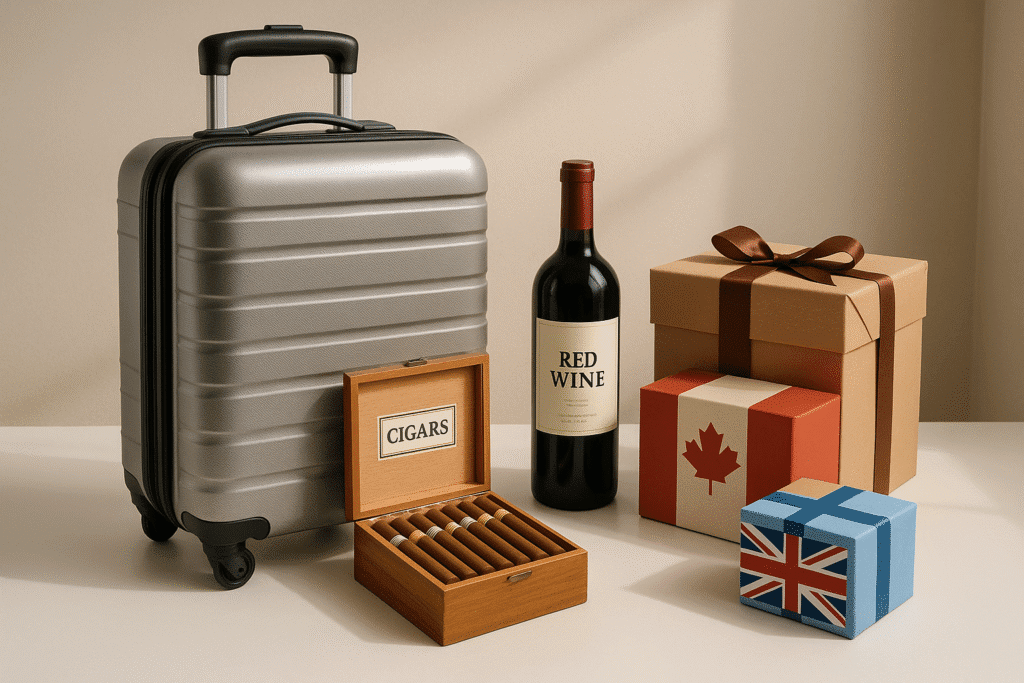
- Alcohol: You can bring 1 liter duty-free (if you’re 21 or older). Travelers from U.S. territories may bring up to 5 liters, with conditions.
- Tobacco: The standard limit is 200 cigarettes and 100 cigars. Travelers from U.S. territories can bring up to 1,000 cigarettes.
- Gifts: Gifts up to $800 count toward your exemption. Items like alcohol and tobacco have separate limits.
- Exceeding Limits: If you go over, the first $1,000 above your exemption is taxed at 3%. Additional taxes vary by item.
Always declare your items, even if unsure. Using tools like the Mobile Passport Control app can simplify the customs process. For smooth travel, keep receipts and check local and federal rules before your trip.
U.S. Customs and Duty-Free Allowances: Everything You Need To Know
1. Alcohol Limits
If you’re a U.S. resident aged 21 or older returning from an international trip, you can generally bring back one liter of alcohol duty-free. This applies to all types of alcoholic beverages – wine, beer, spirits, or liqueurs – as long as it’s for personal use. However, make sure to check the alcohol laws in your destination state, as they can vary. For travelers under 21, importing alcohol is strictly prohibited, even as a gift.
Enhanced Allowances for Certain Locations
Travelers returning from U.S. insular possessions, like the U.S. Virgin Islands, American Samoa, or Guam, enjoy a larger allowance. Under a $1,600 exemption, you can bring back up to five liters of alcohol duty-free – provided that four liters were purchased locally and one liter is a locally made product. Similarly, if you’re coming from eligible Caribbean Basin countries, the duty-free limit increases to two liters, as long as one of those liters was produced in the country you visited.
What Happens If You Bring More Than the Limit
Exceed the duty-free allowance, and you’ll face extra charges: a 3% duty plus IRS excise taxes. These taxes typically range from 21–31 cents per 750 ml bottle of wine, 67 cents per champagne bottle, and $2.14 per bottle of hard liquor. While federal regulations don’t impose a strict maximum on alcohol imports, bringing in large amounts might raise red flags with Customs and Border Protection, who could investigate for potential commercial use.
State laws can also be stricter than federal guidelines, so it’s a good idea to check with your state’s Alcohol Beverage Control Board before you travel. If you’re planning to bring back larger quantities, contacting your U.S. Port of Entry in advance can help simplify the process. And don’t forget: alcohol purchased at duty-free shops still counts toward your limit and may be subject to duty when you re-enter the U.S.
Next, we’ll cover the tobacco limits for returning travelers.
2. Tobacco Limits
If you’re a U.S. resident aged 21 or older, you’re allowed to bring back tobacco products duty-free after international travel, but there are strict limits. The standard allowance is 200 cigarettes and 100 cigars when returning from most countries. For anyone under 21, there’s no tobacco exemption – this restriction applies across the board. However, if you’re coming back from U.S. territories, the rules are a bit more lenient.
Enhanced Allowances from U.S. Territories
Traveling from U.S. insular possessions like the U.S. Virgin Islands, American Samoa, or Guam? Good news: your tobacco allowance increases. You can bring back up to 1,000 cigarettes duty-free, though only 200 of those can come from outside these territories. The cigar limit remains capped at 100 per person, and Cuban cigars are strictly prohibited. It’s always smart to check local customs regulations before traveling to avoid surprises.
Special Tobacco Products and Restrictions
When it comes to pipe tobacco or loose tobacco, the rules can vary. It’s best to consult your Port of Entry for specific guidelines. One thing to note: bidis (small, hand-rolled cigarettes) are generally not allowed into the U.S..
What Happens When You Exceed the Limits
Going over the tobacco allowance can lead to penalties like detention, seizure, or additional taxes. Even if you declare everything, any amount beyond your duty-free limit will be taxed. If you’re bringing back large quantities, customs may investigate whether it’s for personal use or commercial purposes.
Planning to exceed the standard limits for personal use? Reach out to your U.S. Port of Entry in advance. This can help you prepare for any duties or taxes you’ll need to pay and avoid unnecessary complications.
Also, keep in mind that tobacco products bought at duty-free shops – often labeled “Tax Exempt. For Use Outside the United States” – still count toward your personal allowance. These may incur additional duties when you re-enter the U.S..
Next up, we’ll look at limits for gifts and personal items.
3. Gift and Personal Item Limits
After addressing alcohol and tobacco limits, let’s dive into the duty-free allowances for gifts and personal items.
When returning from international travel, U.S. residents can bring back up to $800 worth of goods duty-free, which includes gifts and personal belongings. For non-residents, the duty-free exemption is set at $100.
Higher Allowances from U.S. Territories
If you’re coming back from U.S. territories like Guam, American Samoa, or the U.S. Virgin Islands, you’re eligible for a higher personal exemption of $1,600, instead of the standard $800. This increased limit applies to all personal items and gifts brought from these locations.
What Qualifies as Gifts and Personal Items
The $800 exemption covers a variety of items such as souvenirs, clothing, electronics, and jewelry. Whether you’re keeping these items for yourself or giving them as gifts, they count toward your personal allowance. However, there are some restrictions:
- Gifts intended for business, promotional, or commercial purposes don’t qualify for the duty-free exemption.
- Items like alcoholic beverages, tobacco products, or perfumes containing alcohol with a retail value over $5 are excluded from the gift category under this exemption.
Sending Gifts by Mail
You can also send gifts directly to friends and family in the U.S. without using your personal exemption. Gifts sent by mail are duty-free up to $100 per recipient (or $200 if sent from U.S. territories). Be sure to clearly label the package as an “Unsolicited Gift” and include the total value and recipient’s name. Keep in mind, you cannot send gifts to yourself, nor can travelers exchange gifts with one another.
If You Go Over the Limits
If the total value of goods you bring back exceeds your $800 exemption, you’ll need to pay duties on the overage. Here’s how it works:
- The first $1,000 over the exemption is taxed at 3% (or 5% for items from U.S. territories).
- Any amount exceeding $1,800 is subject to the Harmonized Tariff Schedule.
It’s a good idea to keep your receipts handy and provide them to customs for a smooth process.
Declaration Guidelines
Make sure to declare all items acquired abroad, including gifts, when re-entering the U.S. Customs officers may need to inspect your items, so remove any gift wrapping that could obstruct their examination.
Need help organizing your trip? Check out Flight Booking 247 (https://flightbooking247.com) for round-the-clock travel support.
Next, we’ll guide you through the customs declaration process and what to expect when you arrive back in the U.S.
4. Customs Declaration Process
Filling out your customs declaration accurately is key to a smooth re-entry into the U.S. Every traveler entering the country is required to complete CBP Declaration Form 6059B. However, families traveling together can submit one form for the entire family unit.
Completing the CBP Declaration Form
CBP Declaration Form 6059B asks for basic information about you and the items you’re bringing into the U.S. This includes details about any agricultural or wildlife products and whether you’ve visited a farm during your trip. It’s also crucial to declare all items, including gifts, and list their retail value.
Write clearly and answer every question thoroughly. Be sure to include all items you acquired abroad, such as commercial goods and gifts. If your purchases exceed the $800 duty-free exemption, you’ll need to declare the total value of everything you bought or received while abroad. Don’t forget to sign and date the form before handing it to a CBP officer.
Digital Declaration Options
In 2022, CBP introduced the Mobile Passport Control (MPC) app to streamline the customs declaration process. This app allows U.S. citizens to submit their declarations digitally before arrival, cutting down wait times at customs checkpoints. You can even complete most of the process while still on the plane, making your arrival smoother. These digital tools are a great way to simplify the customs experience.
Best Practices for Declaration
The number one rule for customs? If you’re unsure, declare it.
“Be Honest and Thorough: Always declare your items, even if unsure whether they are subject to duties.” – Global Rescue
Failing to declare items can lead to fines or even confiscation, so it’s better to be safe. Keep all purchase receipts organized and within easy reach in your carry-on bag. CBP officers may ask about your trip and what you’re bringing back, so having everything documented can make the process faster. Keep in mind that officers also have the authority to search you, your baggage, or your vehicle.
Preparing Before You Travel
Before heading out on your trip, check the CBP website for the list of prohibited and restricted items. Knowing what’s not allowed can help you avoid buying anything that might cause issues at customs. If you purchase items that need to be declared, keeping your receipts organized will make things much easier.
What to Expect at Customs
When you arrive in the U.S., you can complete your declaration in one of three ways: on paper, at a Global Entry kiosk, or at an Automated Passport Control kiosk. Make sure your travel documents are ready and that the name on your travel tickets matches your passport or official ID [31, 32]. If your purchases exceed the duty-free limits, a customs officer will calculate the duty on the first $1,000 over your exemption.
Planning your next international trip? Check out Flight Booking 247 (https://flightbooking247.com) for 24/7 support with booking flights and managing your travel plans effortlessly.
Comparison Table
Here’s a clear breakdown of duty-free limits based on your destination or home country. These limits can vary widely depending on where you’re traveling from and your residency status.
| Destination/Territory | General Merchandise | Alcohol | Tobacco |
|---|---|---|---|
| U.S. (from most countries) | $800 | 1 liter | 200 cigarettes, 100 cigars |
| U.S. (from insular possessions) | $1,600 | Up to 5 liters* | 1,000 cigarettes**, 100 cigars |
| U.S. (Caribbean Basin/Andean) | $800 | 2 liters*** | 200 cigarettes, 100 cigars |
| Canada (24-hour absence) | CA$200 | Not included | Not included |
| Canada (48+ hour absence) | CA$800 | 1 liter | 200 cigarettes, 50 cigars, 200g tobacco |
| Japan (residents) | ¥200,000 | 3 bottles | 200 cigarettes or 50 cigars or 250g tobacco |
| Japan (non-residents) | ¥200,000 | 3 bottles | 400 cigarettes or 100 cigars or 500g tobacco |
| Ukraine | €1,000 | 1L spirits, 2L wine, 5L beer | 200 cigarettes or 50 cigars or 250g tobacco |
* At least 4 liters must be purchased in the insular possession, with 1 liter being a product of that territory
** The location where items are purchased can impact the allowance
*** One liter must originate from a Caribbean Basin or Andean country
The following sections provide further details on these allowances and recent updates to ensure you’re fully informed.
Special U.S. Exemptions
As highlighted in the table, U.S. insular possessions offer a $1,600 exemption – double the standard $800 limit. This higher allowance makes places like the U.S. Virgin Islands, American Samoa, and Guam appealing for duty-free shopping enthusiasts.
International Variations
Duty-free allowances can differ significantly depending on your residency and destination. For example, non-U.S. residents visiting America only receive a $100 gift allowance, which is much lower than the exemptions available to U.S. residents. Meanwhile, Canada offers more generous exemptions for travelers who spend over 48 hours abroad. Japan, interestingly, allows non-residents to bring in double the cigarette limit compared to residents, highlighting a unique approach to tobacco regulations.
Recent Changes and Updates
Some recent changes include expanded allowances for specific produce items and tighter restrictions on certain wildlife products. These updates reflect ongoing shifts in duty-free policies, driven by new international agreements and regulations.
It’s essential to stay informed about current rules before traveling. Duty-free allowances and restrictions are frequently updated, so checking the latest guidelines can help you avoid surprises at customs.
Conclusion
The tips outlined above aim to help you handle duty-free purchases with ease and confidence. Knowing the duty-free allowances for U.S. residents – $200, $800, or up to $1,600, depending on your travel details – can make your re-entry into the U.S. much smoother. Since these limits vary, it’s a good idea to check which one applies to your trip before you start shopping.
Being upfront and accurate in your declarations is crucial to avoid potential penalties. As U.S. Customs and Border Protection warns:
“If you do not declare something that should have been declared, you risk forfeiting the item. If in doubt, declare it.”
Failing to declare items can lead to steep consequences, including confiscation of goods, hefty civil fines, or even criminal charges for smuggling or fraud. Small mistakes can carry big penalties, so honesty and attention to detail are key.
To avoid complications, keep thorough records of your purchases and familiarize yourself with restrictions on items like alcohol and tobacco. It’s also worth noting that buying from duty-free shops doesn’t guarantee your items will remain duty-free upon your return. Using tools like the Mobile Passport Control app can simplify the process, letting you submit customs information digitally before you land. When in doubt, declare – it’s a simple step that protects both your purchases and your future travel plans.
With these strategies in mind, you’ll be better prepared to navigate customs and protect your travel experiences. For more travel tips and 24/7 support, check out Flight Booking 247 (https://flightbooking247.com).
FAQs
What happens if I don’t declare items that exceed duty-free limits when returning to the U.S.?
Failing to declare items that go beyond duty-free limits can have serious repercussions. These can range from fines starting at $300 to the seizure of undeclared goods. In more severe situations, you could even face criminal charges with penalties that include up to five years in prison.
To steer clear of these penalties, make it a point to declare everything you’re bringing back – even if you’re unsure whether it qualifies under duty-free limits. U.S. Customs officers are there to help and will guide you through the process. Being honest upfront is the easiest way to ensure your return goes smoothly.
What are the duty-free allowances for U.S. residents returning from international trips versus U.S. territories?
U.S. residents coming back from international travel can bring in up to $800 worth of goods without paying duties, provided they’ve spent at least 48 hours outside the country. This rule generally applies to trips taken to destinations outside of U.S. territories.
If you’re returning from U.S. territories such as the U.S. Virgin Islands, American Samoa, or Guam, the duty-free limit is even higher – $1,600. The main distinction here is the increased exemption for travelers arriving from these territories compared to other international locations.
Can I use the Mobile Passport Control app to declare items like alcohol and tobacco before arriving in the U.S.?
No, the Mobile Passport Control app doesn’t cover the declaration of all goods, including items like alcohol and tobacco. These must be declared separately when you go through U.S. Customs upon arrival. To avoid any issues, check the duty-free allowances beforehand and have any required paperwork ready for a hassle-free customs experience.