
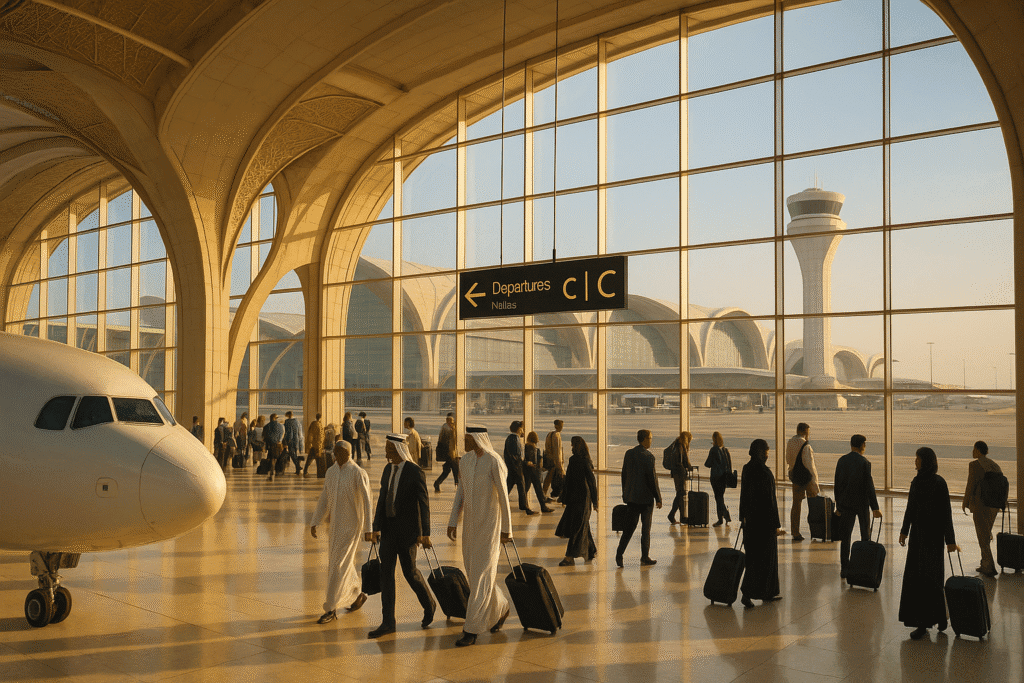
Investing in Middle East airports can be a lucrative opportunity, with the region expected to handle 1.1 billion passengers by 2040. Key strategies include choosing between upgrading existing airports (brownfield projects) or building new ones (greenfield projects), leveraging public-private partnerships (PPPs), and focusing on integrating advanced technology and sustainability into airport operations. With governments heavily backing these developments, U.S. investors can tap into a rapidly growing market, but they must also navigate risks like geopolitical tensions, regulatory changes, and economic volatility.
Key Takeaways:
- Growth Potential: Passenger traffic is projected to grow 300% from 2019 to 2040.
- Investment Opportunities: $240 billion is expected to be invested in airport projects between 2025 and 2035.
- $136 billion for upgrades (brownfield projects).
- $104 billion for new airports (greenfield projects).
- Major Projects: Saudi Arabia’s King Salman International ($266 billion) and Dubai’s Al Maktoum International ($35 billion).
- Risks: Geopolitical instability, fuel price volatility, and competitive pressures.
- Mitigation: Diversify investments, collaborate with local partners, and focus on airports with strong technological and sustainability plans.
By carefully assessing risks and aligning with local governments, U.S. investors can position themselves for long-term returns in one of the fastest-growing aviation markets.
Al Maktoum International Airport being built on an approx cost of $35 billion (₹2.9 lakh crore)
Key Investment Strategies for Middle East Airports
For U.S. investors eyeing the Middle East’s booming airport sector, having a well-defined strategy is crucial. With investment opportunities expected to soar by 2035, the right approach could mean the difference between reaping strong returns and missing out. Three core strategies stand out: choosing between brownfield and greenfield projects, leveraging public-private partnerships (PPPs), and focusing on the integration of technology with sustainability.
Brownfield vs. Greenfield Projects
Deciding between brownfield and greenfield projects is a pivotal step in shaping your investment strategy. Each comes with unique benefits and challenges, catering to different risk appetites and timelines.
Brownfield projects, which dominate with a commitment of US$136 billion, involve upgrading existing airports. These projects offer lower startup costs and quicker market entry since they tap into established passenger flows, demand patterns, and regulatory frameworks. However, they may also come with hidden costs tied to modernizing older infrastructure and ensuring compliance with updated standards.
On the other hand, greenfield projects, funded at US$104 billion, involve building entirely new airports. These projects allow for greater design flexibility, enabling the integration of advanced technologies from the ground up. The trade-off? Higher capital requirements, longer development timelines, and the challenge of generating demand from scratch, alongside potential hurdles like land acquisition and regulatory approvals.
“The US$240 billion investment is not just about concrete and runways, it’s about socio-economic development in the region”, says SGK Kishore, President of ACI Asia-Pacific & Middle East.
Your choice will hinge on your risk tolerance and investment goals. Brownfield projects might deliver quicker returns but could require additional funds for upgrades, while greenfield ventures demand patience and a long-term outlook, especially in rapidly expanding markets.
Next, let’s examine how public-private partnerships can help manage risks and amplify returns.
Using Public-Private Partnerships (PPP)
Public-private partnerships have become a cornerstone for funding major airport projects in the Middle East. These arrangements enable governments to draw on private sector capital and expertise while retaining control over critical infrastructure. By blending government support with private investment, PPPs align with the region’s broader economic diversification goals.
Under a typical PPP model, private investors handle design, construction, and operations, while governments provide regulatory backing, land access, and sometimes long-term revenue guarantees. Revenue streams for investors can include passenger fees, cargo handling, retail concessions, and even real estate developments near airport facilities. For U.S. investors, such partnerships offer the dual benefits of local market expertise and reduced regulatory risks, all while sharing the financial burden of large-scale projects.
However, the success of PPPs depends heavily on well-drafted contracts and aligned incentives. Disputes over revenue sharing, operational standards, or expansion timelines can derail projects. Conducting thorough due diligence on the government partner’s track record and long-term commitment is essential.
“The investment marks a critical step in transforming the sector and delivering a high-quality experience to passengers”, notes Stefano Baronci, Director General of ACI Asia-Pacific & Middle East.
Technology and Sustainability Integration
Technology and sustainability are reshaping the future of airport investments in the Middle East. Modern airports in the region are prioritizing these elements to ensure long-term profitability and operational efficiency. The airport technologies market is projected to hit US$13.99 billion by 2025, with the digitization segment expected to grow to US$27.44 billion by 2030. Rising passenger expectations for seamless, tech-driven travel experiences are fueling this growth, with biometric systems predicted to replace traditional passports and boarding passes by 2030.
A prime example is Kuwait International Airport’s Terminal 2, set to open in 2025 with a US$4.36 billion investment. This terminal boasts smart gate systems, advanced CT scanning technology, and a solar-panel-covered roof designed to achieve LEED Gold certification.
At Hamad International Airport, the Phase B expansion incorporates AI to predict passenger movement patterns, enhancing efficiency and unlocking new revenue opportunities.
Sustainability is equally critical. Airports in Asia-Pacific and the Middle East collectively cut over 529,000 tons of CO₂ equivalent in the latest reporting cycle. These efforts are not just about environmental responsibility – they also align with investor environmental, social, and governance (ESG) requirements and prepare for potential carbon pricing mechanisms.
“They aim to reduce their environmental impact through efforts like achieving carbon-neutral certification, designing eco-friendly infrastructure, and adopting renewable energy”, says Akram Alami, Middle East head of utilities, aviation, and sustainability & responsibility practices at Bain & Co..
The King Salman International Airport in Riyadh illustrates the financial and environmental benefits of renewable energy, as it will be fully powered by renewables, reducing operational costs while meeting sustainability goals.
Digital transformation partnerships further highlight the value of technology. For instance, in December 2023, Riyadh Airports Co. teamed up with Cognizant to enhance digital capabilities in areas like finance, procurement, and planning, showcasing how digital strategies can streamline operations and boost profitability.
While these advancements require significant upfront investment and ongoing maintenance, the focus should be on airports with comprehensive digital strategies. Piecemeal technology adoption often lacks the synergy needed to deliver long-term value. Integrated systems, spanning passenger processing to cargo handling, are key to maximizing returns and ensuring sustained growth.
Risk Assessment and Mitigation for Airport Investments
Building on earlier discussions about market opportunities and strategies, assessing risks effectively is key to ensuring steady returns. While investing in airports across the Middle East offers promising rewards, it also requires a careful evaluation of potential risks. Addressing and mitigating these risks is essential to protect investments.
Geopolitical and Market Risks
The Middle East’s political complexities often heighten the risks tied to airport investments. Events in the region have repeatedly shown how quickly situations can escalate, impacting aviation operations.
Political instability and regional conflicts are among the most pressing concerns. For example, in June 2025, Israel initiated “Operation Rising Lion”, a large-scale military campaign targeting Iran’s nuclear facilities. The U.S. supported the effort with strikes on three Iranian nuclear sites. Over 12 days, the conflict exposed Iran to significant air and missile attacks. While this did not disrupt oil supplies or transport notably, uncertainties remain about Iran’s ability to recover and maintain the ceasefire. The aviation sector felt the tension, with temporary airspace closures in Qatar, Kuwait, and the UAE affecting over 500 flights during similar past conflicts. Additionally, GPS interference in the Gulf and the Strait of Hormuz continues to threaten both maritime and aviation operations.
Economic volatility also plays a critical role. A 17.8% spike in fuel prices in early 2025 put pressure on airlines, impacting both profitability and passenger numbers.
The BlackRock Geopolitical Risk Indicator highlights several high-likelihood risks that could affect airport investments:
| Risk | Description | Likelihood |
|---|---|---|
| Middle East regional war | Escalation of conflict threatening energy infrastructure and increasing volatility | High |
| Major terror attack(s) | Significant loss of life and commercial disruption due to terrorism | High |
| Major cyber attack(s) | Sustained disruption to critical infrastructure caused by cyber incidents | High |
| Global trade protectionism | Increased tariffs negatively affecting the macroeconomic outlook | High |
“Uncertainty and volatility have become fixtures of the geopolitical landscape, with rapidly evolving U.S. policy an animating force”, notes the BlackRock Investment Institute.
Regulatory changes add another layer of unpredictability. Governments may revise foreign investment rules, impose new taxes, or alter operational requirements with little notice. Since the 9/11 attacks, global geopolitical risks have remained elevated.
Following these geopolitical challenges, operational and competitive risks further complicate the investment environment.
Operational and Competitive Risks
Beyond geopolitical concerns, operational and competitive factors also pose challenges for airport investments.
Construction delays and cost overruns are common, often caused by regulatory obstacles, supply chain disruptions, or labor shortages. These delays can push back revenue generation timelines.
Fierce competition among Middle Eastern airports and airlines adds to the pressure. The region’s hub-and-spoke model means airports are constantly vying for transfer passengers and cargo. Dubai International Airport, for instance, handles 52.7 million passengers annually, setting a high standard. Airline performance also varies significantly. In 2023, Emirates Airlines carried around 26 million departing passengers, earning a profit of over $104 per passenger. In contrast, Oman Air reported a loss of about $83 per passenger during the same period [11].
“The challenges and scale of investment needed to achieve the required levels of critical network mass are daunting for many private sector investors and for many airlines; state support and investment is crucial”, explains OAG [11].
Operational disruptions are another concern. For example, flight cancellations in the Middle East and Africa surged by 12% in March 2024. However, King Khalid International Airport (RUH) managed an impressive 87.32% on-time departure rate during the same period.
Technology integration risks also deserve attention. While adopting advanced technologies can improve efficiency, unsuccessful implementations may disrupt operations and tie up funds, requiring ongoing investments to remain competitive.
Risk Mitigation Strategies
Investors can employ several strategies to navigate these risks effectively. Turning potential threats into manageable challenges is key.
- Diversify investments across multiple projects to minimize localized risks. Dubai’s $50 billion airport expansion is a prime example of spreading risk.
- Real-time monitoring systems can provide early warnings by continuously tracking geopolitical risks and offering intelligence for swift responses.
- Hedging strategies against oil price fluctuations are crucial, given the impact of fuel costs on airlines. Short positions can help manage this volatility.
- Flexible insurance coverage tailored to evolving risks is essential. For instance, some marine insurers have reduced cancellation notice periods for war breach rates, enabling quicker adjustments. Similar flexibility should be negotiated for airport investments.
- Strategic partnerships with local governments and established operators can reduce regulatory and operational risks. Businesses should also evaluate how changes in supply chains, security protocols, and insurance terms affect their risk management strategies.
- Resilient operators with diversified networks, like Emirates, Qatar Airways, Etihad, Saudia, and Riyadh Air, offer additional stability due to their strong government ties [11].
- Sustainability efforts can enhance long-term resilience. Environmental, Social, and Governance (ESG) initiatives are increasingly critical. For instance, Etihad Airways aims to cut its carbon emissions by 50% by 2035 and reach net-zero emissions by 2050, showcasing how sustainability commitments can attract long-term investment.
Proactive measures are essential. Monitoring ongoing geopolitical risks can help investors anticipate delays in infrastructure projects or additional airspace closures. Collaboration with governments to develop risk forecasting models can further aid in preparing for future challenges.
Practical Considerations for U.S. Investors
When stepping into the Middle Eastern airport market, U.S. investors face a unique set of financial and regulatory challenges. Addressing these practical aspects carefully can mean the difference between a profitable venture and an expensive misstep.
Currency and Tax Implications
Currency fluctuations are a key concern for U.S. investors, especially given how the Federal Reserve’s monetary policies ripple through the region. In countries like Saudi Arabia and the United Arab Emirates, currencies are pegged to the U.S. dollar. This setup brings both advantages and obstacles. For instance, while a strong dollar can lower the cost of importing equipment, it may also squeeze local revenue streams, potentially impacting airport earnings.
Tax considerations add another layer of complexity. As of 2025, the UAE has not established a double taxation agreement with the U.S., which could leave investors navigating tax liabilities in both nations. On the flip side, the UAE’s compliance with FATCA through an intergovernmental agreement offers some clarity on regulatory obligations.
To mitigate these risks, U.S. investors should explore financial tools to hedge against currency swings and conduct a deep dive into tax scenarios, including withholding taxes and potential double taxation. These measures are key to managing financial uncertainties effectively.
Due Diligence Checklist
A robust due diligence process is non-negotiable when entering this market. Investors need to evaluate everything from air traffic forecasts and infrastructure conditions to financial performance and legal frameworks. Environmental, social, and climate-related risks also demand careful assessment.
Key financial areas to review include aeronautical and non-aeronautical revenues, operating costs, and capital expenditure needs. Legal experts with knowledge of foreign investment regulations should be consulted to navigate requirements like CFIUS compliance. Notably, the “America First Investment Policy” allows for an expedited CFIUS review for investments from allied nations in the Middle East.
Here’s a quick snapshot of key risks and strategies to address them:
| Risk Category | Description | Responsibility | Mitigation Strategy |
|---|---|---|---|
| Demand and Traffic Risk | Traffic below forecasts leading to revenue shortfalls | Shared | Conduct rigorous traffic studies; delay capacity-driven projects |
| Non-aeronautical Revenue Risk | Challenges in attracting tenants or patrons | Private | Perform detailed feasibility studies; align with government goals |
| Latent Defects and Liabilities | Hidden issues in airport assets | Shared | Carry out thorough technical reviews; allocate risks properly |
| Climate Risks | Issues like runway damage and flood risks | Private | Upgrade designs and maintenance; improve drainage systems |
Environmental and social due diligence should identify gaps between local laws and international standards. This includes examining risks tied to land use, resettlement, pollution, and biodiversity. Climate assessments should also factor in greenhouse gas emissions, historical weather trends, and specific risks to airport infrastructure. For a comprehensive approach, investors might consider engaging consultants skilled in airport planning, demand forecasting, and transaction advisory.
Using Flight Demand Data for Investment Decisions
Beyond traditional due diligence, real-time flight demand data can sharpen investment strategies. The Middle East’s aviation sector is booming, with air travel demand up 18% compared to 2019 and revenues climbing by 37%. Passenger traffic insights can help pinpoint airports with the best growth potential.
For example, major hubs like Jeddah and Abu Dhabi have seen traffic increases of 56% and 65%, respectively. Projections indicate that by 2040, the region’s air passenger traffic will triple to 1.1 billion, requiring $151 billion in capacity expansions. Airlines in the region are also thriving, with an estimated $5.3 billion in net profits expected by the end of 2024 – three times the global average per passenger.
Operational data further highlights key trends. In February, passenger demand across the region grew by 3.3% year-over-year, with airlines achieving an 82% load factor. The commercial fleet is expected to expand at a 5.1% annual growth rate through 2035, reaching 2,557 aircraft.
Tools like Flight Booking 247 offer valuable insights into booking patterns, route popularity, and demand shifts. This data helps investors distinguish between airports experiencing sustainable growth and those with temporary spikes.
Performance metrics also reveal which airports are excelling. Oman Air, for example, achieved a 90% on-time arrival rate in 2024, while Riyadh’s King Khalid International Airport maintained an 86.65% on-time departure rate across nearly 241,000 flights. These figures underscore the importance of infrastructure and operational investments in driving performance.
Key Takeaways for Middle East Airport Investments
Building on the earlier analysis of risks and strategies, here’s a summary of essential insights for U.S. investors considering opportunities in the Middle East aviation sector.
Balancing Opportunity and Risk
The Middle East aviation industry is poised for substantial growth, but navigating the associated risks is crucial. Forecasts indicate that the region’s airports will handle 1.1 billion passengers by 2040, requiring an estimated $151 billion in infrastructure investments. This expansion presents significant opportunities for U.S. investors, but it also demands a well-balanced approach.
Geopolitical risks remain a major challenge. For example, airspace closures due to regional conflicts have previously disrupted over 500 flights. To mitigate such risks, real-time monitoring and dynamic routing systems are essential to minimize delays and maintain operational continuity.
The financial performance of airlines in the region also highlights the importance of careful evaluation. In 2023, Emirates achieved over $104 profit per passenger, while Oman Air faced a loss of $83 per passenger. This stark contrast underscores the need for thorough due diligence and a focus on investments with strong operational foundations.
Technology and sustainability are becoming central to airport operations. Airports that adopt digital tools like biometrics, artificial intelligence, and automation are not only improving efficiency but also enhancing passenger experiences and addressing environmental concerns. These advancements are key for long-term success.
Diversifying investments across different regions and sectors within the Middle East can help manage macroeconomic risks. Instead of concentrating on a single country or airport, spreading exposure across various markets could lead to better risk-adjusted returns.
These factors set the stage for actionable strategies that U.S. investors can pursue in this dynamic market.
Next Steps for U.S. Investors
To navigate this evolving landscape, U.S. investors should adopt a targeted approach. With the regulatory landscape becoming more streamlined – thanks to policies like the “America First Investment Policy” introduced in February 2025 – investing in the Middle East has become more accessible. This policy includes a fast-track CFIUS review process for investments from allied countries, including those in the region.
Start by consulting legal experts familiar with U.S. foreign investment regulations to assess potential CFIUS implications and ensure compliance. A notable example is Mubadala Capital, the Abu Dhabi state-owned firm, which secured a $3 billion majority stake in Fortress Investment Group. This deal shows that while approvals are possible, they may come with requirements like data localization.
Focus on high-growth airports with strong operational metrics. For instance, King Abdulaziz International Airport in Jeddah reported a 56% rise in passenger traffic, while Zayed International Airport in Abu Dhabi saw a 65% increase. Monitoring performance metrics is equally important – Middle East airlines earned a record $23.1 profit per passenger in 2024, far exceeding the global average.
As May Ismail, Event Manager at RX, aptly put it:
“For the Middle East airports, the focus is not on surviving but thriving and bringing about tectonic changes to the landscape.”
Consider large-scale infrastructure projects already underway. Saudi Arabia is building a $50 billion hub in Riyadh, aiming to accommodate 300 million passengers by 2030, while Dubai is investing $35 billion in the development of Al Maktoum International Airport. These projects represent significant opportunities for U.S. firms to form partnerships and participate in the region’s growth.
The GCC equity risk premium has dropped from 6.6% in 2016 to 2.4% as of March 2025, reflecting improved market conditions. This makes it an ideal time for U.S. investors to enter the market.
Finally, keep a close eye on policy changes, fuel price trends, and competitive dynamics to adapt your strategy as needed.
FAQs
What’s the difference between brownfield and greenfield airport projects in the Middle East, and how can investors choose the right one?
Brownfield and Greenfield Airport Projects in the Middle East
In the Middle East, brownfield airport projects focus on upgrading and expanding existing airports. These initiatives aim to increase capacity and improve efficiency by building on already established infrastructure and markets. Because they leverage existing facilities, brownfield projects often involve lower risk and tend to deliver faster returns.
On the other hand, greenfield projects are all about starting from scratch. These involve constructing entirely new airports, which means higher initial investment and greater risk. However, the payoff lies in the ability to fully customize the facility and tap into new, underserved markets. This approach aligns well with long-term growth strategies, especially in emerging regions.
For investors, the choice between brownfield and greenfield projects depends on several factors: market demand, the condition of current infrastructure, and their overall strategic objectives. Brownfield projects are a good fit for those prioritizing quicker returns in established markets. Meanwhile, greenfield projects appeal to those looking to innovate and create opportunities in untapped areas.
What are the best ways for U.S. investors to manage geopolitical and economic risks when investing in Middle Eastern airports?
To navigate the geopolitical and economic risks tied to investing in Middle Eastern airports, U.S. investors should consider diversification as a cornerstone strategy. By spreading investments across different regions and industries, they can minimize the impact of localized conflicts or economic disruptions.
Working with seasoned investment managers and using risk management tools – like setting exposure limits and performing in-depth due diligence – can also play a critical role in protecting assets. Moreover, forming strategic partnerships with established local organizations can offer valuable on-the-ground insights and help mitigate the challenges posed by regional tensions.
Keeping a close eye on geopolitical shifts and adopting a long-term outlook are equally crucial for successfully navigating the complexities of investing in this dynamic region.
How do technology and sustainability impact the profitability of Middle East airport investments, and what steps can investors take to benefit from these trends?
Technology and Sustainability Boosting Middle East Airport Investments
Middle East airports are reshaping their operations by embracing smart technologies and renewable energy solutions. Tools like AI, real-time resource management systems, and automation are being implemented to streamline processes, increase efficiency, and deliver a smoother passenger experience. Simultaneously, airports are turning to renewable energy sources, such as solar and wind, to cut down on operational expenses and lower carbon emissions.
For investors, this creates an opportunity to back projects that emphasize digital innovation and eco-friendly infrastructure. By aligning with global sustainability goals, these investments not only promise long-term stability but also position themselves for growth as the aviation sector continues to adapt and evolve.