

Flying between Australia and New Zealand is quick and offers plenty of options for different budgets and preferences. Here’s a breakdown of the main airlines:
- Jetstar: Best for budget travelers, with fares starting as low as $29 NZD. However, extras like baggage and meals cost more.
- Qantas: A good balance of price and service, with fares averaging $596 round trip. Includes meals and generous baggage allowances.
- Air New Zealand: Premium experience with fares starting around $938 round trip. Known for comfort and unique in-flight options like the Skycouch.
- Virgin Australia: Mid-range pricing with fares starting at $544 AUD. Offers a mix of comfort and value, including family-friendly perks.
Quick Comparison
| Airline | Starting Fare (Round Trip) | Best For | Key Features | Drawbacks |
|---|---|---|---|---|
| Jetstar | $213 | Budget-conscious | Low fares, pay for extras | Limited inclusions |
| Qantas | $596 | Balanced service seekers | Meals, baggage included, loyalty perks | Higher upfront cost |
| Air New Zealand | $938 | Premium experience | Skycouch, premium options, extensive routes | Expensive fares |
| Virgin Australia | $544 AUD | Balanced value | Family perks, moderate pricing | Restrictive carry-on |
Flights are short (3–4 hours), and with over 2,000 weekly flights, you can find options that fit your schedule and budget. Choose based on your priorities: affordability, comfort, or premium services.
Australia Vs New Zealand’s BEST Airline
1. Air New Zealand
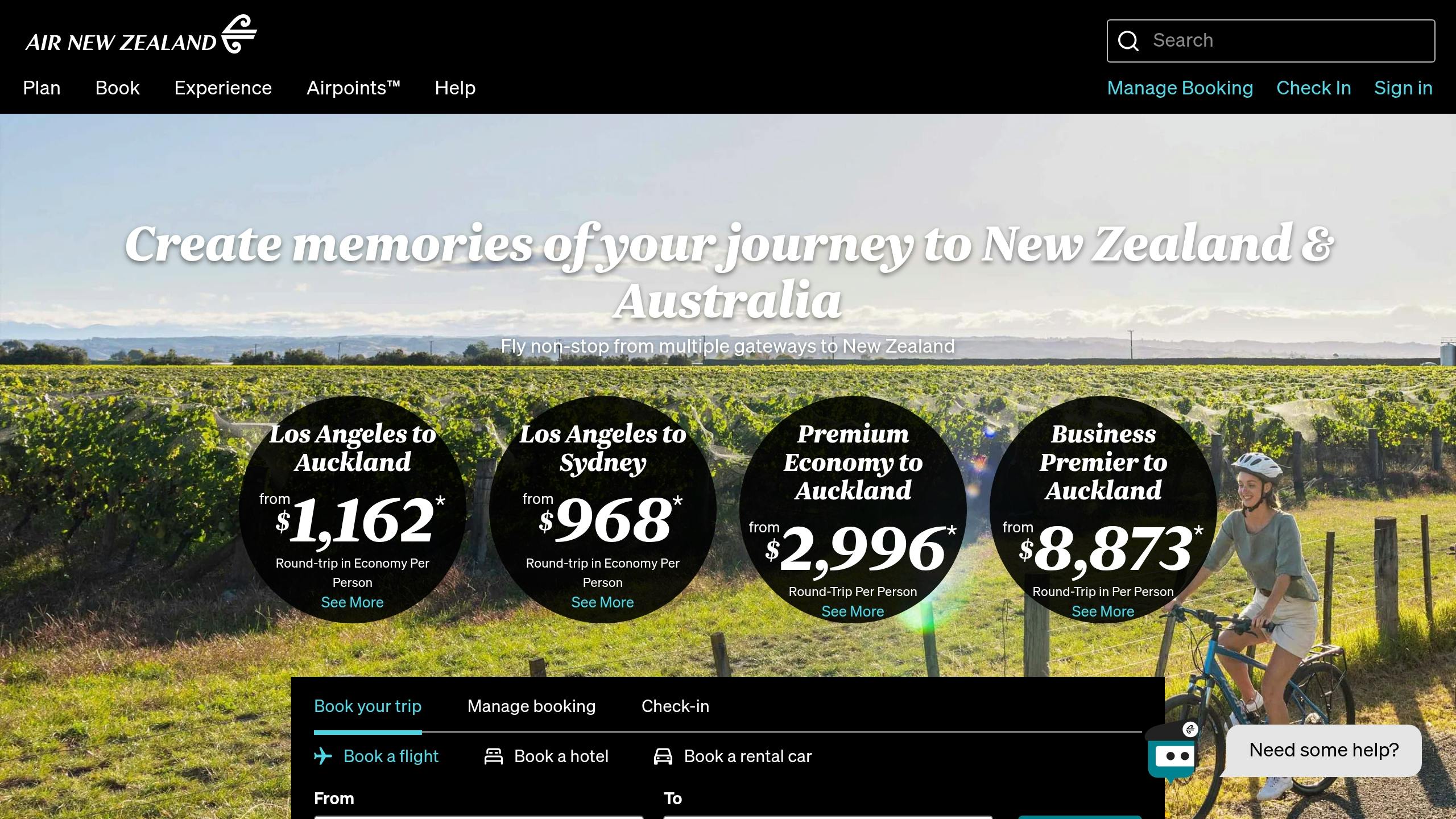
Air New Zealand, the national airline of New Zealand, connects Australia and New Zealand through an extensive network of routes. Known for its reliable service and diverse offerings, it caters to both business travelers and vacationers with competitive pricing and unique in-flight experiences.
Route Coverage
Air New Zealand operates flights across key routes, including:
- From Auckland: Sydney, Melbourne, Brisbane, Gold Coast, Hobart, Adelaide, and Perth. Seasonal routes to Cairns and the Sunshine Coast are also available.
- From Wellington: Brisbane, Melbourne, and Sydney.
- From Christchurch: Brisbane, Melbourne, and Sydney, with seasonal flights to Gold Coast and Adelaide.
- From Queenstown: Melbourne and Sydney.
Looking ahead, the airline will add service to Western Sydney International Airport starting in mid-2027. This broad network provides travelers with plenty of options to suit their schedules and budgets.
Flight Costs
Air New Zealand offers three fare classes to suit different needs:
- Economy: Includes options like ‘seat,’ ‘theworks,’ and ‘worksflexi.’
- Premium Economy
- Business Premier: Includes ‘businesspremier’ and ‘businessflexi.’
Round-trip fares start at $938. For those seeking flexibility, Economy fares typically cost about NZ$60 more for flexi options, while Business Premier flexi fares add approximately NZ$120. The basic Economy ‘seat’ fare covers carry-on baggage, snacks, and entertainment, but checked baggage and meals are additional costs.
Travel Times
Direct flights between major cities take about 3 to 3.5 hours. Popular routes, such as Auckland–Sydney and Melbourne–Auckland, offer several departures daily, making travel convenient and efficient.
Service Features
Air New Zealand’s standout features include its ‘Seats to Suit’ program, which allows travelers to customize their experience. The Skycouch option, for instance, turns three economy seats into a flat surface, ideal for couples or families. Elite Airpoints members enjoy perks like annual upgrades and access to Business Premier Luxe options on Boeing 787-9 flights, which provide enhanced privacy and comfort.
The airline also emphasizes a digital-first approach, offering a wide selection of movies, TV shows, music, and games to enrich the onboard experience. With these thoughtful touches, Air New Zealand delivers a distinctly Kiwi vibe throughout its service.
2. Qantas
Qantas, Australia’s flagship airline, is a key player in the trans-Tasman market, known for its competitive pricing and dependable service. It has positioned itself as a strong choice for travelers heading between Australia and New Zealand, offering a combination of value and quality.
Much like Air New Zealand, Qantas capitalizes on its extensive network and efficient operations to cater to both leisure and business travelers.
Route Coverage
Qantas connects major Australian cities with New Zealand’s top destinations through an extensive flight network. From Sydney, passengers can fly directly to Auckland, Wellington, Christchurch, and Queenstown. Melbourne serves as another key hub, offering direct flights to Auckland, Wellington, and Queenstown. Brisbane provides connections to Auckland and Wellington, while the Gold Coast (Coolangatta) links directly to Auckland.
This network covers the busiest routes between the two countries, making it convenient for both business and leisure travelers. Popular routes like Sydney–Auckland feature multiple daily flights, giving passengers added flexibility. This robust network supports Qantas’s competitive pricing and high-quality service.
Flight Costs
Qantas consistently delivers competitive fares on trans-Tasman routes. A Consumer NZ study found that Qantas fares were, on average, 16.7% lower than Air New Zealand’s across various routes and booking periods[1]. The average cost of a Qantas round-trip ticket was approximately $596 (converted from NZ$801.27), compared to $706 for Air New Zealand. Even during peak travel times, Qantas fares tend to remain lower, as highlighted in the same study[1].
The airline’s dynamic pricing model adjusts fares based on demand and seasonality, ensuring stable and cost-effective options for travelers, even during high-demand periods.
Travel Times
Direct flights between major cities typically range from 3 to 3.5 hours.
Service Features
Qantas provides a range of amenities designed to enhance the travel experience. Passengers can enjoy quality meals, beverages, and an extensive entertainment selection, including movies, TV shows, and documentaries. Wi‑Fi is also available on selected flights.
Baggage allowances vary by travel class and membership status. Economy passengers can check up to 66 lbs (30 kg), Premium Economy and Business travelers are allowed 88 lbs (40 kg), and First Class passengers can bring up to 110 lbs (50 kg). Members of the Qantas Frequent Flyer and Qantas Club programs enjoy additional baggage perks on eligible flights.
Qantas’s loyalty program is tailored for frequent travelers, offering flexible monthly memberships starting at $99 or fixed-term plans beginning at $699. These memberships come with benefits like increased points accrual and lounge access, making them appealing for regular flyers.
With its competitive pricing, extensive network, and premium services, Qantas stands out as a top choice for trans-Tasman travel.
3. Jetstar
Jetstar has established itself as a go-to choice for budget-conscious travelers seeking affordable trans-Tasman flights. As a subsidiary of Qantas, it combines low-cost operations with a focus on reliability, making it a popular alternative to full-service airlines. Its no-frills model appeals to those who prioritize savings over luxury, carving out a solid presence in the Australia–New Zealand travel market.
Route Coverage
Jetstar connects major Australian hubs with key destinations across New Zealand, including Auckland, Christchurch, Dunedin, and Queenstown. Starting in June 2025, Hamilton will also join its network. By focusing on high-demand routes, Jetstar ensures frequent flights and operational efficiency, which helps keep costs down while maintaining broad connectivity.
Flight Costs
Jetstar stands out with fares that are significantly lower than those offered by full-service carriers. For example, while Air New Zealand has charged over $400 for an Auckland–Christchurch flight, Jetstar offers fares starting as low as $60. Some promotional fares have even been advertised at NZ$29. A Jetstar spokesperson highlighted, “We’ve invested heavily in our reliability which, combined with fares as low as $29 NZD, is driving strong demand for our flights.” [4]
Travel Times
Jetstar’s direct flights across the Tasman typically range between just over 3 hours and 4 hours, depending on the route. Here’s a breakdown of some common travel times:
| Route | Flight Time |
|---|---|
| Auckland to Sydney | 3 hours 30 minutes – 4 hours 5 minutes |
| Christchurch to Sydney | 3 hours 15 minutes – 3 hours 40 minutes |
| Wellington to Sydney | 3 hours 40 minutes |
| Auckland to Melbourne | 4 hours – 4 hours 20 minutes |
| Christchurch to Melbourne | 3 hours 45 minutes – 4 hours |
| Auckland to Brisbane | 3 hours 40 minutes – 3 hours 55 minutes |
These durations align with typical expectations for trans-Tasman flights [6].
Service Features
Jetstar’s approach focuses on giving travelers the flexibility to pay only for what they need. Unlike full-service airlines with bundled amenities, Jetstar offers an unbundled pricing model, allowing passengers to add extras like meals, baggage, or seat selection as needed. Some flights also feature FareCredit for added booking flexibility [2][3]. With ongoing fleet expansion in New Zealand, Jetstar is well-positioned to support its growing network and maintain reliable service [5].
4. Virgin Australia
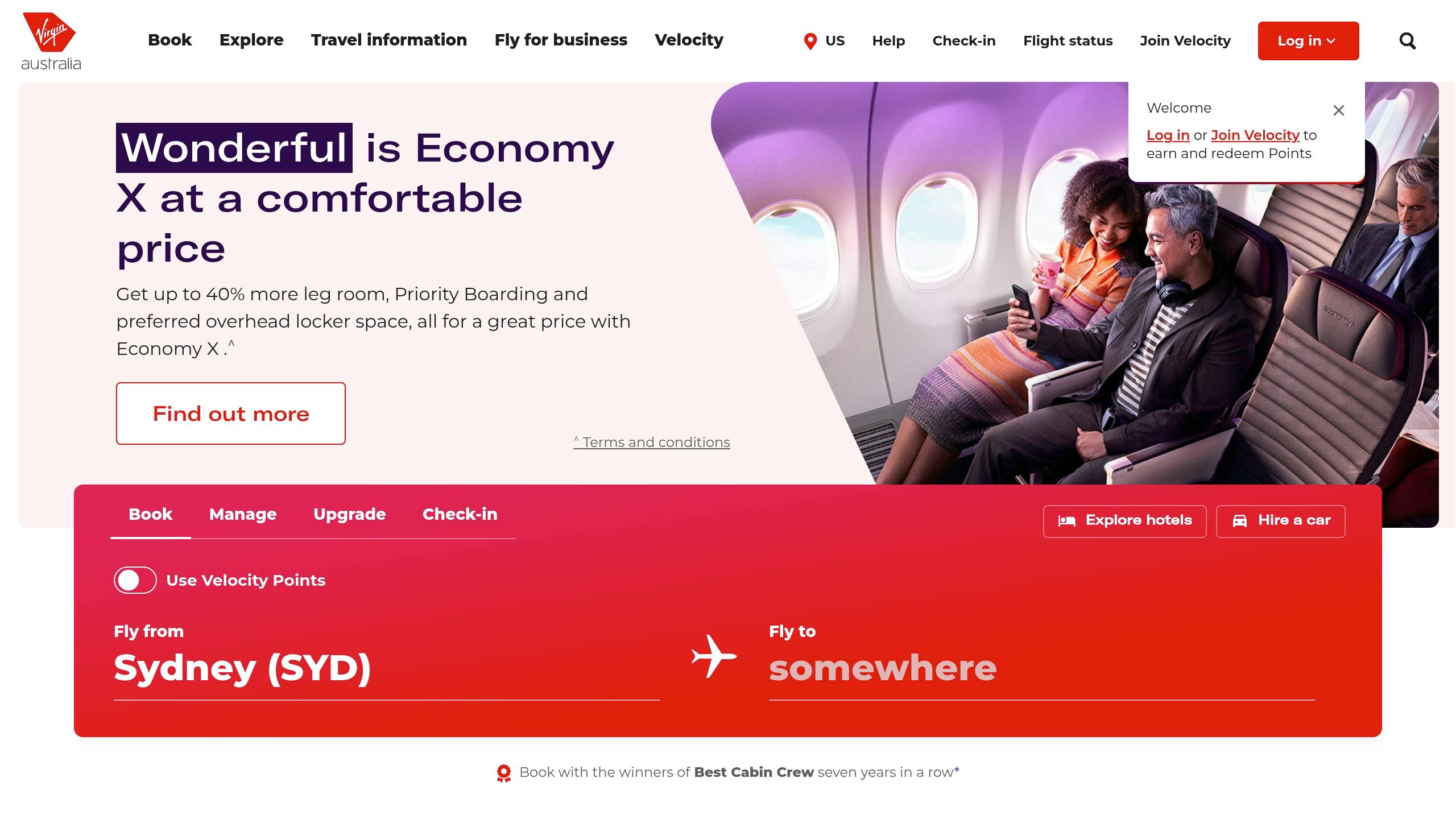
Virgin Australia provides direct flights to Queenstown from nine Australian cities, including major hubs like Brisbane, Sydney, and Melbourne. Through a codeshare partnership with Air New Zealand, travelers can also connect to Auckland, Wellington, and Christchurch for added convenience [7][8].
Route Options
Virgin Australia’s direct routes to Queenstown include departures from Brisbane, Sydney, Melbourne, Perth, Adelaide, Gold Coast, Canberra, Cairns, and Launceston [7][8].
Ticket Prices
Round-trip economy fares with Virgin Australia depend on your departure city and travel dates. Here’s a snapshot of starting prices:
- Melbourne to Queenstown: From $544 AUD
- Sydney to Queenstown: From $636 AUD
- Brisbane to Queenstown: From $699 AUD
- Gold Coast to Queenstown: From $704 AUD
- Canberra to Queenstown: From $731 AUD
- Adelaide to Queenstown: From $826 AUD
- Cairns to Queenstown: From $692 AUD
- Perth to Queenstown: From $1,335 AUD
Virgin Australia offers various fare options, including Economy Lite, Economy Choice, Economy Flex, and Business class. These options differ in terms of baggage allowances, flexibility for changes, and refund policies [7]. Travelers can also take advantage of the “Pick Your Bonus” campaign, which offers double Velocity Points or Status Credits on eligible flights [10].
Onboard and Travel Perks
Virgin Australia focuses on making the journey as enjoyable as possible with several key features. Select Boeing 737 aircraft come equipped with wireless in-flight entertainment, allowing passengers to stream movies, TV shows, and music directly to their personal devices [11][13].
Seating options include standard economy, Preferred Seats, and Economy X upgrades, with advance seat selection available for most fare types (except Economy Lite). Baggage policies are straightforward: Economy Choice, Flex, and Reward fares include one checked bag up to 23 kg, while Business class passengers can bring two 32 kg bags. Additional bags are priced at $85 AUD online or $170 AUD at the airport [11][12][13][14].
Virgin Australia also caters to families by ensuring children under 12 are seated with an accompanying adult. Members of the Velocity Frequent Flyer program enjoy perks like extra baggage allowances and preferred seating options, adding value for frequent travelers [12][14].
These thoughtful services position Virgin Australia as a strong contender in the trans-Tasman travel market, offering competitive fares and a comfortable flying experience.
Airline Comparison: Pros and Cons
When planning your journey between Australia and New Zealand, the right airline can depend on what matters most to you – budget-friendly fares, inclusive services, or baggage flexibility. The following breakdown highlights the strengths and weaknesses of the major carriers on this route, helping you weigh your options against evolving travel trends like the rise of “bleisure” (business and leisure) travel.
Jetstar is the go-to choice for budget-conscious travelers. Their fares are hard to beat, with round-trip flights starting as low as $213. For comparison, Virgin Australia begins at $355, Air New Zealand at $371, and Qantas at $395 [15]. One-way tickets are even more enticing, with Jetstar offering prices as low as $84 from New Zealand to Australia [9]. However, these low fares come with limitations. Checked baggage isn’t included in their most popular fares, so travelers need to pay extra for bundles or add-ons. Oversized items also incur a $25 fee [17][18].
“We’ve invested heavily in our reliability which, combined with fares as low as $29 NZD, is driving strong demand for our flights.”
– Jetstar spokesperson [4]
On the other end of the spectrum, Air New Zealand caters to those seeking a premium experience. According to Consumer NZ, which tracked over 7,000 flights across 34 weeks, Air New Zealand’s average return ticket price was $948.75 – making it the priciest option. In contrast, Qantas averaged $801.27, a 16.7% price difference [1]. Air New Zealand’s fares tend to spike during peak travel periods, unlike Qantas, which maintains steadier pricing. However, the higher cost often includes more amenities, aligning with their premium positioning.
Qantas strikes a balance between price and service. Their fares are consistently lower than Air New Zealand’s, and they offer generous baggage allowances. Frequent flyers, for instance, benefit from perks like two 70 lb bags for Gold members and the same for Platinum members [18]. Carry-on policies are also flexible, allowing either one 22 lb bag or two pieces totaling 31 lb [18]. This inclusive approach often makes Qantas a better value for travelers with standard baggage needs [1].
Virgin Australia sits in the middle, offering moderate pricing and balanced policies. Most fares include checked baggage, though their Lite options come with restrictions [18]. Frequent flyer benefits are competitive, with Platinum members allowed three 50 lb bags [18]. However, their carry-on limit of 15 lb is more restrictive compared to Qantas’s more generous allowance [18].
| Airline | Pricing Position | Best For | Main Drawback |
|---|---|---|---|
| Jetstar | Lowest fares ($213 round-trip) | Budget-conscious travelers | Limited inclusions; extra fees |
| Qantas | Mid-range (16.7% cheaper than Air New Zealand) | Comprehensive service seekers | Higher upfront cost than Jetstar |
| Air New Zealand | Highest fares (average return: $948.75) | Premium experience | Expensive; significant price surges |
| Virgin Australia | Moderate pricing | Balanced service and value | Restrictive carry-on limits |
The competition is tight, with Qantas and Jetstar sharing 44% of the market, while Air New Zealand operates 43% of the capacity [1]. This near-equal split gives travelers a variety of choices and explains the stark differences in pricing strategies.
Air New Zealand does offer competitive deals for early bookings, such as return fares from Auckland to Melbourne starting at $530 [1]. However, last-minute bookings can be steep, with fares like $2,314 for routes such as Christchurch to Brisbane during peak times [1].
“As more customers book and the flight fills up, fares will move up through the range, reflecting that there is now greater demand for fewer remaining seats… Simply put, it is a supply and demand-driven pricing system, which means lower fares do sell out quickly for peak travel times, locations or around events.”
– Air New Zealand spokesperson [1]
When choosing an airline, it’s crucial to look beyond the base fare. Consider the total cost, including baggage fees, seat selection, and other add-ons. Jetstar’s low upfront prices can climb quickly with extras, while Qantas’s higher initial cost often includes services that others charge for. This comparison provides a clear snapshot to help you decide which airline aligns with your travel needs.
Conclusion
With over 2,164 weekly flights between Australia and New Zealand, averaging just under four hours, you have plenty of choices to suit your travel needs [16]. Let’s recap the standout features of each airline to help you decide.
Jetstar is the go-to option for budget-conscious travelers, offering the lowest fares [15]. However, keep in mind that extras like checked baggage, meals, and seat selection come at an additional cost.
Qantas strikes a balance between service and value, with reliable and frequent flights that cater to a wide range of travelers [16].
For those seeking a touch of luxury, Air New Zealand delivers premium comfort with fare options like premium economy, which includes extra legroom and added perks [20].
Meanwhile, Virgin Australia offers competitive pricing and balanced policies. Its business class on the Wellington route, in particular, has earned praise for comfort and quality [19].
Popular routes, such as Auckland–Sydney, often feature competitive fares and shorter flight times, especially when booked in advance.
Ultimately, the variety of options ensures you can find an airline that matches your budget, comfort preferences, and travel priorities. The competitive Trans-Tasman market guarantees there’s something for everyone. And for personalized assistance or real-time deals, Flight Booking 247 is ready to help you anytime.
FAQs
What are the key differences in pricing and services between budget airlines like Jetstar and premium airlines like Air New Zealand for flights from Australia to New Zealand?
The Main Differences Between Jetstar and Air New Zealand
When comparing budget airlines like Jetstar to premium carriers such as Air New Zealand, the key distinctions lie in pricing and included services.
Jetstar operates as a low-cost carrier, offering one-way fares that typically start around $276. However, the base price only covers the essentials. Extras like checked baggage, meals, and seat selection come with additional fees. For travelers focused on saving money and willing to forgo added comforts, Jetstar can be a practical choice.
In contrast, Air New Zealand delivers a more premium travel experience. Round-trip fares average approximately $808, but these tickets often include perks such as meals, beverages, and checked baggage. The airline also provides flexible ticket options and enhanced in-flight service, catering to those who prefer a more comfortable and convenient journey.
Choosing between these airlines ultimately depends on your priorities – whether you’re looking to keep costs down or enjoy a more relaxed and inclusive travel experience.
What benefits does the Qantas loyalty program offer frequent flyers traveling between Australia and New Zealand?
Qantas Loyalty Program Perks for Trans-Tasman Flyers
Qantas’ loyalty program brings added value to frequent flyers traveling the trans-Tasman route, offering a range of exclusive benefits. Members can earn Status Credits even on reward flights, gain access to premium airport lounges, and take advantage of special offers designed specifically for loyal customers.
Additionally, frequent flyers enjoy greater access to Classic Reward seats and Points Planes, giving them more flexibility and ease when booking flights between Australia and New Zealand. These perks position Qantas as a top choice for travelers looking for a smooth and rewarding flying experience.
What should travelers consider when choosing between Virgin Australia and Qantas for flights from Australia to New Zealand?
When choosing between Virgin Australia and Qantas for flights from Australia to New Zealand, it’s important to weigh factors like price, comfort, and reliability.
Qantas stands out for its extras, such as complimentary seat selection near departure and upgraded onboard amenities. These features make it a solid pick for travelers who value a more comfortable and convenient flying experience. On the other hand, Virgin Australia often offers more budget-friendly fares, making it a better fit for those keeping an eye on costs. While both airlines have similar flight times, Virgin Australia edges ahead with slightly better on-time performance, which could be a deciding factor for punctuality-focused passengers.
Your final decision will come down to what matters most to you – saving money, enjoying added comforts, or ensuring a reliable schedule.