What’s the fastest and safest way to board a plane during a pandemic? Airlines tested five methods to balance health safety and efficiency. Here’s what they found:
- Back-to-Front: Passengers board from the rear to the front. Safer but slower (15–20% longer boarding time).
- Reverse Pyramid: Staggered boarding by seat type (window first) and rows. Speeds up boarding by 35%.
- WilMA (Window-Middle-Aisle): Groups passengers by seat type, reducing aisle congestion. Cuts boarding time by 25%.
- Spaced Random: Small groups board at staggered intervals. Flexible but slower without strict enforcement.
- Dual-Door: Uses both front and rear doors, cutting boarding time by up to 40%, but requires extra equipment.
Quick Comparison:
| Method | Boarding Speed | Health Safety | Challenges |
|---|---|---|---|
| Back-to-Front | Slowest (+15–20%) | Reduces row interference | Crowding in aisles |
| Reverse Pyramid | Faster (+35%) | Maintains spacing | Requires precise coordination |
| WilMA (Window-Middle-Aisle) | Faster (+25%) | Limits passenger contact | Needs clear instructions |
| Spaced Random | Moderate | Reduces gate congestion | Gate coordination needed |
| Dual-Door | Fastest (+40%) | Separates boarding flows | Requires dual jet bridges or stairs, extra staff |
Combining methods (e.g., WilMA + Dual-Door) often works best for balancing speed and safety. Airlines continue to adjust these strategies as health guidelines evolve.
GDB TSE Airport Video
1. Back-to-Front Boarding Process
To minimize aisle congestion and passenger interaction during COVID-19, airlines adopted a back-to-front boarding approach. This method started with passengers seated in the back rows, followed by the middle, and finally the front rows [1]. Another approach, known as the reverse-pyramid method, spaces out boarding across the cabin to limit crowding even more effectively.
2. Reverse Pyramid Boarding
Reverse pyramid boarding improves on the back-to-front method by staggering seat zones to cut down on aisle congestion. Here’s how it works: passengers with window seats board first, alternating rows from the back to the front. Next, middle seats are filled, followed by aisle seats in the same staggered pattern. This setup not only reduces crowding but has been shown to speed up boarding by as much as 35% compared to traditional methods [1].
The staggered seating arrangement naturally spaces passengers apart, aligning with airlines’ efforts to limit contact during boarding. Up next, we’ll explore how the window-middle-aisle method balances speed with safety.
3. Window-Middle-Aisle (WilMA) Method
The WilMA method organizes boarding by seat type – window, middle, and aisle – rather than by rows. This approach minimizes cross-aisle interactions and simplifies the boarding process.
Here’s how it works: passengers with window seats board first, starting from the back of the plane and moving forward. Next, those with middle seats follow the same rear-to-front order. Finally, passengers with aisle seats board. This sequence helps reduce aisle congestion and limits the need for passengers to squeeze past each other, maintaining a safer distance during boarding.
Tests show that WilMA can cut boarding time by up to 25% compared to the standard back-to-front method, while still offering the same spacing advantages as the reverse-pyramid approach. It’s a win for airlines looking to combine quicker boarding with reduced contact. However, the method does require clear instructions and active crew management to ensure passengers stick to the order, which can slightly offset the time saved.
As we move on, we’ll take a look at spaced random boarding – a different strategy designed to balance health considerations and efficient cabin loading.
4. Spaced Random Boarding
Spaced random boarding focuses on balancing safety and efficiency by assigning passengers to smaller groups with specific boarding times. This helps reduce crowding at gates and along jet bridges.
Here’s how it works:
- Passengers are grouped into smaller clusters and board at staggered intervals to avoid congestion.
- Notifications are sent through digital alerts, gate displays, and announcements.
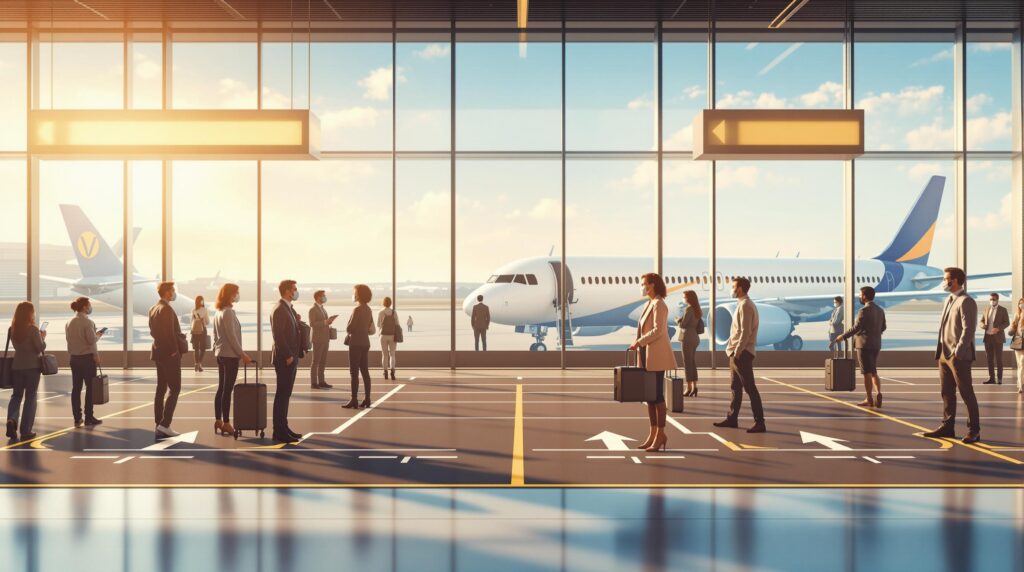
- Floor markings or visual cues are used to encourage proper spacing.
Gate agents can adjust group sizes and timing based on the aircraft type, passenger count, and current health protocols. While this method might slightly extend boarding time, it prioritizes a safer and more organized process. It also offers flexibility without sticking to a strict seat-zone boarding order.
5. Dual-Door Boarding Options
Narrow-body jets like the Airbus A320 and Boeing 737 can use both the front and rear doors for boarding when airports provide dual jet bridges or mobile stairs.
Here’s how it works: Rows 1–15 board through the front door, while rows 16 and beyond use the rear door. This creates two separate boarding flows that don’t overlap.
Compared to single-door boarding, this method speeds up the boarding process, reduces congestion in the terminal and jet bridge, and limits passenger interaction by keeping groups physically apart.
However, it does come with challenges. It requires extra ground equipment, more staff at both doors, and terminal infrastructure that supports dual-door access. Weather can also affect the use of rear doors.
Airlines often combine dual-door boarding with strategies like window-to-aisle or small-group sequencing when possible. If facilities don’t support this, they switch back to single-door boarding while maintaining distancing protocols. Up next, we’ll compare all five boarding methods in terms of time efficiency and health safety.
Method Comparison
Airlines have tested various boarding methods, each with its own upsides and challenges:
- Back-to-Front Boarding
- Pros: Passengers board from the rear to the front, reducing interference between rows.
- Cons: Often leads to crowding in the aisle, slowing the process.
- Reverse Pyramid Boarding
- Pros: Staggers boarding, starting with window seats, which helps maintain spacing.
- Cons: Requires precise timing and extra coordination from staff.
- Window-Middle-Aisle (WilMA) Sequencing
- Pros: Groups passengers by seat type (window, middle, aisle), speeding up boarding.
- Cons: Relies heavily on clear communication for zone compliance.
- Spaced Random Boarding
- Pros: Passengers board in small, staggered groups, helping maintain distance.
- Cons: Effective only with strict enforcement of group rules.
- Dual-Door Boarding
- Pros: Allows boarding from both the front and rear doors, speeding up the process and improving spacing.
- Cons: Requires access to two jet bridges and additional staff.
The best boarding method depends on factors like the aircraft’s design, airport facilities, available staff, and the mix of passengers. Many airlines combine methods – like pairing dual-door boarding with WilMA – to strike a balance between efficiency and safety. Additional measures like temperature checks and thorough cabin cleaning remain a priority.
Next: Key Findings.
Key Findings
Comparing different boarding methods reveals insights into their impact on speed, crowd management, and crew workload:
- Back-to-Front: Limits row interference but increases boarding time by 15–20% compared to pre-COVID practices, focusing more on distancing than efficiency [1].
- Reverse Pyramid: Speeds up boarding by 35% while maintaining six-foot spacing through staggered seating, balancing safety and speed [1].
- WilMA (Window-Middle-Aisle): Reduces boarding time by 25% compared to back-to-front, while also lowering cross-passenger interactions for a mix of efficiency and reduced contact [2].
- Spaced Random: Offers flexibility in crowd management through digital group assignments but requires extra gate coordination.
- Dual-Door: Cuts boarding time by up to 40% when paired with other methods, making it the fastest option where facilities allow [3].
These findings highlight that combining methods – like WilMA with dual-door boarding – can strike the right balance between safety and efficiency. As airlines adjust to evolving health guidelines, these strategies could shape more effective boarding processes.
FAQs
How do airlines choose a boarding method to ensure social distancing?
Airlines typically select boarding methods based on several factors, including the layout of the aircraft, the number of passengers, and safety protocols. During the COVID-19 pandemic, many airlines adopted modified boarding procedures, such as back-to-front boarding or boarding in smaller groups, to reduce crowding and maintain social distancing.
These decisions are often guided by health recommendations and operational efficiency to ensure passenger safety while keeping flights on schedule. If you’re planning a trip, it’s a good idea to check with your airline for specific boarding procedures in place for your flight.
What other safety measures are airlines using during boarding to protect passengers?
Airlines have implemented several additional measures to enhance passenger safety during boarding. These include frequent sanitization of high-touch areas like boarding gates, providing hand sanitizers at key points, and requiring passengers and staff to wear masks. Some airlines also encourage contactless boarding by using digital boarding passes and minimizing physical interactions. These steps, combined with adjusted boarding procedures, aim to create a safer and more comfortable travel experience.
Do certain types of aircraft work better with specific boarding methods for social distancing?
While there isn’t definitive evidence linking specific aircraft types to better compatibility with certain boarding methods, airlines often adapt their boarding strategies based on the aircraft layout. For example, planes with multiple aisles may use zone-based boarding to minimize crowding, while single-aisle aircraft might rely on back-to-front boarding to promote social distancing. The effectiveness of these methods depends more on the boarding process itself than the aircraft type.
If you’re planning to travel and want to learn more about flight options or booking assistance, Flight Booking 247 offers 24/7 support to help you find the best deals and make your journey as smooth as possible.