
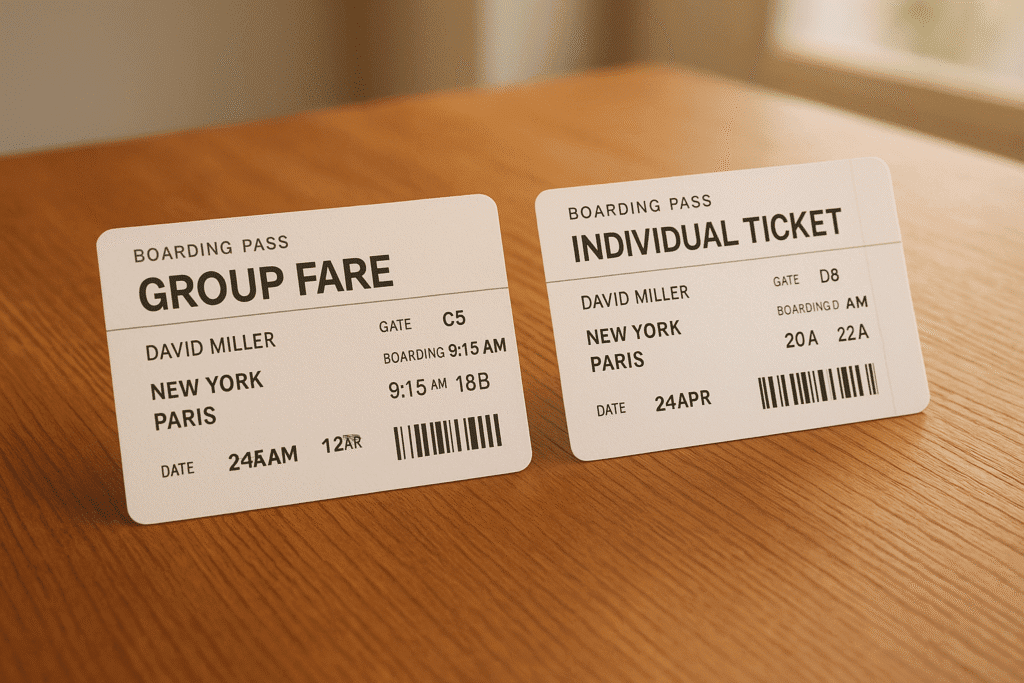
When booking flights, the decision between group fares and individual tickets can significantly impact cost and convenience. Here’s the key takeaway:
- Group fares are designed for 10+ travelers, offering fixed pricing, flexible payment options, and coordinated seating.
- Individual tickets allow for more flexibility in airline choice and fare combinations, often benefiting smaller groups or those booking during promotions.
Key Factors to Consider:
- Group fares: Lock in rates early, require deposits, and allow name changes.
- Individual tickets: Prices fluctuate with demand and require full payment upfront.
Quick Comparison
| Feature | Group Fares | Individual Tickets |
|---|---|---|
| Minimum Passengers | 10 or more | 1 to 9 |
| Payment | Deposit, balance later | Full payment upfront |
| Price Fluctuation | Fixed once booked | Dynamic, changes with demand |
| Flexibility | Name changes allowed (fees apply) | Often non-refundable |
| Seating | Grouped together | No guarantee |
For large groups, group fares simplify logistics and offer stability. For smaller groups or flexible travelers, individual tickets may yield better deals.
Group Flights & Hotels 101 ✈️ How to Book Like a Pro
Group Fares vs Individual Tickets: Basic Definitions
To make informed travel decisions, it’s essential to understand the difference between group fares and individual tickets. Here’s a breakdown of what each option entails and how they compare.
What Are Group Fares?
Group fares are discounted rates available for parties of 10 or more travelers sharing the same itinerary. These fares come with several perks: you can book up to 11 months in advance without needing to provide travelers’ names right away. A deposit of around $100-$200 per person secures the booking, with final names and payment due approximately 45 days before departure.
Airlines typically assign group seats in the same section of the plane, making it easier to keep everyone together. Another advantage is the flexibility to make name changes or cancellations after full payment, though additional fees may apply.
However, group fares come with some limitations. For example, you must use the same airline for the entire itinerary, and airlines only allocate a limited number of group seats per flight. Booking early is crucial to lock in your preferred travel dates.
What Are Individual Tickets?
Individual tickets are the standard option for booking flights, where each traveler’s reservation is made and paid for separately. Unlike group fares, individual tickets require full payment and finalized names at the time of booking.
One key advantage of individual tickets is the freedom to combine different airlines for various segments of your trip, which can help you find better routes or prices. For smaller groups, airlines may allow you to book up to 9 seats together, though policies vary.
Individual ticket prices are influenced by real-time demand and dynamic pricing algorithms, meaning fares can change frequently. While some individual fares include perks like special luggage allowances or reduced change fees, the cheapest options often come with strict conditions: they’re typically non-refundable, non-transferable, and carry high change fees.
Coordinating individual tickets requires extra effort to ensure all travelers have matching itineraries, and there’s no guarantee that seats will be together or that prices will stay consistent across multiple bookings.
Key Differences at a Glance
Here’s a quick comparison of group fares and individual tickets:
| Feature | Group Fares | Individual Tickets |
|---|---|---|
| Minimum Passengers | 10 or more | 1 to 9 |
| Advance Booking | Up to 11 months without names | Up to 11 months with full details |
| Payment Timeline | Deposit first, balance 45 days prior | Full payment at booking |
| Choice of Airline | Same airline throughout | Mix and match carriers |
| Seat Coordination | Automatically grouped together | Manual coordination required |
| Name Changes | Allowed after purchase | Usually not permitted |
This breakdown provides a foundation for comparing the costs and benefits of each option in more detail.
Price Differences: Group Fares vs Individual Tickets
Knowing how airlines price group fares versus individual tickets can help you make smarter travel decisions. These pricing strategies offer different advantages depending on your travel needs.
How Airlines Price Group Fares
When it comes to group fares, airlines typically reserve a block of seats at a set price, meaning everyone in the group pays the same rate regardless of seat or fare class. For groups of 10 or more, airlines often offer discounts of 10–15% off standard fares if booked well in advance. However, smaller groups or last-minute bookings might not see much of a discount – or could even face higher prices – due to reduced flexibility and the risk of unsold seats.
Airlines are more likely to offer appealing group discounts when bookings are made 10–12 months ahead. This allows them to manage their seat inventory and plan revenue. As the departure date nears, these discounts often shrink or vanish. On the other hand, individual ticket prices fluctuate constantly based on demand.
How Airlines Price Individual Tickets
Individual tickets are priced using dynamic algorithms that adjust fares in real time. Factors like demand, seat availability, booking times, and even passenger data influence these prices. Early bookings usually come with lower fares, while last-minute purchases can be significantly more expensive. As flights fill up, the cost of remaining seats tends to rise.
Interestingly, airlines sometimes charge solo travelers higher rates. For example, a Thrifty Traveler report found that a solo United Airlines ticket from Chicago to Peoria cost $269, but adding a second passenger reduced the price to $181 per person for the same flight. During peak travel seasons – like summer or major holidays – individual ticket prices can skyrocket, while group fares may stay more consistent if booked far in advance.
Cost Comparison Table
Here’s a side-by-side look at group fares versus individual ticket prices in various scenarios:
| Scenario | Group Size | Group Fare (per person) | Individual Ticket (per person) | Savings/Premium |
|---|---|---|---|---|
| Charlotte to Fort Myers | 10 travelers | $231 | $422 | 45% savings with group fare |
| Delta Minneapolis to Miami | Solo traveler | N/A | $199 | Group fare not applicable |
| Delta Minneapolis to Miami | 2 travelers | N/A | $118 each | 41% savings when booked together |
| American Cincinnati to Miami | Solo traveler | N/A | $261 | Group fare not applicable |
| American Cincinnati to Miami | 2 travelers | N/A | $189.50 each | 27% savings when booked together |
| Peak season booking | 20 travelers | $410 | $390 | Individual tickets 5% cheaper |
| Last-minute booking | 8 travelers | Not available | $520 | Group fare unavailable |
Booking early for large groups often leads to noticeable savings, but individual tickets can sometimes be cheaper during promotions or when group rates aren’t offered.
Group Fares: Pros and Cons
When planning travel for a large group, group fares can be a tempting option. They come with several perks that cater to the needs of big travel parties but also carry some challenges that might not suit every situation. Here’s a closer look at the upsides and downsides of booking group fares.
Group Fare Benefits
Group fares bring a range of advantages, especially for large parties. One standout benefit is the potential for lower per-person rates. Airlines often reserve blocks of seats at fixed prices, shielding your group from price hikes as the departure date nears.
Another plus is flexibility in payments. Many airlines offer deferred payment schedules, making it easier to manage budgeting for large groups. Additionally, group fares frequently allow name changes before ticketing, which is helpful if your participant list isn’t finalized.
Airlines also provide dedicated support for group bookings, assisting with itineraries, seating arrangements, and special requests. Services like Flight Booking 247 even offer round-the-clock assistance for booking changes or cancellations. Plus, group bookings ensure coordinated seating, so everyone in your party can sit together without the stress of juggling individual reservations.
While these benefits can simplify group travel, there are trade-offs to consider.
Group Fare Drawbacks
Despite the perks, group fares come with a few notable challenges. For starters, they often have stricter cancellation and change policies. Once tickets are issued, making modifications can lead to hefty penalties – or no changes may be allowed at all.
Most airlines require a minimum of 10 travelers to qualify for group rates. If your group size dips below this number, you might face penalties, lose your deposit, or see an increase in the per-person cost. Availability can also be a hurdle. Group fares are only offered when airlines can set aside enough seats, so on busy routes, you might be forced to book individual tickets instead.
Interestingly, group fares don’t always guarantee the best deal. In some cases, individual ticket prices may end up being cheaper, especially when airlines lock group rates based on expected demand while individual fares fluctuate with promotions or sales.
Group Fares Summary Table
Here’s a quick comparison of the benefits and drawbacks of group fares:
| Benefits | Drawbacks |
|---|---|
| Potential for lower rates when booked early | Minimum of 10 passengers required |
| Deferred payment options for easier budgeting | Stricter cancellation policies after ticketing |
| Flexibility to change names before ticketing | Penalties or deposit loss if group size drops below 10 |
| Dedicated support for booking and special requests | Limited availability on busy routes |
| Coordinated seating for the entire group | Sometimes higher costs than individual fares |
| Protection from price increases after booking | Risk of losing deposit for cancellations |
| 24/7 assistance from specialized services |
sbb-itb-e205081
Individual Tickets: Pros and Cons
Individual tickets are a great option for solo travelers and small groups who value flexibility and control. While they offer several perks, there are also a few challenges to weigh before deciding on this option instead of group fares.
Individual Ticket Benefits
One of the standout advantages of individual tickets is flexibility. You can book, modify, or cancel flights for each traveler independently, without being locked into a group itinerary. If someone needs to adjust their plans, it won’t disrupt the rest of the group.
Another benefit is the ability to mix and match fare classes and airlines. For example, you might opt for a budget airline on one leg of your trip and splurge on business class for another. This lets you balance comfort and cost based on your preferences.
For groups of up to nine people, booking individual tickets is straightforward and can be done entirely online – no need to deal with group contracts or special arrangements.
There’s also the potential for cost savings. Booking multiple tickets at once can sometimes lower the per-person price, depending on seat availability and fare rules.
Additionally, services like Flight Booking 247 offer round-the-clock assistance, connecting you with travel experts who can help you snag deals and manage multiple reservations.
But while these benefits are appealing, there are some downsides to keep in mind.
Individual Ticket Drawbacks
Coordinating individual tickets can get tricky for larger groups. Since each ticket is booked separately, there’s a chance that travelers might end up on different flights or seated far apart, which can complicate group travel plans.
Another challenge is price volatility. Airlines use dynamic pricing, meaning fares can change rapidly based on demand and seat availability. If you’re booking several tickets, the price for later bookings might be significantly higher as cheaper seats sell out.
Individual tickets often require immediate payment in full, unlike some group fares that allow for deferred payments. Additionally, the lowest-priced tickets typically come with strict rules: they’re non-refundable and have steep fees for changes, limiting your flexibility despite the convenience of online booking.
The process can also be time-consuming. Comparing fares across airlines, reading the fine print on terms and conditions, and timing your bookings to avoid price hikes can be overwhelming without professional help.
Individual Tickets Summary Table
Here’s a quick look at the pros and cons of individual tickets:
| Benefits | Drawbacks |
|---|---|
| Flexibility for changes and cancellations | Difficult to coordinate for larger groups |
| Option to mix fare classes and airlines | Prices can increase as tickets are booked |
| Easy online booking for small groups | Full payment required at booking |
| Potential savings for 2+ passengers | Risk of being seated apart |
| 24/7 booking assistance available | Time-intensive to compare options |
| Per-person itinerary control | Non-refundable lowest fares |
| No minimum passenger requirements | Higher change fees compared to group fares |
How to Choose Between Group Fares and Individual Tickets
Deciding between group fares and individual tickets largely depends on the specifics of your trip. Factors like group size, timing, and flexibility all play a role in determining the best option.
Key Decision Factors
The size of your group is one of the first things to consider. Group fares are typically available only for parties of 10 or more travelers. If your group is smaller, individual tickets are likely your only choice. For groups of 10 or more, you’ll need to weigh the balance between saving money and having more flexibility.
Timing and payment options are also important. Booking timelines and payment flexibility vary greatly between these two options. Group bookings allow you to reserve seats up to 11 months in advance with a deposit of $100–$200 per person, with the final payment due 45–90 days before departure. This flexibility is helpful if you’re still finalizing your group’s participants.
In contrast, individual tickets require full payment upfront and the names of all passengers at the time of booking. While this might seem restrictive, it can sometimes lead to lower prices. For instance, a United Airlines flight from Chicago to Peoria dropped from $269 for a single traveler to $181 per person when two tickets were purchased together.
Another key factor is cost versus flexibility. If saving money is your top priority, individual tickets might be the way to go. However, if you need the ability to make changes – like adjusting names, travel dates, or handling cancellations closer to the trip – group fares provide that added flexibility.
Certainty around travel dates also plays a role. Individual ticket prices can fluctuate, and waiting too long to book might result in higher costs. Group fares, on the other hand, lock in rates early, protecting you from price changes.
Finally, think about your group’s coordination needs. Group fares ensure everyone is on the same flights, making it easier to manage seating and logistics. Booking individual tickets can sometimes lead to travelers being on separate flights or seated far apart, which could complicate the trip.
Getting Help with Flight Booking Decisions
Navigating these options can feel overwhelming, but expert advice can make it easier. Flight Booking 247 offers 24/7 concierge assistance to help you weigh these factors and find the best deal. Their team understands airline group policies and can provide tailored recommendations based on your group size, travel dates, and flexibility needs.
They can also explore creative solutions, like splitting your group into smaller booking blocks to secure lower fares or determining if a group rate is more beneficial. Their expertise ensures you can time your bookings effectively, avoiding price hikes and securing favorable terms.
For trips with complex itineraries or when juggling priorities like budget and flexibility, professional guidance can save you both time and money. Starting your planning early and leaning on expert insights can help you make the best choice for your travel needs.
Conclusion
Choose based on what fits your travel needs best: group fares are ideal for larger parties needing coordinated travel, while individual tickets often provide better rates for smaller groups. Group fares are particularly useful for groups of 10 or more, offering perks like deposit-based reservations, flexibility with passenger names, and guaranteed seating together. However, they may not always offer the lowest per-person cost and can sometimes be pricier than booking tickets individually.
On the other hand, individual tickets are often the go-to for smaller groups looking to save money. Airlines frequently offer lower rates for individual bookings, and purchasing multiple tickets together can result in substantial per-person discounts. Examples from major airlines highlight how smaller groups can benefit from these lower fare buckets.
The main trade-off comes down to flexibility versus cost. Group fares provide options like delayed payments and name changes, while individual tickets require upfront payment but often grant access to cheaper, real-time pricing. Understanding these differences can make it easier to decide what works best for your group.
For added convenience, Flight Booking 247 offers round-the-clock concierge support to guide you through the process. Their travel experts can compare group and individual fare options on your behalf, ensuring you get the best deal for your group size, budget, and schedule. Whether you’re traveling with a large party or just a few people, their expertise ensures a smooth and cost-effective booking experience.
FAQs
What are the benefits of booking group fares instead of individual tickets for large groups?
Booking group fares can be a smart move for large groups of travelers, offering several perks that make the process easier and more affordable. One major advantage is the potential for cost savings. Airlines often provide discounted rates for groups – typically for parties of 10 or more – making it a budget-friendly option compared to buying individual tickets.
Another benefit is the added flexibility that comes with group bookings. Many airlines allow changes to passenger names or other booking details without charging extra fees, which can be a lifesaver when plans shift. Plus, booking as a group often guarantees that everyone is on the same flight, simplifying logistics and ensuring smooth coordination.
If you’re looking for help navigating group bookings or want to find the best deals, services like Flight Booking 247 are available around the clock to assist, making the entire process hassle-free.
What are the differences in flexibility between group fares and individual tickets when it comes to payment and booking options?
When deciding between group fares and individual tickets, it all boils down to your travel priorities and needs.
Group fares are great for larger parties looking for cost savings and streamlined planning. That said, they often come with stricter rules – things like upfront deposits, firm payment deadlines, and limited flexibility for changes or cancellations. If you’re organizing travel for a big group, these fares can simplify things, but you’ll need to be prepared to commit early.
On the flip side, individual tickets tend to offer more freedom. You can book them whenever it suits you, without needing a specific number of travelers. Plus, depending on the airline, they often make it easier to adjust or cancel plans.
To decide which option works best, think about your group size, how fixed your travel dates are, and how much wiggle room you need in your itinerary.
When might it be more cost-effective to buy individual tickets instead of group fares for a group of 10 or more travelers?
When it comes to booking flights, group fares often come with perks like flexible payment options and easier itinerary adjustments. However, individual tickets can sometimes be the cheaper route, especially when airlines roll out promotions or when ticket prices fluctuate based on demand and timing.
For instance, snagging individual tickets during a sale or when prices drop for specific flights can often beat the fixed rates offered with group fares. That said, group fares still have their advantages – like guaranteeing everyone in your group is on the same flight and simplifying the booking process. To make the smartest choice, it’s a good idea to weigh both options and see which one aligns better with your group’s priorities.