
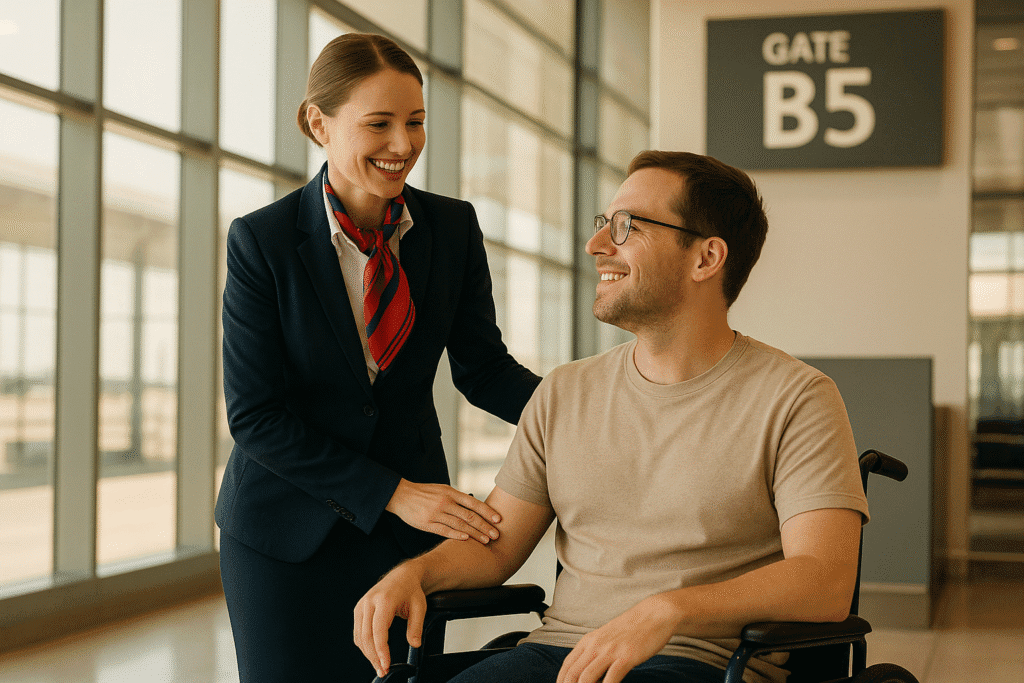
Navigating air travel with a disability can be challenging, but knowing your rights and available services makes it easier. U.S. airlines are legally required to provide accommodations under the Air Carrier Access Act (ACAA) and the Airline Passengers with Disabilities Bill of Rights. These laws ensure fair treatment, pre-boarding assistance, accessible seating, and proper handling of mobility devices. Key points include:
- Wheelchair Services: Free assistance from check-in to boarding.
- Service Animals: Service dogs are allowed in the cabin with prior notice.
- Accessible Aircraft Features: Includes movable armrests, accessible lavatories, and storage for assistive devices.
- Advance Notice: Notify airlines 48-72 hours ahead for specific needs like medical devices or service animals on long flights.
- Complaint Resolution: Airlines must have trained Complaint Resolution Officials (CROs) available to address issues.
Starting January 16, 2025, stricter rules will further protect mobility device users. If problems arise, you can file complaints with the airline or the Department of Transportation. Planning ahead and communicating your needs ensures a smoother trip.
A Closer Look at Airline Passengers with Disabilities Bill of Rights
Legal Rights for Passengers with Disabilities
Federal laws ensure that travelers with disabilities are treated fairly and have equal access to air travel. These protections are enforced within U.S. airspace, with the Air Carrier Access Act (ACAA) forming the backbone of these regulations.
Air Carrier Access Act (ACAA) Basics
The Air Carrier Access Act is a federal law that prohibits airlines from discriminating against passengers with disabilities. It applies to U.S. airlines and foreign carriers operating within the United States.
Under this law, airlines cannot deny you transportation because of your disability, your appearance, or involuntary behaviors linked to your condition. While airlines may require early check-in or advance notice for certain disability-related services, they are prohibited from imposing restrictions that do not apply to other travelers. Additionally, pre-boarding options are often available for passengers who need extra assistance.
The ACAA also mandates several accommodations, such as accessible communication and the proper handling of mobility aids. Airline staff must undergo training to ensure they can provide safe and respectful assistance to passengers with disabilities.
Airline Passengers with Disabilities Bill of Rights
Expanding on the ACAA, the Airline Passengers with Disabilities Bill of Rights was introduced in July 2022 by the U.S. Department of Transportation. This document highlights your core rights under the ACAA and its regulation, 14 CFR Part 382. It applies to both domestic and international flights operated by U.S. carriers.
The Bill of Rights guarantees that passengers with disabilities are treated with dignity and respect. Airlines are required to train their staff to accommodate passengers safely and courteously. General airline staff must complete refresher training every three years, while Complaint Resolution Officials (CROs) undergo annual training.
You’re also entitled to clear information about available services and any limitations onboard. Airlines must provide details about features like accessible lavatories, movable aisle armrests, storage for assistive devices, and any services they cannot offer upon request.
Additionally, travel information must be made available in accessible formats to ensure inclusivity.
Airline Services for Passengers with Disabilities
Airlines provide a range of services designed to ensure passengers with disabilities have a smooth and comfortable travel experience. From the moment you arrive at the airport to your arrival at your destination, these accommodations aim to support every step of your journey.
Wheelchair and Mobility Assistance
Airlines are required to offer wheelchair services at no extra cost, covering the entire journey – from check-in to boarding and deplaning. This includes help navigating security, reaching your gate, and boarding the aircraft.
When booking, you can choose from three types of wheelchair assistance:
- WCHR (Wheelchair Ramp): For passengers who can walk short distances and climb stairs but need a wheelchair for longer distances within the airport.
- WCHS (Wheelchair Steps): For passengers who can walk short distances but cannot climb stairs, requiring assistance during boarding.
- WCHC (Wheelchair Cabin): For passengers unable to walk, needing help transferring to and from their seat.
If you use a personal wheelchair, airport staff will assist with transferring you to an aisle chair for narrow-body aircraft boarding. Your wheelchair is typically stored in the cargo hold and returned upon arrival.
For connecting flights, airline staff are available to help you navigate between gates – even if it involves changing terminals – so you can make your next flight without worry.
Service Animal Guidelines
Service animals, primarily dogs, play an essential role in assisting individuals with disabilities. These animals are trained to perform specific tasks related to their owner’s needs. Airlines allow service dogs to travel in the cabin at no additional cost, provided you notify the airline in advance and submit any necessary documentation.
The service dog must remain leashed or harnessed and fit comfortably within your designated floor space without obstructing aisles or emergency exits.
It’s important to note that emotional support animals are no longer recognized as service animals for air travel. Most airlines now treat them as pets, which may involve additional fees and adherence to standard pet policies.
Accessibility Features on Aircraft
Modern aircraft are equipped with features to enhance accessibility, though these vary based on the carrier and aircraft model. For instance, wide-body planes with multiple aisles often include accessible lavatories with grab bars, secure locks, and enough space for easier maneuvering.
Many aircraft also have aisle seats with movable armrests, making it easier for passengers to transfer from a wheelchair to their seat. While flight attendants can assist with raising these armrests, those in emergency exit rows typically remain fixed due to safety regulations.
Airlines also offer priority seating options, such as seats with removable armrests, extra legroom, or proximity to accessible lavatories, which can be requested during booking.
Additionally, small assistive devices like canes, crutches, or prosthetics can be stored in the cabin, while larger mobility devices, such as wheelchairs or scooters, are carefully handled and transported in the cargo hold to prevent damage.
How to Book Accessible Flights
Booking accessible flights requires clear communication about your needs and some thoughtful planning. By sharing the necessary details and preparing your equipment in advance, you can ensure a smoother travel experience.
Informing Airlines About Your Accessibility Needs
While airlines generally cannot require advance notice of your disability, certain accommodations do need extra time to arrange – typically 48 to 72 hours. This allows airlines to make sure everything is in place for your journey .
When booking online, check for an option like “Add special assistance” on the passenger details page. Alternatively, you can call the airline directly to discuss your requirements. If you’ve already booked your flight, use your confirmation code to locate your reservation and update your accessibility needs under the “Special Assistance” section.
Be specific about your requirements, such as mobility assistance or the use of medical equipment, to avoid any last-minute complications.
Some services that require advance notice include:
- Transporting electric wheelchairs on smaller aircraft (fewer than 60 seats).
- Using medical devices like ventilators or CPAP machines.
- Requesting electrical hook-ups for respiratory equipment (48 hours).
- Arranging for carrier-provided medical oxygen (72 hours for international flights, 48 hours for domestic).
- Traveling with a service animal on flights longer than 8 hours (requires DOT forms, 48 hours’ notice) .
Preparing Mobility Devices for Air Travel
Once you’ve communicated your needs, it’s time to prepare any assistive devices for the trip. Battery-powered mobility devices must comply with aviation safety rules, and the type of battery determines the specific requirements.
- Wet-cell batteries: These must be disconnected, and the terminals should be protected with tape or caps.
- Lithium batteries: These can stay connected, but the device must be powered off.
If your battery requires special hazardous materials packaging, be sure to request this service at least 48 hours before your flight.
Assistance from Flight Booking 247

For travelers who prefer extra support, Flight Booking 247 offers a 24/7 travel concierge service tailored to passengers with disabilities. Their team specializes in booking, modifying, or canceling flights, ensuring your accessibility needs are effectively communicated to airlines.
Their concierges can help you identify airlines with the best accommodations for your situation. They handle the advance notice requirements for specialized services, ensuring all your requests are properly documented in your booking.
Using real-time flight searches, they can also find aircraft that meet your needs. For example, if you require an accessible lavatory, they’ll locate wide-body planes on your route that include these facilities.
If your plans change, Flight Booking 247 can quickly rebook flights while preserving your accessibility arrangements. They also manage communications with airlines to ensure any updates to your special service requests are handled seamlessly.
With no hold times, their service provides immediate assistance for time-sensitive needs, giving you peace of mind when traveling.
Filing Complaints and Getting Help
If an airline fails to meet its obligations regarding accommodations or violates disability rights, there are steps you can take to address the situation. You can either work directly with the airline or involve the U.S. Department of Transportation (DOT) for further assistance.
Complaining to Airlines Directly
When a disability-related issue occurs, reach out to the airline’s Complaint Resolution Official (CRO) or a supervisor as soon as possible. The CRO is specifically trained to handle disability-related concerns in air travel and has the authority to address and resolve complaints. Airlines are required to have a CRO available, either in person or by phone, during their operating hours.
If your issue isn’t resolved through this channel, you can escalate it further.
Filing Complaints with the U.S. DOT
If the airline fails to resolve the problem, you can contact the DOT Office of Aviation Consumer Protection’s Disability Hotline at 1-800-778-4838 for immediate assistance with disability-related matters.
Conclusion
Knowing your rights can make traveling less stressful and more accessible. Federal laws, such as the Air Carrier Access Act (ACAA) and the Airline Passengers with Disabilities Bill of Rights, ensure that you are treated with dignity and respect throughout your journey.
Starting January 16, 2025, new Department of Transportation (DOT) regulations will introduce stricter rules for handling mobility devices. These include enhanced protections for wheelchair users, mandatory specialized training for airline staff, and clearer deadlines for returning delayed equipment. If your wheelchair or assistive device is not returned in its original condition, airlines will now be presumed in violation. Additionally, you’ll have the right to select a vendor of your choice for repairs or replacements.
It’s essential to understand your core rights, such as pre-boarding assistance, accessible seating, service animal accommodations, and the proper handling of mobility devices. The ACAA prohibits airlines from discriminating against passengers with disabilities. To ensure your needs are met, communicate any specific requirements when booking your flight so the airline can prepare accordingly.
If issues arise, there are several ways to seek resolution. You can request to speak with the airline’s Complaint Resolution Official (CRO) or file a formal complaint with the U.S. Department of Transportation. These resources are in place to help you address any concerns during your travels.
For tailored booking assistance, Flight Booking 247 offers round-the-clock support. Their travel concierges can help coordinate accessibility needs while finding the best flight options to suit you.
FAQs
How can I make sure my service animal is accommodated when flying?
To make sure your service animal is accommodated during your flight, notify the airline as soon as possible – preferably when you book your ticket. Airlines often have specific documentation requirements, so check their policies ahead of time and have everything prepared well before your travel date.
It’s essential that your service animal is trained to behave appropriately in public settings. Airlines can deny boarding if the animal poses a safety risk. However, they cannot refuse your service animal simply because other passengers feel uncomfortable. If you run into any problems or believe your rights have been violated, you can file a complaint with the airline or the relevant regulatory authority. Following the airline’s guidelines will help ensure a smooth and hassle-free journey.
How should I prepare my mobility device for air travel to meet airline requirements?
To make sure your mobility device meets airline regulations, share specific details about its size, weight, and battery type with the airline ahead of time. If your device is battery-powered, remove the batteries, secure them properly, and cover the terminals to avoid short circuits. For lithium-ion batteries, check that they don’t exceed the 300Wh limit and carry them in your hand luggage.
When you arrive at the airport, fill out any necessary forms and request the appropriate tags for your device during check-in. These steps can help ensure your device is handled with care and make your journey more hassle-free.
What can I do if my wheelchair or assistive device gets damaged during a flight?
If your wheelchair or assistive device gets damaged during a flight, the airline is responsible for repairing or replacing it as quickly as possible. If the device is lost, destroyed, or cannot be repaired, they are required to compensate you for up to the original purchase price.
To resolve the issue, report the damage to airline staff immediately after landing. Be prepared to provide detailed information about your device, such as its value and condition before the flight. This can help speed up the process. Under regulations set by the U.S. Department of Transportation, airlines are required to address these situations promptly, ensuring your mobility needs are taken care of.